Makarska travel guide
Complete guide to Makarska — the Dalmatian riviera's beach capital, Biokovo Nature Park hiking, Brač and Hvar ferry connections and lively coastal…
Split: Blue cave and 5 islands tour
Quick facts
- Best time
- Jun–Sep for beach; May & Oct for hiking
- Days needed
- 2–3 days
- Getting there
- Bus from Split (1.5 hrs) or Dubrovnik (3.5 hrs)
- Budget per day
- €50–€140
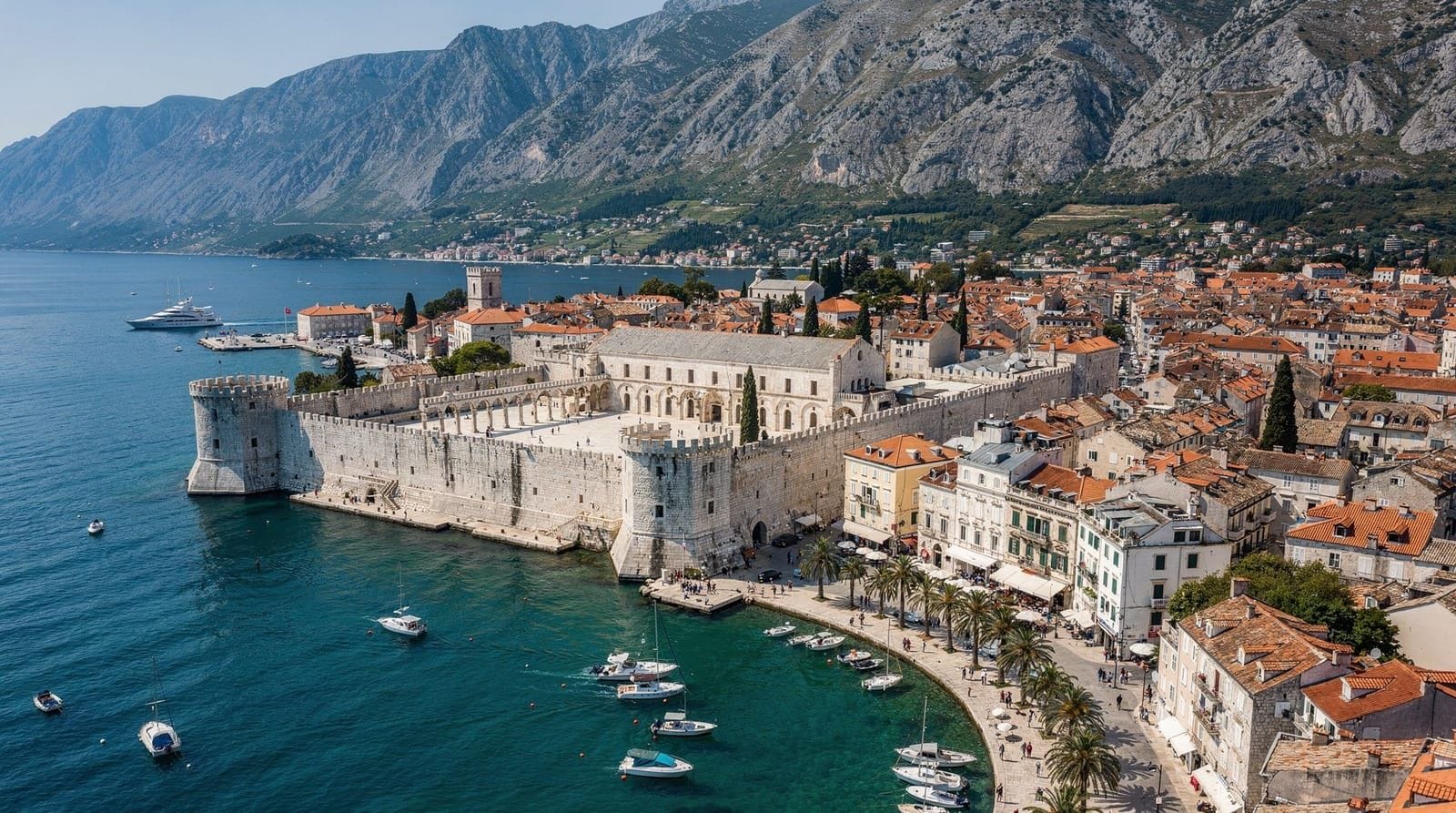
Makarska occupies a narrow coastal plain between the Adriatic and the sheer limestone wall of Biokovo Mountain — a physical drama that sets the visual stage for the entire Makarska Riviera. The town itself is a pleasant mix of baroque church and palm-lined harbour, with a long pebble beach curving west toward the resort village of Brela. What Makarska does exceptionally well is the combination of serious beach holiday and serious outdoor activity: the Biokovo Skywalk (at 1,228 metres) opened in 2021 and has made the mountain accessible to non-hikers for the first time, while experienced trekkers find a full day’s walking within 20 minutes of the town centre.
| Where | Dalmatian coast, at the foot of Biokovo Mountain |
| Cost | around €50–140/day; Skywalk entry €7, Biokovo road toll ~€10/car |
| Time needed | 2–3 days for beach plus Biokovo |
| Getting there | Bus from Split (1.5 hrs, ~€8–12) or Dubrovnik (3.5 hrs) |
| Best time | June–September for beach; May & October for hiking |
Getting to and around Makarska
By bus: The primary connection. Buses from Split run approximately hourly (1.5 hours, €8–€12). Dubrovnik buses run 3–4 times daily (3.5 hours, €16–€22). The bus station is five minutes’ walk from the seafront.
By car: Makarska sits on the D8 coastal road, 65 km southeast of Split. The road is scenic but slow in summer; allow 90 minutes from Split. Parking is tight in the centre in July–August.
By ferry: A car ferry runs from Makarska to Sumartin on Brač (50 minutes), connecting to the island road network. This is the best connection to the eastern part of Brač and is significantly less crowded than the Split–Supetar ferry.
Within the city: Makarska is walkable end to end in 15 minutes. The riviera resorts (Brela, Baška Voda, Tučepi, Podgora) are connected by bus.
What to see and do in Makarska
Beaches
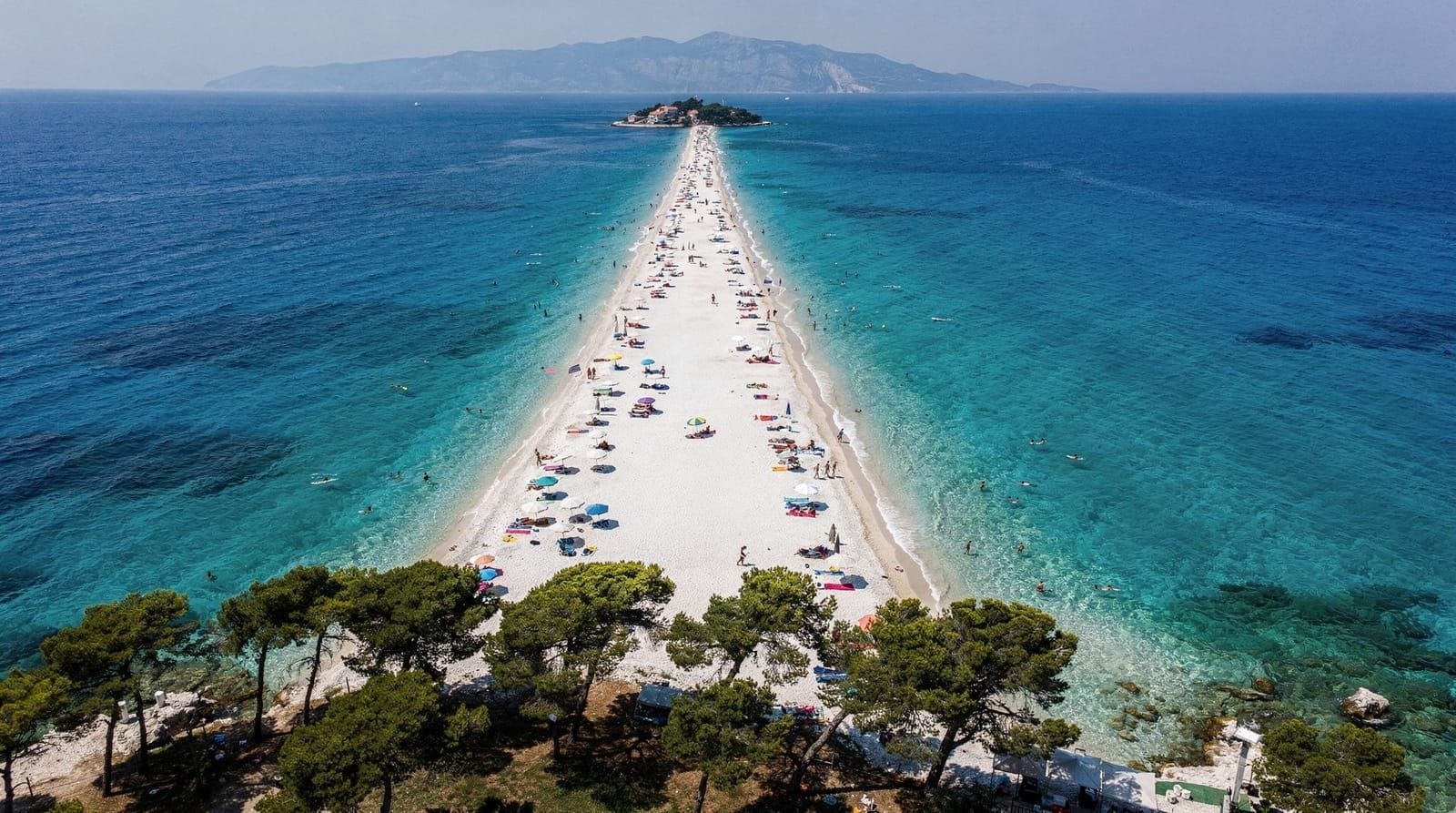
The town beach — a 1.5 km pebble arc — is well-maintained and reasonably spacious by Dalmatian standards. Nugal Beach, 3 km southeast (accessible by cliff path or water taxi), is a smaller, more secluded cove. Brela (15 minutes by bus) is often listed among the most beautiful small beaches in Croatia: fine pebbles, crystal-clear water, and the distinctive Brela stone (Kamen Brela) rock rising from the shallows.
Biokovo Nature Park and the Skywalk
The Biokovo massif rises directly above Makarska to 1,762 metres at Sv. Jure, the second-highest peak in Croatia. The lower slopes are accessible by road from Makarska; the top requires the D8-to-Biokovo road (open late April–October, toll around €10 per car).
The Biokovo Skywalk is a glass-bottomed U-shaped walkway cantilevered over the cliff at 1,228 metres, with views of Makarska 1,200 metres below and the islands of Brač, Hvar, and Korčula laid out across the Adriatic. Entry costs €7 per person (separate from the road toll). It is one of the most vertiginous — and genuinely spectacular — viewpoints in Croatia.
For walkers, marked trails range from 2-hour nature walks on the lower plateau to a demanding 6-hour return hike to Sv. Jure summit. Start before 7 am in summer to avoid heat.
Town harbour and civic buildings
Makarska’s baroque Church of St Mark on the main square, the small Franciscan monastery with a shell collection, and the harbour promenade are the conventional town sights — pleasant without being remarkable. The real point of Makarska is the combination of beach and mountain, not urban architecture.
Nightlife
Makarska has a lively summer nightlife centred on the harbour bars and the beach clubs along the main beach. More boisterous than Split and significantly more so than Trogir; this is a feature or a drawback depending on your travel style.
Where to stay in Makarska
Town centre: Several four-star hotels on or near the beach. Hotel Biokovo (Obala kralja Tomislava 14) is a well-positioned mid-range option on the harbour; doubles from €110–€180. Hotel Osejava (Šetalište fra Jure Radića 6) occupies a quieter position east of centre with a pleasant garden.
Riviera resorts: Brela, Baška Voda, and Tučepi all have apartment blocks and smaller hotels at prices slightly below Makarska’s. Brela in particular is worth considering for its beach quality.
Budget: Private rooms in family houses throughout the riviera from €35–€70. Campsite Rivijera (northwest of town) is popular with younger travellers.
Where to eat in Makarska
Jeny (Prvosvibanjska 7): Long-established konoba with excellent grilled fish and locally caught seafood; good value for the setting.
Riva (harbour promenade): Several restaurants line the harbour; prices are tourist-level but the grilled fish is generally fresh. Check that the catch is local rather than farmed.
Villa Dalmacija (Šetalište fra Jure Radića 52): Good Dalmatian cuisine with a terrace view, reliable pasta and fish dishes.
Konoba Stari Grad (Kalalarga 5): Tucked into the old town grid, serving traditional home-cooking (lamb stew, grilled octopus salad) at prices below the harbour strip.
The Makarska Riviera beyond the town
The Makarska Riviera stretches 60 km along the base of Biokovo from Brela (15 km north) to Gradac (24 km south), connecting a series of small towns each with their own beach, konoba, and character. The bus (line Makarska–Split and Makarska–Dubrovnik) connects them all, making it feasible to stay in one and explore others.
Brela (15 km north, 15 minutes by bus): Most beautiful beach on the riviera, with fine white pebbles and the distinctive Kamen Brela rock. Quieter and more family-oriented than Makarska town.
Baška Voda (8 km north): Small resort with a long pebble beach, harbour with fishing boats, and a range of apartments and hotels at better prices than Makarska.
Tučepi (4 km south): The Riviera’s second town with a long beach, traditional stone architecture, and a pleasant seafront promenade.
Gradac (24 km south): The southernmost riviera town with the longest beach (1.5 km) and the fewest tourists — genuinely quiet by peak-season standards.
Adventure sports in the Makarska area
Biokovo provides the backdrop for several adventure activities beyond the Skywalk. Rock climbing routes are established on the limestone walls above the coast road; the sector above Makarska is suitable for intermediate and advanced climbers. Contact local operators (Aktivatur Makarska) for guide-led routes.
Via ferrata: Several fixed-rope routes on Biokovo are accessible to guided groups with no prior climbing experience. The views from mid-mountain during descent are exceptional.
Paragliding: Launch sites on Biokovo above the coast road; tandem flights available through local operators, landing on the beach below.
Cycling: Biokovo’s mountain road and the coastal cycling path (under development) provide routes from easy flat riding to demanding mountain climbs. Bike rental in Makarska town.
Sailing and boat trips from Makarska
The Makarska marina is a competent sailing base with good facilities. Day charter trips run to the nearby islands of Brač and Hvar. The fast catamaran connections from Split give Makarska visitors good access to the wider Dalmatian island network.
Boat taxis run seasonally between Makarska riviera towns, allowing coastal hopping without the road. Water taxis also serve Nugal Beach (inaccessible by road, walk or boat only).
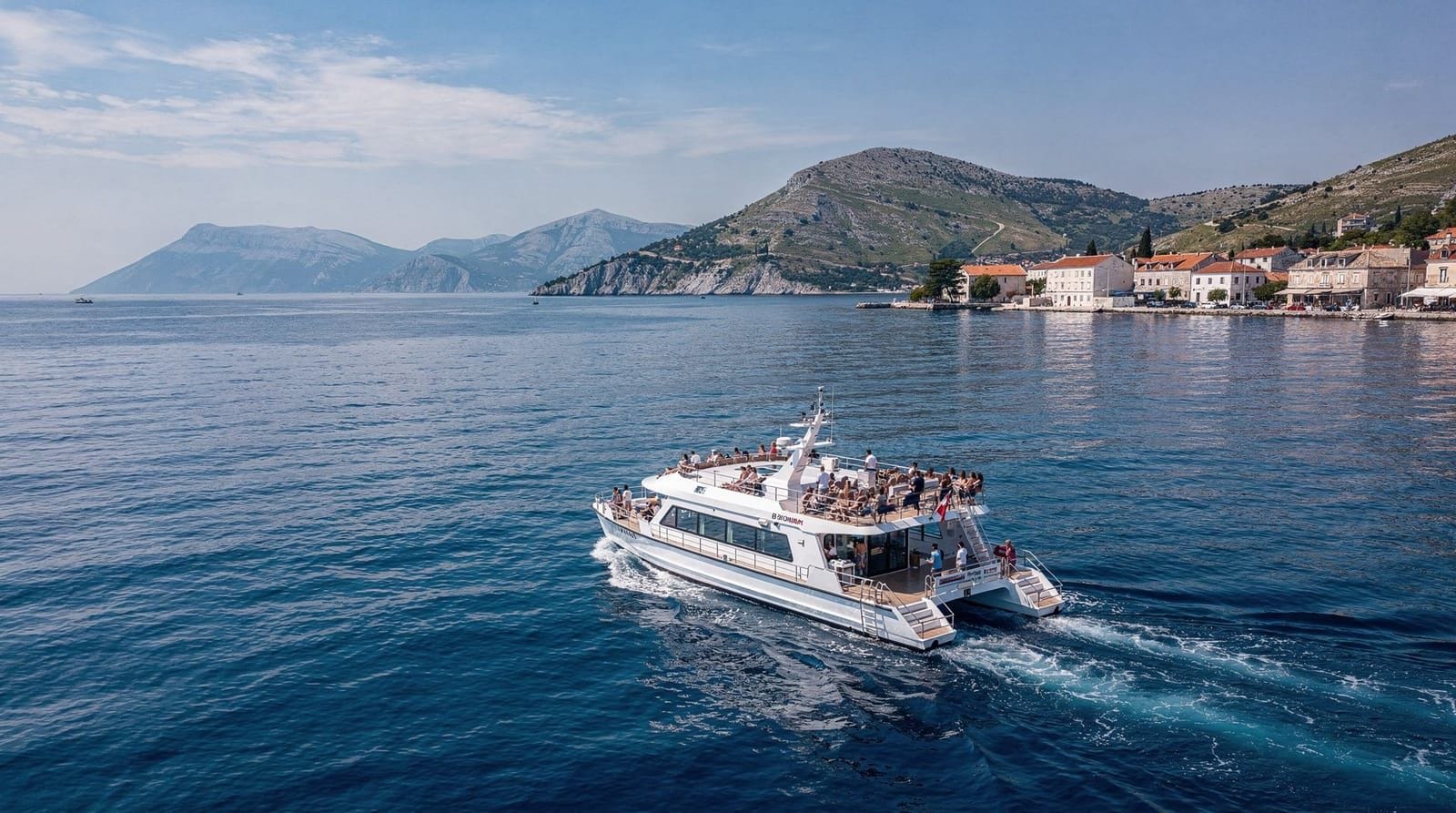
Blue Cave and five islands day tour departing from Split — a good add-on if you’re basing yourself between Makarska and SplitBest time to visit Makarska
July–August is Makarska’s obvious peak: beach, bars, the full complement of boat taxis and excursions. It is busy and hot (35°C regularly), but the beach is the point and the Adriatic is at its warmest (26–27°C).
June and September offer the best balance: warm swimming, Biokovo accessible, boats running, accommodation at 20–30% below peak rates.
May and October are ideal for Biokovo hiking: cool temperatures, clear air, dramatic autumn or spring light. The beach is swimmable in May (water 18–19°C) and October (still 22–23°C in early autumn).
Day trips from Makarska
Biokovo: The most compelling excursion and entirely local. Allow a full day for hiking; a half-day with the Skywalk.
Brač island: The Makarska–Sumartin ferry takes 50 minutes and arrives at the quiet eastern end of the island. Brač is then explorable by rental car (available in Sumartin) — Bol, Zlatni Rat beach, and Pučišća (stone quarry town) are the highlights.
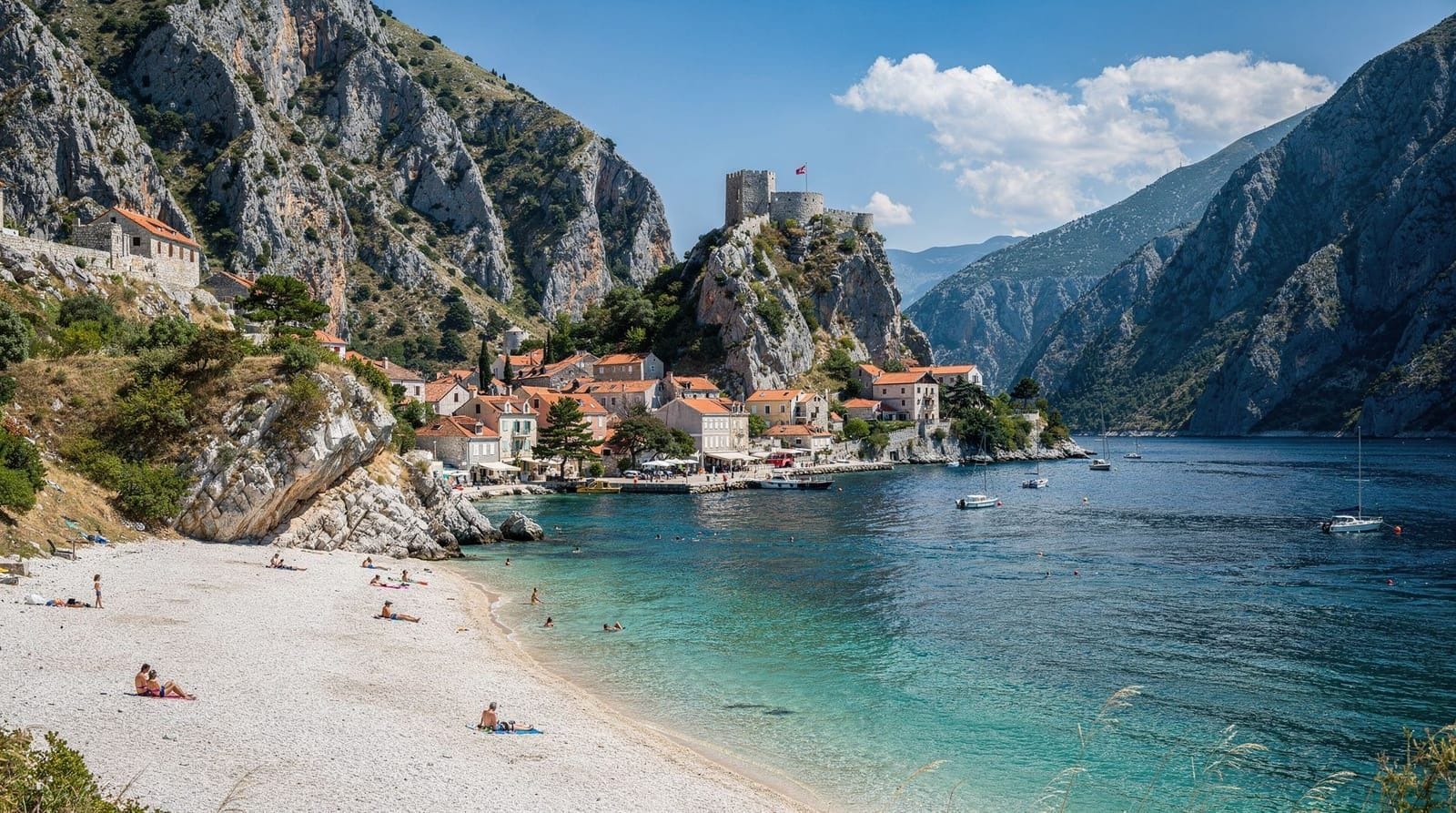
Omiš: Omiš is 30 km north by bus (45 minutes), offering the Cetina canyon, cliff-top fortress, and Croatia’s best river rafting.
Makarska’s history
Makarska was one of the most fought-over towns on the Dalmatian coast — its position beneath Biokovo and at the northern end of the Neretva approach made it strategically important both to the Ottoman Empire (which held it repeatedly from the mid-16th century) and to Venice (which took it back in 1646 after the siege commemorated in Šibenik’s Barone Fortress). The current baroque church of St Mark, the Franciscan monastery, and the 17th-century urban layout are products of the Venetian reconstruction following the Ottoman withdrawal.
The Franciscan monastery (Franjevački samostan) on the harbour contains the most significant collection of shells in Croatia — a collection assembled by Father Jure Radić in the 18th–19th century, covering 3,000 species of mollusc from the Adriatic and beyond. It is a genuinely extraordinary collection in an unexpected setting; the monastery church is also worth entering for its baroque altarpiece.
Makarska food and drink specifics
Makarska’s restaurant scene is oriented toward volume and convenience rather than innovation, which is fine for a beach holiday destination but means some effort is required to eat well.
Seek out: Brela konobas (15 km north) are consistently better value than Makarska town restaurants. Baška Voda harbour restaurants have fresh fish at lower prices. Tučepi (4 km south) has several good fish konobas with terrace views.
Riviera wine: The Makarska hinterland produces a small amount of local wine from the Grabovac and Zagvozd villages above Biokovo — mostly consumed locally and unavailable commercially, but occasionally poured at the most traditional family-run konobas. Ask.
Dalmatinska peka (peka cooking) is available throughout the riviera but must be ordered 24 hours ahead. The best versions use lamb from the Biokovo highlands and seasonal vegetables; the dish arrives at the table in the bell-shaped lid and is opened ceremonially.
Makarska and the national road system
The D8 coastal road (Jadranska magistrala), running from Rijeka to Dubrovnik, passes through Makarska. This makes the city a natural stop on a coastal road trip. The road between Split and Makarska is among the most scenic sections — the Omiš canyon approach, the Brela corniche, and the gradual arrival under Biokovo’s wall create a dramatically satisfying approach.
Warning: In July–August, the D8 between Split and Makarska can back up significantly in both directions during the weekend changeover (Saturday–Sunday); allow extra travel time. The A1 motorway (running inland) is faster for through travel but misses the scenery entirely.
Practical Makarska logistics
Parking: Town car parks fill by 9 am in July–August. Arrive before 8:30 am or use the outlying car parks and walk. Alternatively, use the bus from Split (no parking issues).
Pharmacies and medical: Makarska has a general hospital (Dom zdravlja Makarska) for minor medical issues. The nearest A&E for serious cases is Split’s KBC Split (75 km north).
Biokovo road access: The road to Biokovo Nature Park opens approximately late April and closes in October (weather-dependent). The toll for private vehicles is around €10 per car at the park entrance. Electric vehicles may use the road.
Makarska’s connection to the inland Dalmatian hinterland
The Makarska Riviera is the natural coastal terminus of the routes descending from the Dalmatian hinterland — the Imotska Krajina and Cetinska Krajina regions that most coastal visitors never see. Inland from Biokovo is a karst plateau world of vineyards, stone villages, and extraordinary geological formations.
Imotski Blue Lake (Modro jezero) and Red Lake (Crveno jezero): 35 km inland from Makarska (45-minute drive), these two karst sinkholes contain lakes of remarkable colour. The Blue Lake is a collapsed cave system whose floor has filled with water; the Red Lake is deeper (530 metres — one of the deepest sinkholes in the world) and blood-red from the iron-rich cliff walls. Both are accessible and genuinely extraordinary. The drive inland through the Biokovo foothills is itself spectacular.
Baćinska jezera: A chain of six freshwater lakes 25 km southeast of Makarska, connected by a narrow river, in a landscape of reeds, herons, and absolute quiet — one of the most peaceful spots in Dalmatia.
Vrgorac: A market town in the interior wine-growing district; producers of Kujundžuša (a local white grape variety unique to this district) offer informal tastings that represent some of Croatia’s most distinctive — and affordable — white wines.
Accommodation strategy for the Riviera
Choosing where to stay on the Makarska Riviera:
Brela (15 km north): Best beaches, quietest atmosphere, family-oriented, bus to Makarska every 30 minutes. Good choice for families prioritising beach quality over nightlife access.
Baška Voda (8 km north): Mid-size resort with apartments, good value, direct bus to both Split and Makarska. Suitable for couples and families.
Makarska town: Most transport connections, best restaurant selection, proximity to Biokovo, liveliest nightlife. Best choice for those who want both beach and activities.
Tučepi (4 km south): Quieter than Makarska, pleasant long beach, lower prices, scenic Old Village section inland. Good mid-season choice.
Gradac (24 km south): Quietest, longest beach, fewest facilities, lowest prices. For those who genuinely want to escape.
Makarska vs Omiš and Split for a Dalmatian base
Travellers deciding where to base themselves on this stretch of coast often compare Makarska with its neighbours. Split, an hour and a half north, has far more transport connections, restaurants and city sights, but no comparable mountain or riviera beach scene right on its doorstep. Omiš, 30 minutes north, is the adventure-sports specialist — rafting and canyoning in the Cetina gorge — but has a smaller and less developed beach and hotel scene than Makarska. Makarska sits between the two: a proper beach-holiday town with a genuine outdoor-adventure add-on in Biokovo, and good ferry links to Brač and Hvar that neither Split nor Omiš quite match from a small-town base.
Frequently asked questions
Is Makarska better for families or for nightlife? Both, depending on where you stay. Makarska town itself leans toward a livelier summer scene with harbour bars and beach clubs, while Brela and Tučepi, a short bus ride along the riviera, are quieter and more family-oriented. Families who want beach quality over nightlife access should base in Brela or Baška Voda rather than Makarska town.
Do I need a car to enjoy the Makarska Riviera? No. The coastal bus line connects Makarska with Brela, Baška Voda, Tučepi and Gradac frequently in season, and the same buses run to Split and Dubrovnik. A car is useful for reaching the Biokovo Skywalk road and the inland lakes (Imotski, Baćinska jezera) independently, but is not essential for a beach-and-town holiday.
Top experiences
Bookable activities with verified prices and instant confirmation on GetYourGuide.
Top-rated experiences in Makarska travel guide
Best-rated activities across GetYourGuide and Viator.

Blue cave, Mamma Mia and Hvar, 5 islands speedboat tour
- Viator

Blue Cave and Hvar Tour - 5 Islands Tour from Split and Trogir
- Viator

Blue cave, Mama Mia and Hvar, 5 Island Speedboat Tour from Trogir
- Viator

From Split: Plitvice Lakes National Park Guided Tour
- Viator

Krka Waterfalls Day Tour with Boat Ride from Split and Trogir
- Viator

Plitvice Lakes National Park Guided Day Tour from Split
- Viator