Mostar travel guide
Complete guide to Mostar — the UNESCO Stari Most bridge, Ottoman bazaar, cliff diving and how to visit from Dubrovnik or Split as a day trip or…
Dubrovnik: Full-day trip to Mostar
Quick facts
- Best time
- Apr–Jun & Sep–Oct
- Days needed
- 1 day (day trip) or 1–2 nights
- Getting there
- 2.5 hrs from Dubrovnik by bus or tour
- Budget per day
- €30–€80 (Bosnia uses BAM, not EUR)
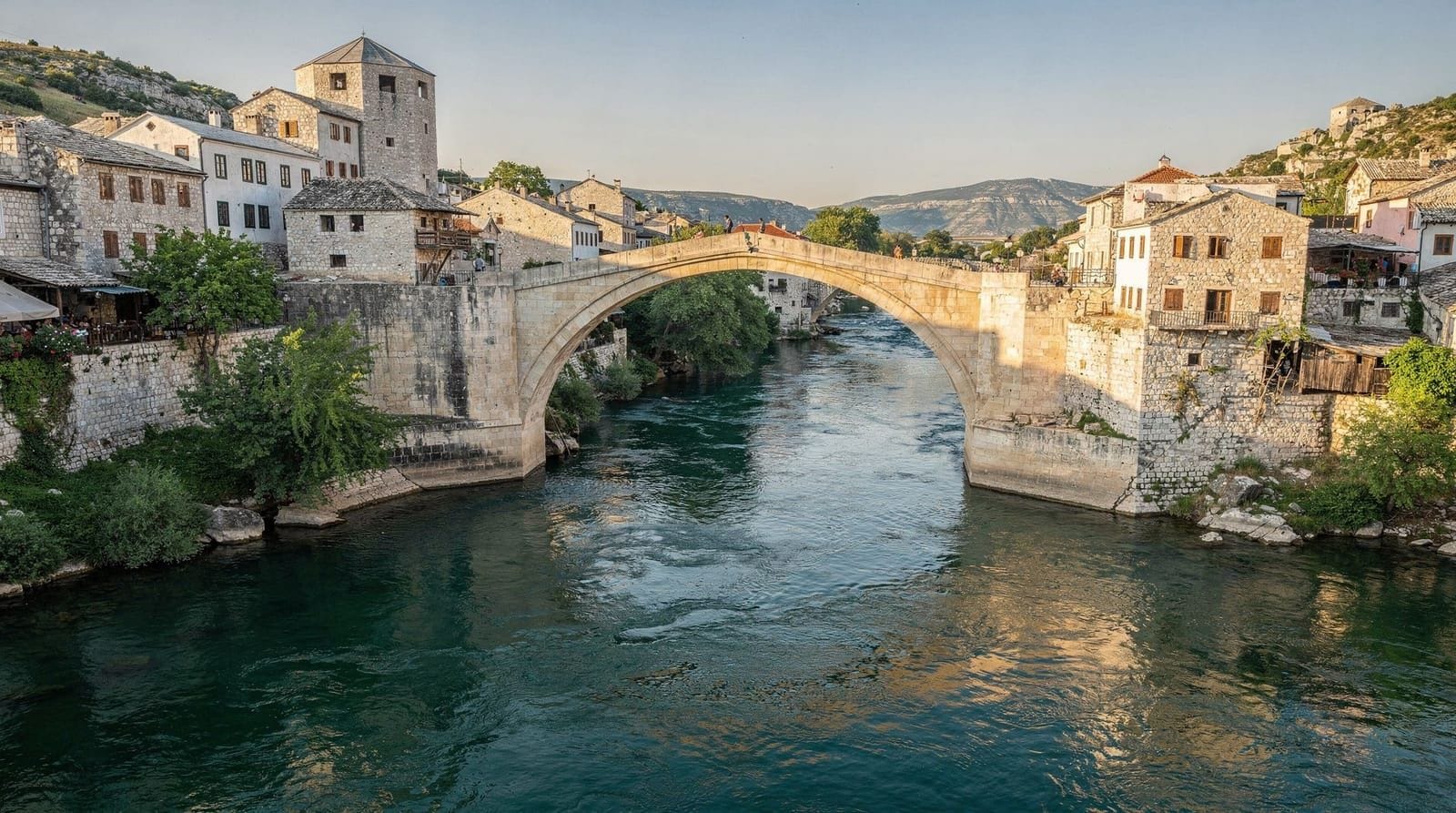
Mostar is the most visited city in Bosnia and Herzegovina and the most popular day trip from Dubrovnik — and for good reason. The UNESCO-listed Stari Most (Old Bridge), rebuilt in 2004 after its 1993 destruction during the war in Bosnia, arches over the Neretva River with a grace that earns every superlative. Around it, a virtually intact Ottoman bazaar (Kujundžiluk) sells copper goods, silk, and coffee in the same lane plan it has followed since the 16th century. Mostar is also honest about its recent history in a way few tourist destinations attempt; the damage of the 1990s war is neither hidden nor exploited but visible in bullet-scarred facades and rebuilt mosques that stand alongside irreparable ruins.
| Where | Herzegovina, Bosnia and Herzegovina |
| Cost | around €30–80/day; Bosnia uses BAM, not euro |
| Time needed | 1 full day minimum; 1–2 nights for a relaxed visit |
| Getting there | 2.5 hrs from Dubrovnik by bus or tour |
| Best time | April–June and September–October |
Currency note: Bosnia uses the Convertible Mark (BAM), pegged to the euro at approximately 1.96 BAM to €1. Most tourist businesses in Mostar accept euros but give change in BAM. Carry some local cash for smaller purchases.
Getting from Croatia to Mostar
Organised day tour from Dubrovnik: The standard approach. Tours run daily April–October, collecting from Dubrovnik hotels at 7–8 am and returning by 8–9 pm. Most include a licensed local guide in Mostar, lunch, and entry to key sites. Journey time each way is approximately 2.5 hours.
A full-day guided Mostar tour from Dubrovnik includes the Old Bridge, bazaar, mosque, and lunchCombined Mostar and Kravica Waterfalls tour: The most popular version adds a swim stop at the Kravica waterfalls (a stunning 25-metre horseshoe cascade on the Trebižat River, 40 km from Mostar) — effectively two destinations in one day.
The Mostar and Kravica waterfalls combination is the most popular day trip from DubrovnikBy public bus: Direct buses from Dubrovnik run twice daily (2.5–3 hours, €15–€20). Also buses from Split (4 hours). The Mostar bus station is a 15-minute walk from the old town.
Self-driving: 153 km from Dubrovnik via E73/M17. Note that the route passes through Bosnia’s Neum corridor or (since 2022) avoids it entirely via the Pelješac Bridge. No visa required for most Western nationalities; border crossing typically 15–30 minutes.
What to see and do in Mostar
Stari Most (Old Bridge)
The 16th-century Ottoman bridge, designed by Mimar Sinan’s apprentice Mimar Hayruddin and completed in 1566, stood for 427 years before being deliberately destroyed in November 1993. The rebuilt bridge (2004) uses stone from the same Tenelija limestone quarry as the original and is structurally faithful. Walking across it gives views of the turquoise Neretva and the old town on both banks. Designated divers — members of the traditional Mostar Divers association — still jump from the 21-metre bridge parapet (typically in summer afternoons) for donations; they have been doing so since the 17th century.
Kujundžiluk Bazaar
The cobbled bazaar street runs from the bridge’s west side into a dense grid of workshops and shops. Copperwork, jewellery, hand-painted tiles, silk scarves, and local coffee sets are the main products. The quality varies enormously; the better copperwork is in shops away from the bridge approach. The bazaar is also the place to drink Bosnian coffee (served with a metal džezva, a cube of Turkish delight, and a glass of water) — a completely different ritual from Croatian coffee culture.
Old Mosque and religious heritage
The Koski Mehmed Pasha Mosque (1618) is the most visited, with a minaret climbable for €3 giving panoramic views over the bridge and river. The Karadžozbeg Mosque (1557) is the most architecturally significant. Both are active houses of worship; dress modestly. The old bazaar also contains several Ottoman-era hans (caravanserais) and türbe (mausolea).
War history and reconciliation
Mostar’s 1990s war damage remains visible and worth understanding. The rebuilt Croat–Bosniak confrontation line ran along what is now Boulevard Stjepana Radića; bullet-scarred buildings on the Croatian side of the boulevard were never repaired. The Museum of War and Genocide Victims (not far from the bus station) gives a sobering account. Visitors who engage with this history leave with a deeper understanding of what the rebuilt bridge represents.
Nearby: Počitelj and Blagaj
Počitelj (30 km south) is an Ottoman fortress village clinging to a limestone cliff above the Neretva — one of the most photogenic spots in Bosnia, untouched by the war and often included in Mostar day tours. Blagaj (12 km southeast of Mostar) is a Dervish tekke (monastery) built into a cliff face at the source of the Buna River, where the spring gushes out of the limestone at 40 cubic metres per second — extraordinary to witness and serene to visit.
Where to stay in Mostar
Most visitors come as a day trip from Croatia. For overnight stays:
Hotel Mepas (Kardinala Stepinca bb): Modern four-star near the bus station; comfortable and convenient if slightly removed from the old town atmosphere. Doubles from €60–€100.
Kriva Ćuprija (Crooked Bridge) guesthouses: Several small guesthouses cluster near the second historic bridge (Kriva Ćuprija, the smaller 1558 bridge upstream of Stari Most). Highly atmospheric; often under €50 per room.
Villa Ana: Well-reviewed boutique option near the old town; doubles from €50–€80.
Where to eat in Mostar
Tima-Irma (Kujundžiluk 7): The best-regarded restaurant in the old bazaar area, specialising in traditional Bosnian cuisine — burek (filo pastry with meat or cheese), ćevapi (grilled minced meat sausages), lamb stew. Long queues at lunch; arrive early or late.
Restaurant Stari Most (bridge waterfront): Tourist-facing but adequate grilled fish and meat; the terrace view justifies the mild markup.
Šadrvan (Jusovina 11): Good for Bosnian grilled meats in a courtyard setting with a fountain.
Market eating: The morning market on the east bank sells seasonal vegetables, local cheese, and bread. Bosnian burek from the oven (around €2) is the best quick breakfast or lunch option.
Mostar’s bridge diving tradition
The bridge divers (mostarski skakači) are a living tradition with roots in the 17th century. The dive from the 21-metre bridge parapet into the Neretva below (water temperature typically 16–18°C) requires significant courage and technique — the entry angle must be precisely controlled to avoid injury from the impact. Divers practice throughout their youth in the diving club and perform the jump publicly, typically in summer afternoons, for donations.
The bridge diving competition (Red Bull Cliff Diving series has featured Mostar; local competitions run annually) attracts divers from across the Balkans. The Mostar Diving Club (Ronilački Klub Mostar) has maintained the tradition through war, reconstruction, and the bridge’s rebuilding. Watching a dive from the bridge itself or from the bank below is a genuinely striking experience.
Important note: Do not attempt the jump yourself without training. The Neretva at the bridge point is deep enough, but the current and water temperature require experience; untrained jumpers have been seriously injured.
Mostar’s architectural context
Beyond the Old Bridge and bazaar, Mostar has significant Ottoman-era architecture that rewards careful attention.
The Crooked Bridge (Kriva Ćuprija): A smaller, older bridge (1558, predating Stari Most by 8 years) a short walk upstream; less photographed but architecturally purer and less crowded. Many visitors miss it.
Old Bazaar hamam (Turkish bath): The ruined 16th-century hamam on the Kujundžiluk is one of the largest surviving Ottoman hamam structures outside Turkey; only the shell remains, but it is accessible and gives scale to the original complex.
Austro-Hungarian quarter: The west bank of Mostar reflects its 1878–1918 incorporation into the Austro-Hungarian Empire; the central boulevard (Bulvar) and surrounding streets have the wide pavements, apartment-block facades, and civic buildings of a provincial Habsburg city. The contrast between the Ottoman east bank and the Austro-Hungarian west bank is one of Mostar’s most legible historical layers.
Best time to visit Mostar
April–June and September–October are the ideal periods: pleasant temperatures (20–27°C), full range of day tours operating, the Kravica waterfalls still full after winter rains. July–August makes Mostar intensely hot (35–38°C in the valley) and very crowded. If visiting in summer, arrive by 8 am and leave by noon before the tour groups and heat peak. Winter (November–March) sees Mostar quiet and cold; many tourist businesses close but the city is authentically itself.
Mostar’s cultural mosaic
Mostar is the administrative centre of Herzegovina — a distinct geographical and cultural region from Bosnia proper, characterised by drier Mediterranean climate, karst landscape, and a historical mixture of Croat Catholic, Bosniak Muslim, and Orthodox Serbian communities. The city itself has a Croat majority on the western bank and a Bosniak majority on the eastern; the dividing line between the two communities roughly follows the east-west boulevard that was the front line in 1993–1994. Understanding this geography makes the city more legible.
The Muslim call to prayer from the Koski Mehmed Pasha Mosque and the bells of the Franciscan Church of Sts Peter and Paul sound simultaneously over the Neretva; the bazaar sells both prayer beads and wine. This religious and cultural coexistence, imperfect but genuine, makes Mostar unlike any other city in the western Balkans.
Herzegovinian wine
One of the best-kept secrets of the Mostar day trip is the wine. Herzegovina’s Neretva Valley, protected from northern winds by the Dinaric Alps and receiving intense sunlight on its limestone slopes, produces Žilavka (white, crisp, high-acid, excellent with the local river trout) and Blatina (red, robust, earthy) that are completely unknown outside the region but genuinely good. Winery Škegro (in the Brotnje wine region, 30 km from Mostar) and Winery Čitluk are producing quality wines at prices that seem impossibly low by Western European standards. A Herzegovinian wine tasting can easily be incorporated into a Mostar day trip by self-driving visitors.
Kravica Waterfalls
The Kravice waterfalls on the Trebižat River (40 km southwest of Mostar) form a horseshoe waterfall 25 metres high and 120 metres wide — dramatic on a scale closer to Niagara than to most European waterfall attractions. The turquoise pool beneath the falls is swimmable (though cold) and surrounded by greenery that seems improbable in the otherwise dry karst landscape. Entrance approximately €5; most day tours from Dubrovnik include it as a swimming stop.
Important: Avoid peak midday in July–August when the falls fill with visitors. Organised tours typically time the Kravica stop at midday — acceptable but not the quietest experience. Self-driving visitors should aim for late morning (before 11 am) or late afternoon.
Herzegovina road trip extensions
Mostar as a single day trip from Dubrovnik represents the minimum engagement with a region that rewards further exploration. If you have two or three nights in the area:
Medjugorje (30 km southwest): One of the world’s major Catholic pilgrimage sites, where reported Marian apparitions since 1981 have attracted 30+ million visitors. Architecturally unremarkable as a result, but an interesting cultural phenomenon to observe.
Trebinje (30 km east, across the Montenegrin border): A small Herzegovinian city of exceptional architectural beauty, with a Venetian-influenced old town, a vineyard hilltop above the city, and almost no foreign tourists. Well worth an overnight for those who drive.
Jajce (150 km north): A medieval fortress town with a waterfall running through the middle of the old town — Bosnia’s most photographed urban site after Mostar.
Mostar practical logistics
Currency exchange: BAM is the local currency (1.96 BAM = €1 at the official peg). Euros accepted widely in tourist businesses; change is given in BAM. For BAM, use bank ATMs (Raiffeisen, UniCredit, NOVA) rather than free-standing exchange kiosks. The exchange rate at tourist-area kiosks near the bridge is typically 5–10% below the official rate.
Communications: Bosnia is not in the EU, so EU roaming agreements do not apply. If you have a Croatian SIM, check with your provider about Bosnian roaming rates before the trip. Mostar has free Wi-Fi in the old town area. A local SIM (BH Telecom) costs approximately €5 and provides data coverage throughout Bosnia.
Dress code: The Koski Mehmed Pasha Mosque and Karadžozbeg Mosque require modest dress for entry (shoulders covered, no shorts; scarves available to borrow at the mosque entrance). This is a functional place of worship, not a tourist venue.
Photography: The bridge and old bazaar are freely photographable. Inside mosques, ask permission before photographing people at prayer. The bridge divers typically request a donation if you photograph them; this is reasonable and customary.
Bosnia beyond Mostar: what to expect
Visiting Mostar means crossing an international border and entering a country with a different political and social context from Croatia. A few observations for first-time visitors:
Bosnia is a safe country for tourists. The political complexity (the country has three presidents, two entities, and several cantons in a constitutional structure created by the Dayton Agreement) is fascinating for those interested in Balkan politics but does not affect daily life for visitors.
The infrastructure is less developed than Croatia — road quality is good on main routes, poor on minor roads. ATMs in smaller towns may run out of cash. Petrol stations are plentiful on main routes. Mobile coverage is good in cities, patchy in the mountains.
Bosnian hospitality is genuine and warm. The tradition of coffee drinking as a social ritual extends to offering visitors coffee at every opportunity; accepting is polite.
Mostar vs Kotor as a Dubrovnik day trip
Dubrovnik-based travellers deciding between a day trip to Mostar or to Kotor are choosing between two genuinely different experiences. Mostar offers Ottoman architecture, the Old Bridge, and a still-visible war history within a similar travel time (2.5 hours each way). Kotor offers a fjord-like bay, a walled Venetian old town, and a cable car with sweeping views, also around 2.5 hours from Dubrovnik. Neither is objectively better — Mostar is the more culturally distinct choice given the border crossing into a different country and religion mix; Kotor feels more continuous with the Dalmatian coast. The full comparison is in the Dubrovnik vs Kotor guide, and travellers with more time sometimes combine a Mostar day with a separate Kotor day trip rather than choosing one.
If your base is Split rather than Dubrovnik, Mostar is a longer trip (around 4 hours each way) and less commonly done as a day trip — an overnight stay is the more realistic option from that direction. Cavtat, just south of Dubrovnik, is sometimes combined with Mostar tours as a scenic stop en route.
Frequently asked questions
Do I need a visa or passport to visit Mostar from Croatia? A passport is required — Bosnia and Herzegovina is not in the EU or Schengen area, so you will cross a border and have your passport checked, though most Western nationalities do not need a visa. Border crossings on the main Dubrovnik–Mostar route typically take 15–30 minutes; carry your passport at all times during the trip, not just at the crossing.
Is Mostar safe to visit given its war history? Yes, entirely. Bosnia is a safe country for tourists and the war ended in 1995; the visible damage (bullet-scarred facades, some ruins) is a deliberate part of how the city presents its history rather than an active hazard. Normal travel precautions apply, and there is no ongoing conflict or unrest affecting visitors.
Top experiences
Bookable activities with verified prices and instant confirmation on GetYourGuide.