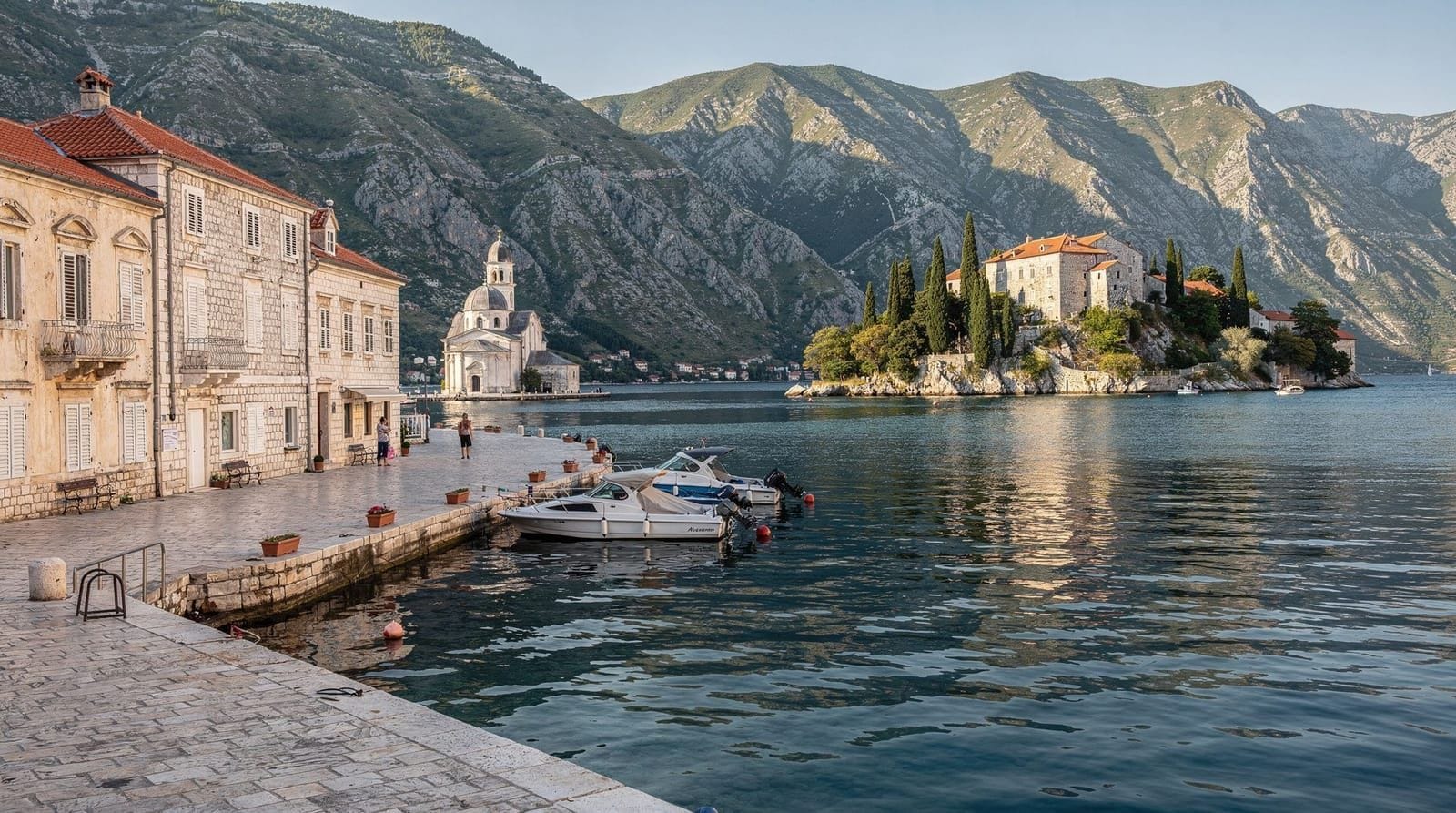
Dubrovnik vs Kotor: two Adriatic walled cities compared
Dubrovnik: Montenegro day trip with cruise in Kotor Bay
Should I visit Dubrovnik or Kotor?
Dubrovnik if the iconic walled city on the Adriatic is your destination — it is more dramatic, more extensively preserved and more famous for good reason. Kotor if you want to combine a medieval walled town with the extraordinary Bay of Kotor, lower prices, far fewer crowds and Montenegro as a country. Most visitors to Dubrovnik take Kotor as a day trip; if you want to do Montenegro properly, stay 2–3 nights.
Two walled cities on the same coast
Ninety kilometres apart, Dubrovnik and Kotor are both walled medieval cities on the eastern Adriatic. Both are UNESCO World Heritage Sites. Both are surrounded by dramatic scenery — Dubrovnik by the sea, Kotor by the spectacular amphitheatre of a fjord-like bay. And yet they are fundamentally different experiences in different countries, with different characters, different price points and different relationships to mass tourism.
The comparison matters because they are close enough to visit together — Kotor is Dubrovnik’s most popular day trip — and far enough apart in character to deserve different traveller profiles.
| Distance | ~90 km, around 2 hours by road including the border |
| Day trip time | 10–11 hours from Dubrovnik, door to door |
| Cost | Kotor day tour €80–130pp; Kotor itself is much cheaper on the ground |
| Border | Croatia–Montenegro, non-Schengen; 15 min–2 hours in peak season |
| Best for | Combine both if you have 3+ nights based in Dubrovnik |
Dubrovnik: the superlative
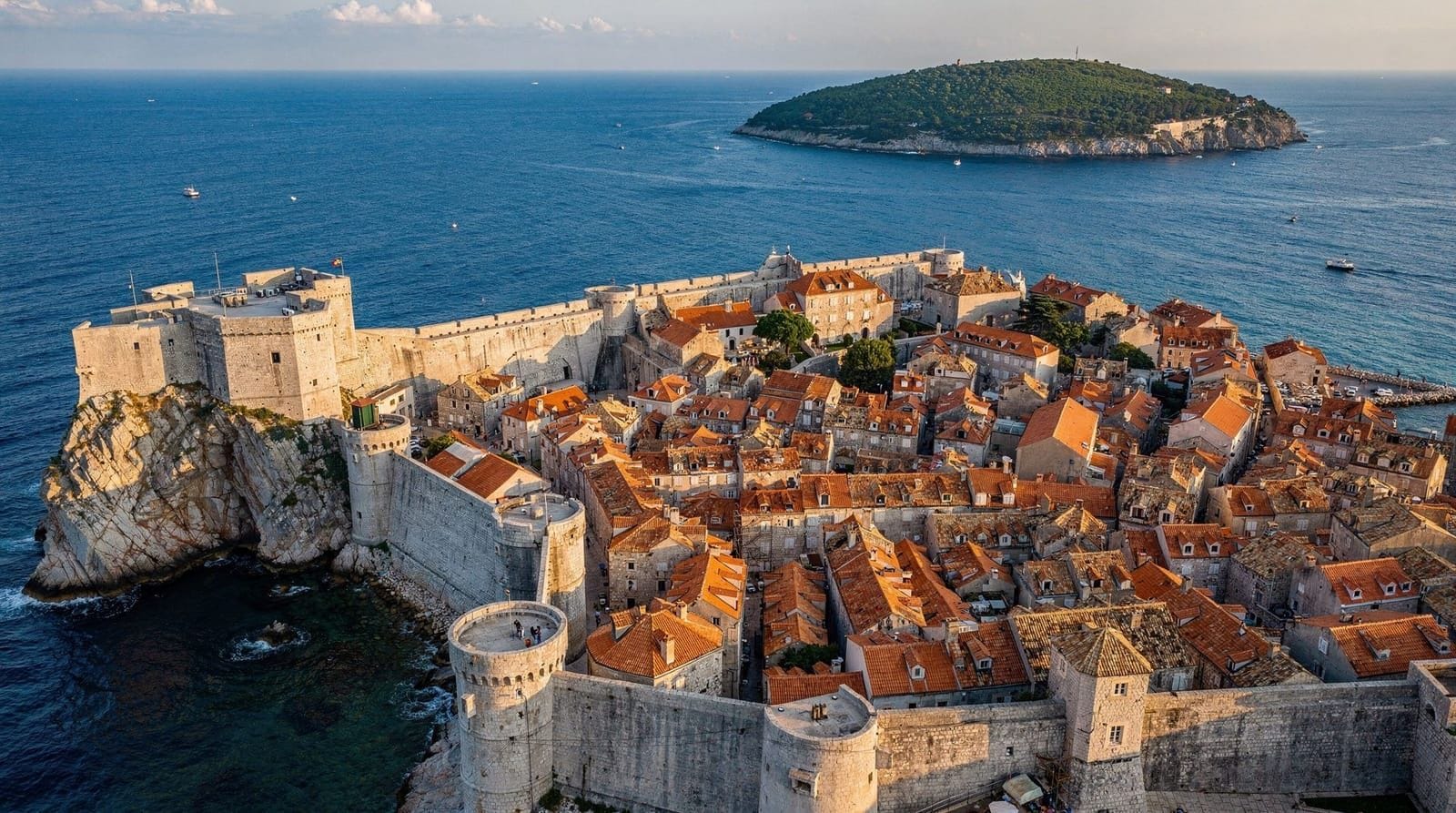
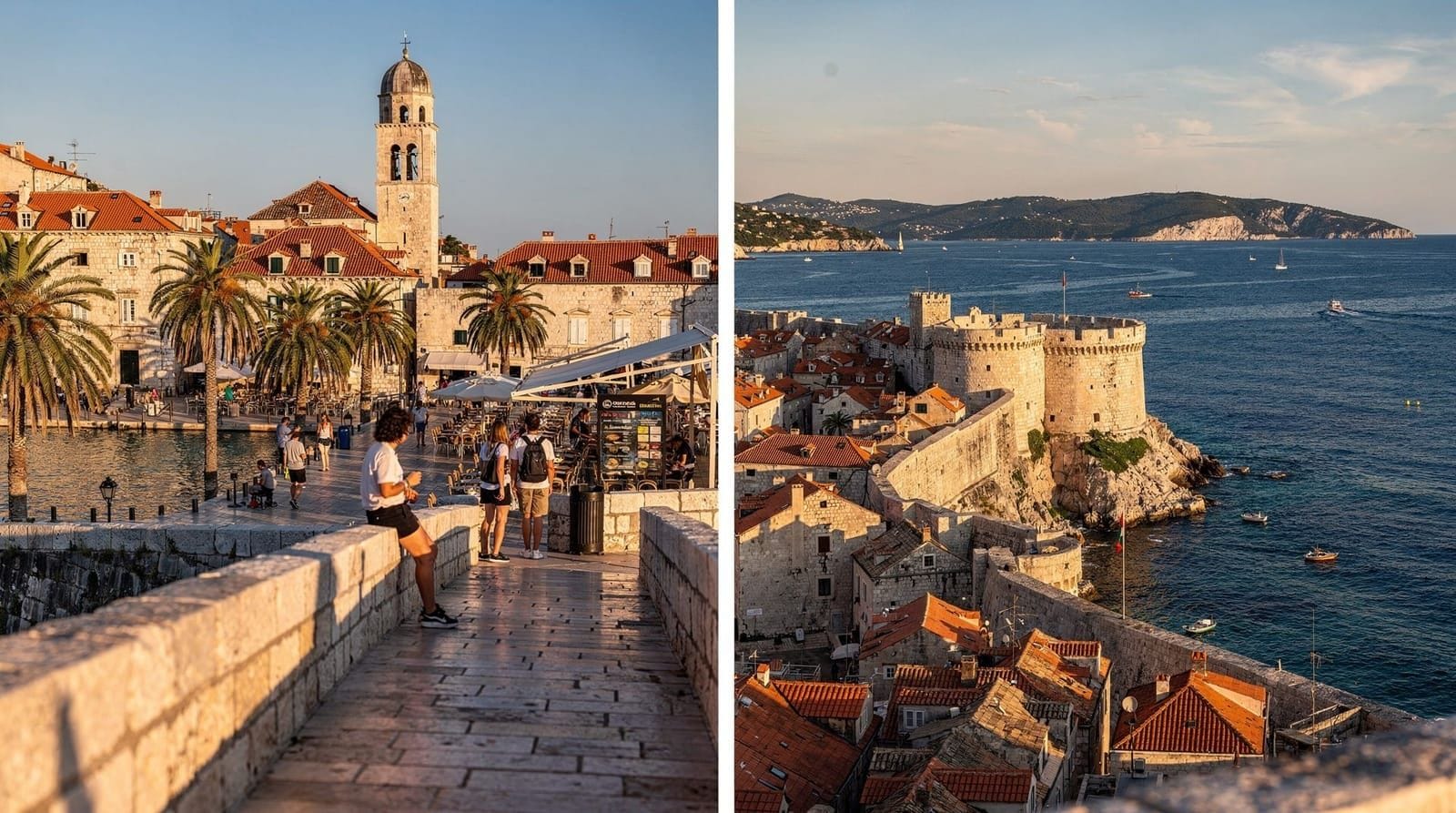
Dubrovnik is, in any objective analysis, one of the world’s most impressive walled cities. The Old Town occupies a rocky peninsula on the Adriatic, surrounded entirely by medieval walls that run along the cliff above the sea. Inside: the Stradun (marble-paved main street), Baroque churches, Renaissance fountains, a Dominican monastery with a cloister of extraordinary delicacy, and the constant blue background of the sea visible at every opening in the walls.
The walls walk — a 2-km circuit of the fortifications — is the defining experience: views in every direction, over rooftops to islands, or down the cliff to the Adriatic. Do it at 07:00 for the best light and fewest people.
The city’s fame is also its challenge. Cruise ships deliver up to 8,000 visitors per day in peak season; the Old Town streets, never wide, become genuinely uncomfortable between 11:00 and 16:00. This is a solvable problem (early mornings, late afternoons, shoulder months), but it cannot be ignored in any honest account.
Dubrovnik for Game of Thrones visitors. The Old Town was the principal filming location for King’s Landing throughout the HBO series. Fort Lovrijenac, the Jesuit staircase, Minčeta tower and Lokrum island are all recognisable from the show.
Kotor: the hidden amphitheatre
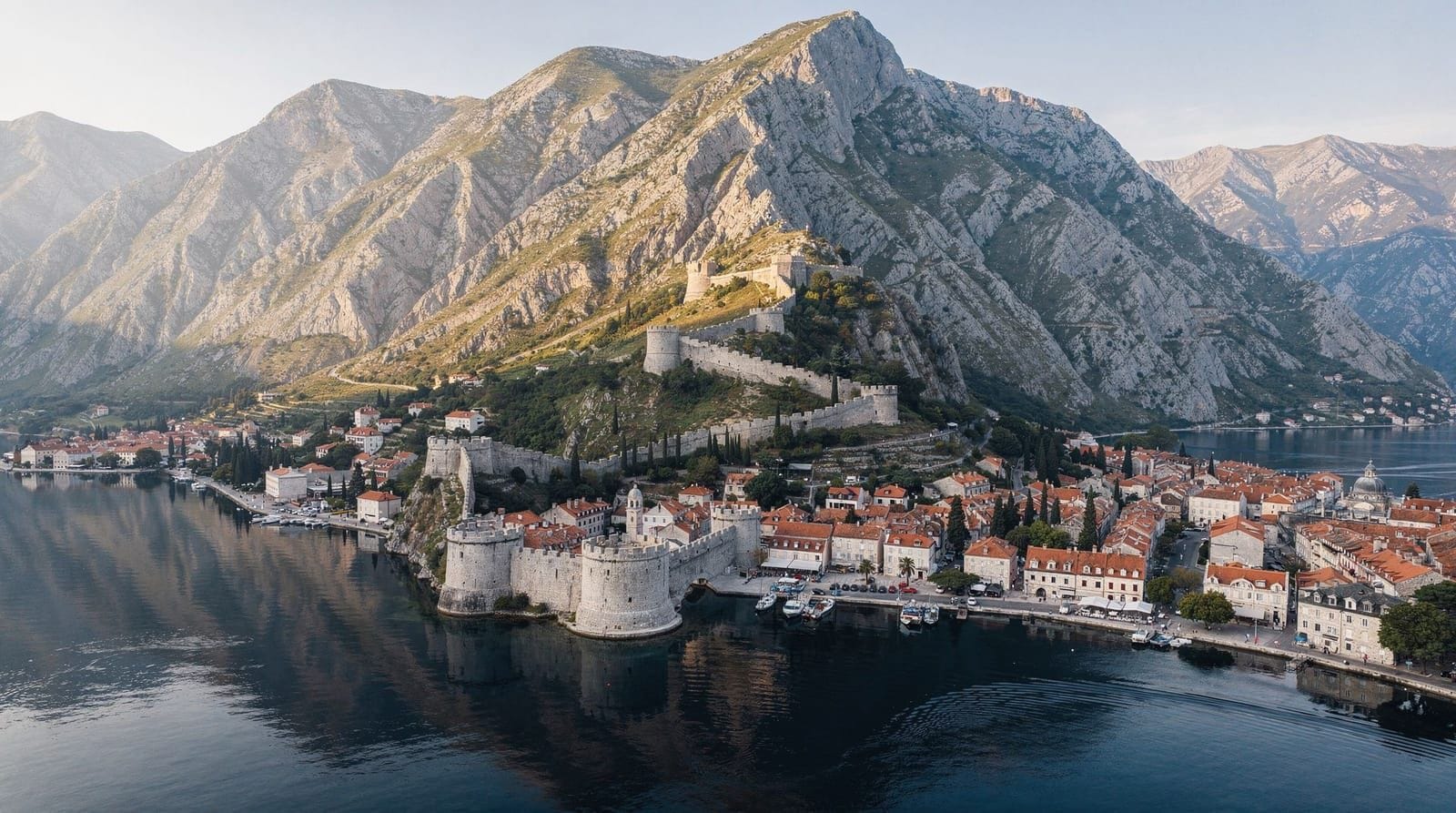
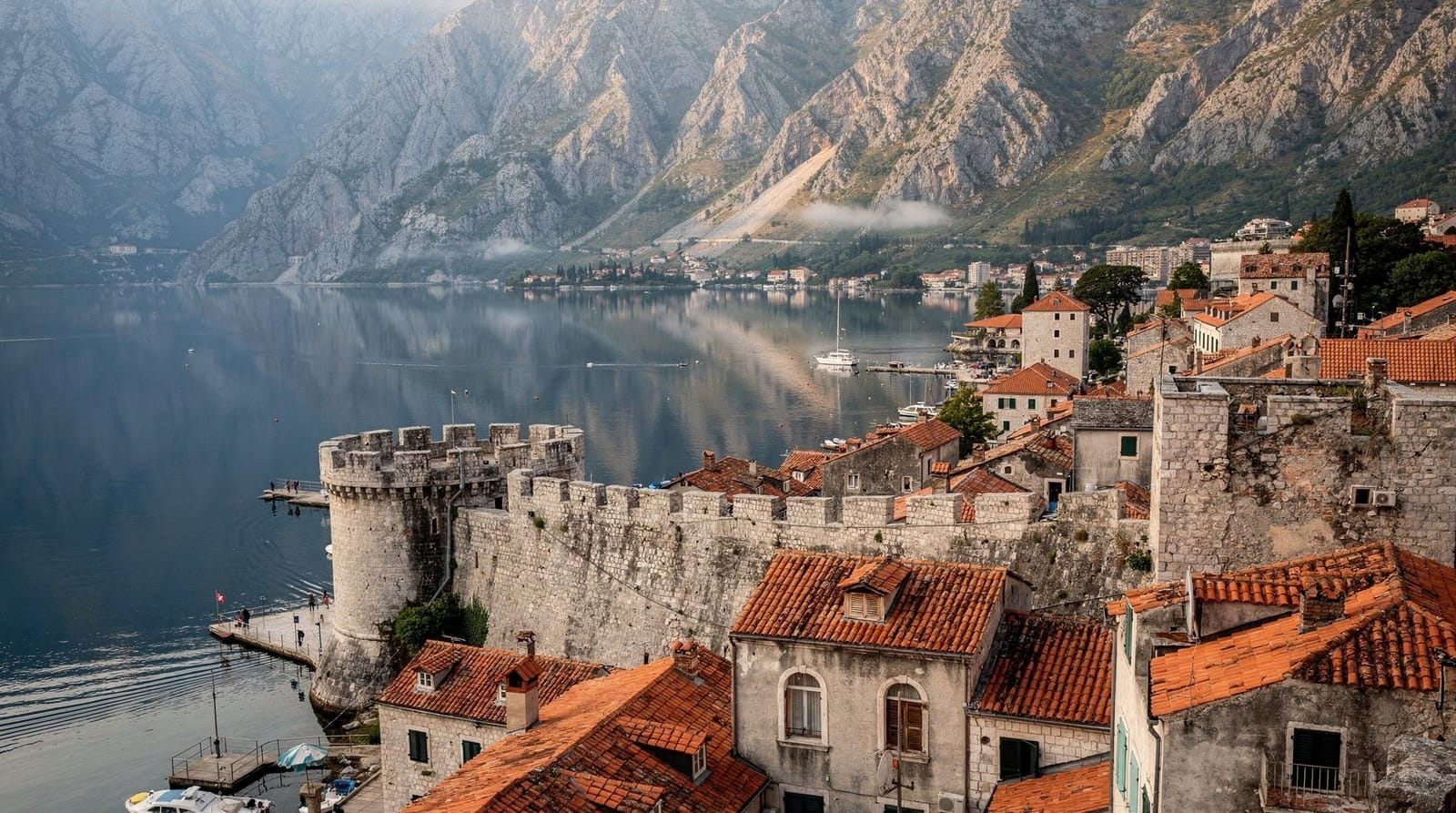
Kotor is Montenegro’s best-preserved medieval town — a UNESCO site since 1979, smaller than Dubrovnik but set in one of the most dramatic natural settings in the Adriatic: the Bay of Kotor (Boka Kotorska), a series of interconnected inlets surrounded by mountains that drop almost vertically into the water. Geologically, the Bay of Kotor is often described as a fjord, though technically it is a submerged river canyon — the distinction is academic; the visual effect is extraordinary.
The Old Town. Smaller than Dubrovnik (you can walk the full circuit of Kotor’s walls in 30–40 minutes), tighter and more labyrinthine. The Cathedral of St Tryphon is one of the finest Romanesque buildings in the Adriatic. The cat culture of Kotor — cats are everywhere, cared for by residents, sold on postcards, enshrined in a Cat Museum — gives the town an idiosyncratic softness alongside the heavy medieval stone.
The city walls climb. From the old town gate, 1,355 steps ascend the cliff to the Fortress of San Giovanni. The climb takes 1.5–2 hours return and rewards with a panorama that exceeds almost any viewpoint on the Dalmatian coast — the bay below, the mountains above, the old town rooftops in miniature. Do it early morning; it is steep and exposed.
Perast and Our Lady of the Rocks. A 20-minute drive from Kotor along the bay, the village of Perast has two small islands in the water in front of it. Our Lady of the Rocks is an artificial island — built, according to legend, from rocks deliberately submerged by local sailors over centuries, and now topped by a 17th-century church filled with ex-votos. It is genuinely beautiful and one of the most unusual sites on the entire Adriatic coast.
Side-by-side comparison
| Factor | Dubrovnik | Kotor |
|---|---|---|
| Country | Croatia (EU/Schengen) | Montenegro (non-EU) |
| UNESCO status | Yes — Old Town | Yes — Natural and Culturo-Historical Region |
| Walled city | Extensive, 2 km circuit | Smaller, more intimate |
| Setting | Rocky peninsula above sea | Fjord-like bay, mountains |
| Crowds | Very high (cruise-ship intensive) | High but less intense |
| Cost | Very high — €€€€ | Moderate — €€ |
| Walls walk | Essential experience (€35 entry) | Steep cliff climb (steps, €8–10 entry) |
| Beaches | Small (Banje, rocky coves) | Very limited |
| Day trips from | Kotor, Mostar, Elaphiti Islands | Dubrovnik, Perast, Lake Skadar |
| Game of Thrones | Major filming location | Not significant |
| Currency | Euro (Croatia) | Euro (Montenegro) |
| Visa/entry | Schengen Area | Not Schengen; requires border crossing |
Doing Kotor as a Dubrovnik day trip
This is the most practical format for most visitors. Leave Dubrovnik by 08:00, reach Kotor by 10:00–10:30 (with a border crossing at Debeli Brijeg or via Neum), spend 3–4 hours in Kotor (walls climb + old town + lunch), drive to Perast for 1–2 hours, and return to Dubrovnik by early evening.
Alternatively, join a group day tour from Dubrovnik (typically 10 hours, includes the border crossing logistics, guide commentary on the Bay of Kotor, and the Perast stop). Group tours are simpler logistically; private cars give more flexibility on timing and stops.
Some tours include a boat cruise on the Bay of Kotor, which gives an entirely different perspective on the fjord than the road — the mountains from water level are genuinely impressive.
Border crossing: what to know
The Dubrovnik–Kotor drive involves leaving Croatia (Schengen) and entering Montenegro (non-Schengen). Passport required for all nationalities; most Western passports (US, UK, Canada, Australia) enter Montenegro visa-free for short stays.
Important: The direct coastal road from Dubrovnik passes through a short strip of Bosnia and Herzegovina (the Neum corridor). This means two border crossings (Croatia–Bosnia, Bosnia–Croatia) before you even reach Montenegro. The Pelješac Bridge (opened 2022) allows you to bypass the Neum corridor entirely — take the bridge and avoid two extra border crossings.
Car rental: confirm with your Croatian rental company that the car is cleared for Montenegro. Many require advance notice and may charge a cross-border fee or provide a green card supplement.
Who should visit Kotor vs Dubrovnik?
Dubrovnik suits you better if:
- The iconic walled city imagery is a travel goal
- Game of Thrones is important to your visit
- You want the most spectacular Adriatic coastal setting
- Flight connections (Dubrovnik Airport) are the priority
Kotor suits you better if:
- You want a less-crowded walled city experience
- Budget is a priority
- Montenegro as a country interests you
- The Bay of Kotor’s mountain-meets-sea drama appeals
- You want to combine with Lake Skadar or Albanian Riviera travel
Visit both if:
- You have 3+ nights based in Dubrovnik
- The Adriatic’s walled-city circuit is a priority
- Montenegro is on your multi-country Balkans itinerary
Planning your Dubrovnik days around a Kotor trip
If Kotor is one day of a longer Dubrovnik stay, sequence it deliberately. Do Dubrovnik’s city walls and old town on the days either side of the Kotor trip, since both are more comfortable without the extra fatigue of a long day-trip on top. See the full day trips from Dubrovnik guide for how Kotor compares with Mostar and the Elaphiti Islands as options, and consider a dedicated Kotor day trip guide for a deeper dive into the Bay of Kotor itself beyond this Dubrovnik-focused comparison.
If you’re routing through Split as well
Travellers combining Split and Dubrovnik in one trip sometimes wonder whether to prioritise Kotor over more time on the Dalmatian coast. The honest answer depends on pacing: if you’ve already allocated significant time to islands and beaches via the Split vs Dubrovnik guide, a single well-planned Kotor day trip is easy to fit in without displacing anything essential. If your itinerary is already tight, Kotor is the first candidate to drop — it’s excellent but not essential to a first Croatia trip.
Frequently asked questions about Dubrovnik vs Kotor
How far is Kotor from Dubrovnik?
Approximately 90 km by road — around 2 hours driving depending on the border crossing at Debeli Brijeg (or via Bosnia and the Neum corridor). The journey takes you along the Adriatic coastal road into Montenegro, through Herceg Novi, and around the Bay of Kotor to the town itself. By organised day tour from Dubrovnik: typically 2.5 hours each way including border formalities.Is a day trip from Dubrovnik to Kotor worth it?
Yes — Kotor is the classic Dubrovnik day trip and among the best in the region. You get a UNESCO walled medieval town, the extraordinary amphitheatre of the Bay of Kotor surrounded by mountains, the village of Perast and Our Lady of the Rocks island, and a taste of Montenegro. A full-day tour (10–11 hours) gives enough time for the town, the bay and lunch. A private car is more flexible than a group tour.Which city is more expensive — Dubrovnik or Kotor?
Dubrovnik is significantly more expensive. Kotor (in Montenegro) operates in a lower price bracket — a restaurant meal that costs €25 in Dubrovnik's Old Town might cost €12–15 in Kotor. Accommodation is also cheaper in Kotor than Dubrovnik. Montenegro as a whole is notably less expensive than Croatia for equivalent travel. If budget is a consideration, Kotor is better value.Can you combine Dubrovnik, Kotor and Mostar in one trip?
Yes — the classic Adriatic circuit. Dubrovnik as the base (2–3 nights), with a day trip to Kotor (Montenegro) and a separate day trip to Mostar (Bosnia & Herzegovina). All three are reachable as day trips from Dubrovnik. Note that both Kotor and Mostar involve passport control at international borders. Montenegro is not in the EU or Schengen; Bosnia is neither. Budget time for border formalities.Is the Kotor city wall hike worth it?
Yes — the Kotor walls ascend the cliff behind the town to the fortified San Giovanni castle at the top. The climb involves approximately 1,355 steps and takes 1.5–2 hours return. The panoramic view from the top over the bay and the old town below is one of the best viewpoints in the Adriatic. Go early morning (07:00–09:00) before the cruise ships arrive and before midday heat. Entrance fee applies.Is Kotor suitable as a base instead of Dubrovnik?
For cost-conscious travellers, yes. Kotor has good accommodation options (considerably cheaper than Dubrovnik), a genuine medieval old town, the Bay of Kotor for half-day boat trips, and Dubrovnik is reachable as a day trip in reverse (2 hours). The downside: Montenegro is outside the EU, so credit card international fees may apply; and Dubrovnik is more connected for flights.Which city has a better beach near the old town?
Neither is a beach destination in the traditional sense. Dubrovnik has Banje Beach (a short walk from the Old Town) and the rocks below the cliff walk. Kotor's Bay is mostly deep-water with boat access to beaches; the town beach is small. For proper beach holidays, both Dubrovnik and Kotor are better as base cities than beach destinations — the Makarska Riviera and Brač have the beaches.
Top experiences
Bookable activities with verified prices and instant confirmation on GetYourGuide.
Top experiences
Best-rated activities across GetYourGuide and Viator.

Blue cave, Mamma Mia and Hvar, 5 islands speedboat tour
- Viator

Blue Cave and Hvar Tour - 5 Islands Tour from Split and Trogir
- Viator

Blue cave, Mama Mia and Hvar, 5 Island Speedboat Tour from Trogir
- Viator

From Zadar: Plitvice Lakes with Boat Ride & Zadar Old town tour
- Viator

Hvar, Brač & Pakleni islands cruise with lunch & drinks from Split & Trogir
- Viator

Blue Cave & Vis Island speedboat tour from Hvar
- Viator