Krka Day Trip from Split, Zadar or Šibenik — Waterfalls, Trails and Honest Tips
Split: Krka waterfalls tour
Is Krka National Park worth a day trip from Split or Zadar?
Yes — Skradinski Buk is one of the most beautiful waterfall systems in Europe and genuinely easy to visit. From Split the journey is 1–1.5 hours; from Zadar about 1 hour; from Šibenik only 30 minutes. Allow half a day at the park and combine with Šibenik's old town for a full day. Simpler and shorter than Plitvice, with its own distinct character.
| Where | Krka National Park, near Šibenik |
| Cost | Around EUR 20-30/person entry; EUR 60-90 for a guided day tour |
| Time needed | Half day at the park; full day combined with Šibenik |
| Getting there | 1-1.5hrs from Split, 1hr from Zadar, 30min from Šibenik |
| Best time | Arrive before 9am; May-June or September-October |
Krka vs Plitvice — understanding what you are choosing
Croatia’s two great waterfall national parks are often compared. Both are magnificent. But they are different experiences:
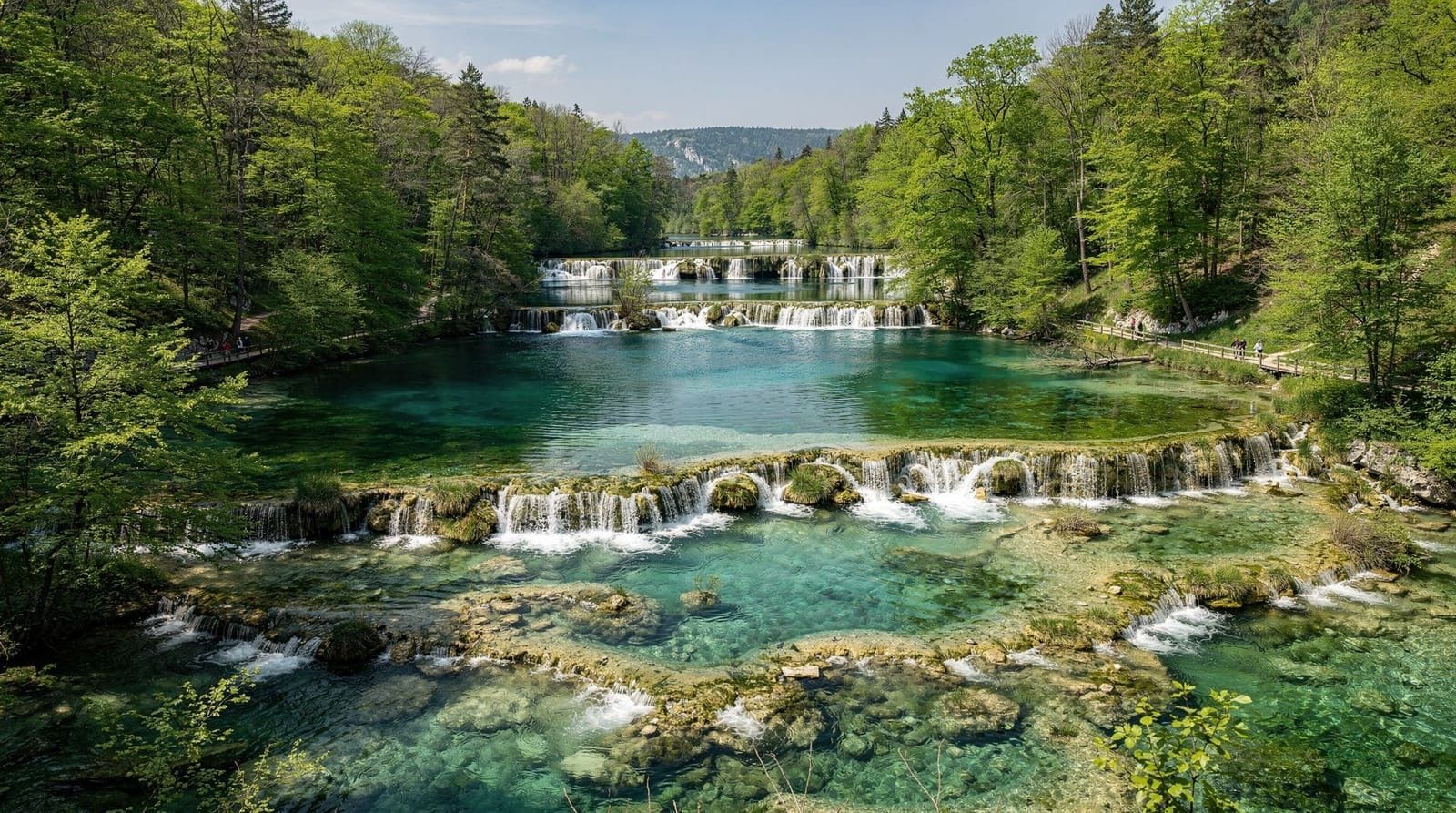
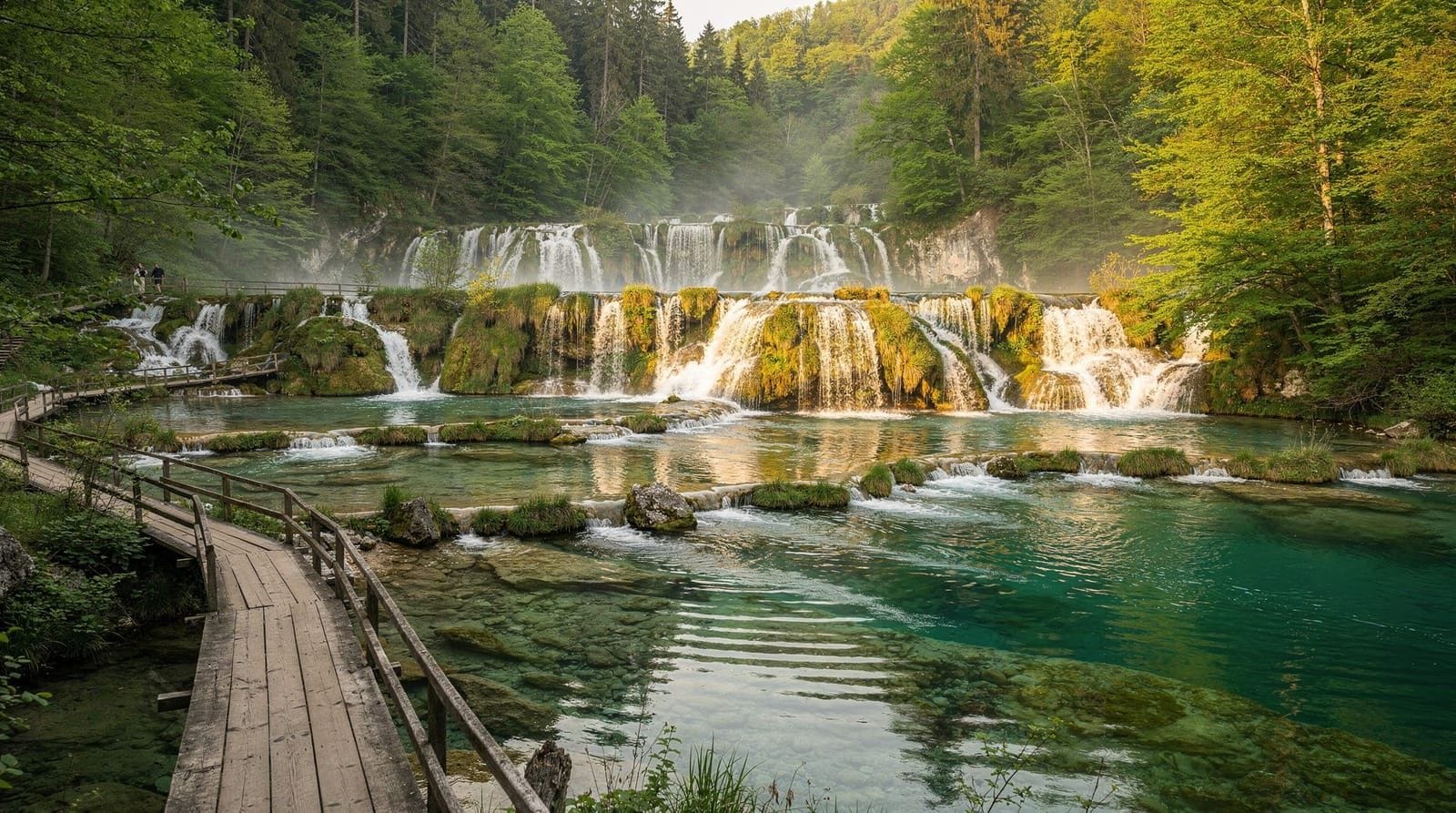
Plitvice is immersive and large — a full day of boardwalk trails, multiple lake levels, dramatic scale. It is 2–3 hours from the coast.
Krka is more compact — a half-day at the waterfall system, an easier drive (1–1.5 h from Split, 1 h from Zadar), and naturally combined with Šibenik’s old town for a full day. Krka’s Skradinski Buk is not smaller than Plitvice’s falls — it is simply a different formation: wider, more horizontal, a stepped cascade across the full river width.
If you have time for both, do both. If you must choose: Plitvice for scale and drama; Krka for ease and a more relaxed pace. Full comparison at Plitvice vs Krka.
Krka from Split
Distance: 80–90 km / 1–1.5 h
Recommended departure: 8:30–9 am
Suggested day: Krka morning → Šibenik afternoon
This is the most popular day trip from Split. The drive is easy on the A1 motorway to the Šibenik exit, then 20 minutes to the Skradin entrance. A 9 am arrival gets you to the Skradinski Buk boardwalk before the crowd peak.
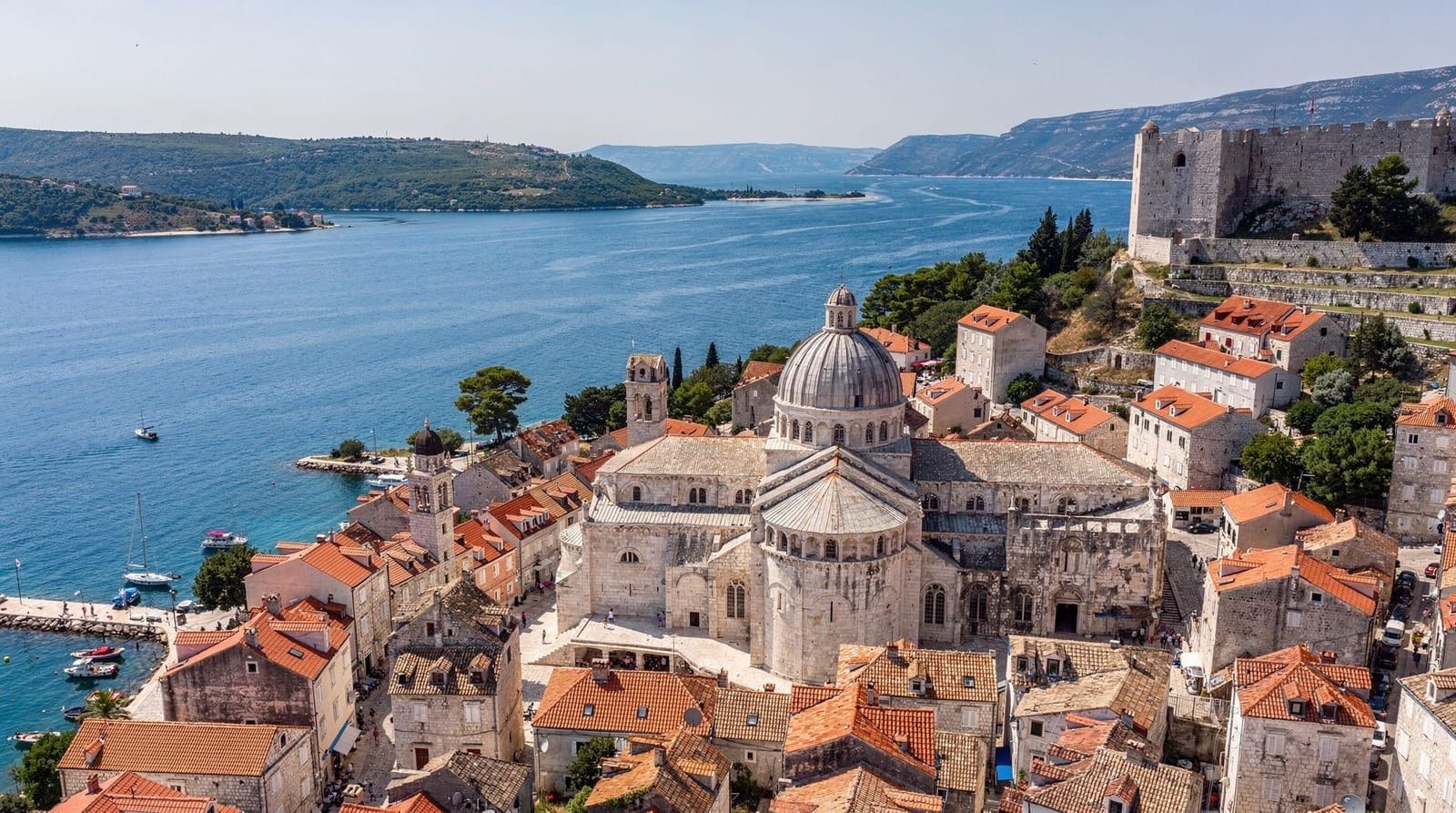
Spend 2.5–3 hours at Skradinski Buk: the loop trail is 3.5 km and takes 1.5–2 hours at a relaxed pace, with time to watch the waterfalls, the old mills, and look into the clear pools. Then drive 20 minutes to Šibenik old town — wander the narrow lanes to the Cathedral of St James (UNESCO, the first Renaissance cathedral built entirely in stone without brick), climb to St Michael’s Fortress for the view, have a long lunch.
Some tours include a boat cruise element within the park — the boat from Skradin into the canyon is a pleasant way to approach the waterfall from the water.
Krka from Zadar
Distance: 70–80 km / 1 h
Access: Either Skradin entrance (south approach) or Roški Slap (north approach)
From Zadar, Krka is equally easy. The Skradin entrance is the most visited. A good alternative from Zadar is the northern approach via the Roški Slap section — a quieter part of the park with different falls and a monastery island on a lake.
Roški Slap and Visovac: The upper Krka canyon at Roški Slap has a smaller but scenic waterfall and an island monastery (Visovac, a Franciscan monastery on an island in the river widening) accessible by boat. The Krka canyon here is narrower and wilder-feeling than Skradinski Buk. Tours and self-drive visitors to the Visovac section are far fewer than at the main waterfall.
If you have visited Skradinski Buk before and want a different experience, or prefer quiet to crowd, approach from the north.
Inside the park: what to do
Skradinski Buk (lower falls)
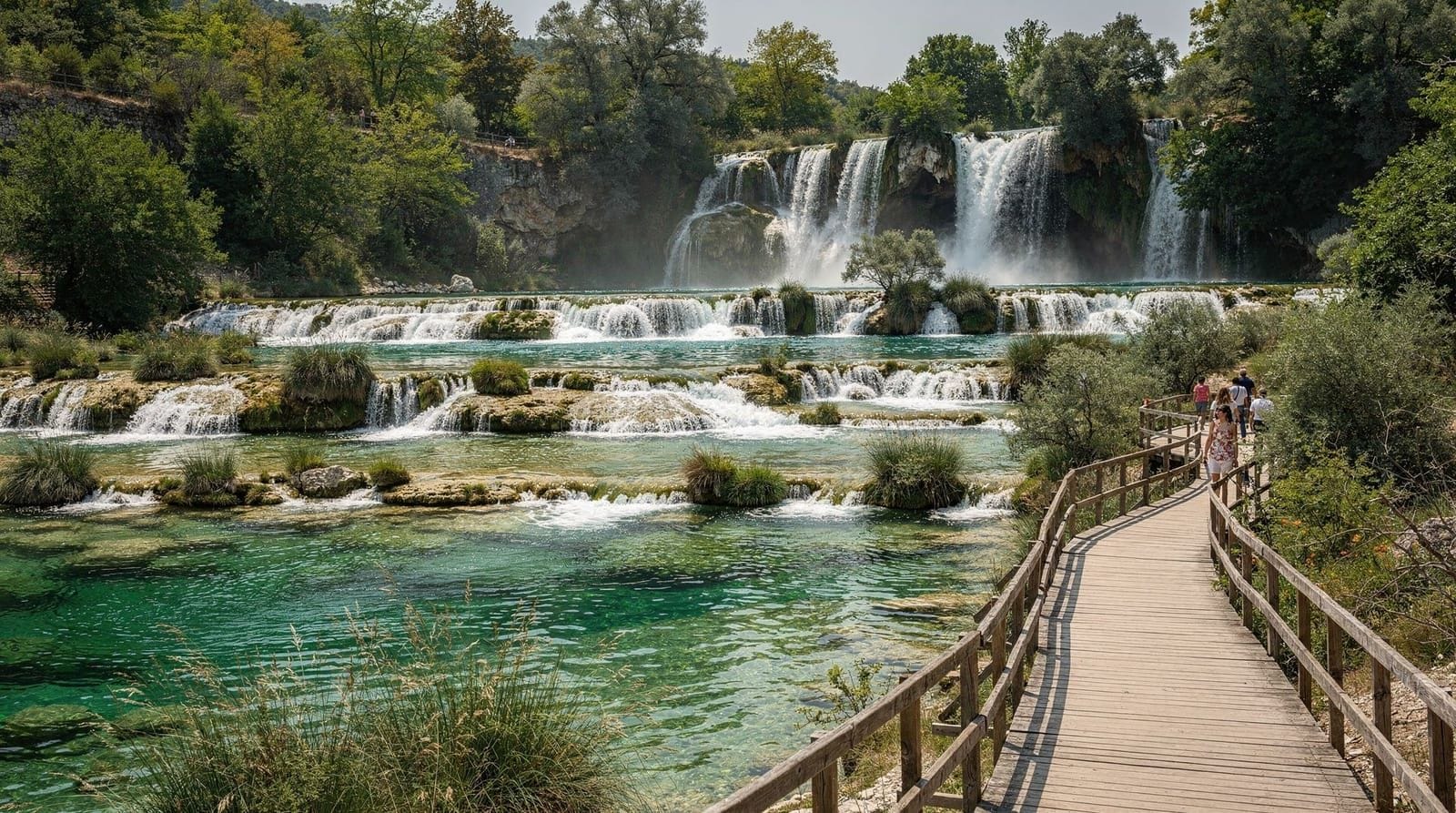
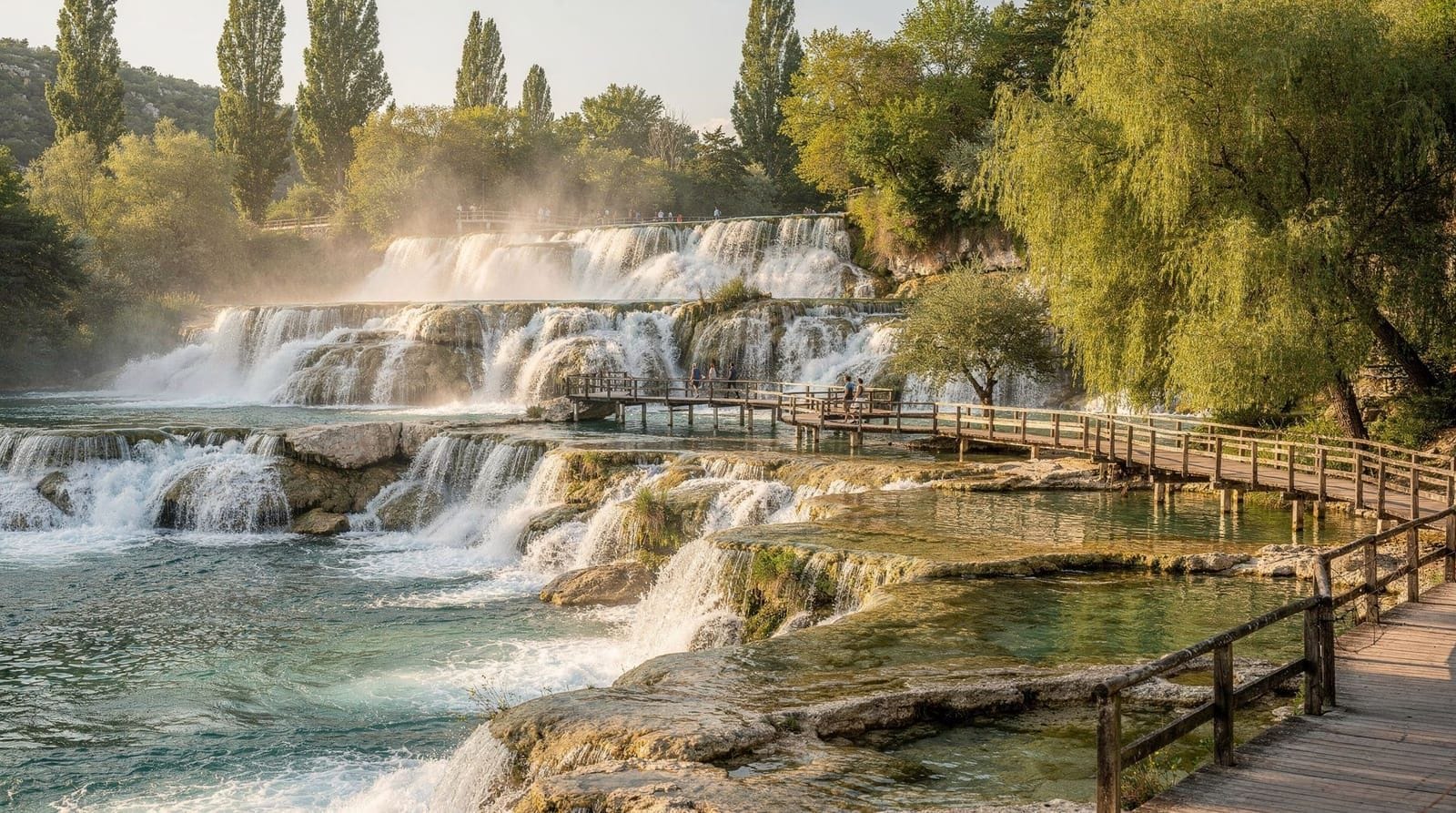
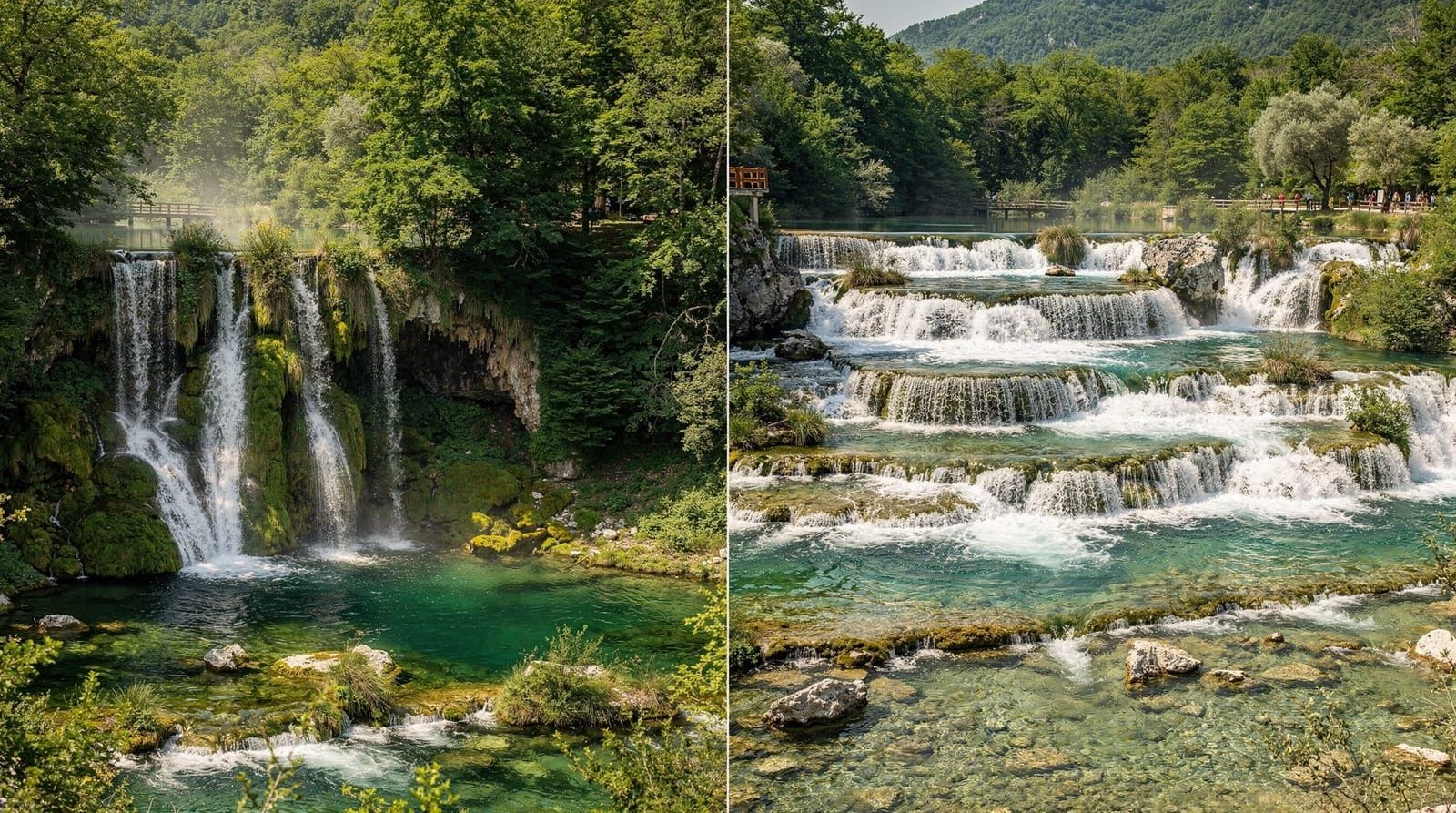
The main attraction. A wide stepped travertine waterfall system — 800 metres long, 45.7 metres total drop — where the Krka river descends in a series of terraced cascades over tufa barriers. The surrounding landscape includes reconstructed old flour mills, the remains of a textile industry, and interpretive displays on the traditional uses of the waterfall’s hydraulic power.
The loop boardwalk takes 1.5–2 hours. The light is best in the morning when the eastern sun catches the water. The pools in the lower sections of the falls are now closed to swimming (see FAQ), but the visual impact of the turquoise water against the white tufa and green vegetation is striking.
The boat from Skradin: A park boat departs Skradin village (5 km downstream) and takes visitors up the river to Skradinski Buk by water. This is one of the more atmospheric ways to arrive at the falls — floating upriver through the canyon. Included in some tours; extra cost if self-driving.
Visovac Island
A lake formed by the Krka widening above Skradinski Buk contains Visovac — a small island with a Franciscan monastery dating to 1445. The monastery has a small museum containing an illustrated 1485 edition of Aesop’s Fables (one of the earliest printed books in this region) and a 16th-century Franciscan library. Boat trips to Visovac depart from Skradin or Lozovac by arrangement.
Upper Krka — Manojlovac and Bilušića Buk
Further upstream, Manojlovac Falls are less visited and among the most powerful in the park — not accessible by most organised tours but reachable by car via the D58 road. For those with vehicles and curiosity for the road less taken.
Combining with Šibenik
Šibenik is 20 km from the Skradin entrance and deserves more visitors than it gets. The old town climbs steeply from the waterfront to St Michael’s Fortress, with narrow lanes and a remarkable skyline.
Cathedral of St James (Katedrala sv. Jakova): A UNESCO World Heritage Site — one of the most architecturally significant churches in the Mediterranean. Built entirely from stone blocks between 1431 and 1535 by Dalmatian and Venetian masters (most notably Juraj Dalmatinac), it contains no brick or mortar — every component is interlocked stone. The 74 heads carved around the exterior apse (portraits of contemporary citizens) are extraordinary.
St Michael’s Fortress and St John’s Fortress: The two fortresses above the city give views over the bay and the old town rooftops. Both are well-preserved and now host summer events.
What changed: the swimming ban
For years, Krka’s Skradinski Buk was one of the few national parks in Europe where you could swim inside the main waterfall attraction. It was enormously popular. In 2021 the park authorities prohibited swimming at Skradinski Buk, citing damage to the tufa ecosystem from the volume of visitors (over a million annually) and sunscreen contamination.
This is a real change that affects the experience. Krka is still magnificent, but the “swimming in a waterfall” element that made it unique among European national parks is gone. If this was your primary reason for choosing Krka over Plitvice, reassess.
Some sections of the Krka river outside the main waterfall area have designated swimming zones — check current park information when planning.
Practical tips
Best months: May–June and September–October. Spring brings the highest water levels and most dramatic falls. Summer (July–August) is hot, busy, and the boardwalks become genuinely crowded by late morning.
Entrance fees: Around €20–30 per person depending on season (check krka.hr for current pricing). Book online to avoid queues in peak season.
What to bring: Good walking shoes, water, sunscreen, a light layer for the spray zone near the falls. Swimwear is less essential now that Skradinski Buk swimming is banned, but a swimsuit is worth having for the river zones.
Food: The park restaurant at Skradinski Buk is serviceable. Better food is available in Skradin village (several good restaurants and konobas). Šibenik has excellent dining options if you combine the two.
Choosing your departure city
| Split | Zadar | Šibenik | |
|---|---|---|---|
| Distance to Skradin entrance | 80-90 km | 70-80 km | 20 km |
| Drive time | 1-1.5hrs | 1hr | 30min |
| Best for | Combining with a Šibenik afternoon | Combining Skradinski Buk or the quieter Roški Slap | A relaxed half-day without a long drive |
| Guided tour availability | Extensive | Good | Limited — self-drive more common |
Šibenik is by far the most convenient base if it is on your route, but most visitors are staying in Split or Zadar, and the extra hour of driving is a fair trade for a fuller itinerary that includes the old town and cathedral.
Is the swimming ban a dealbreaker
For visitors who chose Krka specifically to swim inside a waterfall system, the 2021 ban is a genuine disappointment worth knowing about before you commit a day to the trip. If swimming was your main draw, Croatia’s other waterfalls and river spots outside the national park boundary still permit it, and are worth researching as an alternative or addition. If your priority is the visual spectacle, the boardwalk trail, and a lower-key day than Plitvice, the ban does not meaningfully diminish the experience — Skradinski Buk remains one of the most photogenic waterfall systems in Europe with or without swimming.
Frequently asked questions about Krka Day Trip from Split, Zadar or Šibenik
Can you still swim at Krka Waterfalls?
Swimming at Skradinski Buk is no longer permitted as of 2021 — the park authorities banned it to protect the fragile tufa ecosystem. Swimming was one of Krka's main draws for years; this is a genuine change to expectations. Some other sections of the river and the lake near Visovac island permit swimming; check current park rules when booking, as these change. The park itself remains spectacular without swimming.How far is Krka from Split?
About 80–90 km by road — roughly 1–1.5 hours drive depending on route and traffic. The main entrance at Skradin is the most convenient for arriving from Split. Some tours also use the Lozovac entrance (inland), which has a longer park boat down to Skradinski Buk.How far is Krka from Zadar?
About 70–80 km south, roughly 1 hour by car or 1.5 hours by bus. The Skradin entrance is the same distance from both Split and Zadar. From Zadar, you can also approach from the north via the Roški Slap entrance (upper Krka), which is significantly quieter and less visited.What is the difference between Skradinski Buk and Roški Slap?
Skradinski Buk is the centrepiece of the lower Krka canyon — a wide, stepped waterfall system with multiple cascades, blue-green pools, old flour mills and a loop boardwalk trail. It is by far the most visited and most photographed part of the park. Roški Slap is the upper Krka section — a narrower canyon with different falls, a monastery island (Visovac), and far fewer visitors. Roški Slap suits visitors who want a more solitary experience.Is it better to visit Krka from Split or from Šibenik?
Šibenik is the closest base — only 30 minutes by car. If you are visiting Šibenik's old town (strongly recommended — UNESCO-listed cathedral), combining it with Krka is very natural. From Split, Krka makes a standalone day trip or a combined Šibenik-Krka day. From Zadar, the combination with Šibenik is longer but manageable. Šibenik is an underrated town and worth combining.Do I need to book Krka National Park entry in advance?
In peak season (July–August), yes — booking online avoids queues at the entrance and the park can get busy. In shoulder season (May–June, September–October), you can usually buy tickets on arrival, though online booking is still recommended to avoid waits. Entry fee is approximately €20–30 in peak season (varies; check the official Krka website before visiting).What time should I arrive at Krka to avoid crowds?
Before 9 am at Skradinski Buk. The park opens at 8 am in summer. Arriving between 8–9 am means having the boardwalk almost to yourself for the first 60–90 minutes. By 10:30–11 am, tour groups arrive from Split and Zadar and the main waterfall area becomes busy. Alternatively, visiting after 4 pm as groups leave can be pleasant — but check the last entry time before planning a late visit.
Top experiences
Bookable activities with verified prices and instant confirmation on GetYourGuide.
Top experiences
Best-rated activities across GetYourGuide and Viator.

Mostar and Herzegovina Tour with Kravica Waterfall from Split & Trogir
- Viator

Mostar & Kravice waterfalls full-day guided tour from Split
- Viator

Mostar and Kravica Waterfall Discovery Day Trip from Split or Trogir
- Viator

Taste of Bosnia: Private Trebinje Gastro & Wine Tour
- Viator

From Split/Trogir: Mostar and Medjugorje Tour with Wine Tasting
- Viator

Split to Dubrovnik Private Transfer with Mostar Town
- Viator