Umag travel guide
Discover Umag: the northernmost Istrian resort town, famous for the ATP tennis tournament, local Malvazija wine, and easy day trips into Slovenia and
Umag/Porec: Fish picnic with lunch and swimming
Quick facts
- Best time
- June–September
- Days needed
- 2–3 days
- Getting there
- Car from Poreč (30 km) or Trieste (70 km); bus from Pula (1.5 h)
- Budget per day
- €55–€120
Umag occupies a strategic position at the very tip of the Istrian peninsula — closer to Trieste and Ljubljana than to Split, in a corner of Croatia where Croatian, Italian, and Slovenian cultures have always overlapped. It’s the first town you reach when crossing into Croatia from Slovenia on the coastal road, and it has a pleasant old town on a small peninsula, good beaches, and a solid wine-growing hinterland producing some of Istria’s best Malvazija.
Internationally, Umag is best known for the ATP Croatia Open — a professional men’s tennis tournament held each July on clay courts, attracting major players and a lively international audience. But beyond the tennis week, Umag is a low-key, genuine resort town with less tourist polish than Rovinj and lower prices than Poreč.
Getting to Umag
By car: From Poreč (30 km south, 30 minutes). From Rovinj (70 km south, 1 hour). From Pula (110 km south, 1.5 hours). From Trieste in Italy (70 km west, about 1 hour). From Ljubljana, Slovenia (120 km, 1.5 hours).
By bus: Services connect Umag with Poreč (30 min), Pula (1.5 hours), Rijeka (2 hours), and Zagreb (4 hours). Cross-border buses serve Trieste.
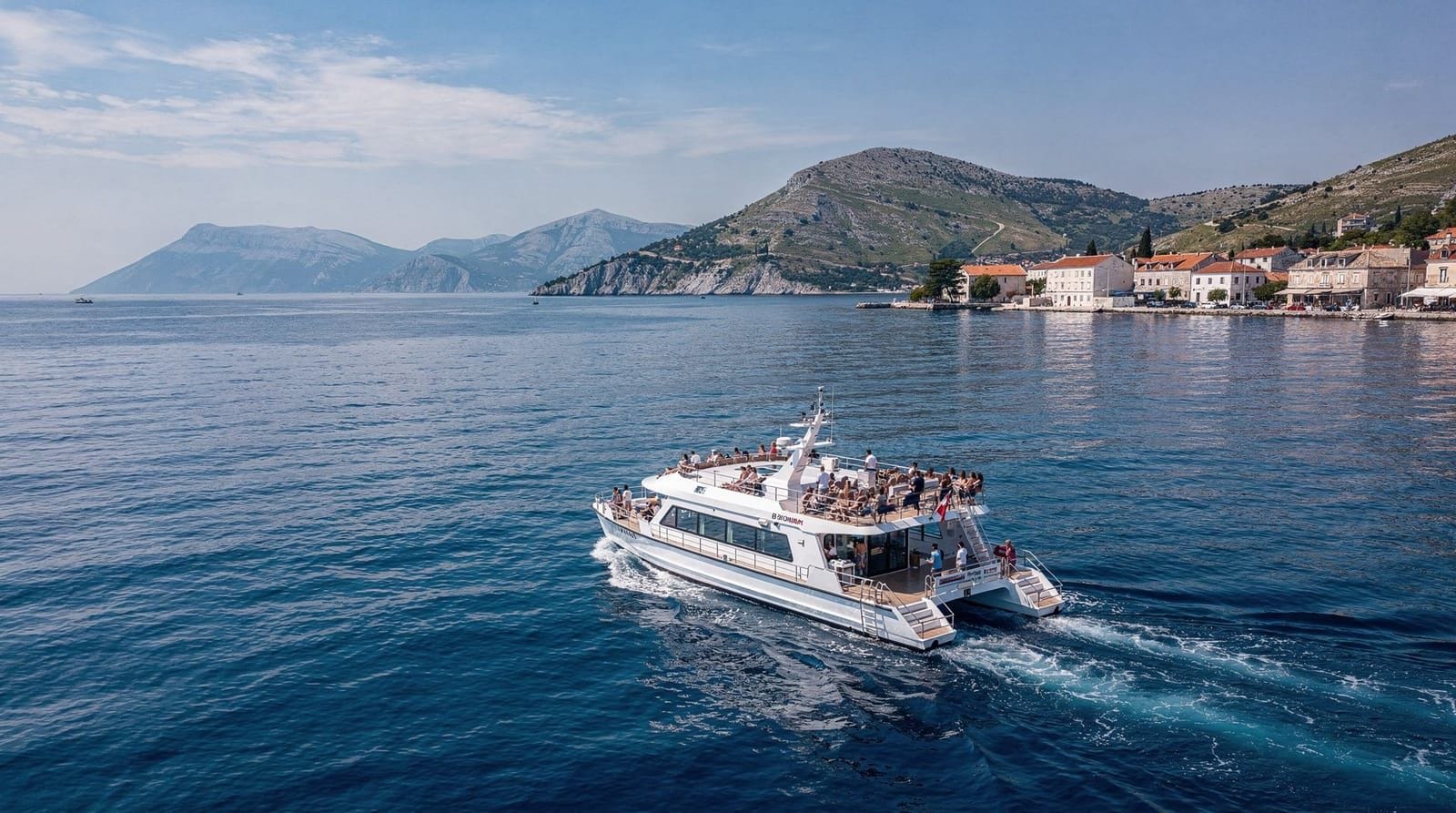
By boat: A seasonal boat service runs along the Istrian coast connecting Umag, Novigrad, Poreč, Vrsar, and Rovinj in summer. A pleasant alternative to driving for those staying along the coast.
What to see and do in Umag
Umag Old Town
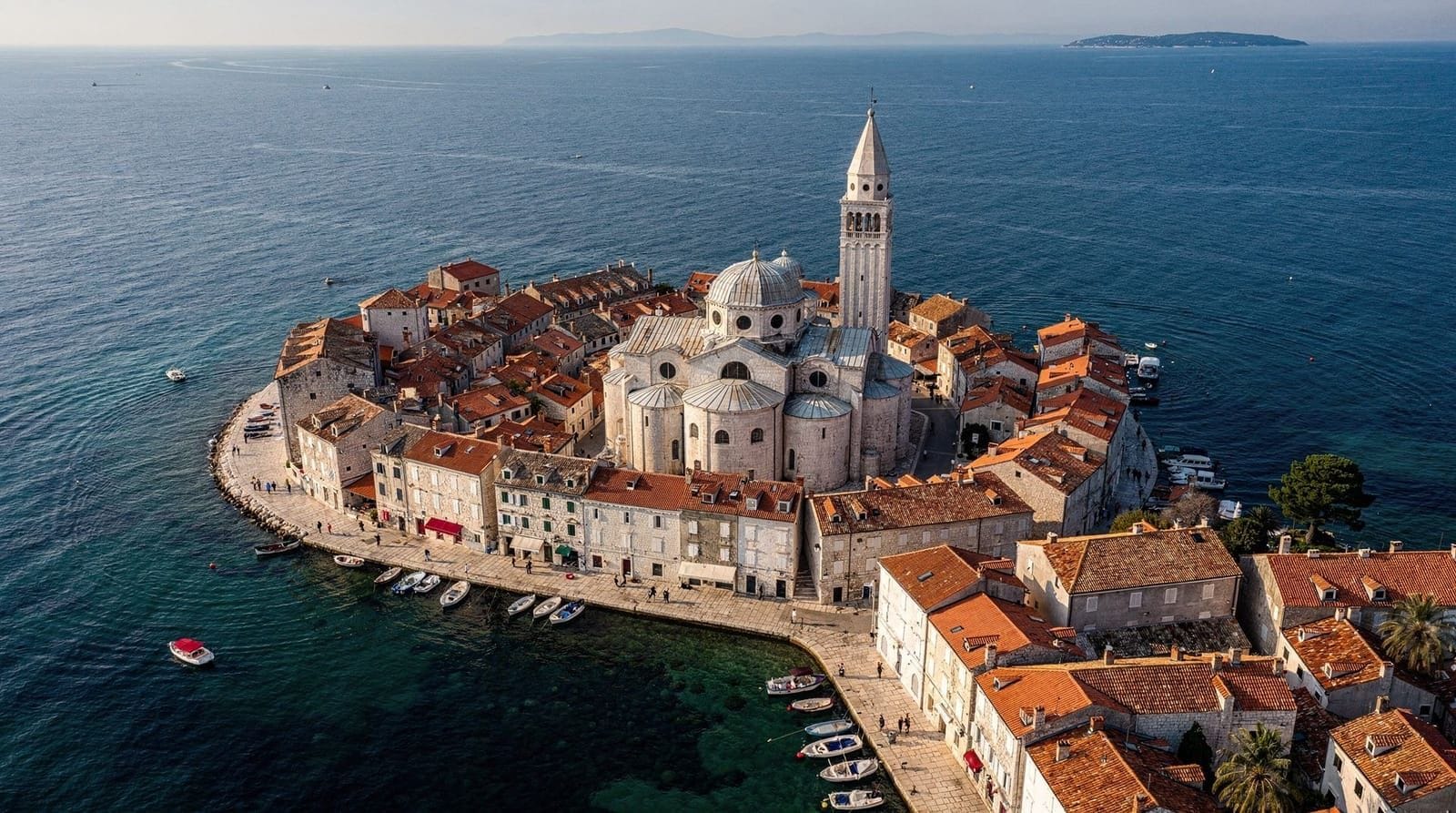
Umag’s old town sits on a small, triangular peninsula — a pattern familiar from other Istrian coastal towns. The scale is small but the atmosphere is pleasant: narrow lanes, Venetian-era architecture, a small harbour where fishing boats rock alongside tourist craft, and a 17th-century church (St Mary’s Assumption) whose bell tower is the town’s main visual landmark.
The old town is compact enough to explore thoroughly in a morning. The town walls (partial remains) enclose a handful of konobas, wine bars, and boutiques. The waterfront promenade below the old town is the main social gathering point.
A small but good archaeology museum (Muzej Umag) displays local prehistoric, Roman, and medieval artefacts. The Roman-era fish-processing tanks and jewellery finds are highlights.
Daily life in the old town carries a texture you won’t find in more heavily touristed Istrian towns. Italian is genuinely spoken as a first language by a portion of residents — Umag has a significant Italian minority community, and you’ll hear it in cafés and at market stalls without having to listen hard. The café culture that results is a pleasant blend of Croatian and Italian rhythms: a cappuccino ordered in Italian at one table, a kava ordered in Croatian at the next, a glass of Malvazija alongside an Aperol spritz at the bar by late afternoon. On weekday mornings, the fish market near the harbour draws local buyers before most tourists are awake — small boats unload their catch and the transaction is quick, direct, and entirely unsentimental. The Wednesday market in Umag expands well beyond the tourist-facing stalls of olive oil and lavender soaps into a genuine weekly market for residents: seasonal vegetables, household goods, local cheese, and clothing sold from fold-out tables. It’s the kind of market where the same family has occupied the same pitch for decades.
ATP Croatia Open (Tennis)
The ATP Croatia Open is an ATP 250 event held at the Stella Maris tennis complex in Umag each July. Top-ranked players compete on clay courts, and the tournament has historically attracted some of the best clay-court players in the world. Tickets can be bought online (book early for finals) or at the venue.
If you’re not attending the tournament, be aware that accommodation in Umag and Poreč during tournament week is significantly pricier and harder to find. Plan accordingly.
Wine Route: Buje and Northern Istrian Wineries
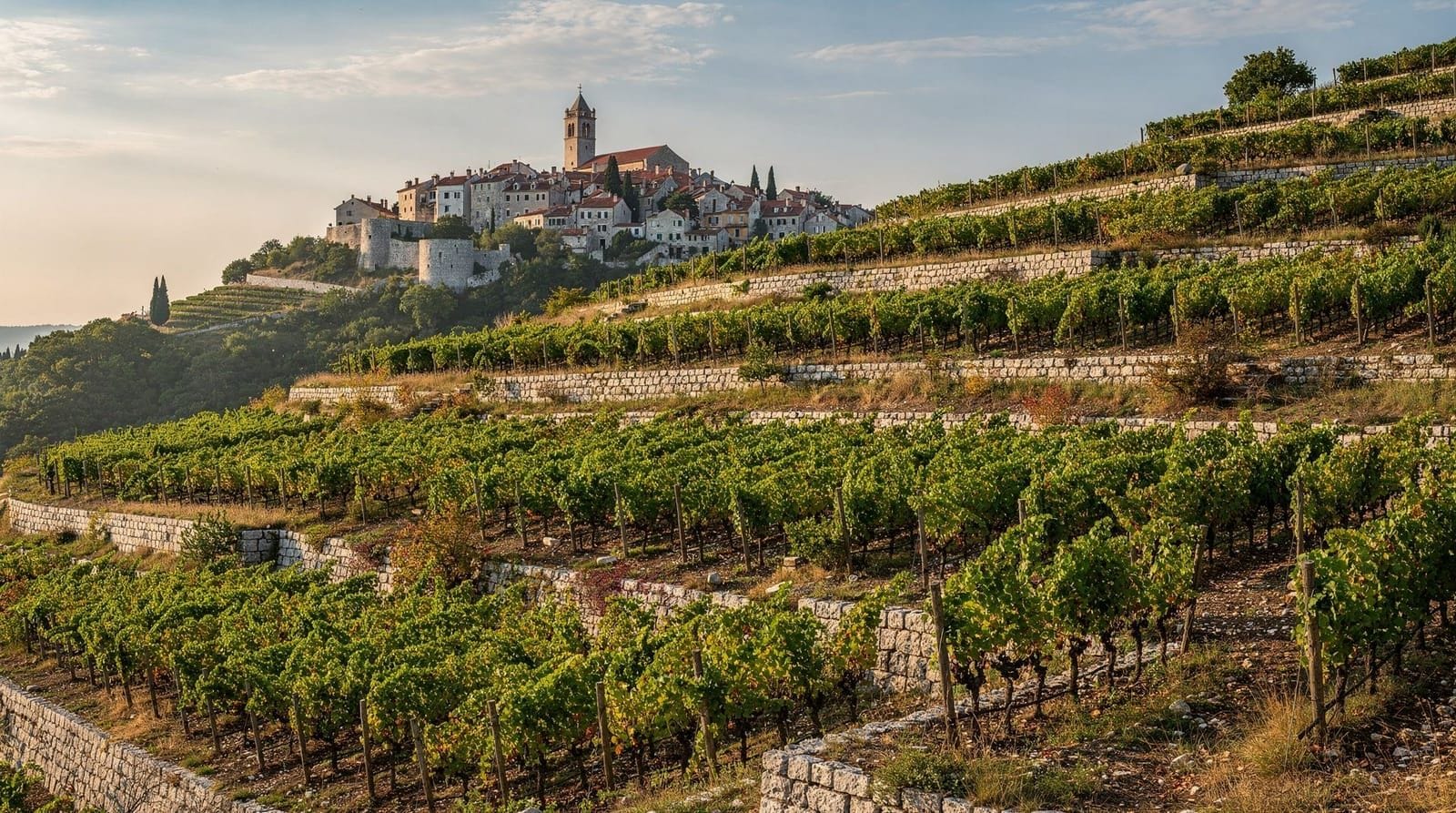
The area around Buje — a medieval hilltop town 14 km inland from Umag — is one of Istria’s prime wine-growing areas. The Teran and Malvazija Istarska grapes both thrive here in the red soil (terra rossa). Several well-regarded wineries welcome visitors:
Kabola Winery (Momjan): One of Istria’s most respected producers, known for elegant Malvazija and structured Teran. The estate dates from the 17th century and offers tastings by appointment.
Kozlović Winery (Momjan): Another high-quality producer — their Santa Lucia Malvazija is frequently cited among Croatia’s best white wines. The wine is aromatic and expressive on the nose, with distinct notes of green apple and citrus, underpinned by a well-balanced acidity that keeps it fresh and food-friendly rather than heavy. It has the kind of precision that rewards slow sipping rather than quick consumption. Vineyard tastings are available in summer, and the estate setting — surrounded by vines on the gently rolling hills above Momjan — is worth the drive alone.
Degrassi Winery (Savudrija): Near Umag, producing fresh Malvazija and interesting Muscat-based wines.
Before Malvazija became the calling card of Istrian wine, the hills around Momjan village were known for something rarer: Muškat Momjanski, or Momjan Muscat. This is a semi-sweet to sweet white wine made in tiny quantities, specific to a cluster of vineyards around the village of Momjan itself. It predates the modern Malvazija boom and has a long local history — references to the wine appear in documents going back centuries. Production remains small by design; the grape is delicate and the yields are low, so bottles rarely circulate beyond specialist wine shops and the wineries themselves. If you visit Kabola or Kozlović and ask specifically about the Muscat, most will pour it alongside the Malvazija. The flavour profile is fragrant and honeyed with orange blossom and stone fruit, very different in character from the drier, mineral-driven Malvazija. It is a wine that belongs entirely to this small corner of Istria and nowhere else.
The white wine of northern Istria has a distinctive quality — the proximity to the sea gives the Malvazija extra salinity and minerality compared to wines from the south of the peninsula.
Buje Hilltop Town
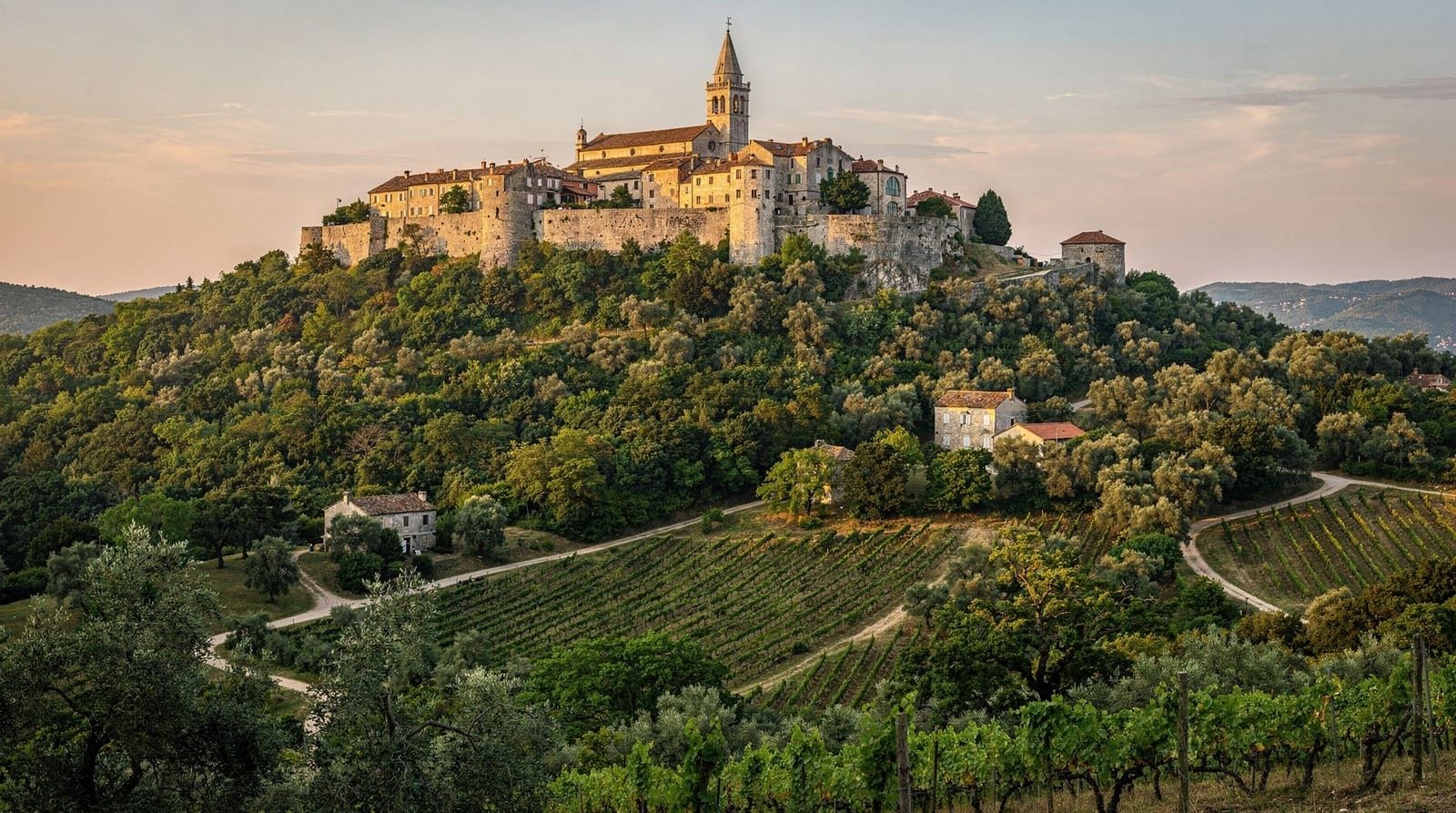
Buje is northern Istria’s finest medieval hilltop town — larger and more substantial than Motovun, with a 15th-century loggia, a baroque cathedral, a small archaeology museum, and a genuinely local atmosphere since tourism hasn’t reached it in significant numbers. The views from the town’s belvedere stretch across the northern Istrian interior and on clear days reach the sea.
Buje’s weekly market (Wednesday mornings) is an excellent source of local wine, olive oil, prosciutto, and cheese — more authentic and cheaper than anything sold in the coastal towns.
Savudrija Lighthouse
Croatia’s oldest lighthouse (1818) stands at Savudrija on the very tip of the Istrian peninsula — the westernmost point of Croatia. It’s 6 km north of Umag. The lighthouse was built under Napoleon and houses a keeper’s residence. The rocky shoreline around it has good swimming spots and is notably uncrowded. A pleasant half-day excursion from Umag by bicycle or car.
Slovenia Day Trip: Piran and Portorož
From Umag, the Slovenian coastal towns of Piran and Portorož are just 30 km north across the border. Piran is one of the most perfectly preserved Venetian towns on the Adriatic — arguably more elegant than most comparable Croatian towns — and for those with a car (or who can join a day tour), combining Umag with Piran is an excellent itinerary. No visa is required (both countries are in the Schengen Area); a passport or EU ID card is sufficient.
Cycling in Northern Istria from Umag
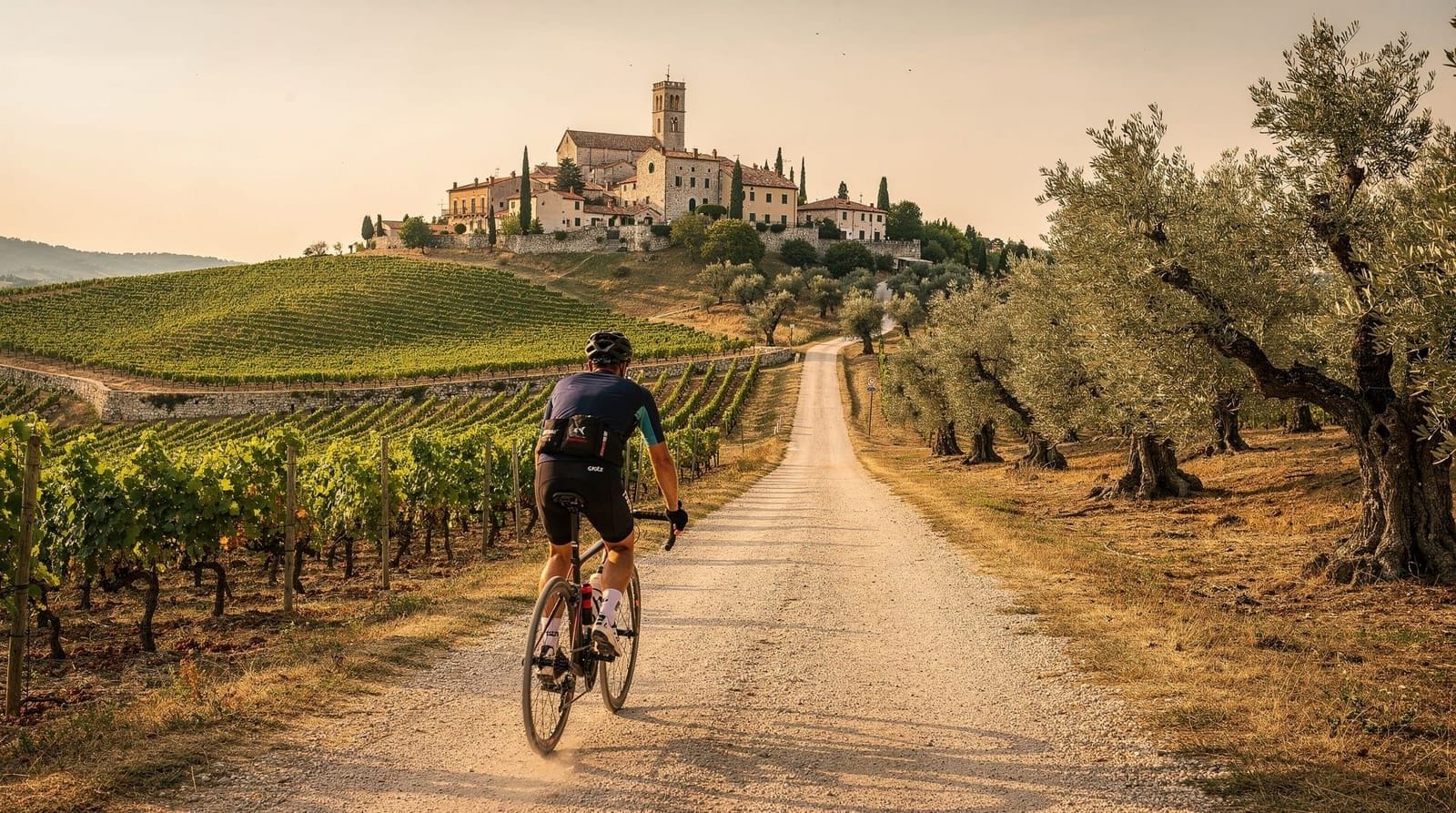
Umag is one of the entry points for the Parenzana, a cycling and walking route that follows the course of a narrow-gauge railway which ran from Trieste to Poreč between 1902 and 1935. The line was built to connect the scattered towns and villages of northern Istria with the broader rail network, carrying passengers, wine, olive oil, and stone through terrain that the standard roads handled poorly. It closed in 1935 and the tracks were eventually removed, but the route survived as a path through the landscape. Today the Parenzana is a 123-km dedicated cycling and walking trail running from the Slovenian border through northern Istria all the way to Poreč — passing through vineyards, olive groves, hilltop villages, and sections of restored tunnel and viaduct from the original railway infrastructure.
From Umag, two routes are immediately accessible. Heading east toward Buje is a 14-km ride with a gentle but steady climb into the hills — rewarding because it delivers you to the old town at the top with good reason to stop for wine and food before returning downhill. Heading south along the coast toward Novigrad is a flatter and easier 10-km ride, following the shore with views across the Adriatic and passing through a quieter stretch of Istrian coastline that sees relatively little traffic. Both are manageable on a basic hire bike, and neither requires specialist cycling experience.
Bicycle hire is available in Umag from several rental points in and around the town centre and the resort complexes. The Parenzana is marked with its own signage along the route. For those wanting more of the trail, the full route to Poreč is achievable over two days with an overnight in Novigrad or Poreč, making cycling in Istria a genuine multi-day itinerary with a historical narrative running through it.
Umag and the Italian Connection
Umag — known in Italian as Umago — has a history shaped as much by Italian culture and language as by Croatian. For much of the Venetian and Austro-Hungarian periods, the town’s population was predominantly Italian-speaking, and Italian remained the majority language through the early twentieth century. After World War II, Istria was transferred from Italy to Yugoslavia, and the years that followed saw the Istrian Exodus — a mass departure of the Italian and Istrian-Italian population from towns across the peninsula and the Kvarner region. In Umag and in towns across northern Istria, the community that had defined daily life for generations left largely within a few years of 1945, many settling in Trieste, Venice, and other parts of Italy. The towns they left behind were noticeably emptier for years afterward.
Today, the Italian community in Umag numbers in the hundreds rather than the thousands it once was, but it maintains a visible and living presence. Community institutions exist, the language is taught and spoken, and cultural events mark the calendar. Walk through the old town and the street signs are bilingual — Croatian and Italian in equal size and weight, not as a tourist gesture but as a legal recognition of the community’s status. The dual naming runs through the town’s self-understanding in ways that go beyond signage: the surnames you see, the languages you hear at café tables, the sense that this town faces both east and west without fully choosing between them.
This dual identity gives Umag a character distinct from other Croatian coastal towns. It is not Italian, and it is not simply Croatian — it occupies the kind of layered cultural position that centuries of border history tend to produce, and which can be genuinely interesting to notice once you’re looking for it.
Beaches near Umag
Finida Beach (south of Umag): A pebbly beach in a pine-wooded bay, popular with campers and resort guests. Clean water, good facilities.
Stella Maris Beach: Adjacent to the tennis complex, a reasonable pebble beach with typical resort facilities.
Katoro Bay: The main campsite and beach resort north of Umag — a long pebbly bay popular with families and naturists (there’s a naturist section).
Savudrija: Rocky swimming near the lighthouse — wild and beautiful.
Where to stay in Umag
Falkensteiner Resort Falkensteiner: The largest and most polished resort complex near Umag — several hotels including a 5-star, extensive facilities, private beach. Popular with Austrian and German families.
Stella Maris Complex: Part of the Maistra hotel group, near the tennis centre. Good-quality mid-range option.
Old town apartments: A handful of private apartments in or near the historic centre, typically €50–€100/night in peak season. More character than the resort complexes.
Campsites: Several large campsites in the Umag area (including the naturist Solaris campsite) offer extensive facilities and good beachside positions.
Where to eat in Umag
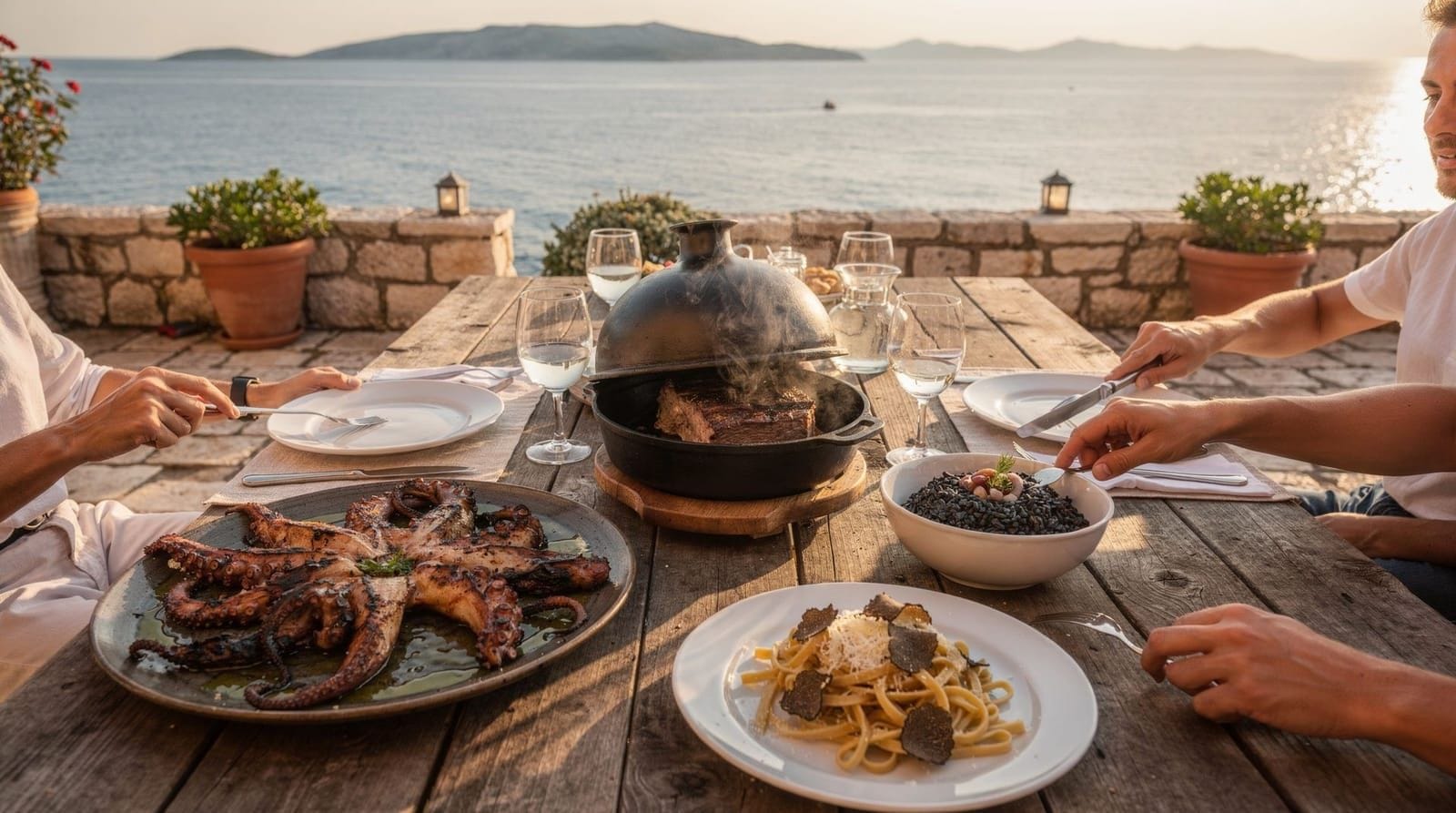
Konoba Baccio (Umag): One of the better traditional restaurants in town — fresh fish, pasta with truffles, good house wine. Honest and reasonably priced.
Restaurant Vitriol (Umag old town): Creative Mediterranean cooking with good wine. One of Umag’s more ambitious dining options.
Konoba Morgan (Buje): In the hilltop town inland, serving Istrian classics — pršut, Malvazija, grilled fish. An excellent reason to drive up to Buje for dinner.
Kabola Winery restaurant: Several wineries in the Buje area serve simple meals to complement their wines — prosciutto, cheese, homemade bread, seasonal dishes. Check individual winery websites for availability.
Best time to visit Umag
June: The best month for a relaxed Umag experience. Warm weather, swimmable sea (from mid-June), manageable crowds, and pre-tennis-tournament accommodation availability.
July: ATP Croatia Open takes place — exciting if you’re attending, but accommodation is premium-priced and scarce during tournament week. Rest of July is good beach weather.
August: Peak summer. Beaches busy, prices highest. Good for family resort holidays.
September: Excellent — warm sea, thinning crowds, wine harvest in the interior begins. A wonderful time to combine beach time with wine-country day trips.
October: Truffle season begins. Quieter coast, but inland excursions to Motovun and Buje are in full swing. Many coastal restaurants close mid-month.
Top experiences
Bookable activities with verified prices and instant confirmation on GetYourGuide.
Top-rated experiences in Umag travel guide
Best-rated activities across GetYourGuide and Viator.