Motovun travel guide
Visit Motovun: Istria's most famous hilltop town, white truffle hunting in the Mirna Valley, Malvazija wine tastings, and the Motovun Film Festival.
Motovun: Truffle hunting private experience in Istria
Quick facts
- Best time
- September–November (truffle season); June also excellent
- Days needed
- 1 day (day trip) or overnight
- Getting there
- Car from Poreč (48 km, 50 min) or Rovinj (55 km, 1 h)
- Budget per day
- €55–€130
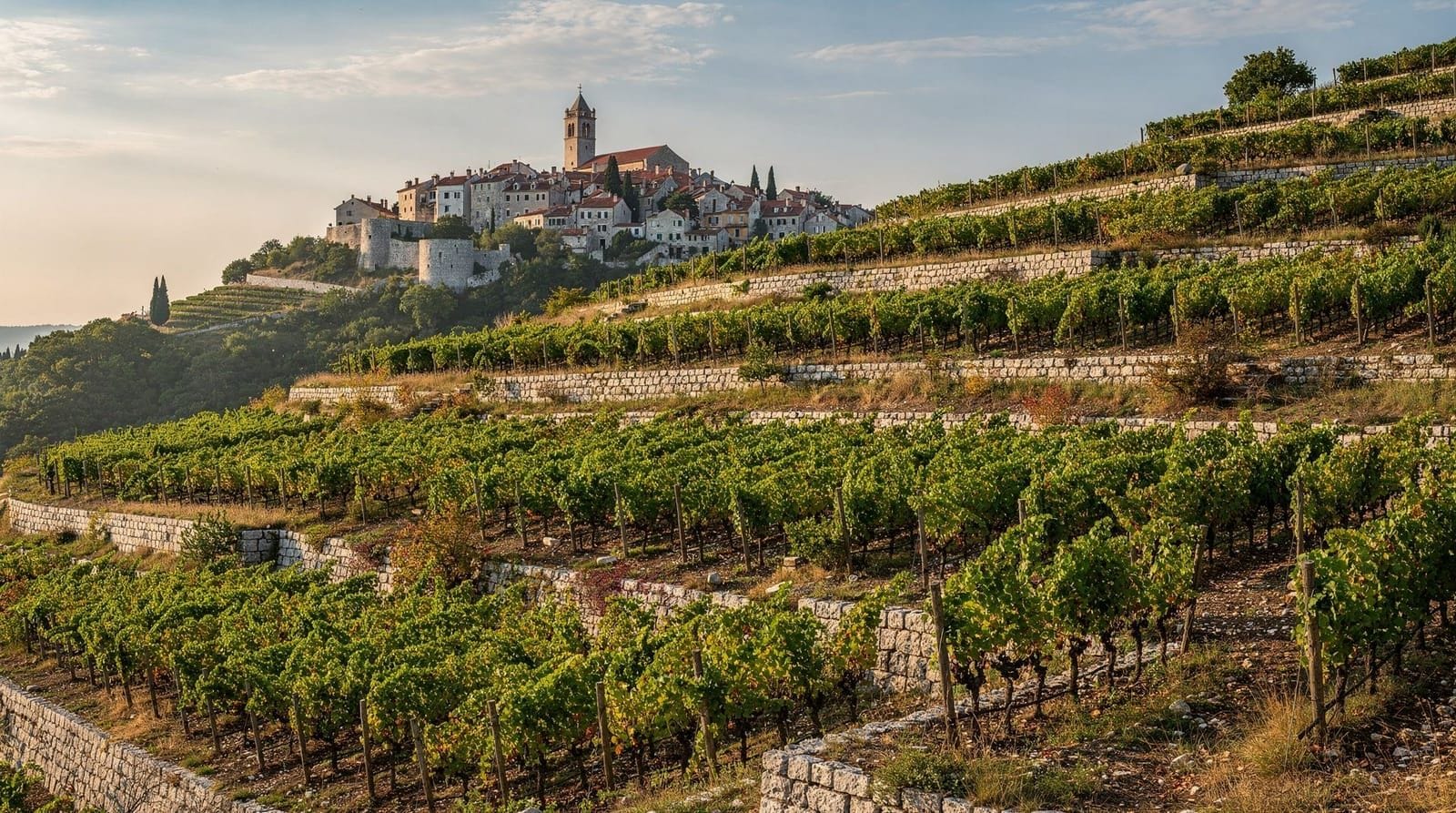
Motovun rises from the Mirna Valley on a 277-metre limestone hill, its medieval town walls visible for kilometres across the Istrian interior. It is simultaneously Istria’s most recognisable skyline and the epicentre of one of the world’s great culinary treasures: the Istrian white truffle (Tuber magnatum Pico), which grows in the forests of the Mirna Valley below and has defeated its Italian competition in multiple international blind tastings.
At its heart, Motovun is a small medieval town — a Venetian-era gateway, a Romanesque church, a handful of streets of stone houses — that happens to sit on top of one of the most truffle-rich landscapes in Europe. The combination of dramatic scenery, extraordinary food culture, good wine, and a renowned summer film festival makes it one of the most rewarding destinations in inland Istria.
| Where | Mirna Valley, inland Istria |
| Cost | around €55–130/day; truffle tastings and tours add significantly more |
| Time needed | 1 day trip, or overnight for the empty-streets experience |
| Getting there | Car from Poreč (50 min) or Rovinj (1 hr); no train or ferry |
| Best time | September–November for white truffles; June for warm weather without crowds |
Getting to Motovun
Motovun is an inland destination — no ferry or train. A car is essentially required unless you join an organised tour.
By car from Poreč: 48 km, approximately 50 minutes via Višnjan. The approach road winds up the hill from the valley — park in the lower car park and take the shuttle bus or walk up to the town gate.
By car from Rovinj: 55 km, approximately 1 hour.
By car from Pula: 70 km, approximately 1 hour via Kanfanar.
By car from Zagreb: 165 km, approximately 2 hours on the A6/A7 motorway via Rijeka.
Organised tours: Numerous operators run truffle-hunting day tours from Poreč, Rovinj, Pula, and Opatija that include transport, making Motovun accessible without a car. These typically include the truffle hunt, cooking demonstration, and a truffle tasting lunch.
Note on parking: Cars cannot enter the walled town. Park in the main car park in the lower town (€2–€4/day) and walk or take the shuttle up. The walk takes about 15 minutes on an uphill road/path.
What to see and do in Motovun
The Medieval Town
Walking through the main Venetian gate (14th century) into Motovun’s old town, the sense of time compressed is immediate. The town is tiny — the complete circuit of the walls takes about 20–25 minutes — but the density of medieval architecture is impressive. The main square is dominated by the Romanesque-Gothic St Stephen’s Church (Crkva Svetog Stjepana), built in the 14th century and topped with a Baroque bell tower.
Motovun actually has two circuits of defensive walls, not one, and the distinction between them rewards a closer look. The lower circuit is Venetian, built in the 15th century when the town came under the rule of the Serenissima and was reinforced to withstand artillery. These outer walls are thicker and more military in character, with clearly visible constructional joints and the pragmatic geometry of Renaissance fortification. The inner, upper circuit is older — medieval in the strict sense, predating the Venetian period — and encloses the very crown of the hill where the church and the main square sit. Together they form a double ring of stone that made Motovun one of the best-defended towns in inland Istria.
On the main square stands the communal palace and loggia, which today serves as Motovun’s town hall. The loggia — an open arcaded structure in the Venetian style — was the civic centre of the medieval town, the place where laws were read, merchants traded, and local justice was administered. It remains one of the most photogenic spots in the upper town and is well preserved relative to similar loggias across Istria.
The best single thing to do in Motovun is walk the medieval town walls. The panoramic views from the ramparts across the Mirna Valley are extraordinary, but they vary considerably depending on which direction you face and what time of day you walk. To the west, the view opens toward the Istrian coast and, on a clear day, a faint silver line of the Adriatic. To the east the perspective is entirely different: the Mirna Valley unfolds into the deep Istrian interior, the river winding through forested hills toward Pazin and the karst plateau. To the south, the terrain drops away toward Pazin, the administrative capital of Istria, with the bare limestone ridges of the central karst visible behind it.
For photography and atmosphere, late afternoon is the best time to walk the wall circuit. When the sun comes from the west, the entire Mirna Valley glows golden, the forest canopy catches warm light, and the stone of the ramparts themselves takes on a deep amber tone. The circuit is open during daylight hours; a small fee applies.
Truffle Hunting in the Mirna Valley
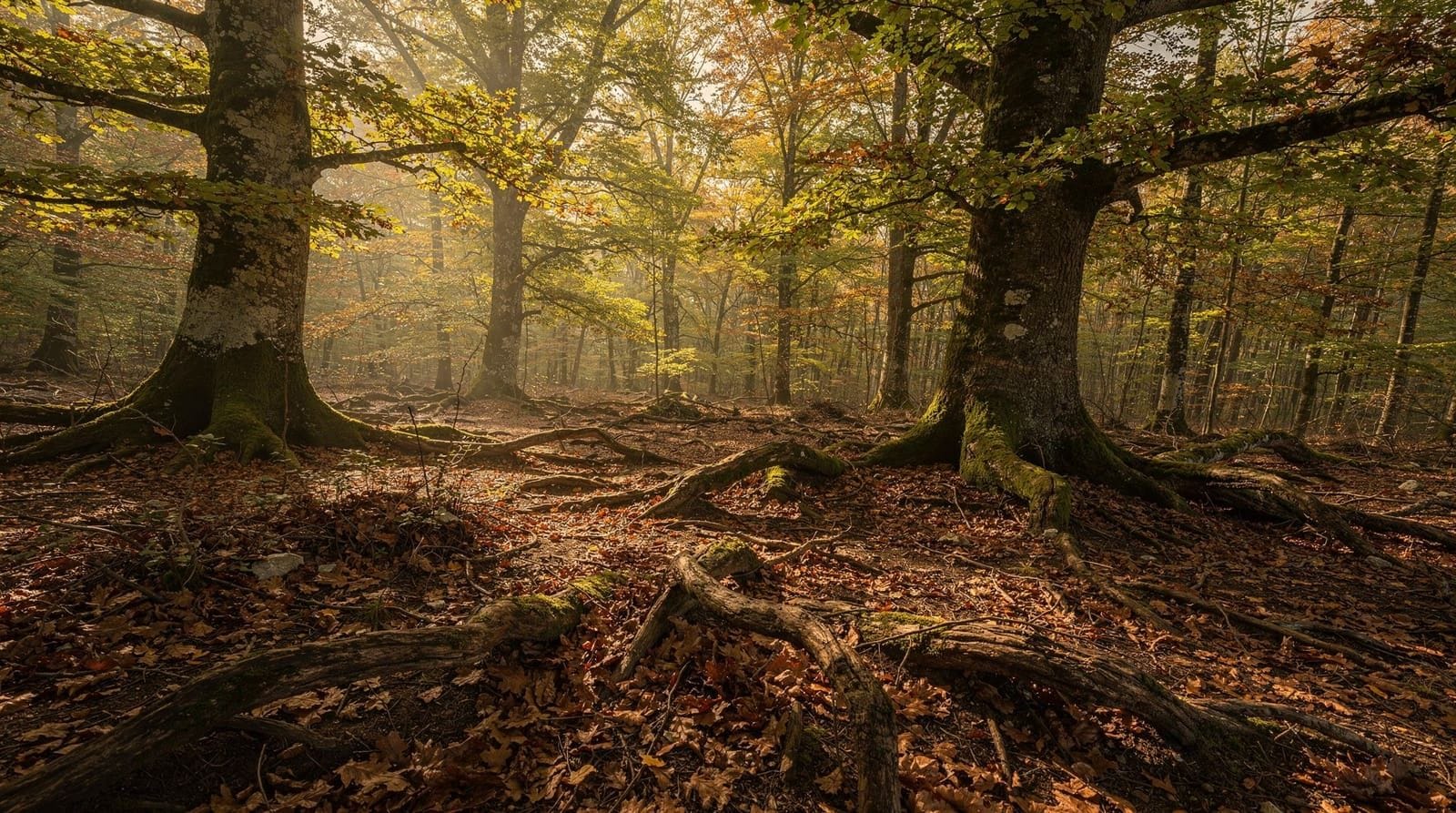
The forests around Motovun — particularly along the Mirna River — are among the richest truffle-producing areas in the world. Both black and white truffles grow here in the clay-rich soil beneath oak trees, but they differ fundamentally in timing, rarity, depth, and value.
Black truffles — principally Tuber aestivum (the summer truffle) and the more prized Tuber melanosporum (the Périgord-style winter black truffle) — are available across a much longer season and grow relatively close to the surface. They are far more common than their white counterpart and command correspondingly lower prices: typically €300–€600 per kilogram depending on the season and quality, which is already expensive by any culinary standard but modest compared to what follows.
White truffles — Tuber magnatum Pico, the same species celebrated in the Langhe of Piedmont and the hills around San Miniato in Tuscany — are something else entirely. They are rarer, more perishable, and require much more precise conditions to form. They grow deeper in the soil, typically 10–30 centimetres down, and their season in Istria runs from September through December with the peak in October and November. The price reflects their scarcity and the intensity of demand: at peak season, premium Istrian white truffles can fetch €3,000–€5,000 per kilogram on the fresh market, and in auction years the prices climb higher still.
Istria’s standing in the white truffle world was cemented in 1999, when hunter Giancarlo Zigante, working the forest near the village of Livade at the foot of Motovun hill, unearthed a single specimen weighing 1.31 kilograms — at the time the largest white truffle ever officially recorded, earning a place in the Guinness World Records. That find changed the perception of Istrian truffles internationally and gave birth to the Zigante Tartufi brand that now anchors the regional truffle economy. Beyond that single landmark, Istrian truffles have also defeated Italian competitors in the prestigious Sarawak World Truffle Competition, confirming that the Mirna Valley’s combination of oak forest, clay soil, and mild humid climate produces fungi that stand comparison with the most celebrated truffle-producing regions in the world.
A truffle hunt with an experienced hunter and a trained dog is one of the most memorable food experiences in Croatia — the dogs locate the buried fungi by scent, digging carefully at the hunter’s direction. Most truffle dogs used in Istria are Lagotto Romagnolo or local mixed breeds trained from an early age. The hunt is followed by a cooking demonstration and a tasting of truffle dishes with local wine.
Motovun Film Festival
Every July (usually late July), Motovun hosts one of Croatia’s most distinctive cultural events: the Motovun Film Festival, an independent film festival known for screening adventurous, non-mainstream cinema in outdoor venues within the medieval town walls. The combination of excellent films, a warm Istrian evening, local wine, and a medieval hilltop setting makes it genuinely special. The festival runs for 5–6 days and attracts around 100,000 visitors despite the town’s tiny size — accommodation books out months ahead.
Malvazija and Teran Wine Tastings
Istria’s winemaking culture is excellent by any European standard. Motovun sits in the heart of Malvazija Istarska country — the dry, aromatic white wine that accompanies almost every meal in Istria. Teran is the other indigenous variety of note, and it deserves equal attention from anyone spending more than a day in the region.
Teran is one of the oldest grape varieties in Croatia, its cultivation in the Istrian karst and red-soil valleys going back at least to Roman times. It produces dark, deeply coloured red wines with high natural acidity, pronounced tannin, and an earthy, mineral character that reflects the iron-rich red soil — called terra rossa — in which it grows. The wines are rustic by design: not polished or internationally smooth but vivid and specific to this landscape. Teran pairs naturally with the most intensely flavoured components of Istrian cuisine — above all with the pungent, cured Istrian pršut (prosciutto), where the wine’s acidity cuts through the fat and amplifies the meat. While most Istrian seafood calls for Malvazija, a Teran is the correct partner for anything off the land.
Several small producers around Motovun and the nearby village of Oprtalj make excellent Teran, and tasting them side by side with a well-made Malvazija gives a complete picture of what Istrian viticulture can do. Wine tastings are available at many of the agritourism properties in the valley, and a number of producers in the upper town accept visits with advance notice.
Livade: The Truffle Capital Below Motovun
At the base of the Motovun hill, in the flat floor of the Mirna Valley, sits the small village of Livade. By population it is barely a hamlet — a cluster of stone buildings, a bridge over the river, surrounding farmland and oak forest. But Livade has an outsized significance in the world of Istrian truffles and is worth visiting in its own right.
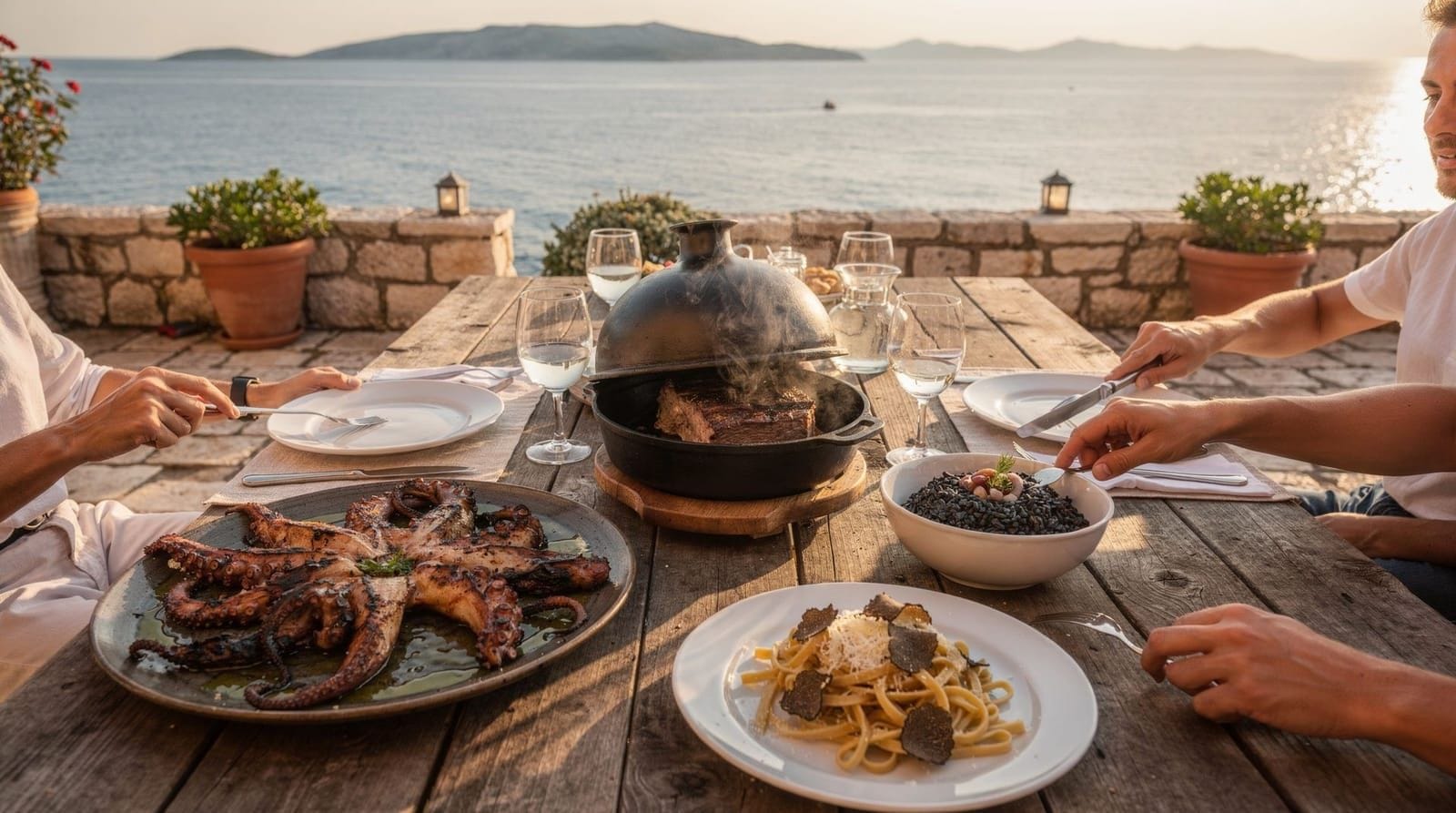
The village is home to Zigante Tartufi, the company founded by Giancarlo Zigante following his 1999 record truffle find. What began as a family truffle operation has grown into the largest truffle company in Istria, encompassing a substantial restaurant, a well-stocked retail shop, and a wine cellar. The restaurant serves truffle cuisine at the highest local standard — white truffle pasta in season, black truffle risotto year-round, truffle-shaved meat and egg dishes — in a large, comfortable dining room that fills quickly in peak season. Reservations are strongly recommended from September onward.
The Zigante shop is worth visiting even outside truffle season. It stocks the full range of truffle-based products produced by the company: truffle oils, truffle paste, truffle-infused honey, truffle-flavoured salt, truffle-aged cheese, and an extensive selection of Istrian wines. Many of these products are available for tasting in-store, and the staff are knowledgeable about the differences between product types and the seasonal variations in fresh truffle quality. It functions as both a quality delicatessen and a useful introduction to the world of preserved truffle products for visitors who want to take something home.
Livade is also the site of the annual Tartufijada truffle fair, which takes place each October when the white truffle season reaches its peak intensity. The festival draws visitors from across Croatia and from the wider European truffle-enthusiast community, with market stalls, fresh truffles for sale, local food and wine, and the unmistakable scent of fresh fungi in the autumn air.
Where to stay in Motovun
Most visitors come on day trips, but overnight stays allow you to experience the town at its most magical — empty streets in the early morning and late evening, with the valley fog sometimes filling the landscape below.
Hotel Kaštel: The only hotel within the walled town — 33 rooms, a pool with exceptional views, and a restaurant. Rates from €120–€250/night in peak season. Must book ahead.
Agritourism and guesthouses in the valley: Several agriturismo-style guesthouses in the Mirna Valley below Motovun offer comfortable rooms with farm breakfasts, good wine, and a rural Istrian experience. Rates from €60–€100/night.
Where to eat in Motovun and nearby
Restaurant Zigante Tartufi (Livade): The temple of Istrian truffle cuisine — a large, polished restaurant in the village below Motovun. White truffle pasta, black truffle risotto, truffle-shaved dishes. Expensive but consistently excellent. The world-record truffle was found near here in 1999.
Konoba Montana (Motovun): In the upper town, serving Istrian classics — pršut, fuži pasta with truffles, local wine. Reliable, reasonably priced for the location.
Restaurant Pod Voltom (Motovun): Under the main arch of the town gate — a convenient and atmospheric spot for lunch after the wall walk.
Konoba Vrh (Vrh, near Motovun): A rural konoba in a tiny village that serves peka dishes and homemade wine to those who find it. Utterly authentic, very cheap, requires a car.
Best time to visit Motovun
September–November: The prime season for white truffle hunting — the most exciting time to be here. October is particularly good: the Tartufijada (truffle fair) in Livade typically takes place in mid-October, when the scent of truffles fills the air and market stalls overflow with fresh specimens.
July: Film festival time. Book early and expect crowds.
June: Warm weather, green valley, full facilities. Fewer tourists than summer. A very pleasant time to visit.
April–May: The valley is beautiful in spring. Truffle season (black) is ongoing. Fewer tourist services but the town itself is lovely.
December–February: Quiet, cold, sometimes foggy. The valley can look extraordinary in winter mist. A few restaurants open on weekends; most tourist infrastructure closed.
Combining Motovun with the rest of Istria
Motovun works best as one stop on a wider Istrian itinerary rather than a standalone destination, since it has no ferry or train and limited accommodation. Most visitors base themselves on the coast — Rovinj, Poreč, or Pula — and drive inland for a day or overnight. The day trips from Rovinj guide covers timing this alongside Rovinj’s old town, and cycling Istria is a genuinely good way to see the hill towns of the Mirna Valley at a slower pace if you have more than a day. For the fuller context on Istria’s truffle economy and wine regions beyond what fits in a single visit, see the Istrian truffles guide and the Istrian Malvazija guide.
Frequently asked questions
Is Motovun worth visiting outside truffle season? Yes. The medieval town, the wall walk, and the valley views are worth seeing year-round, and June in particular offers warm weather with far fewer visitors than the autumn truffle rush. Black truffles are also available for a longer season than white, so a truffle experience is possible outside September–November, just with a different (and cheaper) truffle.
Do I need a car to visit Motovun? Effectively yes, unless you join an organised truffle-hunting tour from the coast. There is no train or ferry access, and public bus connections from Poreč, Rovinj or Pula are limited and inconvenient for a day trip. Most visitors either self-drive or book a tour that includes transport.
Top experiences
Bookable activities with verified prices and instant confirmation on GetYourGuide.
Top-rated experiences in Motovun travel guide
Best-rated activities across GetYourGuide and Viator.