Istrian truffles: everything you need to know about Croatia's finest fungi
Motovun: Truffle hunting private experience in Istria
Are Istrian truffles really as good as Italian ones?
Yes. The white truffles (Tuber magnatum pico) found in the forests around Motovun, Buzet, and Oprtalj are botanically identical to Alba truffles. They grow in the same limestone karst terrain, respond to the same climate conditions, and develop the same intensely aromatic, garlicky, honeyed scent. A 1.31 kg specimen found near Motovun in 1999 set the Guinness World Record for the largest white truffle ever found. The difference is marketing: Italy has built a global brand around Alba; Istria has not. The truffles are equivalent.
In brief: Istria produces white and black truffles of world-class quality from forests harvested since the 1930s. The white truffle season (October-January) is when Istria reaches its culinary peak: shaved raw over egg pasta in a Motovun konoba with a glass of malvazija, it is one of the genuinely transcendent food experiences in Europe. This guide covers how to find the best of it.
| Where | Motovun–Buzet–Oprtalj triangle, inland Istria |
| White truffle season | Late September–January, peaks Oct–Nov |
| Black truffle season | October–March (melanosporum), year-round (aestivum) |
| Hunting tour cost | around EUR 60–160/person |
| Getting there | 45–70 min drive from Rovinj/Poreč; car recommended |
Why Istrian truffles deserve their reputation
In 1999, a truffle hunter named Giancarlo Zigante and his dog Diana found a white truffle near Motovun weighing 1.31 kilograms. It was certified by the Guinness Book of Records as the largest white truffle ever found. Zigante, who had already been one of Croatia’s most prominent truffle figures for years, used the attention to launch a brand — Zigante Tartufi — that became the most internationally recognized name in Istrian truffles. The record specimen itself was eaten at a banquet for 100 people.
The significance of that record goes beyond the number. It demonstrated what truffle hunters in the Mirna River valley had known for decades: the forests around Motovun, Buzet, and Oprtalj are among the most productive truffle grounds in the world. The limestone karst geology, the river moisture, the specific mix of oak, hornbeam, and hazel, and the continental-Mediterranean climate produce conditions that Tuber magnatum pico — the white truffle — particularly loves.
Italy has the better marketing. Istria has the equivalent product at lower prices, fewer crowds, and in a landscape that is arguably more beautiful.
The two truffles of Istria
White truffle (Tuber magnatum pico)
The white truffle is the most valuable fungus on earth by weight. In peak season, a kilogram sells wholesale for EUR 2,000–4,000; exceptional specimens in good years can push beyond that. Individual restaurant plates featuring 5–8 grams of freshly shaved white truffle cost EUR 30–60 in Motovun and Buzet — the same dish in Alba runs EUR 60–100.
The white truffle’s extraordinary value derives from a few facts:
It cannot be cultivated. Unlike black truffles, which can be coaxed to grow on inoculated oak roots in managed orchards, Tuber magnatum pico has never been successfully farmed. Every white truffle that reaches a kitchen was found in the wild by a dog and its handler.
It is intensely seasonal. The white truffle window is September through January at most, peaking in October and November. If weather conditions are wrong — too dry in summer, too warm in autumn — entire seasons produce almost nothing. A good year is a gift.
It cannot be cooked. The volatile aromatic compounds in white truffle — dozens of sulfur-based molecules — are destroyed by heat above about 70 degrees Celsius. White truffle is always served raw, shaved paper-thin directly over warm food at the moment of serving. The heat of the pasta releases the aromatics without cooking them. You cannot make a white truffle sauce, a white truffle oil (genuine white truffle oil is essentially impossible to produce commercially), or a white truffle ragout. Shaved and immediately served is the only method.
The aroma is the experience. Describing white truffle to someone who has never smelled one is like describing a color. The standard vocabulary: garlic, honey, dried mushrooms, damp earth, an almost animal muskiness. None of these individually captures it. Collectively they gesture toward something that no other food resembles.
Black truffle (Tuber melanosporum and Tuber aestivum)
Black truffles are different in every meaningful way from white. Tuber melanosporum (Perigord or winter black truffle) appears October through March and is the premium black variety — it has a genuine, complex truffle aroma that survives gentle cooking. Tuber aestivum (summer black or scorzone) is found year-round and is used in the truffle pastes, truffle butters, and truffle cheeses sold throughout Istria. Its flavor is milder and more variable.
Black truffle is versatile where white is restrictive. You can shave it over pasta, stir it into butter for a sauce, slice it under the skin of a roast chicken, use it in a pate. The flavor intensifies with gentle heat (60–70 degrees Celsius). Restaurants use both forms: fresh Melanosporum shaved on top of dishes in season, Aestivum-based preparations in sauces and starters year-round.
Price for fresh black melanosporum: EUR 300–600/kg. Substantially more affordable than white and still genuinely excellent.
The truffle hunting experience
Truffle hunting in Istria is done with trained dogs — specifically, lagotto romagnolo breeds are most common, though any dog with a good nose can be trained. Pigs, traditionally used in France, are essentially absent in Istrian truffle culture.
A truffle dog is trained from puppyhood to find and indicate truffle locations without eating them — the handler calls the dog off immediately when it starts to dig and finishes the excavation carefully with a small pick. A good truffle dog will find multiple specimens on a 2-hour forest walk; a poor season or an inexperienced dog may produce nothing.
The forest experience itself has its own quality. The Mirna River valley at dawn in October — mist, oak forest, the sound of a dog moving through undergrowth — is the kind of thing that makes truffle hunting more than just a food activity. You are in a medieval landscape that has been hunted this way for centuries.
What to expect practically: most tours meet at a forest edge near Motovun or Buzet, brief you on the dog and the process, then walk for one to two hours at an easy pace, pausing whenever the dog signals a find. Wear sturdy shoes and clothes you don’t mind getting muddy — the forest floor is often damp, especially after the rain that triggers good truffle growth. Groups are usually kept small (4–10 people) since a large crowd disturbs the dog’s concentration and the forest itself. Children old enough to walk for an hour and stay reasonably quiet are generally welcome, and many families find it a genuine highlight rather than an adult-only activity.
Private truffle hunting experience
The most personal truffle experience: out with a single hunter and their dog on a private forest plot. The hunter explains the species, the geology, the technique. You dig out a specimen yourself. Afterward, a tasting of local truffle products and wine.
Hunting, cooking, and tasting combined
A more comprehensive experience combining the forest hunt with a cooking demonstration and tasting — the truffle you help find (or one from that day’s catch) becomes part of the meal:
Premium hunting with full 3-course menu
For those who want the complete truffle day: forest hunting in the morning, then a 3-course lunch built around fresh truffle with wine pairing. This is the version to book if you have one day in Istria and want the maximum experience:
Where to eat truffles in Istria
Motovun
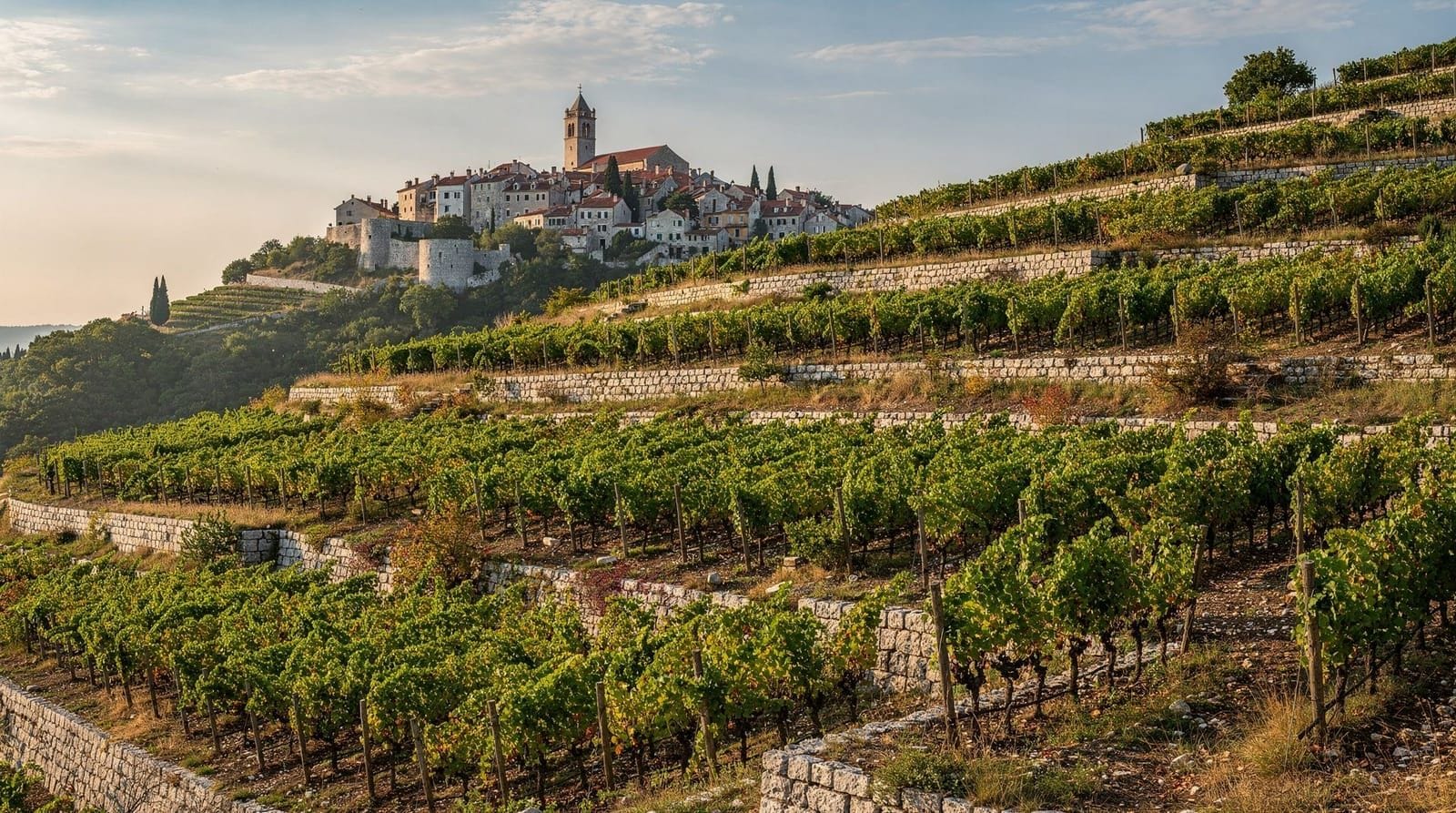
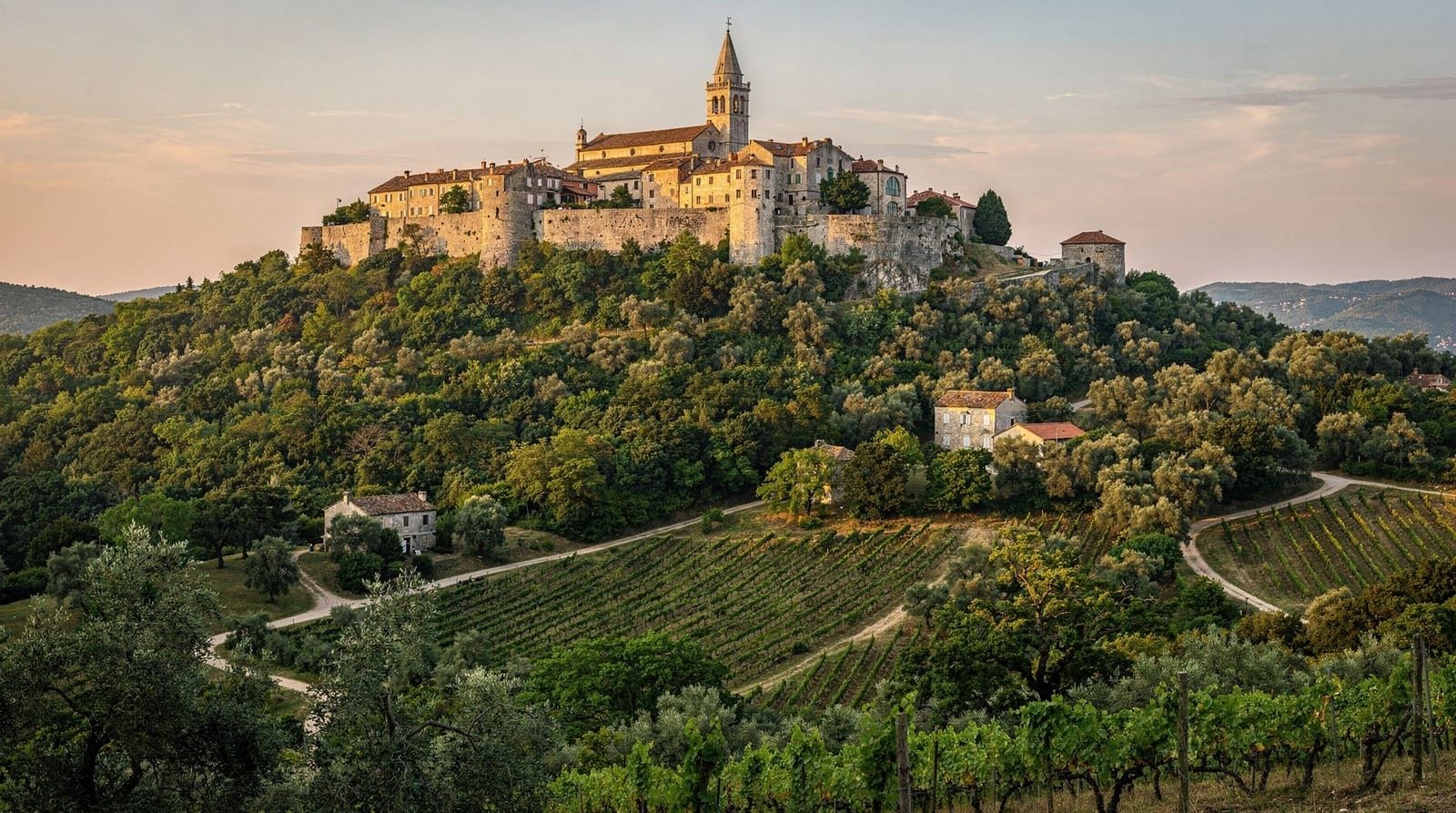
Motovun is the most dramatically situated truffle town — a walled hilltop village visible for 30 km across the Mirna valley. The town has about 500 permanent residents and several restaurants with serious truffle programs.
Konoba Barbakan (below the city walls, with a terrace overlooking the valley): family-run, straightforward menu built on seasonal ingredients. Fuzi s tartufima (fuzi pasta with truffle) is the canonical order. In white truffle season, the chef brings the whole truffle to the table for you to confirm before shaving. EUR 25–40 for a truffle pasta.
Restaurant Zigante (in Livade village, 4 km below Motovun, not in the town itself): the flagship restaurant of the Zigante Tartufi brand. More formal than typical Istrian restaurants, with an extensive truffle menu in all seasons — truffle risotto, truffle tagliata, truffle cheese plates. Reliable but expensive: EUR 40–80 per person.
Konoba Mondo (inside the Motovun walls): small, genuinely family-run konoba with excellent prsut, sheep’s milk cheese, and seasonal truffle dishes. The frittata s tartufima (truffle omelette) is their signature. EUR 20–35 per person.
Buzet
Buzet is called the “truffle capital” of Istria — it is the center of the wholesale truffle trade, where hunters sell to dealers who then supply restaurants throughout Croatia and export to Italy, France, and Germany. The town itself is less picturesque than Motovun but the truffle connection is deeper.
Restaurant San Rocco (in Brtonigla, near Buzet): regularly cited as one of the best restaurants in Istria. The truffle menu is serious — white truffle season produces extraordinary plates here, with a wine list that leans heavily on Istrian and Slovenian wines. Reservation essential; expect EUR 50–80 per person.
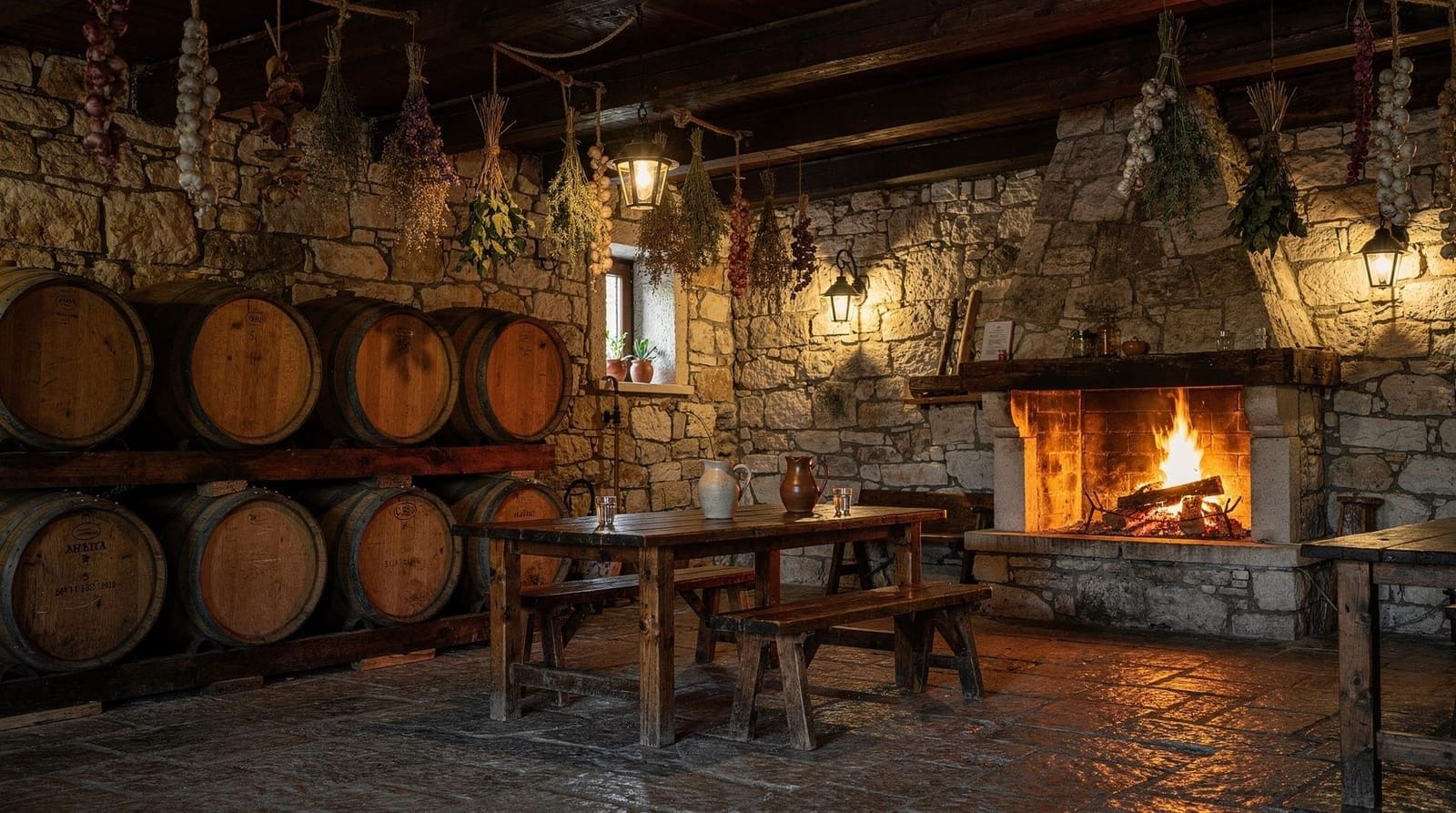
Stari Podrum (Buzet town center): historic wine cellar restaurant, excellent selection of truffle preparations year-round. Good teran wine to pair with black truffle dishes.
Oprtalj (Portole)
The least-visited of the truffle triangle towns, Oprtalj is a nearly abandoned medieval village where the truffle forests begin just outside the walls. Konoba Oprtalj serves local hunters and the handful of visitors who find their way here — uncomplicated truffle dishes, house wine, prices that reflect the lack of tourist markup. Worth the effort.
Rovinj and the coast
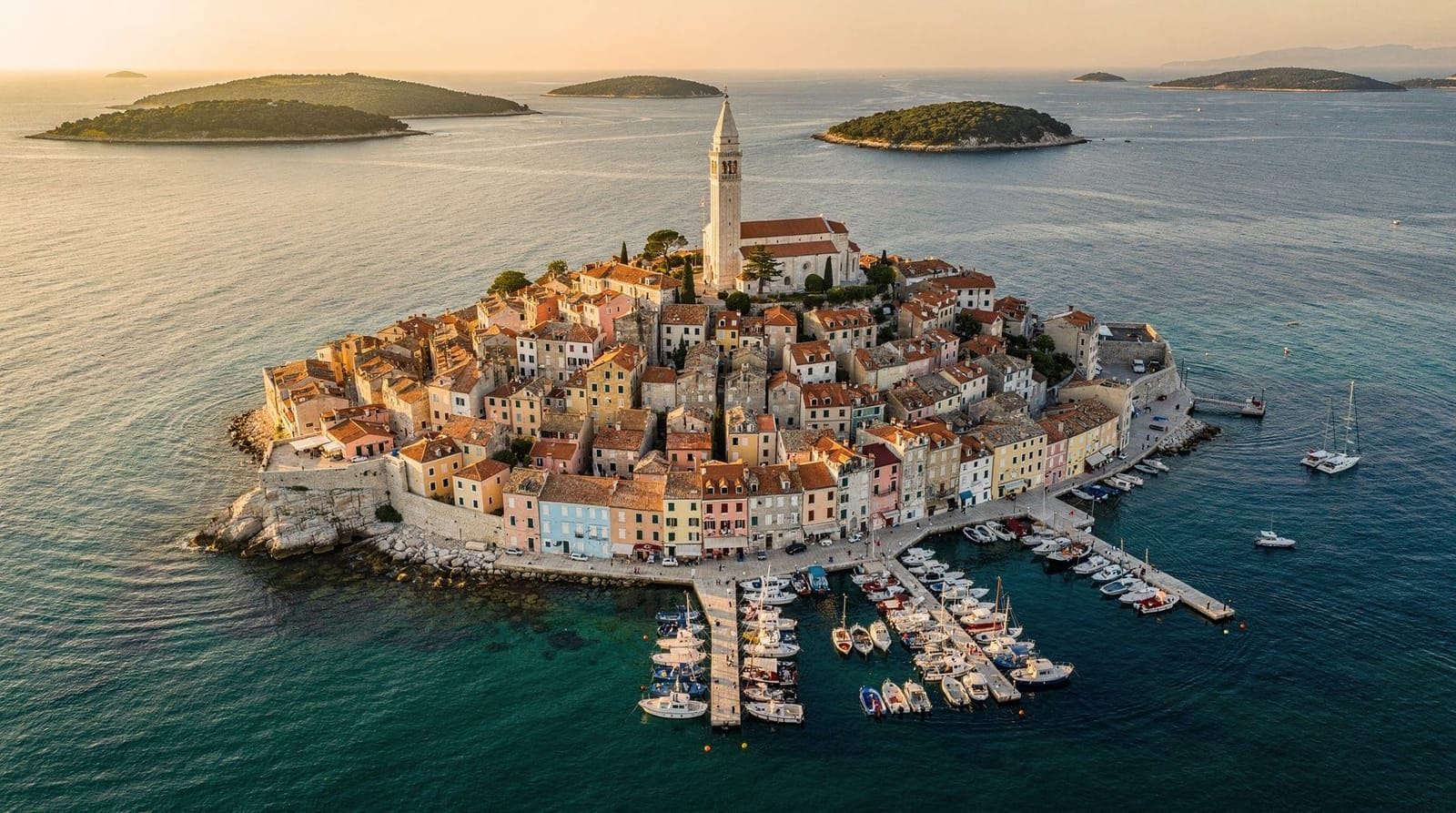
Coastal towns serve Istrian truffles in more polished settings. In Rovinj, restaurants like La Puntuleina (terrace over the sea, sophisticated truffle pasta and risotto) and Monte (the reference fine-dining restaurant, starred, truffle menu October-January) bring the inland product to the coast. Prices are 20–30% higher than inland for the same quality of truffle dish.
Buying truffles and truffle products
Zigante Tartufi (Livade and multiple outlets)
The most visible truffle brand in Istria, with a shop in Livade (open year-round), a shop in Motovun, and outlets in Rovinj and Pula. Fresh truffles in season, plus a comprehensive range of truffle products: paste (crema di tartufo — useful and genuine), truffle honey (miele al tartufo, good with cheese), truffle salt, truffle carpaccio in oil, and various infused oils. Product quality is consistent and reliable.
The Livade shop also functions as the Zigante restaurant entrance — you can buy products and proceed to the restaurant for a full meal.
Market vendors in Motovun and Buzet
During season, private truffle hunters sell fresh truffles from cooler bags in the Motovun main square and at the Buzet weekly market (Thursday mornings). These are often recently harvested specimens at prices below those at Zigante. The catch: you need to assess quality yourself. Fresh white truffle should have an intense, unambiguous aroma — if you cannot smell it clearly from 30 cm away, it is past its best. Black truffle should feel firm when pressed lightly, not spongy.
Small portions (5–10 grams of white truffle for EUR 20–40) are often available for immediate use — buy them and take them to a restaurant or apartment for your own preparation. Some konobas near Motovun and Buzet will happily shave a truffle you’ve bought elsewhere over their pasta for a small corkage-style fee, which is a good way to combine market bargaining with restaurant convenience if you want to control what you spend on the truffle itself.
Truffle products to bring home
Truffle paste (crema di tartufo): The most practical souvenir. Blended black truffle with olive oil — genuine products list Tuber melanosporum or aestivum first in the ingredients. Mix with butter and toss with fresh pasta. A 90g jar costs EUR 8–15 and lasts 12–18 months.
Truffle honey: Acacia honey infused with black truffle. Excellent with hard cheeses — Pag cheese (paski sir) and truffle honey is one of the better simple combinations in Croatian food. EUR 10–15 per jar.
Truffle oil: Only buy oil that lists actual truffle in the ingredients (Tuber melanosporum, Tuber aestivum, or Tuber magnatum). If the ingredient list shows “natural truffle aroma” or “truffle flavor,” it is synthetic. Zigante’s own truffle oil uses actual truffle extract.
Truffle cheese: Semi-hard cheese with black truffle veins. Reasonably good; vacuum-seal it for transport. Available at Zigante and at the market vendors.
Dry truffles: Sliced dried black truffle reconstituted in water — significantly reduced aroma compared to fresh but a fraction of the price. Useful for home cooking in sauces where fresh truffle is not available.
The truffle and wine pairing
Truffle and Istrian malvazija is the regional combination — the wine’s herbaceous, slightly mineral character supports white truffle without competing with it. A good malvazija from Kozlovic, Matosevic, or Clai Bijeli served at 10–12 degrees Celsius alongside a plate of fuzi in white truffle is one of Croatia’s definitive food experiences.
For black truffle with pasta or risotto, teran — the tannic, acidic Istrian red made from the Refosco dal Peduncolo Rosso grape — is the classic pairing. Buzet’s Kabola winery makes a widely praised teran; the wine’s earthy character echoes the truffle without obscuring it.
More on Istrian wine: Istrian malvazija guide.
Practical information for the truffle triangle
Getting there: Motovun is 38 km from Porec (45 min) and 40 km from Rovinj (50 min). Buzet is further east, 60 km from Rovinj (70 min). A rental car is essentially required — public transport between these inland villages is minimal. The roads through the Mirna valley are narrow but scenic and easy to drive.
Best base: Rovinj is the most beautiful base for exploring the truffle triangle, with excellent restaurants and accommodation across all budgets. Porec is more affordable. Staying in Motovun itself (a handful of small hotels and apartments in the hilltop village) is worth it for one or two nights in truffle season — waking up above the mist in the valley with the truffle forests below is a particular experience.
Booking restaurants in truffle season: The best Motovun and Buzet restaurants fill up weeks in advance in October and November. Book by email or phone at least 2–3 weeks ahead for peak truffle weekends.
Combining with other Istria highlights: A Motovun truffle day pairs naturally with the Istria-Zagreb-Slovenia circuit. From the truffle triangle, Plitvice Lakes is 2.5 hours east, Ljubljana is 2 hours northeast, and Porec and Rovinj are 45–60 minutes west.
Is a truffle day worth building your Istria trip around?
For food-focused travellers, yes, without much hesitation — nothing else in Croatia matches the truffle-and-Malvazija pairing for sheer sensory intensity, and the forest hunt itself is a genuine experience rather than a staged photo opportunity. For travellers without a strong interest in food, a single guided hunting-and-tasting experience is still worth the half-day detour from the coast, but building a multi-day itinerary around truffles specifically only makes sense in season (late September through January) and for those willing to prioritise it over beach time, since the truffle triangle has no coastline of its own. Comparing the wider region helps calibrate expectations: the Istria vs Dalmatia guide is useful if you’re deciding how many days the whole peninsula deserves relative to the islands and walled cities further south.
Frequently asked questions about Istrian truffles
When is the best time to find white truffles in Istria?
White truffles (Tuber magnatum pico) are found from late September through January, peaking in October and November. Rain followed by warm days accelerates their development. The season is unpredictable: a dry autumn can produce almost nothing; a wet autumn with mild temperatures can yield record quantities. If white truffles are your primary reason for visiting Istria, come in October or November and check with local truffle houses before booking if the season is unclear.What is the difference between white and black Istrian truffles?
White truffle (Tuber magnatum pico): seasonal (September-January), intensely aromatic, never cooked. Always shaved raw over warm food at the last moment since heat destroys the volatile compounds responsible for the scent. Price in good years: EUR 2,000-4,000 per kg. Black truffle (Tuber melanosporum): found October-March, more robust, benefits from gentle heat, used in sauces, butters, and pastes. Price: EUR 300-600 per kg. Black summer truffle (Tuber aestivum): available year-round, milder flavor, much cheaper, used in lower-end truffle products.What do Istrian truffles taste like?
White truffle has an aroma far more than a taste — the experience is primarily olfactory. The scent is intensely savory, with notes of garlic, dried mushrooms, honey, and an almost animal quality. On warm pasta, heat releases the volatile aromatics and they fill the entire space. Eating properly shaved white truffle over fresh egg tagliatelle with butter is a sensory experience unlike any other food. Black truffle has a more conventional earthy, mushroom flavor that survives heat and is more versatile in cooking.How much does a truffle hunting tour cost in Istria?
Tours run EUR 60-160 per person depending on duration, group size, and inclusions. A basic hunting experience with dogs in the forest and a tasting of truffle products costs around EUR 60-80. More elaborate experiences — hunting followed by a 3-course truffle menu with wine pairing — run EUR 120-160. Private experiences with a truffle hunter and their dog on a small forest plot cost EUR 100-200 for a group. Tours listed below include the full range.Can I buy fresh truffles to take home from Istria?
Yes. Fresh truffles travel well when properly wrapped in dry paper, placed in a sealed container, and kept refrigerated. White truffles at their peak are best consumed within 5-7 days of harvesting; black truffles last 2-3 weeks refrigerated. Zigante Tartufi in Livade and shops in Motovun sell fresh truffles during season. Truffle paste, truffle oil, and truffle honey in jars travel without refrigeration and last 12-18 months. When buying truffle oil, check the label: genuine truffle oil lists Tuber melanosporum or Tuber magnatum in the ingredients; most commercial truffle oil uses a synthetic compound that mimics the aroma but is not actual truffle.What are the best truffle festivals in Istria?
The Zigante Truffle Days festival runs each October in Livade (near Motovun), with hunting demonstrations, cooking demonstrations, and tastings of truffle dishes and local wine. The Buzet Subotina festival (first Saturday of September) celebrates the start of truffle season with a giant truffle omelette cooked in the town square — usually 2,000 eggs and several kilograms of truffles — with free wine and music. The Istrian truffle season runs September through January with festivals throughout.Do I need to go inland to experience Istrian truffles?
For the actual forest experience: yes. The truffle triangle is roughly defined by Motovun, Buzet, and Oprtalj in the central-northern interior. The forests here — predominantly oak, hornbeam, and hazel along the Mirna River valley — produce both white and black truffles. Coastal towns (Rovinj, Porec, Pula) do not produce truffles but their restaurants serve them. To experience the forest and the hunting ritual, you need to go inland. It is a 45-60 minute drive from Rovinj or Porec.
Top experiences
Bookable activities with verified prices and instant confirmation on GetYourGuide.
Top experiences
Best-rated activities across GetYourGuide and Viator.

Krka National Park Tour with tour Guide & Wine tasting from Split & Trogir
- Viator

Dolphin Watching & Sunset Boat Tour With Drinks & optional Dinner
- Viator

Fantastic DOLPHIN & SUNSET TOUR with dinner ( Pula-NP BRIJUNI )
- Viator

Dubrovnik Guided Group Tour with Ston Oyster tasting from Split & Trogir
- Viator

Zadar Highlights: Old Town, Sea Organ & Local Tastings
- Viator

Zadar: Luxury Island Boat Tour, Snorkeling & Unlimited Wine
- Viator