Malvazija Istarska and Teran — Istria's Two Great Wines
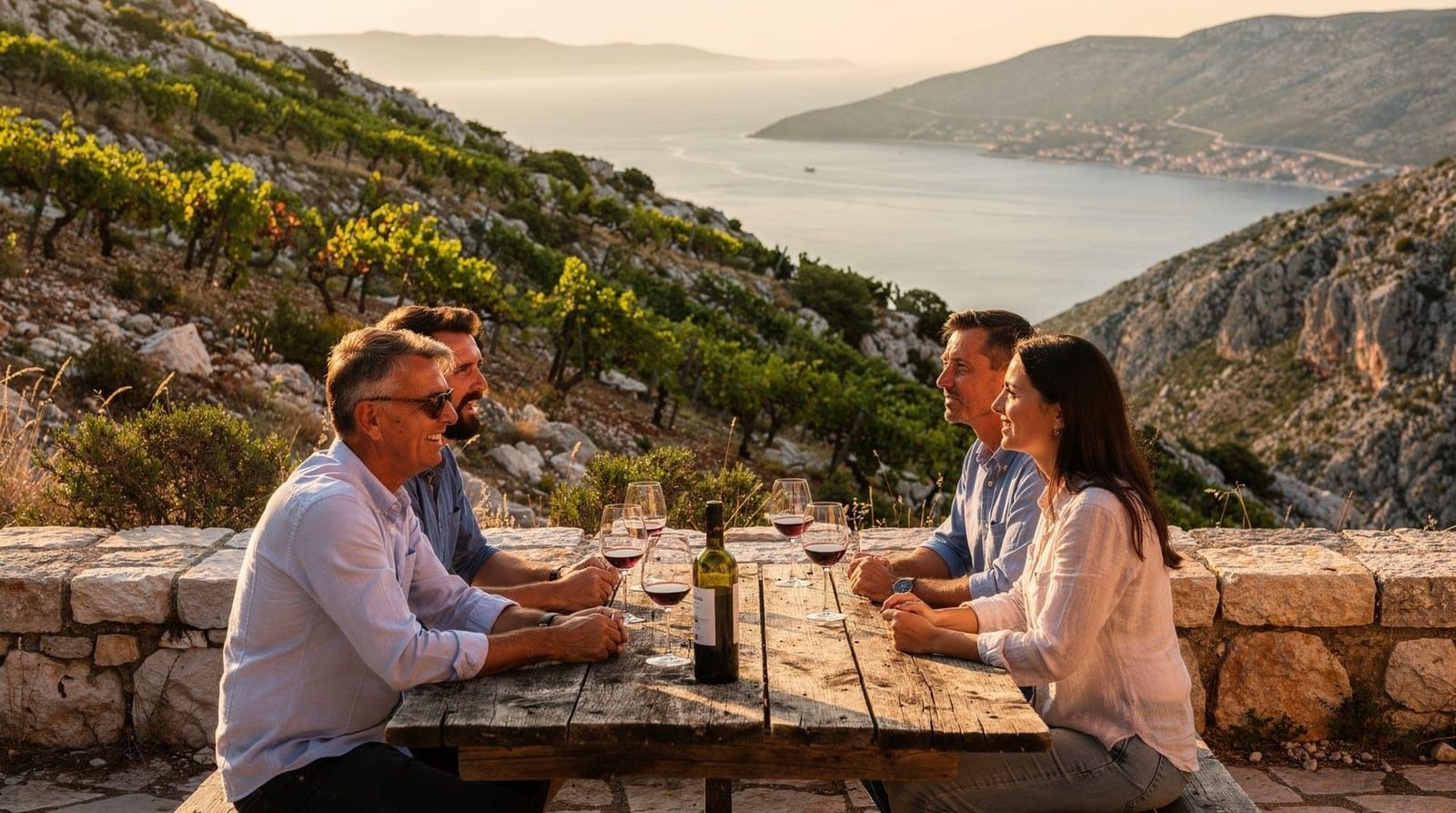
Split: Vineyard wine tasting experience with a sea view
What is Malvazija Istarska and how does it taste?
Malvazija Istarska (Malvasia Istriana) is an indigenous white grape variety unique to the Istrian peninsula — it is not genetically related to other Malvazia or Malvasia varieties found elsewhere in the world. At its most typical, it produces wines with floral aromatics (acacia, elderflower), citrus and stone fruit (peach, apricot), and a distinctive mineral and slightly bitter finish. It is approachable and food-friendly in its standard unoaked form; more complex and textured when aged in amphora or old oak by natural wine producers. It is the most widely planted grape in Istria and the defining taste of the region.
Two grapes, one peninsula
| Where | Istrian interior — Motovun, Buzet, Momjan, Grožnjan, Buje |
| Cost | Cellar-door tastings around EUR 10–25/person; bottles around EUR 10–25 |
| Best time | May–October for open cellar doors; October–January adds truffle season |
| Booking | Larger estates walk-in friendly; small natural producers by appointment |
| Getting there | Self-drive is easiest; wine-tasting day tours run from the coast |
Istria produces two wines that are entirely different from each other and entirely unlike anything else in Croatia. Malvazija Istarska — the white — is the everyday wine of the peninsula: light, aromatic, mineral, drunk by the carafe at harbourside restaurants in Rovinj, served at lunch with grilled fish on sun-warmed terraces in Poreč, poured almost reflexively whenever a visitor sits down and asks what to drink.
Teran — the red — is something more confrontational. Dark, tannic, high in acid, earthily flavoured, grown in iron-red soil that stains the boots of anyone who walks through the vineyards, Teran demands food and attention. It is not a sipping wine. It is a wine for prosciutto, game, truffles and cold nights.
Together they define Istrian wine culture as completely as Plavac Mali defines Dalmatia. But where Dalmatia has one great red and several interesting whites, Istria has built an identity on the interplay between these two contrasting varieties — and increasingly on the producers who push both into unexpected territory with natural wine techniques, amphora ageing and minimal intervention.
Malvazija Istarska: the wine of everyday life and special occasions
What makes Malvazija Istarska distinctive
The first and most important thing to understand is that Malvazija Istarska is not related to any other Malvasia or Malvazija in the world. There are dozens of unrelated grape varieties carrying variants of the Malvasia name — in Madeira, Sicily, Slovenia, Sardinia, Friuli and elsewhere — and most share nothing but a name. Malvazija Istarska is genetically distinct, indigenous to the Istrian peninsula, and has been grown continuously here since at least the medieval period.
In its most typical expression — fresh, unoaked, bottled young — Malvazija Istarska has aromatics of white flowers (acacia, elderflower), fresh citrus (lemon, lime peel), peach and apricot. On the palate it is medium-bodied with moderate alcohol (12–13%), refreshing acidity, a slightly bitter almond note in the finish and a mineral quality that good versions carry from the limestone and marl soils of the Istrian terroir. It is approachable, versatile and genuinely delicious without requiring any particular expertise to appreciate.
This accessible version — what you will drink in almost every restaurant in Pula, Rovinj or Umag — represents the majority of Malvazija production. It is meant to be consumed young, within one to three years of harvest.
Malvazija at the other extreme
A growing number of producers have discovered that Malvazija Istarska, given time and unconventional techniques, can produce wines of considerably more complexity. Skin-contact Malvazija (so-called orange wine) — where the grape skins are left in contact with the juice during fermentation, extracting tannin, texture and additional aromatic compounds — produces amber-coloured, grippy wines that are polarising but fascinating. Some producers use clay amphora (terracotta vessels), following an ancient winemaking tradition revived by natural wine producers in Georgia and Friuli. Others use old oak barrels for partial or full fermentation, adding texture without dominant oak flavour.
The results range from excellent to experimental, but the best examples show that Malvazija has structural depth that the fresh, light version never hints at. These wines age beautifully — five to ten years for the best amphora or skin-contact versions — and develop honey, wax, dried apricot and complex mineral notes that rival good aged white Burgundy in their textural richness.
If you want to explore this style, look for Matošević’s Grimalda Bijela (amphora-fermented), Clai’s Ottocento Bijeli or Roxanich’s skin-contact expressions.
Malvazija wine routes and where to taste in Istria
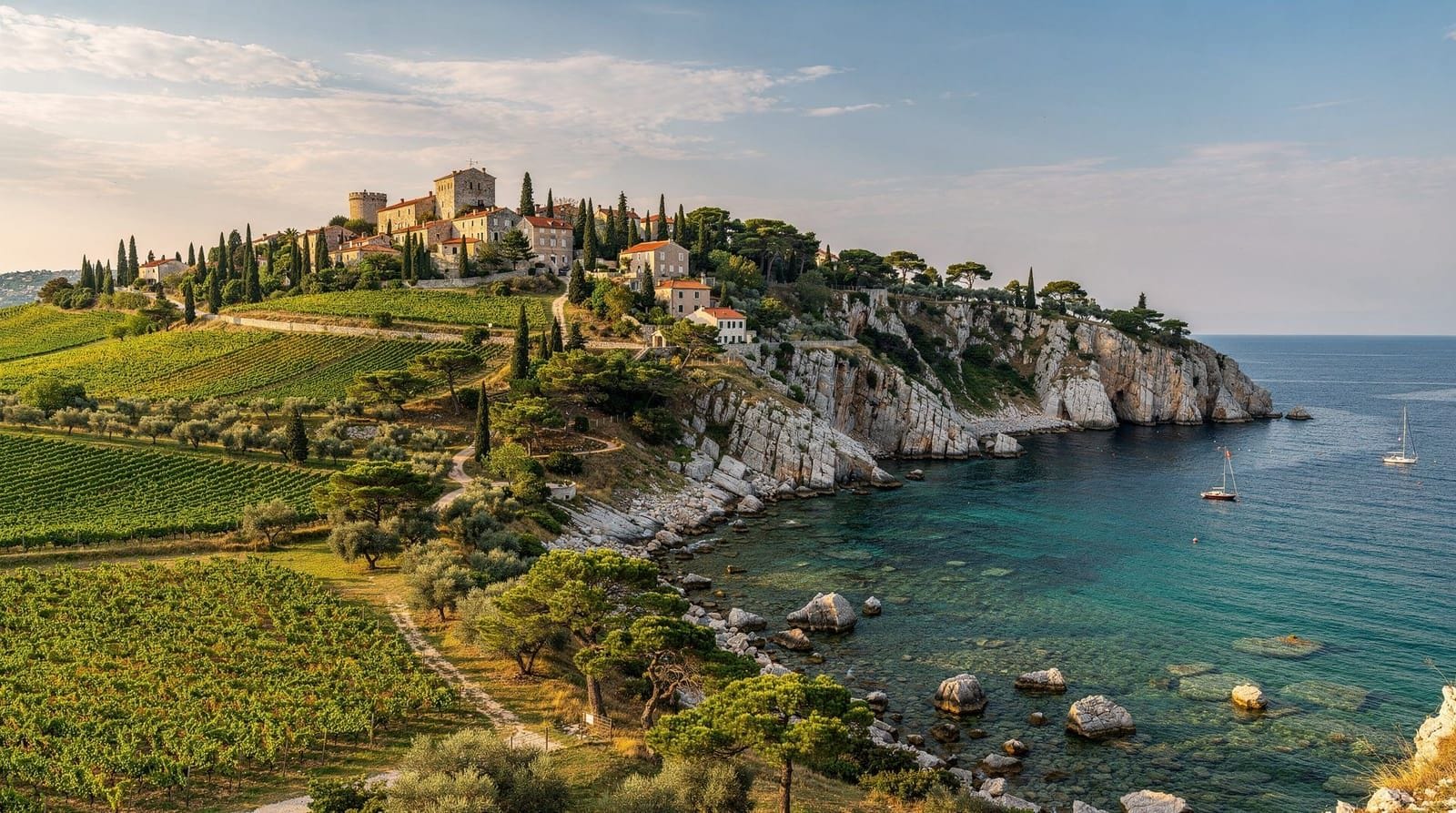
The official Vinska Cesta Malvazija (Malvazija Wine Road) connects producers across the interior and western coast of Istria. The best starting points are the hilltop towns:
Motovun sits on a dramatic ridge in the Mirna river valley, surrounded by some of the most beautiful wine and truffle landscapes in Croatia. The truffle connection is important here: white truffles from the Motovun forest are the most prized in Croatia, and the pairing of Malvazija with fresh truffle shaved over pasta is the defining food experience of the region. Our guide to Istrian truffles covers the season, pricing and where to eat.
Buzet in northern Istria is known for concentrated, mineral Malvazija and some of the peninsula’s most serious Teran. The town is quiet out of season but has good restaurant options and several producers accessible by road.
Grožnjan and Momjan: These small hilltop villages in the Buje area (far northwest Istria) are surrounded by some of the oldest and most respected Malvazija estates — including Kozlović near Momjan, the producer most consistently cited as making Istria’s benchmark Malvazija.
Rovinj and its surroundings offer the most pleasant base for wine tourism on the western coast — good restaurants, a beautiful old town, and day-trip access to multiple wine estates. The Valpovac enoteca in Rovinj’s old town has one of the best selections of Istrian wine by the glass.
Opatija on the Kvarner coast — just north of Istria proper — is an elegant resort town with good wine shops and proximity to the wine estates of the Učka mountain area.
Key Malvazija Istarska producers
Kozlović (Momjan)
The benchmark. The estate was founded in 1890 and the current generation has elevated it to consistent excellence. Their single-vineyard Santa Lucia Malvazija — from old vines on a specific limestone-marl slope above Momjan — is widely considered the finest example of the variety: concentrated, mineral, long-lived and complex without any of the oak or skin-contact that characterises the natural wine movement. The standard Malvazija is excellent value at around EUR 10–14 at the cellar door.
Matošević (Koreniki)
Ivan Matošević is one of Istria’s most respected winemakers, producing both a fresh, conventional Malvazija and the more ambitious amphora-fermented Grimalda Bijela. The estate is located in a renovated stone building in the village of Koreniki near Svetvinčenat, about 20 minutes from Rovinj. Visits by appointment.
Benvenuti (Kaldir)
A family estate near Motovun working with organic principles and producing both Malvazija and Teran. The winery is in a restored stone farmhouse surrounded by vineyards; stays at the associated agriturizam are possible. Their Malvazija is reliably fresh and accurate; their Teran is among the cleaner, less rustic expressions of the variety.
Trapan (Fažana)
Based near Fažana (the port for the Brijuni islands), Trapan produces some of the most accessible and widely distributed Istrian wines. Quality is consistent rather than spectacular, but the Malvazija is well-made and the prices are honest. Good choice for a first encounter with the variety.
Kabola (Momjan)
Small estate near Momjan with a long tradition and an interesting range that includes both conventional Malvazija and older-style skin-contact versions. The Momjan area’s limestone soils give wines with a distinctive mineral and slightly salty character.
Teran: the red wine of Istria’s red earth
What is Teran?
Teran is one of Europe’s most unusual red wines. The grape itself — closely related to Refosco dal Peduncolo Rosso in Friuli — produces wines of intense colour, very high natural acidity (malic acid rather than the softer tartaric acid, giving a sharp, almost tart edge), and earthy, iron-mineral flavours that directly reflect the terra rossa (red, iron-rich clay soil) in which it grows.
The terra rossa of Istria’s interior plateau is visually striking: deep brick red, fine-textured, underlain by limestone, it stains everything it touches. When geologists trace a soil-type to wine character, Teran from Istrian terra rossa is one of the clearest examples they cite. The wine literally tastes of its soil — dark cherry, plum, iron mineral, earth, and a persistent tang that prevents it from ever becoming heavy or clodding.
Historically, Teran was credited with medicinal properties. High iron content in both the wine and the soil led local tradition to prescribe it for anaemia; stories of Croatian mountain people drinking a morning glass of Teran mixed with olive oil were not unusual. Today’s producers are more focused on gastronomic quality than folk medicine, but the iron-mineral character remains central to the wine’s identity.
Teran key producers
Roxanich (Kloštar): One of Istria’s most ambitious and internationally known natural wine producers. Roxanich’s Teran is made with minimal intervention, extended skin contact and ageing in large old oak — the result is a wine of intensity and complexity that rewards decanting and patience. Also known for unusual varieties and amphora whites.
Clai (Buje): Giorgio Clai is a key figure in Croatian natural wine. His Teran (and Malvazija) are made with biodynamic principles, very low sulphites and hand-picking. The wines are not always predictable but at their best are among Istria’s most exciting.
Kabola: As well as their Malvazija work, Kabola produces Teran of characteristic northern Istrian sharpness and mineral intensity — honest, unfined, age-worthy.
Benvenuti: Their Teran is made in a slightly more approachable style than the natural wine producers — still earthy and acidic, but with cleaner fruit and better balance for those new to the variety.
Pairing Malvazija and Teran with Istrian food
Istrian cuisine is one of the most distinctive in Croatia — a fusion of Mediterranean coastal tradition, Italian pasta culture (Istria was part of Italy until 1947), Central European influence and an extraordinary local abundance of ingredients. The wines of Istria evolved alongside this cuisine and pair with it instinctively.
Malvazija with truffles: The pairing of Malvazija Istarska with fresh truffle is the signature experience of Istrian gastronomy. The wine’s floral aromatics and mineral finish create a complementary frame around the truffle’s earthy, garlicky, almost fungal intensity. The combination works with white truffle shaved raw over pasta (fuži, pljukanci, homemade tagliatelle) and with black truffle in risotto or scrambled eggs. Read more in the Istrian truffles guide.
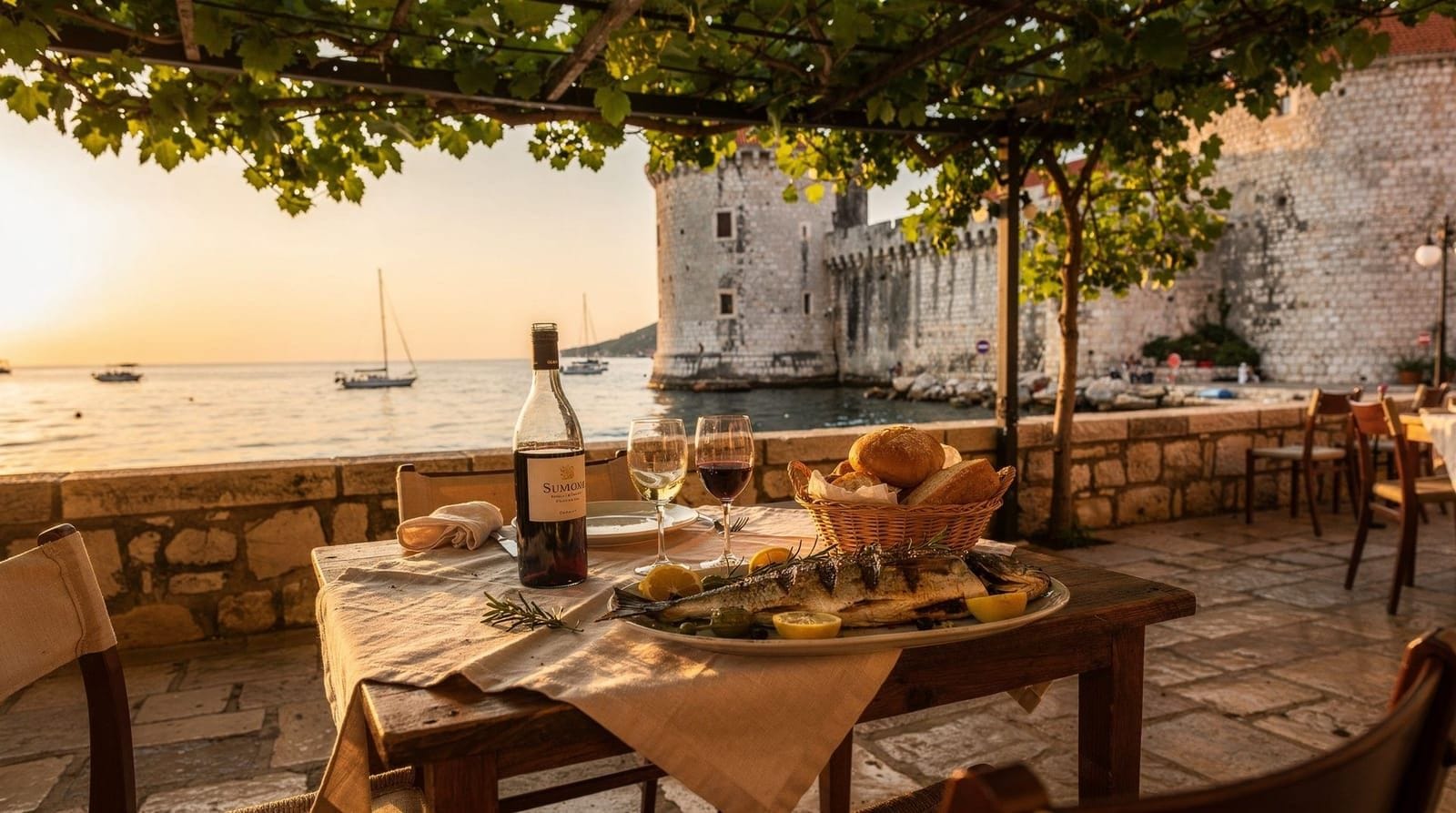
Malvazija with seafood: The wine is the natural partner for all Istrian seafood: grilled dentex, sea bass, bream, scampi in buzara sauce (garlic, white wine, breadcrumbs), mixed seafood pasta, fish soup (brodet). The mineral and slightly saline character of Malvazija bridges naturally to the iodine of fresh seafood.
Teran with prosciutto d’Istria: Istrian prosciutto (pršut) is dry-cured in the bura wind and aged for a minimum of twelve months, developing a flavour more delicate and perfumed than Parma ham. Teran’s high acidity cuts through the fat; its earthy character complements the cure. This pairing is the classic aperitivo moment at any Istrian konoba.
Teran with wild boar and game: The high acid and earthy tannins of Teran make it the obvious red for game: wild boar (divljač) stew, venison, rabbit. These dishes appear regularly on menus in the Motovun area and inland Istria during autumn and winter.
Teran with peka: Like Plavac Mali in Dalmatia, Teran can hold its own against the rich, slow-cooked lamb or veal of a peka preparation. It is a less conventional pairing than the Dalmatian version but worth trying.
The contrast with Dalmatian wine
The debate between Istria and Dalmatia as wine regions is partly a question of style and partly of temperament. Dalmatia’s Plavac Mali is a wine of power, sun and stone — extracted, high-alcohol, demanding of time and the right food. Istrian Malvazija is a wine of lightness, aromatics and versatility — ready immediately, appropriate with almost any dish. Teran occupies an interesting middle ground: it has Dalmatian earthiness and tannin but Istrian acidity and freshness.
If you are comparing the two halves of the country, the Istria vs Dalmatia guide offers a balanced assessment. The short version: Istria wins on white wine and the overall food-wine culture; Dalmatia wins on iconic reds and dramatic wine landscapes.
Wine with truffles and the agriturizam experience
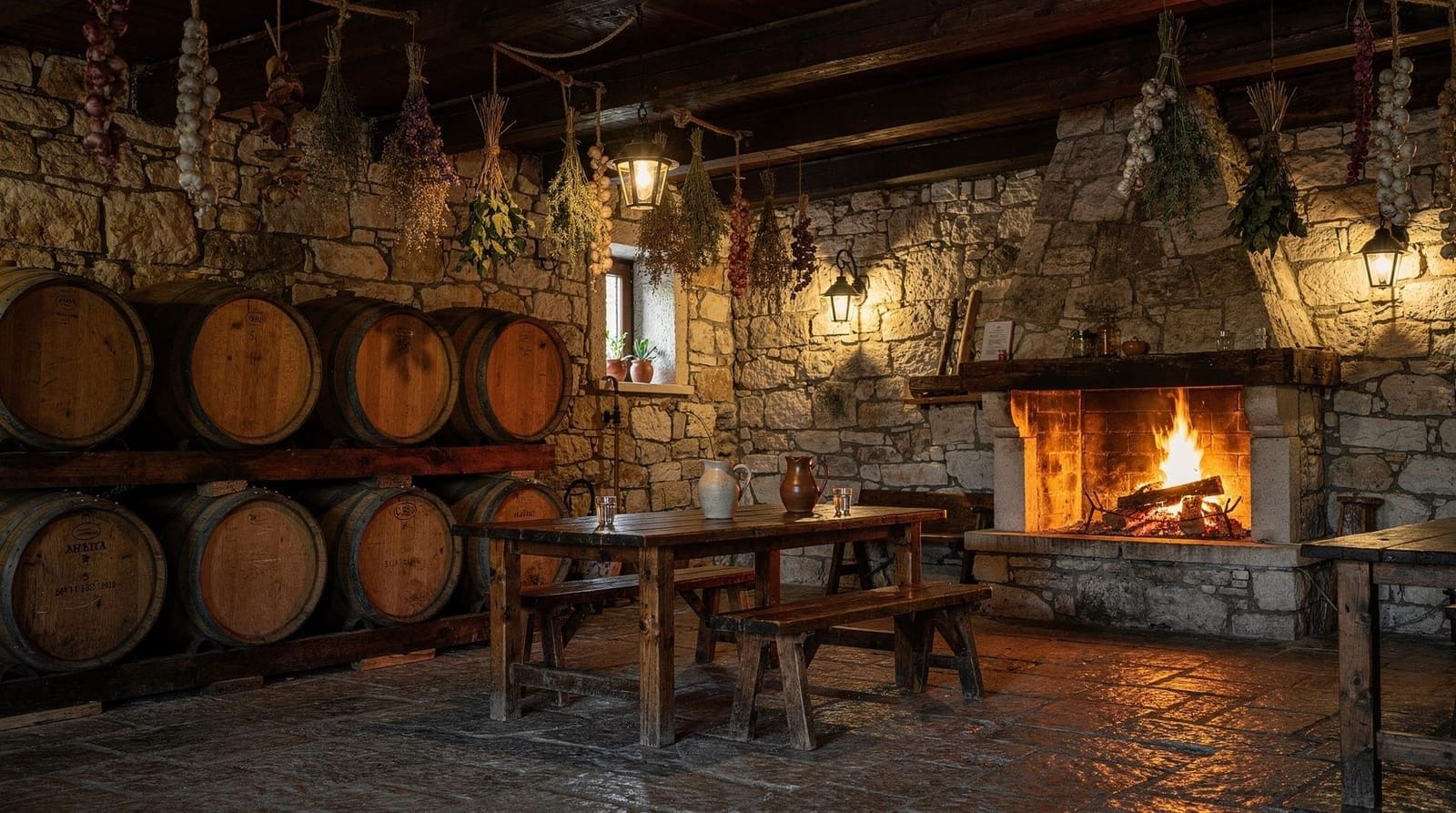
Much of the best Istrian wine is consumed not in formal restaurants but in agriturism estates (agroturizam) — farmhouses and rural properties that offer meals prepared from their own produce, served in their own wine. These are not tourist operations in the conventional sense: they are family farms where you eat what the farm grows, drink the farm’s wine, and sit at long tables with other visitors or with the family itself.
The agroturizam format is particularly common in the Motovun and Buzet area. Many combine truffle hunting or olive oil tasting with the wine experience. Booking ahead is essential; most operate seasonally from May through October, with some opening in winter for truffle season.
For wine combined with truffle hunting and Istrian cooking, the guided experiences available from the coastal towns give you the full immersion in a single day — truffle hunting in the forest, cooking demonstration, lunch with the estate’s Malvazija and Teran:
For the Dalmatian island comparison — seeing how Croatian wine varies between Istria’s style and the island wine traditions:
For more on eating well across Croatia, the konoba guide explains the local restaurant format that defines Croatian dining in both Istria and Dalmatia. The Croatian wine guide provides the full regional context.
Planning a wine day in Istria
The wine day is one of the few parts of an Istria trip where the honest advice is to slow down rather than optimise — the appeal is as much the drive between vineyards, the stop at a viewpoint over the Mirna valley, and the unhurried lunch as it is the tasting itself. Most visitors base themselves in Rovinj, Poreč or Motovun and drive out to two or three estates in a day — trying to fit in more than that usually means rushing the tastings and the roads themselves, which are narrow, scenic and not built for speed. A realistic day: one larger, well-signposted estate in the morning (Kozlović or Trapan are reliable starting points, no advance booking usually required), lunch at a konoba or agriturizam near Motovun or Buzet, then one smaller, appointment-based producer in the afternoon if you’ve emailed ahead. Tasting flights at the larger estates typically run around EUR 10–20 for four to six wines; smaller natural producers sometimes charge more given their limited production, or fold the tasting into a meal price.
If you don’t have a car, guided wine-tasting day tours from the coast handle the driving and the appointments, which matters more in Istria than it might seem — many of the best small producers simply don’t have the staff to handle drop-in visitors, and a tour operator’s existing relationships open doors that a cold visit won’t. This matters especially for anyone staying on the coast rather than inland, since taxis between the hilltowns and wine estates are scarce and expensive by comparison to a half-day tour that bundles transport, tastings and often lunch into one price.
A note on driving and tasting: designate a driver, or plan the day around a single serious tasting with smaller pours and spitting elsewhere. Istria’s back roads are narrow, unlit after dark, and unforgiving of both wine and inattention — this is not the place to test local drink-driving limits, which are strict and enforced.
Getting to Istria’s wine country
Istria’s interior is genuinely a driving region — public transport between the hilltowns and wine estates is minimal, and the few bus routes that exist are aimed at residents commuting to the coast rather than visitors touring vineyards on their own schedule. If you’re based in Dalmatia rather than Istria itself, the Istria vs Dalmatia guide covers how the two regions connect, since combining a Dalmatian coastal trip with an Istrian wine detour requires real planning (the drive between the regions runs 4.5–5.5 hours). For visitors flying directly into the peninsula, Pula Airport puts you within an hour of most of the wine routes described here, making a fly-in, wine-focused long weekend genuinely practical without ever touching Dalmatia.
Frequently asked questions about Malvazija Istarska and Teran
What is Teran and how is it different from Malvazija?
Teran is Istria's defining red grape — the opposite of Malvazija in almost every way. Where Malvazija is white, aromatic and approachable, Teran is deep ruby-red, high in malic acid, earthy and intense. It grows in the terra rossa (iron-rich red clay soil) of the Istrian plateau and reflects that soil in its flavour: dark cherry, plum, iron mineral, earthy notes, and a tartness that makes the mouth water. Historically, Teran was consumed for its high iron content — local tradition held it was beneficial for anaemia. Today's producers make it as a serious food wine, pairing it with prosciutto, game, truffles and rich stews.Is Malvazija Istarska the same as Malvasia or Malvazija in other countries?
No — this is an important distinction. Malvazija Istarska (Malvasia Istriana) is genetically distinct from other varieties sharing the Malvasia name. There are dozens of unrelated grapes called Malvasia, Malvazija, Malmsey or Malvoisie grown across Europe — in Madeira, Sicily, Slovenia, Friuli, Sardinia and elsewhere — and most are not closely related to each other or to the Istrian version. Malvazija Istarska is indigenous to the Istrian peninsula and has been grown there continuously since at least the medieval period. Do not assume that because you have tasted a Malvasia from another country you know what to expect from Istria.Where are the main wine zones in Istria?
Istria's wine production is divided into several informal zones. The Buzet area in northern Istria, around the hilltop town of Buzet, is known for concentrated Malvazija and some of the peninsula's best Teran. The Poreč area on the western coast has a long winemaking tradition and several established estates. The Rovinj area to the south of Poreč has producers working both Malvazija and Teran. The Labin area on the eastern coast has its own distinct microclimate. Interior Istria — the hilltop towns of Motovun, Grožnjan, Oprtalj and Buzet — sits at the heart of the most interesting wine and food production on the peninsula.What food pairs best with Malvazija Istarska?
Malvazija is the natural companion to Istrian cuisine generally. Its most celebrated pairing is with truffles — the fresh white truffle (tartufo bianco) shaved over homemade pasta (fuži, pljukanci) with a glass of good Malvazija is one of the definitive culinary experiences of the Adriatic. The wine also works beautifully with Istrian seafood: grilled sea bass, scampi buzara (in white wine sauce), fish soup, oysters. Lighter versions pair with salads, fresh cheese, vegetable antipasti. Richer, amphora-aged Malvazija can hold up to prosciutto d'Istria and aged sheep's milk cheese.Who are the best Malvazija Istarska producers?
The benchmark producer is Kozlović, based near Momjan in northern Istria — their single-vineyard Santa Lucia Malvazija is widely considered Croatia's finest example of the variety. Other respected names include Matošević (Koreniki, known for both conventional and amphora-aged Malvazija), Benvenuti (Kaldir, near Motovun, organic approach), Degrassi (Savičenta, classic style), and Trapan (Fažana, accessible price point and wide distribution). For natural and minimal-intervention Malvazija, look for Giorgio Clai (Buje) and Roxanich (also known for Teran). The Kabola estate near Momjan is another name consistently recommended by Istrian restaurant sommeliers.What is the Vinska Cesta Malvazija wine route?
The Vinska Cesta Malvazija is an official wine route through Istria connecting producers of Malvazija Istarska. It runs through the interior and western coast of the peninsula, linking the hilltop towns of Buje, Grožnjan, Momjan, Oprtalj, Motovun and Buzet with the wine estates in the surrounding valleys. Most estates on the route are open for tastings from May through October, with some maintaining year-round hours. The route is driveable in a day but deserves two or three days if you want to stop for meals and extended cellar visits. Many estates also offer accommodation (agriturismo, agroturizam in Croatian).Can I visit Istrian wineries without booking in advance?
In Istria more than anywhere else in Croatia, spontaneous winery visits are feasible. Agritourism (agroturizam) is well established: many producers have signposted tasting rooms open during daylight hours from May to October, and the cultural norm in Istria leans toward welcoming visitors. However, smaller estates and natural wine producers often work by appointment — particularly those with very limited production. The safest approach is to email ahead for your two or three priority wineries and leave the others to chance. Failing that, restaurant sommeliers in Rovinj, Motovun or Poreč know who is open and can often make a call on your behalf.
Top experiences
Bookable activities with verified prices and instant confirmation on GetYourGuide.
Top experiences
Best-rated activities across GetYourGuide and Viator.

Krka National Park Tour with tour Guide & Wine tasting from Split & Trogir
- Viator

Dolphin Watching & Sunset Boat Tour With Drinks & optional Dinner
- Viator

Fantastic DOLPHIN & SUNSET TOUR with dinner ( Pula-NP BRIJUNI )
- Viator

Dubrovnik Guided Group Tour with Ston Oyster tasting from Split & Trogir
- Viator

Zadar Highlights: Old Town, Sea Organ & Local Tastings
- Viator

Zadar: Luxury Island Boat Tour, Snorkeling & Unlimited Wine
- Viator