Bareboat vs Skippered Charter in Croatia — Which Is Right for You?
Split: Hvar, Pakleni, Brac and Solta all-inclusive tour
Should I book a bareboat or skippered charter in Croatia?
Bareboat if you hold a valid ICC sailing licence, have offshore experience and want total freedom over your route and schedule. Skippered if you are new to sailing, want to learn while you go, or simply prefer not to handle the navigation and weather decisions. Skippered costs more but removes all the responsibility. Both access the same beautiful Adriatic sailing.
The Fundamental Question
Every sailing holiday in Croatia starts with the same decision: do you charter a bareboat and sail it yourself, or do you hire a boat complete with a professional skipper? The right answer depends on your experience, your risk tolerance, your budget and what you actually want from the holiday.
This guide sets out the comparison honestly, including the situations where each option fails — because booking the wrong type of charter is a reliable way to have a miserable week.
| Bareboat needs | ICC/equivalent licence + VHF SRC, 1,000nm+ offshore experience |
| Skippered needs | No licence required, any experience level |
| Skipper cost | around €150–250/day extra, plus food and berth aboard |
| Best season | May–June or September for easier winds and quieter marinas |
| Booking lead time | 3–6+ months ahead for July–August departures |
What Bareboat Charter Means
Bareboat means you charter the boat alone — no crew, no skipper. You and your party take full responsibility for the vessel: navigation, weather decisions, anchoring, marina manoeuvres, mechanical issues and safety. The boat comes equipped with sails, safety gear, engine, instruments and everything needed for the voyage. You bring your crew, your provisions and your licence.
The appeal: Total freedom. You go where you want, when you want, at the pace you choose. Anchor in a remote cove and stay three nights. Skip Hvar entirely because it is too busy. Change your planned route based on wind. Nobody else’s schedule to accommodate except your crew’s.
The reality: This freedom comes with full accountability. Croatian marinas can be tight. Mediterranean mooring (stern-to the quay, anchor forward) is a skill that takes practice to do smoothly. Weather changes can require quick decisions. Mechanical issues — a tangled anchor chain, a failed furling system, a blocked head — are your problem to solve or report to the charter company’s support line.
Who it suits: Sailors who hold the ICC or equivalent, have at least 1,000 nm offshore experience (more is better), are comfortable with marina manoeuvres and feel confident making weather decisions independently. Experience matters more than the piece of paper — charter companies check both.
What Skippered Charter Means
Skippered means the charter company provides a professional skipper who sails the boat and takes responsibility for all seamanship decisions. You still participate fully — pulling ropes, trimming sails, helming if you want, handling anchor watches — but the skipper decides when to leave, which route to take, how to handle conditions and where to berth.
The appeal: You access the sailing experience without the stress of being responsible for an expensive boat in unfamiliar waters. A good skipper also functions as a local guide — they know which anchorages are sheltered in a sirocco, which fish restaurant in Komiža is genuinely good, which marina in Hvar is worth paying extra to book in advance. The sailing itself is also typically better: a professional skipper will push the boat harder and find better sailing angles than a conservative bareboat crew.
The reality: You pay substantially more. The skipper’s daily rate of €150–250 is just the start — by custom, charterers provide the skipper with his accommodation aboard (the skipper takes the nav station berth) and meals. Over seven days, this custom adds meaningfully to your total. You also lose some autonomy: a skilled skipper will consult you but will veto any decision they consider unsafe.
Who it suits: Beginners and non-sailors who want to experience sailing. Couples or groups who want someone else to handle the responsibility. People with some sailing experience who are not yet confident solo. Anyone who wants tuition as part of the experience.
Cost Comparison
Indicative costs for a 40 ft yacht, one week, central Dalmatian season (2026 estimates):
| Bareboat (low season May/Sep) | Bareboat (peak Jul/Aug) | + Skipper | |
|---|---|---|---|
| Charter fee | €2,000–2,800 | €3,500–5,000 | Add €1,000–1,750 |
| Marina fees | €400–600 | €600–900 | Same |
| Fuel | €150–250 | €200–300 | Same |
| APA (provisioning) | €400–600 | €500–800 | Same |
| Skipper’s food/accommodation | — | — | €300–500 |
| Approximate total | €3,000–4,250 | €4,800–7,000 | Add ~€1,300–2,250 |
These are approximations — actual costs vary significantly by boat size, charter company, how many nights in paid marinas vs free anchoring, and fuel usage. The APA (Advance Provisioning Allowance) is typically 20–30% of the charter fee, paid upfront and reconciled at the end.
Where you actually sail: the same route, two ways
Bareboat and skippered charters typically cover similar central Dalmatian ground, but the pace and decision-making differ. A representative week out of Split:
| Day | Bareboat crew | Skippered crew |
|---|---|---|
| 1 | Handover briefing, provisioning, short shakedown sail | Boarding, skipper briefs safety and plan, easy first evening |
| 2 | Sail to Hvar via the Pakleni Islands, anchor decision made by crew | Skipper picks a quieter Pakleni cove based on the day’s wind, avoiding the busiest anchorage |
| 3 | Continue to Vis if conditions allow, or shelter if forecast is marginal | Skipper reads the forecast and commits to Vis or an alternative without second-guessing |
| 4 | Explore Vis, crew handles mooring in Komiža | Skipper handles mooring; crew free to swim and explore |
| 5 | Passage decision toward Brač or Šolta, weather-dependent | Skipper times departure for the best sailing angle |
| 6 | Return leg toward Split, marina booking made by crew in advance | Skipper’s local contacts secure a berth even in a busy marina |
| 7 | Refuel, clean, handover — crew manages all logistics | Skipper manages logistics; crew disembarks with nothing to organise |
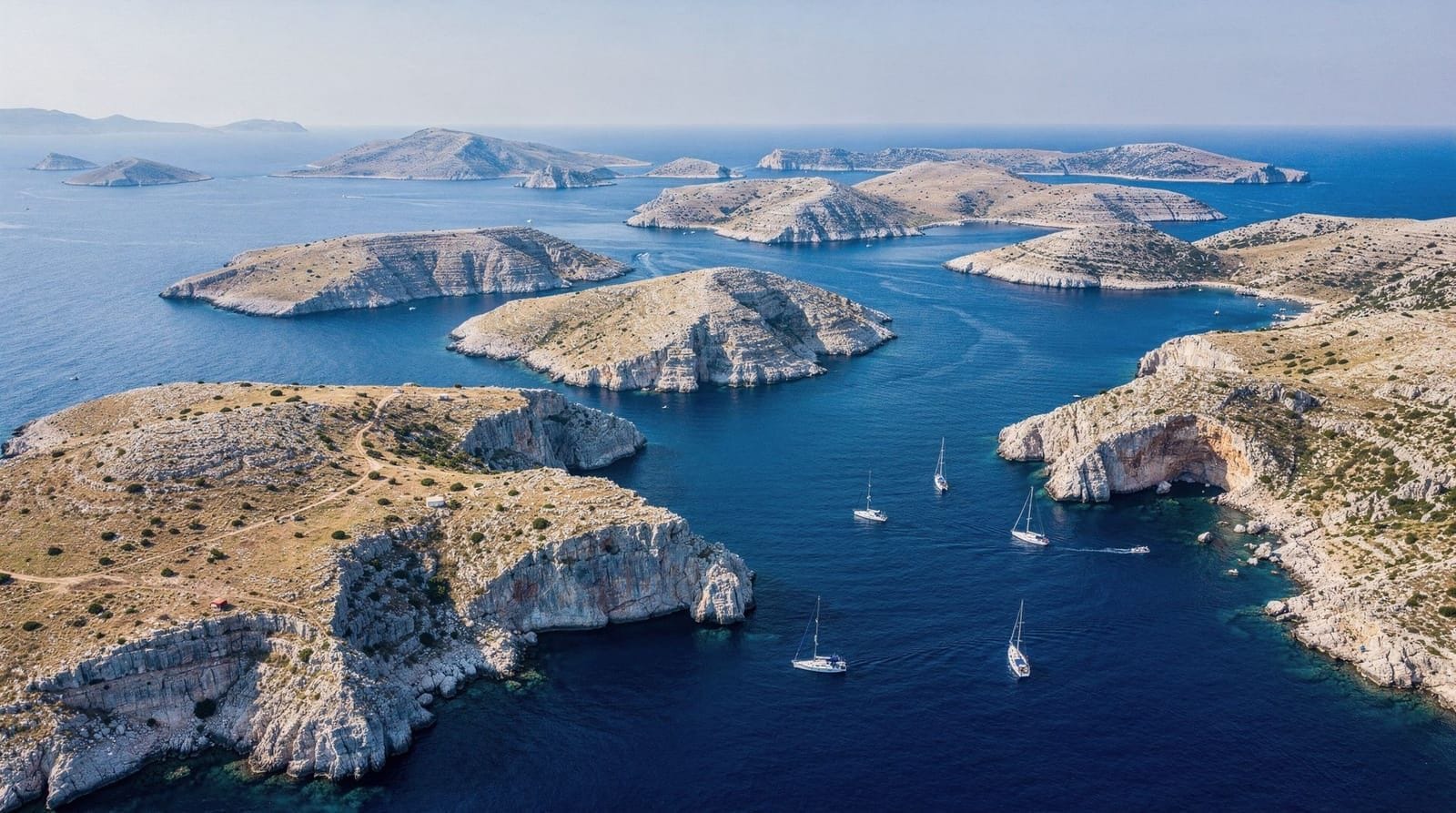
The itinerary content is similar either way — the difference is who carries the decision-making load on marginal-weather days and tight marina evenings. For islands further afield, both the Kornati islands and the wider best Croatian islands guide are worth reading before you finalise a route, and the island-hopping itinerary has a non-sailing alternative if chartering turns out not to suit your group.
Licence Requirements for Bareboat
Croatia’s maritime regulations require a valid sailing licence for any chartered vessel. The internationally recognised standard is the ICC (International Certificate of Competence) — accepted by Croatia and most Mediterranean countries. Many national licences (UK Day Skipper offshore, German SBF See, French Coastal/Offshore certificate) are also accepted; the charter company will tell you what they will accept.
In addition to the sailing licence, a VHF Short Range Certificate (SRC) is required for operating the boat’s radio — and the radio must be used, as it is your connection to harbour authorities and emergency services. Channel 16 is the international distress and calling channel; leaving it monitored at all times is both legal requirement and good seamanship.
The practical test is whether you can handle: Mediterranean mooring (reversing into a tight marina berth, dropping anchor and setting it correctly), heavy weather sail reduction, coastal navigation and chart reading. Charter companies vary in how rigorously they check this beyond the paperwork.
The Middle Options
Flotilla sailing: A group of 5–12 chartered boats sail a shared route with a professional lead boat. You skipper your own boat with your own crew but have guidance, route planning and technical backup from the lead crew. Flotillas run regular programmes on the Dalmatian islands and Kornati. They cost more than bareboat but less than a full skippered charter. Ideal for newly qualified sailors.
Skipper for delivery or first day: Some companies will supply a skipper for the first day or two — enough to check you out on the boat and help you clear Split marina — before you take over independently. Less common but worth asking about.
Sailing schools aboard: Some operators run week-long courses where an RYA or equivalent instructor sails as part of your crew and provides formal tuition. You end the week with logged miles and potentially a course completion certificate. These are structured around instruction, not pure holiday sailing.
Boat size and crew number also shape the decision
The bareboat-vs-skippered choice interacts with boat size in ways first-time charterers often miss. A 40 ft yacht with six aboard is manageable bareboat for an experienced skipper-of-the-group; the same boat with two inexperienced sailors and four guests who have never touched a winch is a much harder proposition, regardless of who holds the licence. Larger catamarans (44 ft+) are increasingly popular for families and groups of 8–10 because of cabin space and stability, but they handle differently under sail and in marina manoeuvres than a monohull — if your ICC experience was entirely on monohulls, factor in an adjustment period or lean towards a skipper for the first day or two. Charter companies will generally advise honestly on whether your stated experience matches the boat you have chosen; listen to that advice rather than the boat you would prefer to have.
Making the Decision
Work through this honestly:
- Do you hold a valid ICC and SRC? If no, the choice is made for you: skippered only.
- Have you done Mediterranean-style mooring before? If no and you are not confident practising during the charter, hire a skipper at minimum for marina entries.
- How many in your crew have sailing experience? If you are the sole experienced person and something incapacitates you, who sails the boat?
- How much does the responsibility matter to you? Some sailors specifically do not enjoy being the responsible person on holiday. There is no shame in preferring someone else to handle that.
- What is your budget? If the additional cost of a skipper breaks the trip budget, and you hold a valid licence with real experience, bareboat is the practical answer.
What Nobody Tells You
Marina manoeuvres are where bareboat crews struggle most. The open-water sailing in Croatia is not technically demanding. Docking in a crowded Hvar marina, in a 20-knot maestral, in front of an audience of 40 other yachties is where reputations are made and lost. Practise Mediterranean mooring before the charter or budget for a few stern-to disasters.
Good skippers are worth more than the fee. A professional skipper who knows the Dalmatian coast well will unlock anchorages you would never find on a chart, fish restaurants with no signage, the cove that is perfect on this specific wind direction and not obvious from the pilot book. That knowledge is worth considerably more than his daily rate.
Weather decisions are not optional. On a bareboat, you will face at least one morning where the conditions are marginal and the decision to go or stay is genuinely unclear. Have a conservative default: if in doubt, stay. A missed passage is inconvenient; a bad weather incident on an unfamiliar boat is dangerous.
The charter company’s support line is your friend. If something breaks — and something always breaks on a week of intensive sailing — call immediately. Charter companies are used to technical support calls and most have mechanics at the major marinas.
For more practical advice on the sailing itself, see the Croatia sailing guide and the dedicated sailing from Split guide. For charter company selection and pricing, see the Croatia yacht charter guide.
Frequently asked questions about Bareboat vs Skippered Charter in Croatia
What licence do I need for a bareboat charter in Croatia?
You need a valid ICC (International Certificate of Competence) or an equivalent national sailing licence recognised by Croatia, plus a VHF Short Range Certificate (SRC). The charter company checks these before handover. Sailing without the correct paperwork is illegal and voids your insurance.How much does a skippered charter cost compared to bareboat?
A professional skipper typically adds €150–250 per day to the charter cost, depending on experience and the charter company. Over a week, that is roughly €1,000–1,750 additional. Some charter companies offer packaged skippered charters at all-in prices. The skipper's food and accommodation aboard the boat are customarily provided by the charterers.Can I learn to sail on a skippered charter?
Yes, and this is one of the best uses of a skippered charter. A good skipper will teach you — sail trimming, chart reading, anchoring technique, weather interpretation — as part of the experience. Some companies specifically market 'skipper who teaches' arrangements. Ask explicitly when booking if tuition is part of the deal.What experience level is needed for bareboat in Croatia?
A realistic minimum: ICC or equivalent, at least 1,000 nm offshore experience, confidence handling the boat in confined spaces (marina manoeuvres are the most stressful part), basic chart and weather reading skills. Charter companies assess this differently — some will accept less experience than others. Be honest: a boat too large or a crew too inexperienced creates dangerous situations.Can I hire a skipper for just part of a charter?
Some charter companies offer this arrangement — a professional skipper for the first day or two to hand over the boat and sail the first passage, then you take over. It is less common than full-week skippered charters but worth asking about if you are transitionally experienced.What is a flotilla holiday and how does it differ?
A flotilla involves a group of chartered boats (typically 5–12) sailing a shared route with a lead boat carrying professional crew who handle weather routing, marina bookings and technical support. You sail your own boat with your own crew but have guidance and backup. It is a popular choice for newly qualified sailors building confidence.Do I need experience to join a skippered charter as crew?
No — you can join a skippered charter with zero sailing experience. You will still pull on ropes, help with the anchor and participate in the sailing, but the skipper takes all responsibility for navigation, safety and decision-making. Many people do their first sailing experience this way.
Top experiences
Bookable activities with verified prices and instant confirmation on GetYourGuide.
Top experiences
Best-rated activities across GetYourGuide and Viator.

Blue cave, Mamma Mia and Hvar, 5 islands speedboat tour
- Viator

Blue Cave and Hvar Tour - 5 Islands Tour from Split and Trogir
- Viator

Blue cave, Mama Mia and Hvar, 5 Island Speedboat Tour from Trogir
- Viator

Medulin-Kamenjak 5h boat trip ALL-INCLUSIVE drinks on Sandra Boat
- Viator

Medulin: All-Inclusive Kraken Boat Tour to Kamenjak Cave & Levan
- Viator

3Hour ALL-INCLUSIVE Sunset Dolphin Watching from Medulin onSandra
- Viator