Driving in Croatia — Road Rules, Routes and Tips
Is it easy to drive in Croatia?
Yes, for the most part. Croatia drives on the right, has a modern motorway network, and well-signed main roads. The challenges are narrow coastal roads in summer, heavy traffic around Dubrovnik and Split in peak season, limited parking in old towns, and the short Neum corridor in Bosnia that interrupts the coastal road south of Dubrovnik — though the Pelješac Bridge now bypasses it.
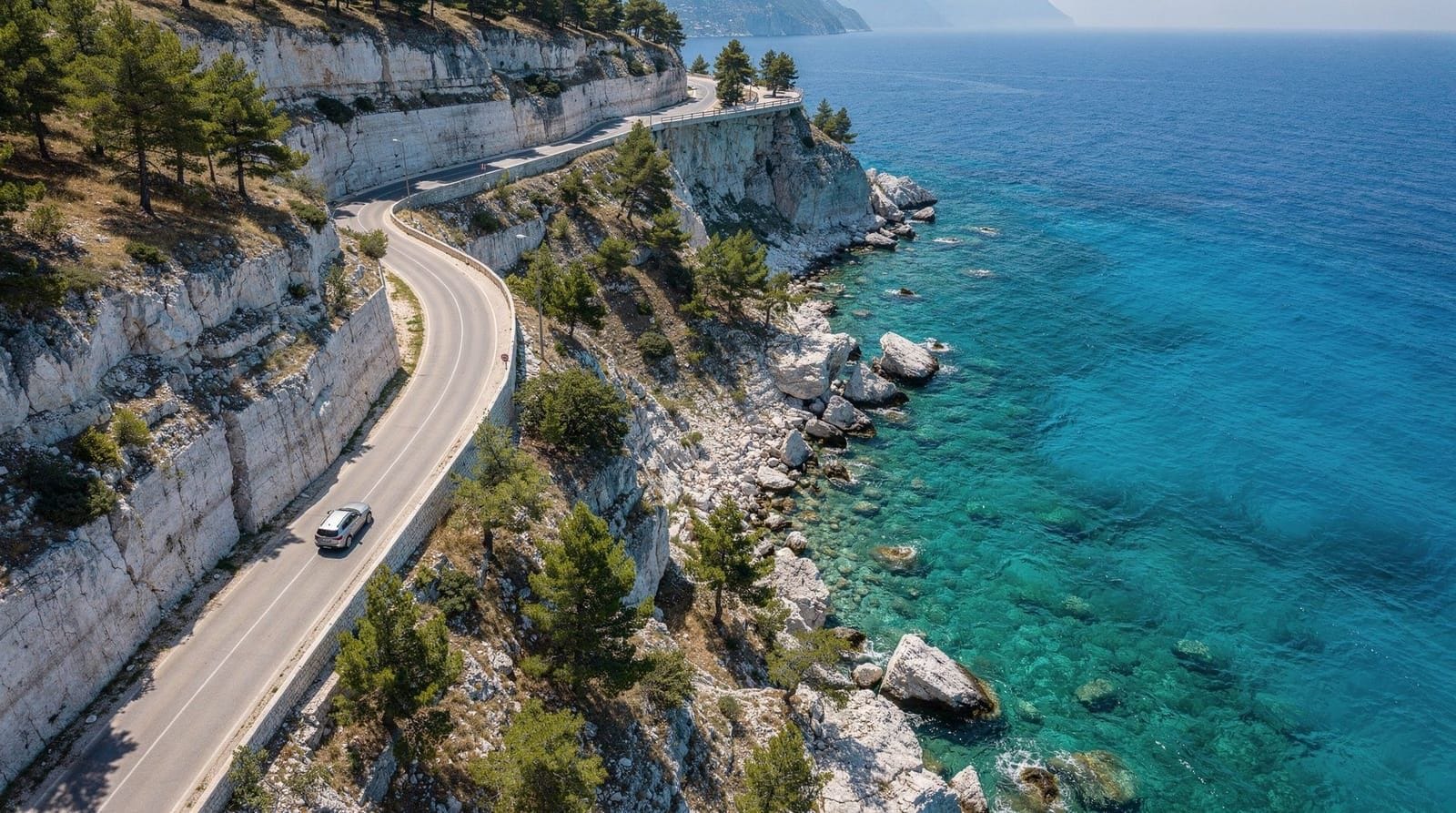
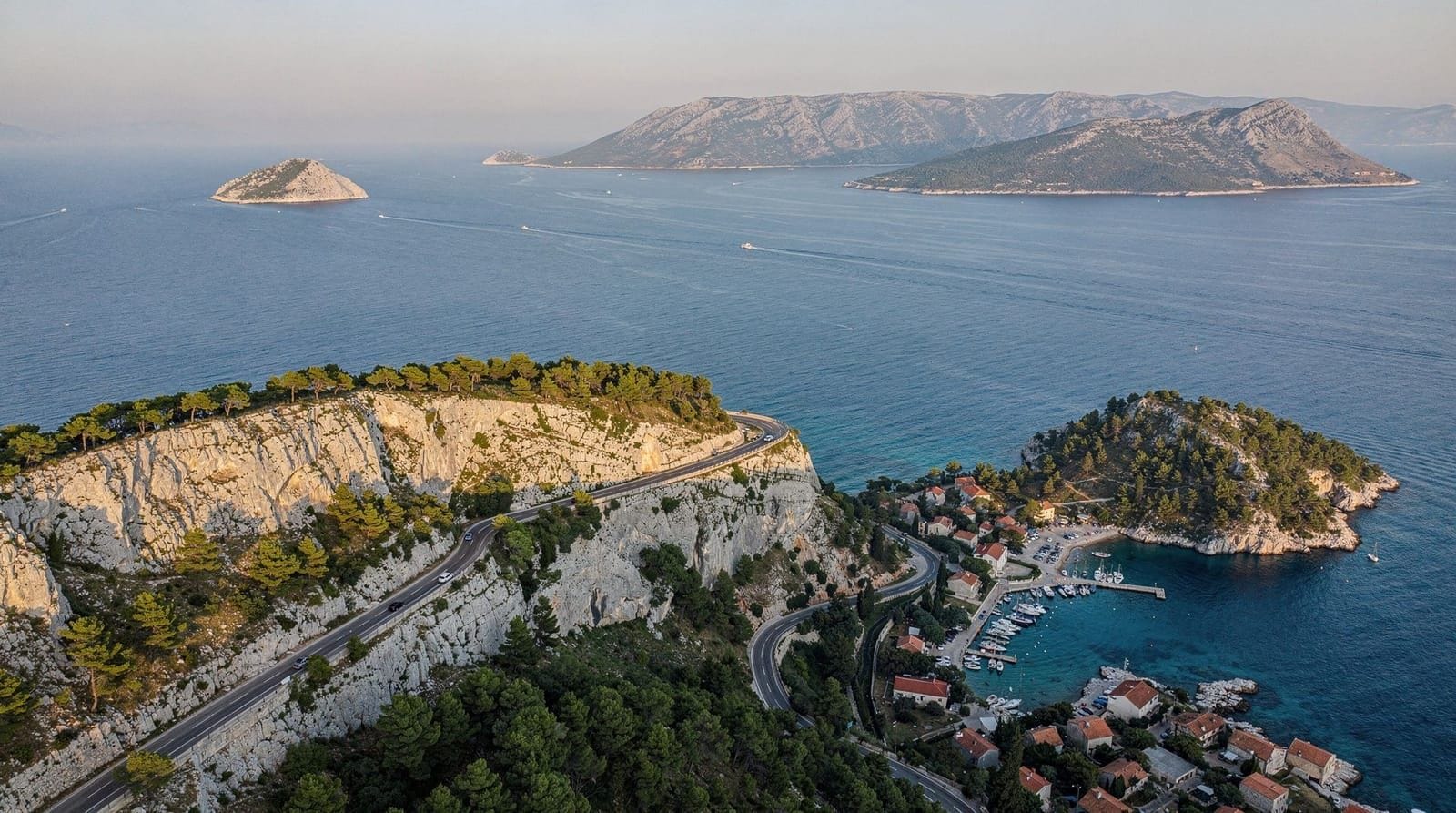
Croatia rewards drivers. The Adriatic Highway threading through Dalmatia is one of Europe’s most spectacular coastal roads; the Istrian interior offers hill-village lanes that feel unchanged since the 1970s; and the motorway from Zagreb to Split is fast, modern and punctuated by extraordinary karst scenery as it descends toward the coast. Here is what every driver in Croatia needs to know.
| Where | Adriatic Highway (D8), A1 motorway, Istrian interior, Pelješac |
| Cost | Around EUR 26 tolls Zagreb–Split; fuel around EUR 1.50–1.65/litre |
| Rules | Drive on the right, 0.05% BAC limit, headlights required Nov–Mar |
| Getting around | Distance-based tolls, no vignette needed |
| Best time | Shoulder season (May–June, Sept) for lighter coastal traffic |
Road network overview
Croatia has three tiers of roads:
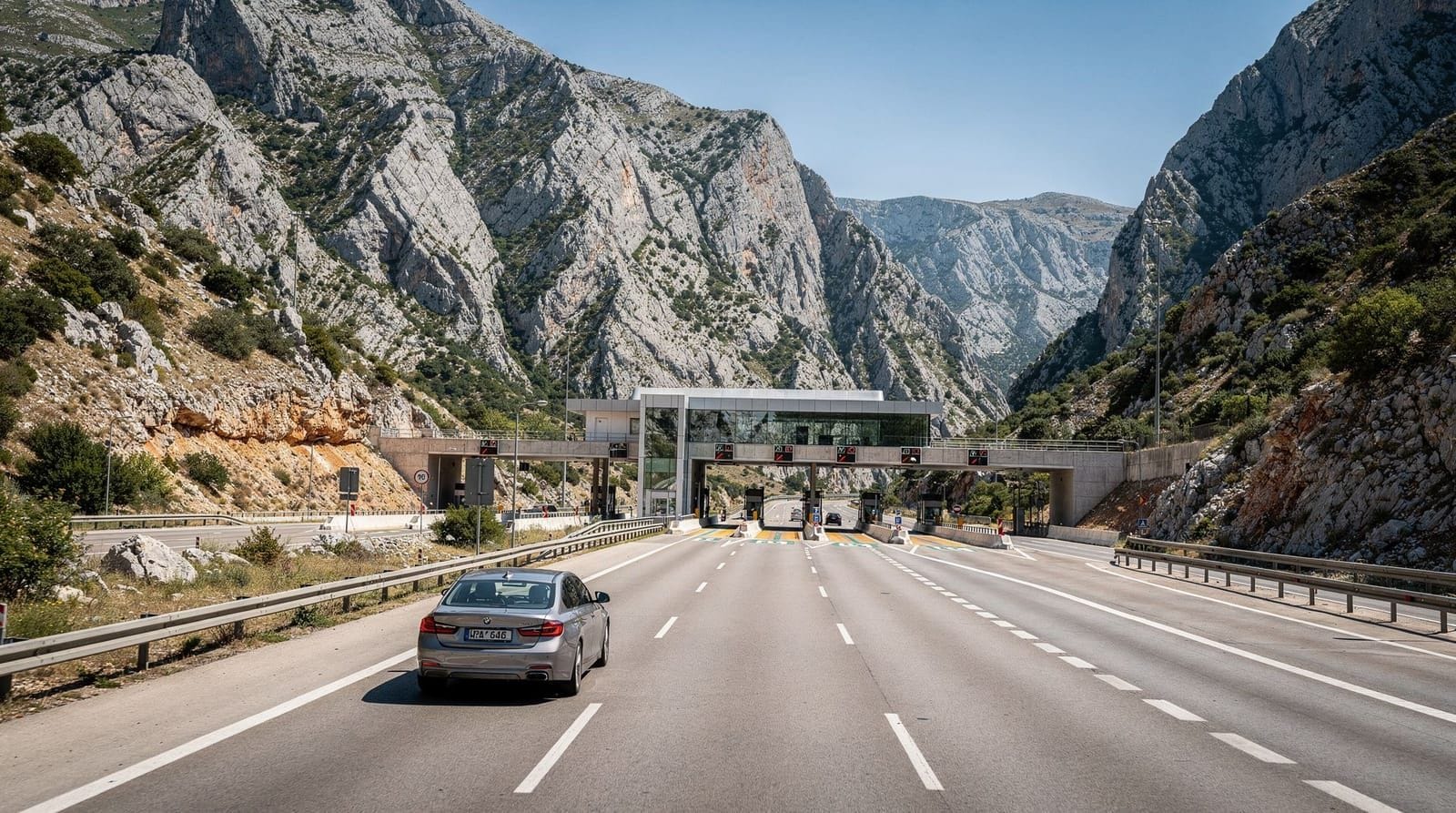
Autoceste (motorways/highways): The A1 Zagreb–Split–Ploče is the spine of the road network — fast, well-maintained, with frequent petrol stations and service areas. The A6 connects Zagreb to Rijeka and Istria. These are toll roads; see the full Croatia tolls guide for details. Expect to pay around €26 for a car on the Zagreb–Split run.
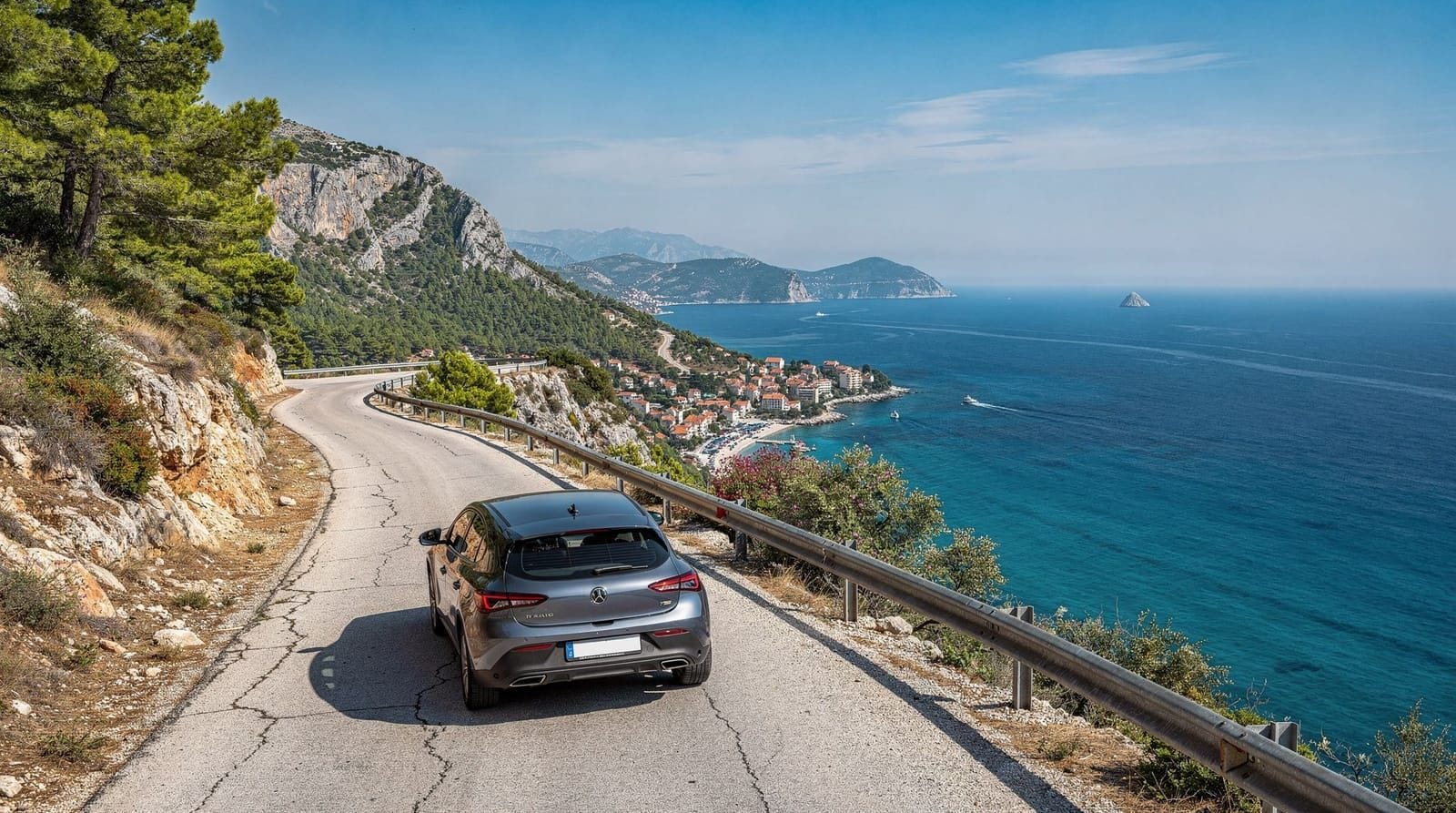
Državne ceste (state roads): The D8 (Jadranska magistrala, “Adriatic Highway”) runs along the coast connecting Rijeka, Zadar, Šibenik, Split, Makarska and toward Dubrovnik. It’s scenic but can be slow — particularly in July and August when the 30 km queue into Dubrovnik is a real phenomenon. Average speeds on the D8 in summer: 40–60 km/h.
Lokalne ceste (local roads): The network of roads reaching hilltop villages, island interiors and national park approaches. These vary from good to goat-track. GPS sometimes directs you onto “shortcuts” that are unpaved or too narrow for standard cars; always check before entering.
Key road rules
Speed limits:
- Urban areas: 50 km/h
- Open roads (state roads): 90 km/h
- Expressways (brze ceste): 110 km/h
- Motorways: 130 km/h
Speed cameras are widespread on motorways and increasingly on state roads. Local police use handheld radar frequently on coastal roads.
Mandatory equipment in the vehicle:
- Reflective vest (for each occupant)
- Warning triangle
- First-aid kit
- Spare bulb kit
- Fire extinguisher (technically required; often overlooked in rentals — check at pick-up)
Mobile phones: Strictly prohibited while driving unless using a hands-free kit. Fines are substantial.
Child seats: Children under 12 or under 150 cm must use an appropriate restraint system.
Seatbelts: Mandatory for all passengers including rear seats.
Overtaking: On single-carriageway roads, only where the road marking permits. Solid white line = no overtaking. Particular care on the coastal D8 with its blind bends.
Seasonal driving conditions
Summer (June–August)
The busiest driving season by far. The A1 motorway handles volume well, but secondary coastal roads and town approaches can become severely congested. The approach to Dubrovnik on the D8 is notorious — queues of 1–3 hours are reported in late July. Practical solutions: use the morning (before 9 am) or evening (after 7 pm) to enter and exit Dubrovnik; use the park-and-ride at Ilijina Glavica rather than driving into the old town area. Take local coastal roads with patience — the views are worth the pace.
On the islands, roads are narrow and often shared with cyclists and pedestrians in summer. Drive slowly and patiently; give priority to oncoming vehicles at natural passing places.
Winter (November–March)
Mountain passes (including the Biokovo ascent and some Velebit routes) can be closed by snow. The Gorski Kotar region between Rijeka and Zagreb experiences heavy winter snowfall. Check the Croatian Roads (HAK) website before driving mountain routes. Coastal driving is fine year-round.
The most scenic drives in Croatia
Adriatic Highway (D8): Split to Dubrovnik
Around 230 km. The classic Croatia road trip — limestone cliffs dropping to turquoise water, fortified towns on rocky headlands, the Makarska Riviera, the Biokovo massif. Allow a full day for the drive if you’re stopping. The section through Makarska is particularly dramatic.
Istria interior loop
Rovinj → Motovun → Grožnjan → Buje → Poreč → Rovinj. A half-day or full-day loop through the Istrian hills — truffle forests, hilltop wine villages, Roman mosaics at Poreč. Roads are generally good; some descents into valleys are steep.
Dalmatian hinterland: Split to Plitvice
Head north from Split on the A1, exit at Gospić or Udbina for the approach to Plitvice Lakes. The Dalmatian gorge country en route — particularly around Sinj and the Cetina canyon — is spectacular and off the tourist radar.
Pelješac Peninsula
From Ston, a 90 km finger of land pointing toward Korčula. The road climbs along the ridge of the peninsula with views of both the sea and the Neretva delta — and passes through Dingač and Postup, Croatia’s finest Plavac Mali wine villages.
Parking
In town centres: Blue-zone metered parking costs €0.80–€2.50 per hour depending on the city. Machines accept coins and cards. Old-town cores in Split, Dubrovnik and Trogir are completely pedestrianised — cars cannot enter.
In Dubrovnik specifically: Pile Gate car park (expensive; fills fast), Ilijina Glavica park-and-ride (€5 including shuttle bus, much easier). Never leave luggage visible in a parked car in tourist areas.
On islands: Hvar Town has limited expensive parking; most visitors leave cars at the ferry port in Stari Grad and walk or take a taxi to Hvar Town.
The Neum corridor and Pelješac Bridge
The coastal road south of Ploče passes through a short strip of Bosnian territory — the Neum corridor — before re-entering Croatia near Dubrovnik. This was an interruption for drivers (passport check, technically outside the EU for 10 minutes) and a complication for car rental cross-border policies.
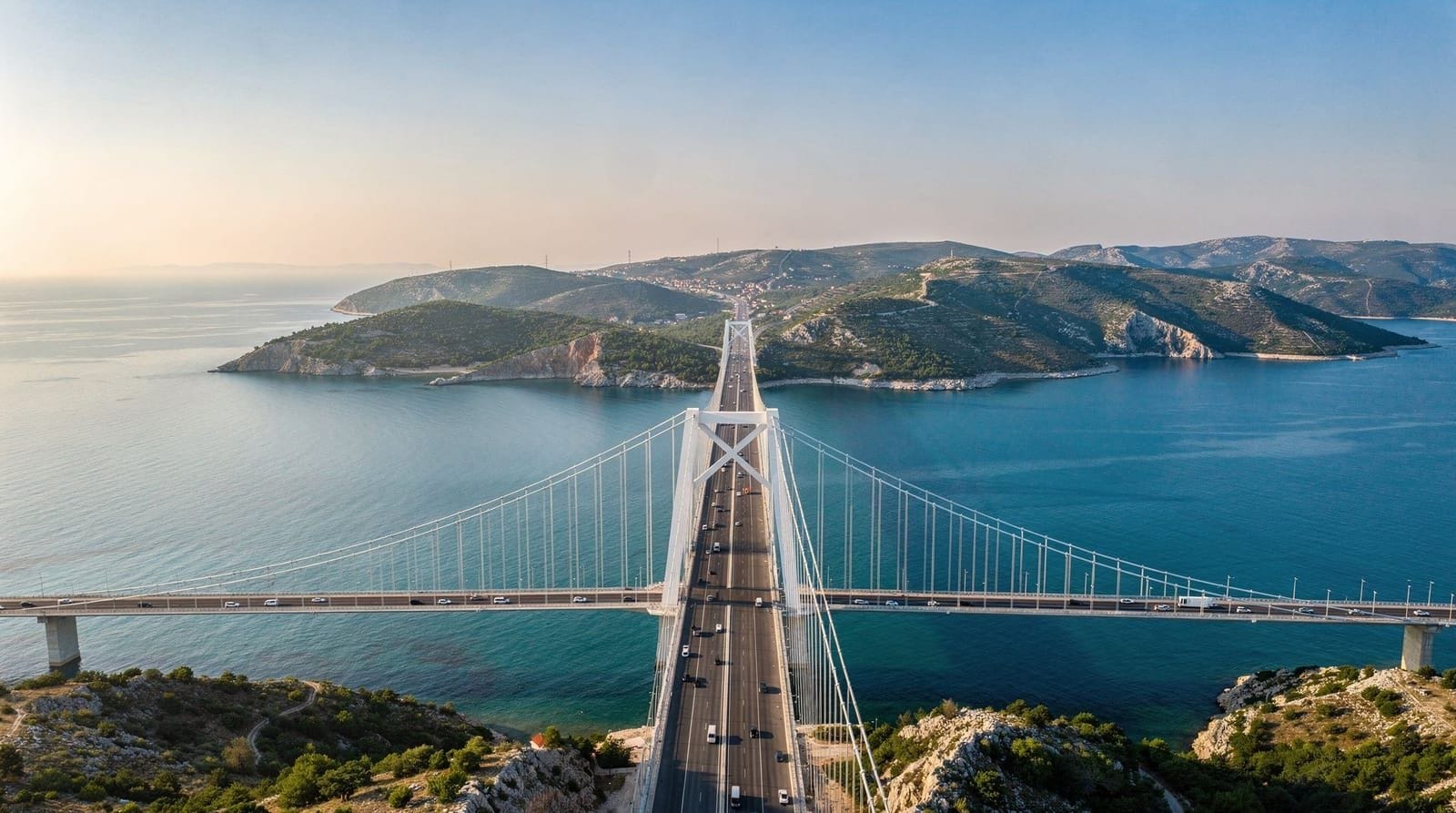
The Pelješac Bridge (opened July 2022) now provides a direct Croatian route bypassing Neum entirely. The bridge connects the mainland north of Ston directly to the Pelješac peninsula, and from there back to the D8 south of the corridor. It adds minor distance but eliminates the border crossing. See our dedicated Pelješac Bridge guide for full details.
Petrol and fuel
Unleaded 95 (eurosuper 95) is the standard fuel. Diesel (dizel) is also widely available. LPG and EV charging are increasingly available at major motorway service areas and in cities.
Petrol prices in 2026 hover around €1.50–€1.65 per litre for unleaded, with diesel slightly cheaper. Prices are regulated by the government for short periods during fuel-price spikes.
Fill up before heading to islands (petrol stations exist on major islands but are often queue-heavy in summer), remote mountain areas, or before long night drives.
Emergency and breakdown
Emergency number: 112 (police, ambulance, fire — English spoken) HAK Roadside Assistance: 1987 (Croatian Automobile Club, 24 hours, English-speaking operators)
HAK patrols major routes and can arrange towing. If you’re in a rental car, call the company’s breakdown line too — they may have their own towing arrangement.
Driving with children
Croatia is child-friendly and family road trips work well. Key considerations:
Child seats: Mandatory for children under 12 or under 150 cm — the correct restraint for the child’s weight must be used. Rental companies provide child seats for a daily surcharge (around €5–€10/day); book in advance as supply is limited in peak season.
Driving breaks: The A1 motorway has well-maintained service areas every 50–70 km with clean toilets, play areas at some stops, and food. On the coastal D8, breaks in small coastal towns are natural and scenic.
Ferry crossings with children: Car ferries have upper decks where children can move around. On catamarans, the indoor seating is enclosed — less stimulating for young children on longer crossings. The Split–Hvar car ferry (1h40m) is generally fine; the longer coastal catamaran (5–6 hours) is better suited to older children.
Road signage and navigation
Croatian road signs follow EU standards — a mix of blue (motorway), green (state road) and white (local/town) backgrounds. Distances are in kilometres. Town names are in Croatian; major international routes also show English equivalents.
Key Croatian road terms:
- Autocesta — motorway
- Ulaz — entry
- Izlaz — exit
- Zaobilaznica — bypass road
- Jednosmjerna ulica — one-way street
- Zabranjen prolaz — no entry
- Radovi na cesti — roadworks ahead
- Pazi djeca — caution: children
GPS navigation (Google Maps, Waze, Maps.me) is generally accurate in Croatia. Waze is popular with Croatian drivers and gives good real-time traffic data. Download offline maps before entering areas with poor signal (mountain tunnels, island interiors).
Tunnels and mountain roads
Croatia has several significant road tunnels:
Učka Tunnel (5.6 km): The main route connecting Istria to the Kvarner coast and the A6 motorway — well-lit, modern, a small toll (around €5). The alternative over the Učka mountain pass is slower but dramatically beautiful.
Sveti Rok Tunnel (5.8 km): On the A1 motorway through the Velebit mountains — part of the motorway, included in the distance-based toll.
Mala Kapela Tunnel (5.8 km): Also on the A1, crossing the Mala Kapela mountain range.
Mountain roads off the motorway — particularly in Gorski Kotar, the Velebit and the Biokovo massif — can be narrow, steep and exposed. The road up Biokovo from Makarska (D62) climbs 1,200 metres in under 20 km — an extraordinary drive but not for those uncomfortable with vertiginous heights. In winter, mountain roads can be closed without warning.
Overnight driving
Driving at night in Croatia is generally safe on motorways but requires care on secondary coastal roads. The D8 coastal highway has no central barrier on most sections, is poorly lit outside of towns, and has pedestrians, cyclists and animals on unlit stretches after dark. If you’re arriving late by ferry from an island, consider staying in Split or Zadar rather than pressing on along the D8 at midnight.
Wildlife is a real night-driving hazard in Slavonia and the forested interior — deer, boar and the occasional bear cross roads unpredictably. Gorski Kotar (between Zagreb and Rijeka) is particularly wildlife-active.
Environmental zones and low emission areas
As of 2026, Croatia has not yet implemented full low-emission zones (LEZ) in its major cities in the way that many Western European cities have. However, Dubrovnik restricts vehicle access to the old town (tourist vehicles banned), and some city-centre areas have permit-only access.
Electric vehicles face no particular restrictions and can use fast-charging infrastructure on the A1 motorway and at most major cities. Charging apps like NEXT-e and Puni (Croatian network) map available chargers.
Driving in winter
For those visiting between November and March, Croatian driving conditions change:
Coastal roads: Fine year-round. The D8 and coastal towns are easily navigable.
Mountain passes: The bura wind that sweeps off the Velebit mountain range toward the coast can be ferocious in winter — gusts above 150 km/h are recorded. The HAK website publishes bura warnings and road closures. Drivers of high-sided vehicles (campervans, lorries) may be banned from some exposed sections during severe bura.
Snow: The A6 Zagreb–Rijeka motorway through Gorski Kotar sees regular winter snow. The A1 is generally treated and maintained. Winter tyres (or chains) are effectively mandatory for mountain travel in December–February.
Daylight: Winter days are short — it is dark by 4:30 pm in December. Plan driving distances accordingly.
Camping and motorhome travel by road
Croatia is one of Europe’s best motorhome destinations — the coastal campsites (autocampovi) are numerous, well-equipped and positioned on spectacular Adriatic shorelines. Driving a campervan or towing a caravan adds considerations:
Vehicle category for tolls: Motorhomes and cars with caravans typically fall into Category II or III for motorway tolls, doubling or tripling the toll cost compared to a standard car. Budget accordingly.
Width restrictions: Some old-town access roads and mountain lanes are too narrow for wide motorhomes. Check vehicle width against road maximums before venturing into village streets.
Campsite reservations: Croatia’s best Adriatic campsites (Lanterna near Poreč, Campsite Straško on Pag, Omišalj on Krk) fill months ahead for July–August. Book pitches well in advance. Wild camping is technically prohibited but informal overnight parking in designated laybys is tolerated in some areas.
Drinking water: Camping gas (butan/propan) is available at larger petrol stations and hardware stores. Mains-hook-up availability varies by campsite — check before booking.
Road art and notable roadside attractions
Croatia has several remarkable roadside sights that reward stopping if you’re driving with time:
Maslenica Bridge: The elegant cable-stayed bridge where the A1 meets the Adriatic at Novigrad — spectacular views of the Velebit mountains and the Novigrad Sea below. A layby viewpoint exists just before the bridge.
Šibenik Tunnel and The Promina mountains: The A1 section between Zadar and Šibenik passes through dramatic limestone plateau scenery — tunnels, viaducts and panoramic views over the Dalmatian hinterland.
The descent to Split: The last 20 km of the A1 before Split is one of the most dramatic motorway approaches in Europe — the road drops 600 metres in a series of curves with panoramic views of the islands and the Kaštela Bay below. Consider stopping at the Dugopolje service area viewpoint before the descent.
Starigrad Paklenica: The village at the mouth of the Paklenica canyon, where the karst walls rise 400 metres immediately behind the town. A 10-minute stop from the D8 coastal road reveals one of Croatia’s most dramatic geological landscapes.
Driving in Dubrovnik: a special case
Dubrovnik’s old town and surrounding area have some of the most restrictive driving conditions in Croatia:
- The old town (Stari Grad): No vehicle access whatsoever. Cars cannot approach within several hundred metres of the walls. Approach on foot from Pile Gate or take the cable car.
- Tourist vehicle ban: During peak season, Dubrovnik has introduced restrictions on tourist vehicles entering the core urban area — enforced electronically. Residents have permit numbers; visitors without permits may be turned back or fined.
- One-way streets: The road system around the Pile Gate area is one-way and confusing at first encounter. Use GPS and follow directions precisely.
- The Dubrovnik bypass (D8): Approaching from Split, some GPS systems route through the old town area. Override this — follow signs for “Zaobilaznica” (bypass road) to reach Gruž harbour and the park-and-ride without entering the old town zone.
Should you rent a car at all?
Not every Croatia trip needs one. Compare where a car genuinely helps against where it’s dead weight.
| Route or region | Car needed? | Why |
|---|---|---|
| Istrian interior (Motovun, Grožnjan) | Yes | No regular public transport between hilltowns |
| Zagorje castles north of Zagreb | Yes | Trakošćan and Veliki Tabor have no bus service |
| Pelješac wine country | Yes, or a tour | Producers are spread along a narrow, winding road |
| Split–Hvar–Korčula–Dubrovnik island hop | No | Ferries and catamarans cover this route well |
| Dubrovnik Old Town base | No | Vehicles are banned from the old town entirely |
| Zagreb to Split via Plitvice | Optional | Buses and tours run this route; a car adds flexibility |
Cross-border driving: what actually changes
Driving into Slovenia is seamless — both countries are in the Schengen zone, so there are no routine border checks, though you should still carry your documents. Bosnia (for Mostar) and Montenegro (for Kotor) are different: both require a passport check at the border, and rental car companies need to explicitly authorise cross-border travel, sometimes for a daily surcharge. Confirm this in writing before you pick up the car, since driving an unauthorised rental across a border can void your insurance entirely if something goes wrong. Border queues for Bosnia and Montenegro lengthen considerably in July and August — budget an extra 30–60 minutes each way at peak times.
Planning your route
A rental car pays off most on routes this guide already covers in detail: the Zagreb to Split guide and the Split to Dubrovnik guide both use driving as the backbone of the journey, and our Croatia road trip itinerary sequences the scenic drives from this guide into a full multi-day loop. If you’re still deciding between renting and relying on public transport, the renting a car in Croatia guide covers costs, insurance and pickup logistics in more depth, and the getting around Croatia guide compares driving against ferries, buses and trains for the whole country.
Frequently asked questions about Driving in Croatia
What side of the road do Croatians drive on?
The right side, like most of continental Europe.What speed limits apply in Croatia?
50 km/h in urban areas, 90 km/h on open roads, 110 km/h on expressways (brze ceste), and 130 km/h on motorways (autoceste). Speed cameras are common on motorways. Radar detectors are prohibited.Are daytime headlights required in Croatia?
From 1 November to 31 March, daytime running lights (or dipped headlights) are mandatory. Outside these months they are recommended but not legally required. Many vehicles have automatic DRL; check your rental car.What is Croatia's drink-driving limit?
0.05% BAC (0.5 mg/ml) for most drivers. Zero tolerance (0.00%) for drivers under 24, commercial drivers, drivers with less than two years' experience, and motorists involved in an accident. Police enforce this actively.Can I drive to Bosnia and Montenegro from Croatia?
Yes. The coastal road from Dubrovnik north passes briefly through Bosnia (the Neum corridor) before re-entering Croatia. The Pelješac Bridge (2022) now provides a direct Croatian route bypassing Neum. For Montenegro and Bosnia day trips, you cross the border — bring your passport and check rental car cross-border permissions.Is there a vignette for Croatian motorways?
No. Croatia uses a distance-based toll system — you take a ticket at the motorway entrance and pay at the exit based on the distance driven. No vignette sticker is needed.What documents must I carry while driving in Croatia?
Driving licence, vehicle registration document (or rental agreement), valid insurance/Green Card, and your passport or national ID card.Is it worth renting a car for a Croatia trip, or better to rely on buses and ferries?
It depends on your route. A car is genuinely valuable for the Istrian interior, the Zagorje castles, Pelješac wine country and any national park beyond Plitvice, none of which are well served by public transport. If your trip is mostly island-hopping along the coast — Split, Hvar, Korčula, Dubrovnik — ferries and buses work fine and a car adds cost and parking hassle without much benefit. Many visitors do a mixed trip: no car on the islands, a rental car for a few inland days.How bad is summer traffic on the coastal road, really?
Genuinely bad in short, predictable bursts. The approach to Dubrovnik on the D8 can back up 1–3 hours in late July and August, and similar (if shorter) queues form around Split and the Makarska Riviera on changeover days (Saturdays, when weekly rentals turn over). Outside those windows and locations, coastal driving is manageable. Timing your driving for early morning or evening avoids the worst of it.
Top experiences
Best-rated activities across GetYourGuide and Viator.

Mostar and Herzegovina Tour with Kravica Waterfall from Split & Trogir
- Viator

Mostar & Kravice waterfalls full-day guided tour from Split
- Viator

Split airport to Split Private transfer to 8 pax (Door to Door any location)
- Viator

Zagreb to Split Group Transfer with Plitvice Lakes guided Tour
- Viator

Zadar: Zrmanja River Kayaking, with optional transfer from Zadar
- Viator

Mostar and Kravica Waterfall Discovery Day Trip from Split or Trogir
- Viator