Euphrasian Basilica, Poreč: the complete guide
Pula: Private walking tour
What is the Euphrasian Basilica in Poreč?
The Eufrazijeva Basilica (Euphrasian Basilica) is a 6th-century early Christian and Byzantine episcopal complex in Poreč, Istria, inscribed on the UNESCO World Heritage List in 1997. It is best known for its apse mosaics — gold-ground Byzantine mosaics of exceptional quality, comparable to those of Ravenna, depicting the Virgin and Child with Bishop Euphrasius and the local martyrs.
Gold in the apse: Poreč’s Byzantine treasure
The Eufrazijeva Basilica in Poreč is one of the most beautiful and least-visited UNESCO World Heritage Sites in Croatia. It does not have the dramatic setting of Dubrovnik’s city walls or the living-history immediacy of Diocletian’s Palace in Split. What it has is a mosaic programme in its apse that belongs among the finest examples of early Christian and Byzantine art in the world — comparable in quality (and exactly contemporary) to the most celebrated mosaics of Ravenna, Thessaloniki and Constantinople.
If you have any interest in Byzantine art, early Christian architecture, or the history of the Mediterranean world in late antiquity, Poreč is not optional. And even without specialist interest, the gold-ground mosaic of the Virgin enthroned, surrounded by angels and bishops and the local martyrs, in a 6th-century basilica built on the ruins of four centuries of earlier churches, is simply astonishing.
| Where | Poreč old town, Istria |
| Cost | Around €5 basilica + museum; bell tower +€3–4 |
| Time needed | 45–90 minutes for the complex |
| Best time | Morning, when the apse is lit from the east |
| Getting there | Bus from Pula (~1h) or Rovinj (30–40 min) |
Four layers of sacred history
What makes the Euphrasian Basilica complex exceptional is not just the 6th-century building but the stratigraphic depth beneath it — the visible remains of the successive churches that preceded the current basilica on the same site.
Early 4th century: A private house (domus) was converted for Christian use shortly after the Edict of Milan (313 AD) legalised Christianity in the Roman Empire. Floor mosaics from this phase survive in the narthex floor — fragmentary but datable.
Mid-4th century: A more formal church — a double nave structure (the Pre-Euphrasian basilica) — replaced the house church. Floor mosaics from this building are the most extensive of the pre-Euphrasian layers; the famous “ichthys” (fish) mosaic with a basket of bread is from this period and is preserved under glass in the floor of the current basilica.
Late 4th / early 5th century: A larger single-nave basilica was constructed. Elements of this building are incorporated into the current structure.
553–554 AD: Bishop Euphrasius undertook the most ambitious phase of construction — essentially rebuilding the entire complex and commissioning the mosaic programme that survives today. His name and portrait appear in the apse mosaics themselves; he holds a model of the church he built.
The depth of this sequence — from a private house church of the 4th century to a major Byzantine episcopal complex of the 6th century, preserved under (and in) the current building — makes Poreč a uniquely important site for the history of early Christianity in the western Mediterranean.
The apse mosaics: reading the programme
The mosaic programme in the main apse is the centrepiece of the basilica and one of the finest single-apse compositions in the Byzantine world. The gold-ground technique — small tesserae of glass with gold leaf backing, set at slight angles to catch and scatter light — creates the luminous, almost dematerialised effect that characterises the best Byzantine mosaic art.
Conch (the curved surface of the apse): The central composition depicts the Virgin Mary enthroned with the Christ Child, flanked by angels. To the Virgin’s right, St. Maurus (the local 1st-century martyr) presents Bishop Euphrasius (holding the model of his church) and his brother Claudius; the Claudius holds his son Euphrasius the younger. On the Virgin’s left, the archangel Gabriel and further figures complete the composition.
This is an unusual composition. Most Byzantine apse programmes place Christ (not the Virgin) in the central position; the Poreč choice — the Virgin enthroned with Child in the position of majesty typically reserved for Christ — places Poreč among the very early examples of Marian apse iconography. The Virgin is also depicted in the type known as the Theotokos (God-bearer, or Mother of God) — a title whose theological definition was finalised at the Council of Ephesus in 431, making the Poreč mosaics a relatively early post-Ephesus expression.
Triumphal arch: The arch above the apse opening carries additional figures — the Annunciation (the Angel Gabriel and the Virgin Mary), the Visitation (Mary visiting Elizabeth), and the presentation of gifts by the Magi. Christ enthroned is depicted in the arch lunette.
Side panels and other mosaics: Portrait medallions of local martyrs and saints fill the remaining mosaic surfaces. The quality of individual portraiture — even in the medallion format — is remarkable; individual faces have specific, almost recognisable character.
The baptistery and bishop’s palace
The baptistery — a free-standing octagonal structure adjacent to the atrium — is largely 6th century but has been modified. Its central font, where adult baptism by full immersion was performed, is still visible. The octagonal form was standard for early Christian baptisteries (the most famous example is the Lateran Baptistery in Rome); the Poreč example is well-preserved despite later alterations.
The bishop’s palace on the north side of the atrium now serves as the museum of the Euphrasian Basilica complex. It holds:
- Earlier mosaic fragments from the 4th and 5th-century predecessor churches, including pieces of the famous fish mosaic
- Architectural stonework from various building phases
- Early medieval liturgical objects
- A small collection of medieval and Byzantine finds from the site
The museum provides essential context for understanding the sequence of building phases visible in the basilica itself.
The bell tower and atrium
The bell tower (14th century, added to the complex well after the Byzantine construction) can be climbed for views over the Poreč peninsula, the Poreč Channel, and — on clear days — the islands of Brioni to the south. The climb is accessible by a medieval stair; the view from the top rewards the effort. Entry: an additional €3–4 beyond the basilica ticket.
The atrium — the forecourt of the basilica, flanked by a colonnade — includes a well-head and several fragments of early Christian stonework. It functions as the transition zone between the street and the sacred space of the basilica; in antiquity, this was where catechumens (those preparing for baptism) could stand without entering the main church.
Poreč old town: the Roman grid
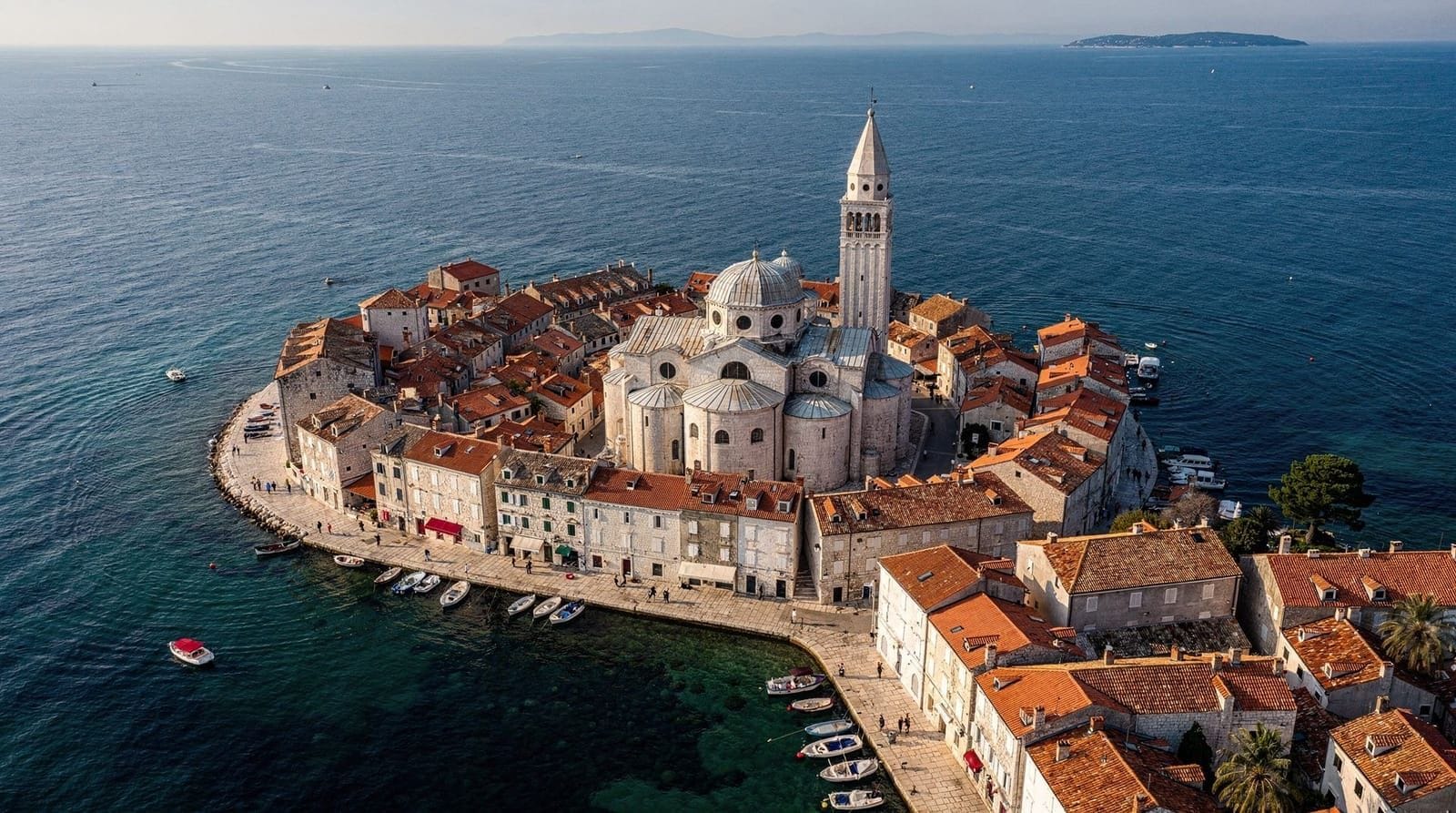
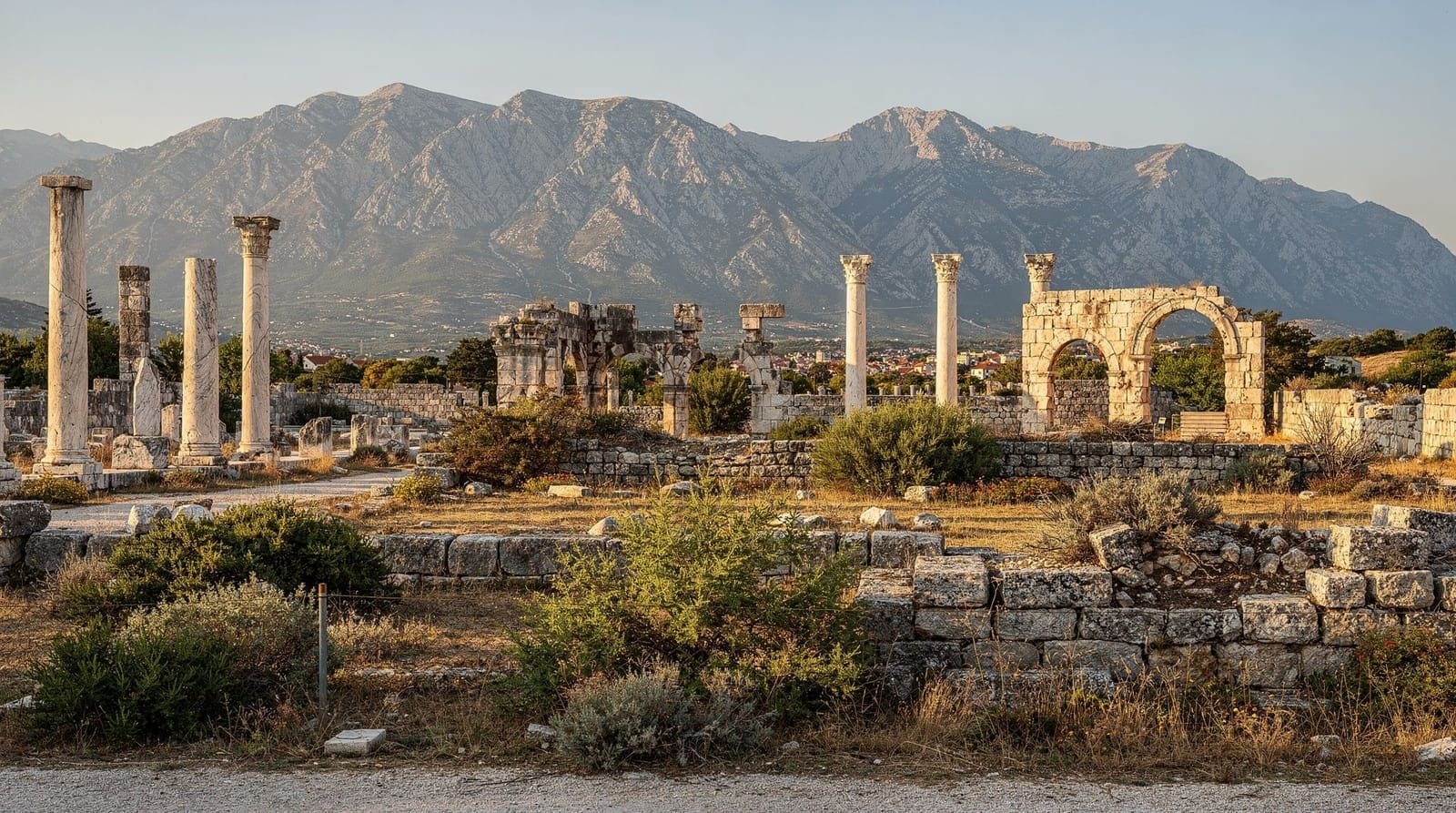
Poreč (ancient Parentium) is a Roman town — its street pattern is the Roman grid laid out in the 1st century AD, still clearly legible in the modern old town. The Decumanus (main east-west road of the Roman town, now a pedestrian shopping street) remains the principal axis of the old town.
Forum Square (Marafor): The ancient Roman forum of Parentium is today a square at the western end of the Decumanus. Two Roman temples originally flanked the forum; their remains are partially visible. The Temple of Neptune (partially preserved walls) and the Temple of Mars are the two structures in question; both date from the 1st or 2nd century AD.
The town walls: Poreč’s medieval and Venetian-era walls are partially preserved. The Round Tower (Okrugla kula) and Pentagonal Tower (Peterokutna kula) on the waterfront date from the late medieval/Venetian period.
The waterfront and harbour: The western waterfront of the Poreč peninsula faces the Poreč Channel and the island of Sveti Nikola. In summer, regular boat services connect the old town to the island (5 minutes); Sveti Nikola has a small beach and a ruined 18th-century church. The Poreč waterfront café culture is more relaxed than Split or Dubrovnik.
Practical visitor information
Getting to Poreč: From Pula airport (55km south): no direct bus, taxi or rental car needed. From Rovinj (40km south): bus 30–40 minutes, regular service. From Pula city (55km): bus approximately 1 hour. From Zagreb (300km): motorway (A7, A8) approximately 3 hours.
When to visit: Poreč is less seasonal than the Dalmatian coast but summer still brings peak crowds from the large resort hotels in the surrounding municipality. May–June and September are significantly more pleasant. The basilica in morning light (before noon) is the recommended window for the mosaics.
Combining with the rest of Istria: Poreč fits naturally into an Istrian circuit: Pula (60km south) → Rovinj (40km south) → Poreč → Motovun (40km east, inland) → back to Pula. Three to five days covers Istria comfortably with a car.
Why Poreč is undervisited
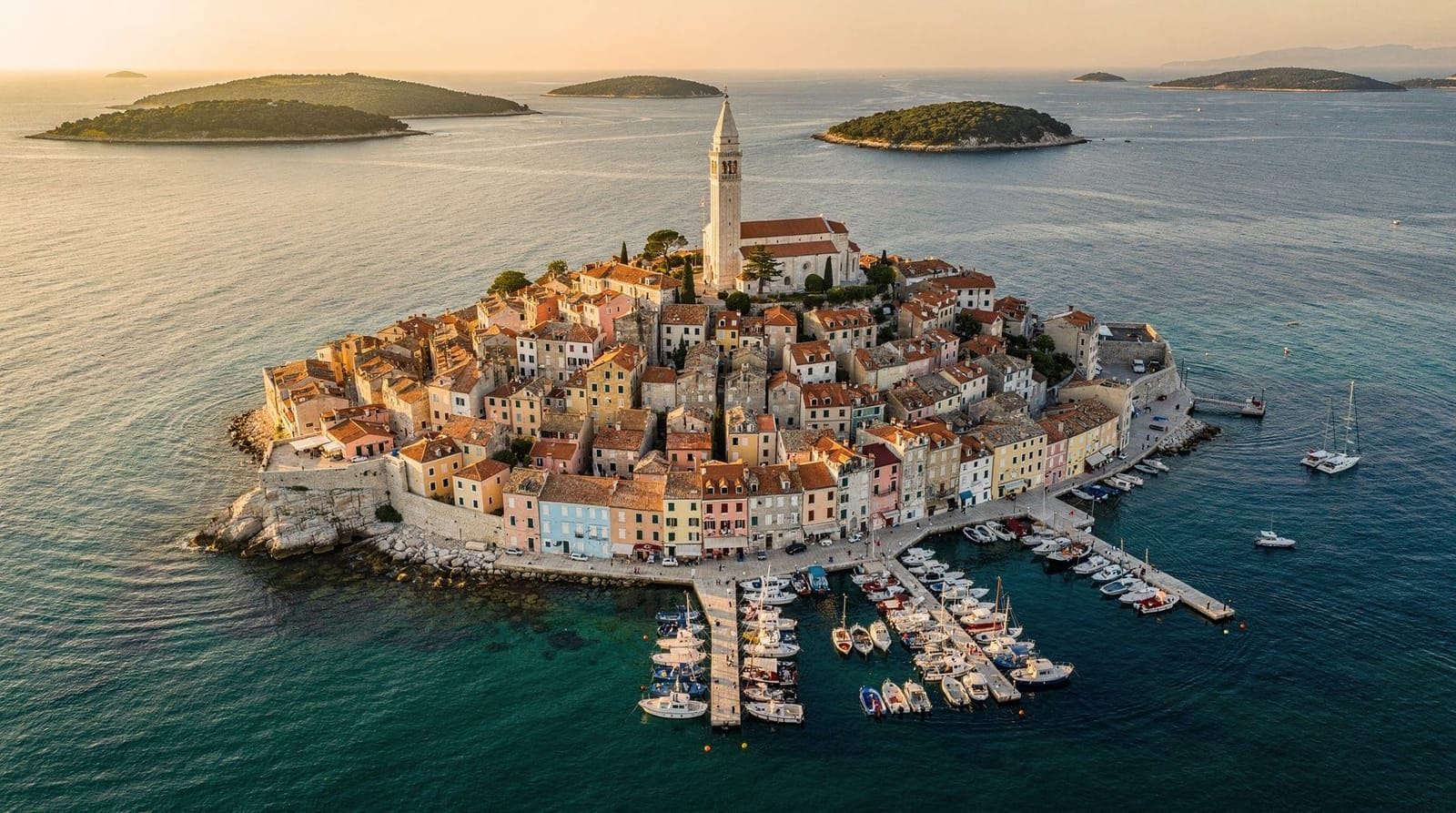
A candid observation: most international visitors to Croatia focus on the Dalmatian coast and do not reach Istria at all, or reach only Rovinj without continuing to Poreč. This is partly Rovinj’s strength as a destination (it is more immediately photogenic) and partly Poreč’s relative lack of visual drama from the exterior — the basilica looks modest from the outside; its treasure is entirely interior.
The visitor who does reach Poreč tends to be pleasantly surprised — not just by the mosaics but by the relative lack of crowds, the genuine liveliness of the old town (Poreč is a real working town, not a tourism monoculture), and the quality of the Istrian food scene (olive oil, wine, truffle-based dishes) that applies throughout the peninsula.
Comparing Poreč to Istria’s other historic towns
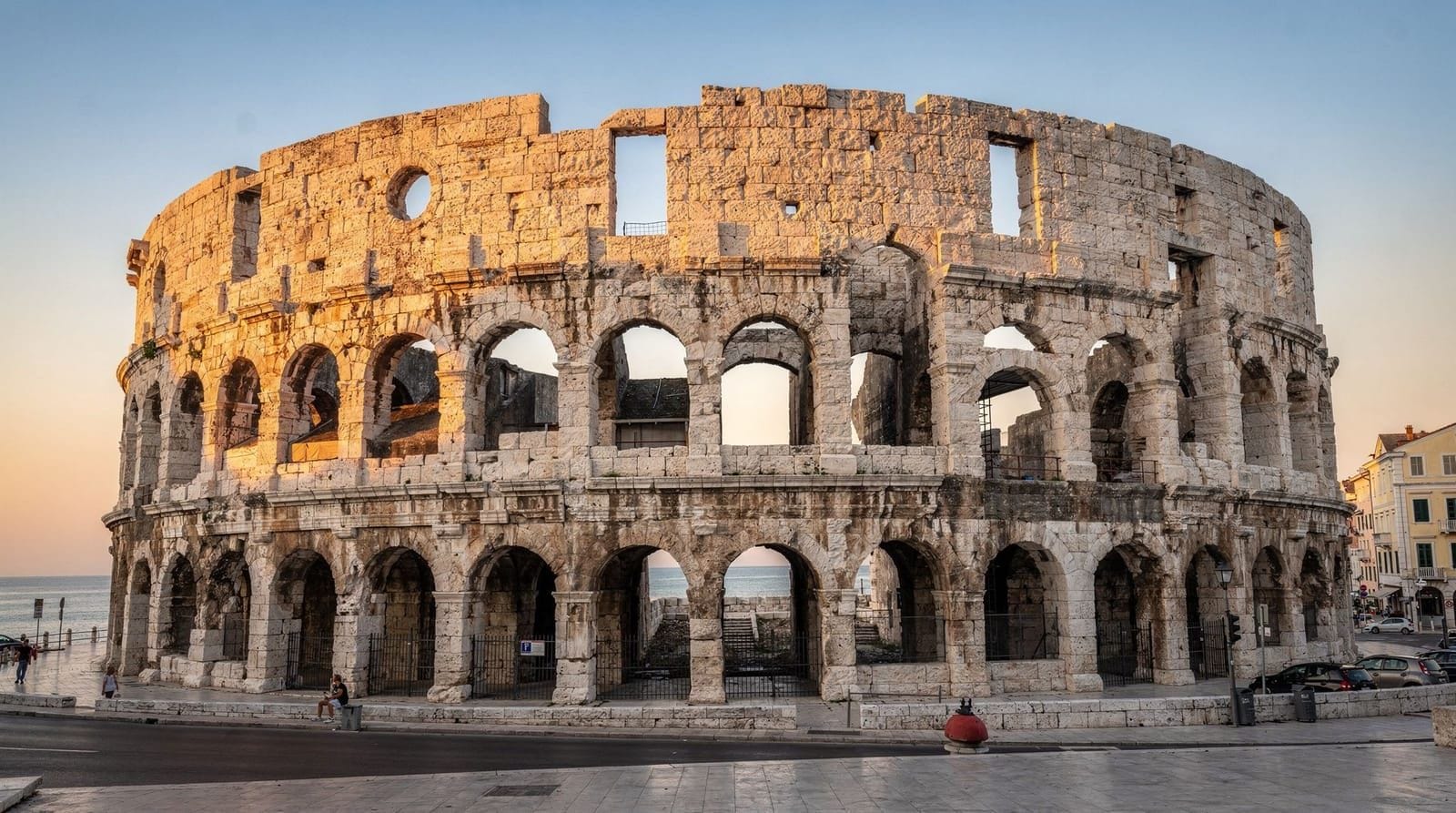
Poreč sits alongside Rovinj and Pula as one of Istria’s three major historic towns, and each rewards a different kind of interest. Rovinj wins on photogenic waterfront charm; Pula has the Roman amphitheatre and street-level Roman remains at a scale nothing else in Istria matches; Poreč’s strength is entirely interior — the basilica’s mosaics reward visitors who read the Istria vs Dalmatia guide and come specifically for the region’s Roman and Byzantine layers rather than beach time.
Pairing the basilica with Istria’s food and countryside
Istria’s inland reputation for truffles, olive oil and wine is well earned, and Poreč makes a sensible base for a short countryside detour. The Istrian truffles guide covers the Motovun area (about 40km inland) if you want to combine the basilica visit with a hunt or a tasting menu the same trip. For travellers building a longer circuit, cycling in Istria covers routes that connect Poreč with the coast and hill towns at a gentler pace than driving.
Frequently asked questions about Euphrasian Basilica, Poreč
How old are the mosaics in the Euphrasian Basilica?
The principal mosaics date from around 553–554 AD, commissioned by Bishop Euphrasius during the reign of the Byzantine Emperor Justinian I — the same period that produced the famous mosaics of Sant'Apollinare in Classe in Ravenna. Earlier mosaic fragments from a 4th-century predecessor church are also preserved in the floor and narthex.How much does it cost to visit the Euphrasian Basilica?
Entry to the basilica and museum complex costs around €5 for adults (2026). Climbing the bell tower is an additional €3–4. The mosaics are visible from the nave without paying additional entry, but the museum provides essential context. The complex is also a working parish church and masses are held regularly.How does the Euphrasian Basilica compare to Ravenna?
The mosaics of Ravenna are more extensive — Ravenna has multiple churches with extraordinary mosaic programmes from the same Byzantine period. The Poreč mosaics are exceptional in quality, particularly the apse composition and the individual portrait panels. Ravenna's San Vitale and Sant'Apollinare Nuovo have stronger overall mosaic programmes; the Poreč apse is arguably the finest single apse composition outside Ravenna.What else is in the Euphrasian Basilica complex?
The complex includes: the basilica itself (6th century), the narthex (entrance hall), the atrium (forecourt with a well), the baptistery (octagonal, 6th century), the bishop's palace (now a museum of the complex's archaeology), and the detached bell tower (accessible separately for views). The archaeological museum in the bishop's palace displays earlier mosaic fragments, architectural stonework and finds from the successive churches on the site.Is Poreč worth visiting beyond the basilica?
Yes — Poreč old town sits on a small peninsula with a Roman street grid still legible in the modern layout. The Decumanus (main east–west Roman street) is still the principal commercial street; Forum Square (Marafor) contains the remains of two Roman temples. The waterfront is pleasant and less developed than in Split or Dubrovnik.How do I get to Poreč?
Poreč is in Istria, 55km north of Pula. By road from Pula: 55km (45 minutes). From Rovinj: 40km (35 minutes). From Zagreb: around 300km (3 hours by motorway). No train service; bus connections from Pula, Rovinj and Rijeka are regular. Poreč is also accessible by catamaran from Rovinj and from Venice (seasonal service).When is the best time to visit the Euphrasian Basilica?
Morning light enhances the gold-ground mosaics — the apse faces east and is best illuminated in the morning. May, June and September are the least crowded months. The basilica is a working church, so avoid the main Sunday and feast-day mass times if you want to walk freely around the interior.
Top experiences
Bookable activities with verified prices and instant confirmation on GetYourGuide.
Top experiences
Best-rated activities across GetYourGuide and Viator.

From Zadar: Plitvice Lakes with Boat Ride & Zadar Old town tour
- Viator

3Hour ALL-INCLUSIVE Sunset Dolphin Watching from Medulin onSandra
- Viator

Dolphin Watching & Sunset Boat Tour With Drinks & optional Dinner
- Viator

Fantastic DOLPHIN & SUNSET TOUR with dinner ( Pula-NP BRIJUNI )
- Viator

Medulin :All-Inclusive Pirate Boat Dolphin Watching Sunset Cruise
- Viator

Zadar Highlights: Old Town, Sea Organ & Local Tastings
- Viator