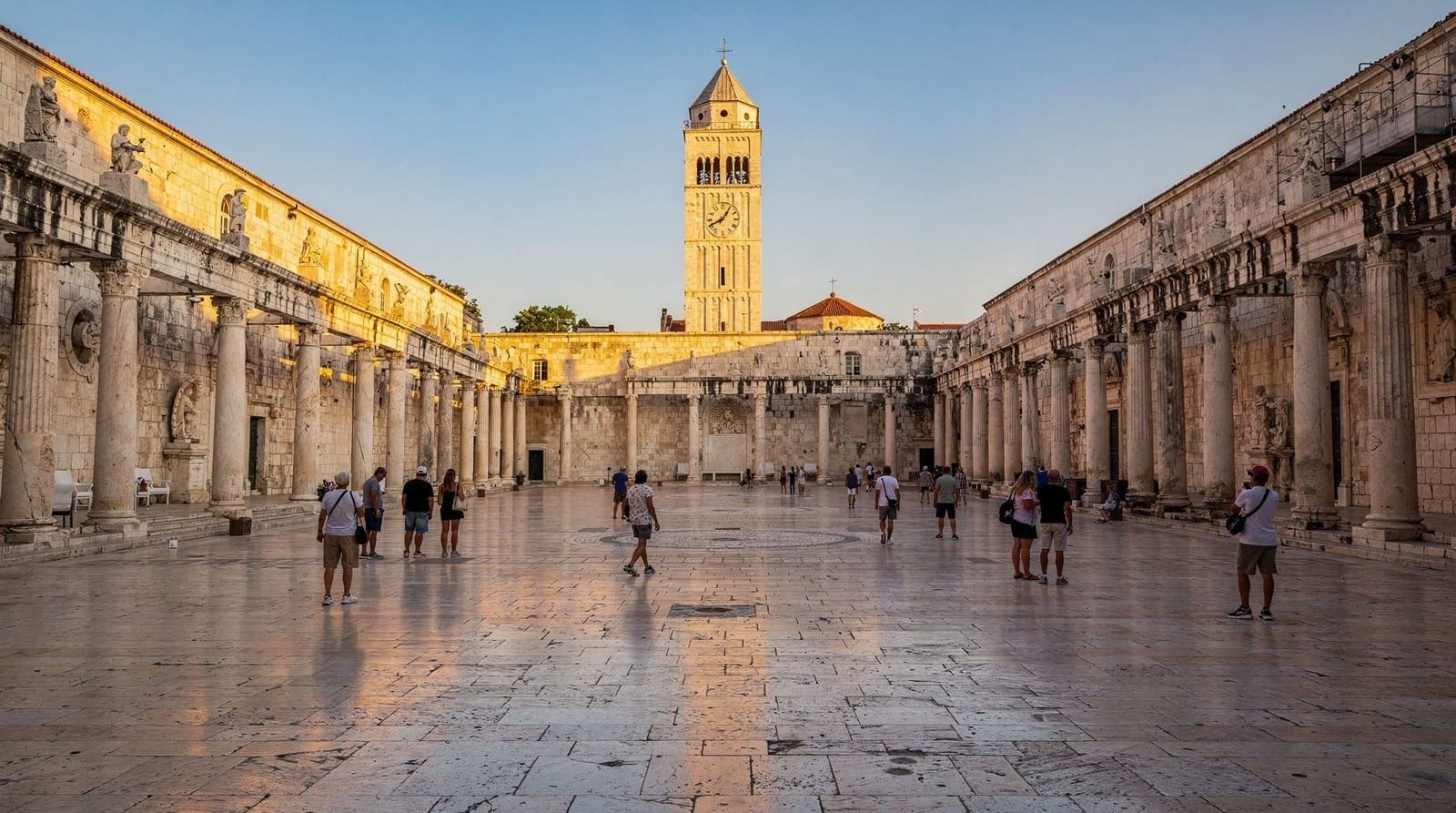
Croatia: a brief, honest history
Dubrovnik: History walk through the old town
When did Croatia become an independent country?
Croatia declared independence from Yugoslavia on 25 June 1991. International recognition came in January 1992. The country became a member of the European Union on 1 July 2013, entered the Schengen Area on 1 January 2023, and adopted the Euro the same day.
| Roman era | 1st century BC–5th century AD — Split, Pula, Zadar |
| Venetian era | 1420–1797 — Gothic-Renaissance Dalmatian towns |
| Independence | Declared 25 June 1991, war 1991–95 |
| EU / Schengen / Euro | 2013 / 2023 / 2023 |
| Where to see it | Diocletian’s Palace, Pula Arena |
A country shaped by everyone else’s interests
To understand Croatian history is to understand a country that spent most of its existence in someone else’s empire. Romans, Byzantines, Franks, Hungarians, Venetians, Habsburgs, Ottomans, Napoleonic France, the Austro-Hungarian Empire, Yugoslavia — Croatia has been administered, fought over, divided, shaped and reshaped by external powers for the better part of two millennia.
What is remarkable is not the disruption but what survived. The Roman amphitheatre in Pula still stands. The Venetian-Gothic architecture of Split, Zadar and Hvar still frames daily life. The Republic of Dubrovnik (Ragusa) maintained its independence by sheer diplomatic cunning for five centuries. The Croats retained their language, their alphabet and a distinct cultural identity through all of it. Croatian independence in 1991, after decades in Yugoslavia, was not an invention — it was, in a real historical sense, a restoration.
Prehistoric and Illyrian period (before 1st century BC)
The territory of modern Croatia has been inhabited since the Palaeolithic period — Neanderthal remains (Krapina Man) found in Zagorje north of Zagreb date from 125,000 to 28,000 years ago, one of the most significant Neanderthal sites in Europe.
By the Iron Age (8th–1st century BC), the dominant populations of the eastern Adriatic hinterland were the Illyrians — a collection of Indo-European tribes whose exact ethnic and linguistic character is still debated but who left a significant material culture. The Japodes and Liburnians were two major Illyrian groups in the Croatian territory.
On the coast, Greek colonists established settlements from the 4th century BC: Tragurion (Trogir), Pharos (Stari Grad on Hvar island), Issa (Vis), Epetion (Stobreč near Split). These were trading posts and agricultural colonies connected to the broader Greek colonial network across the Mediterranean.
Roman Dalmatia (1st century BC – 5th century AD)
Roman expansion into the eastern Adriatic began with campaigns against Illyrian piracy in the late 3rd century BC. By 9 AD, after the Pannonian revolt and the Illyrian uprisings had been suppressed, the territory of modern Croatia was divided between the provinces of Dalmatia (the coast and hinterland) and Pannonia (the interior and the Sava valley).
The provincial capital of Dalmatia was Salona (modern Solin, near Split) — a city that by the 2nd century AD held perhaps 60,000 people, making it one of the largest cities in the western Roman Empire. Pola (Pula), Iader (Zadar), Narona (near Metkovic) and Epidaurum (Cavtat) were other major centres.
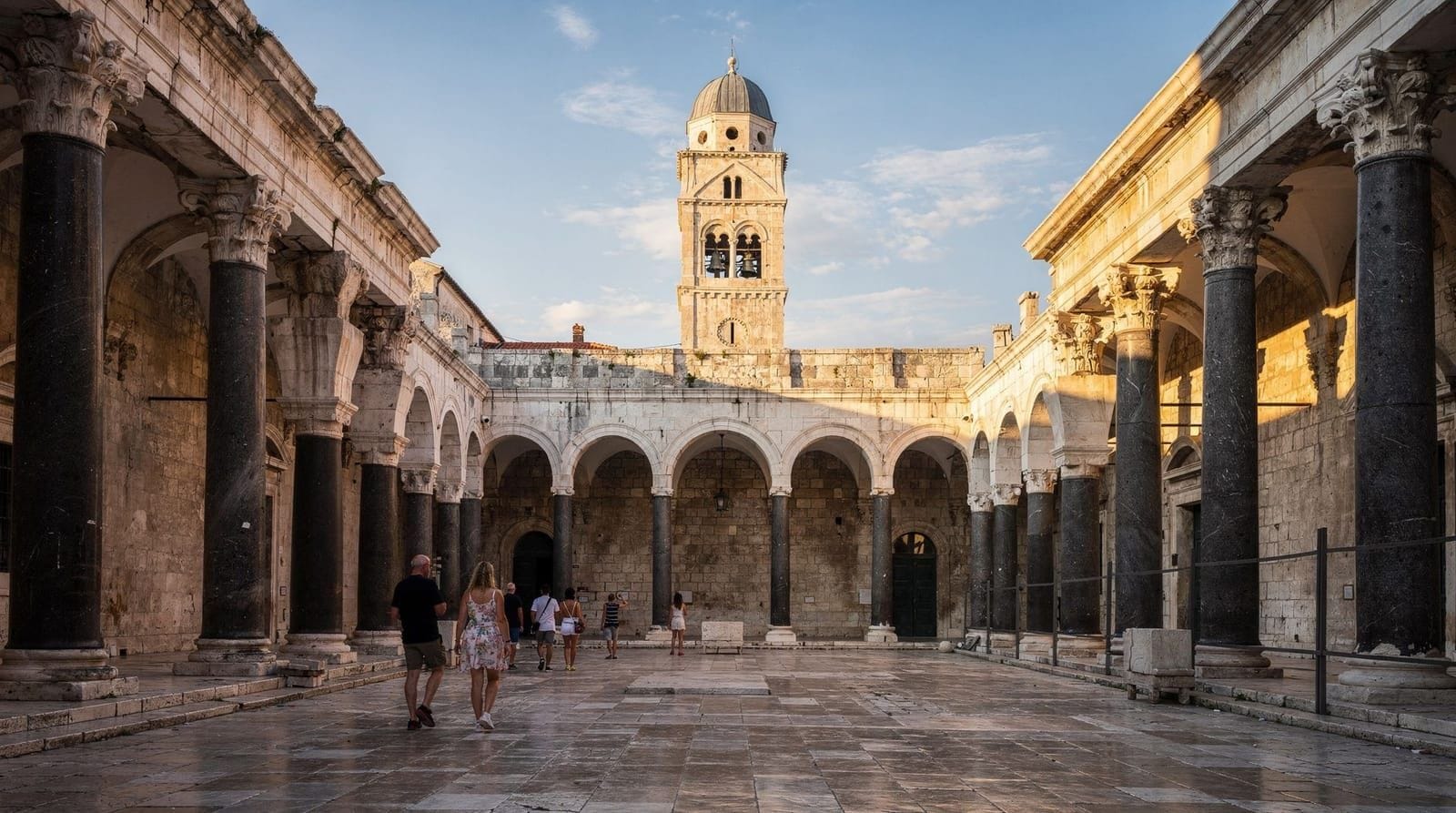
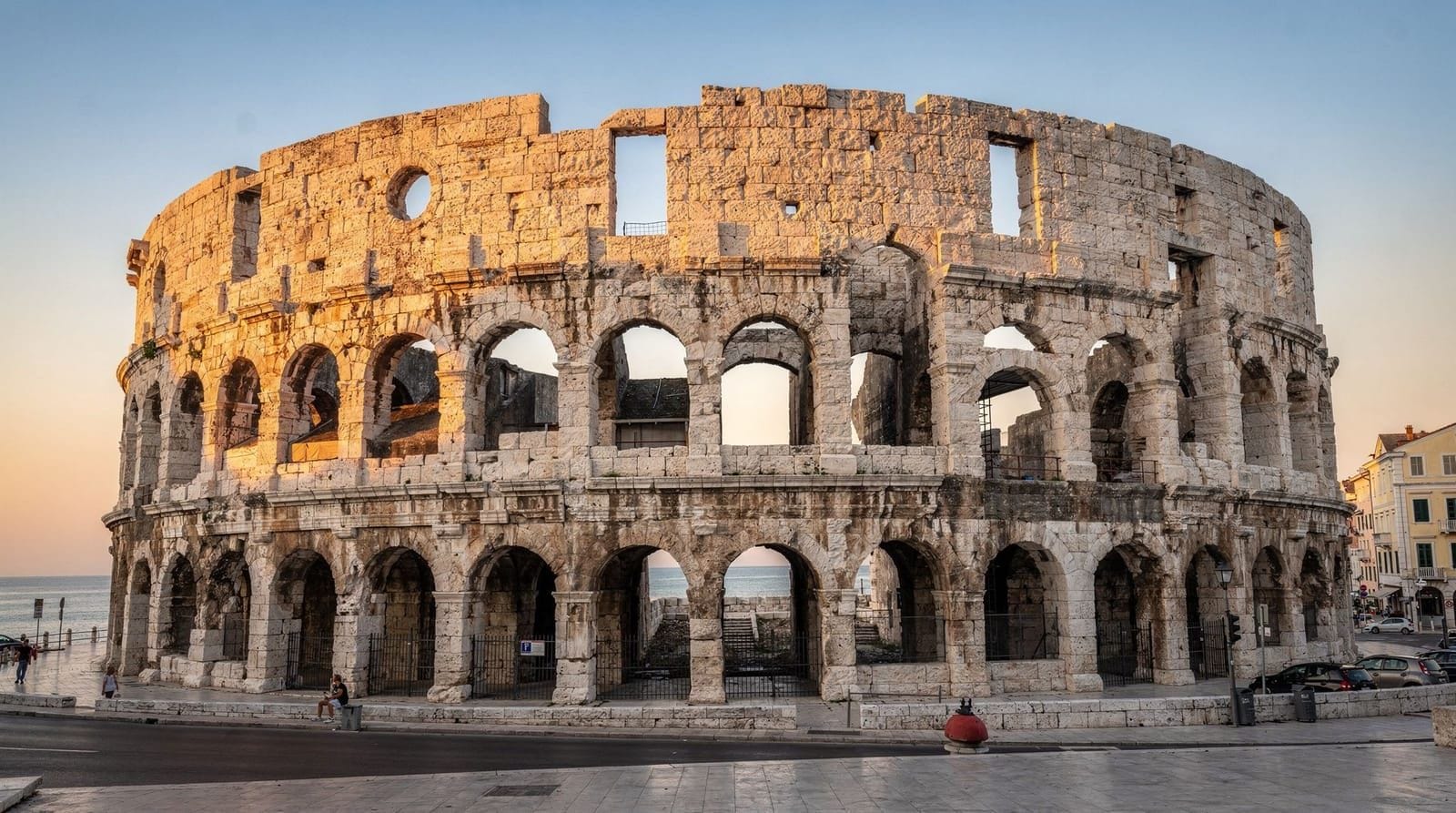
The most visible legacy of Roman Dalmatia is Diocletian’s Palace in Split — built as the retirement palace of Emperor Diocletian (reigned 284–305 AD) and continuously inhabited ever since. The Pula Arena, the Temple of Augustus, and the Arch of the Sergii are other outstanding Roman survivals. The Roman road network, following coastal routes and river valleys, largely determines the modern transport geography of Croatia.
Christianity spread through Roman Dalmatia in the 3rd and 4th centuries — the province produced several early martyrs, and the Episcopal Complex in Poreč (the Eufrazijeva Basilica) represents 6th-century Byzantine Christian architecture of the first rank.
The early medieval period (5th–10th centuries)
The collapse of Roman power in the western empire in the late 5th century destabilised the Adriatic. Salona was progressively abandoned as Slavic and Avar raids intensified in the 7th century; its population moved into the former imperial palace at Split, beginning the town’s medieval history.
Slavic peoples migrated into the Balkans and Adriatic during this period. The people who would become Croats (Hrvati) settled the eastern Adriatic coast and its hinterland by the 7th century. Their ethnic origin and the mechanism of their arrival remain subjects of scholarly debate; the name “Croat” appears in Byzantine sources from the 10th century.
The first Croatian principality emerged under Byzantine suzerainty in the 9th century. Duke (Knez) Branimir (879–892) established formal relations with Rome, giving Croatia recognition as a Christian polity independent of Byzantium. The first Croatian kingdom was established in the late 9th or early 10th century; Tomislav is traditionally regarded as the first king (around 925 AD), though the historical record is sparse.
The medieval kingdom and Hungarian union (10th–16th centuries)
The Croatian kingdom expanded its territory in the 10th and 11th centuries to include Dalmatia (previously Byzantine and then Venetian) and Bosnia. After a period of dynastic crisis following the death of King Zvonimir (1089), the Croatian nobility negotiated a personal union with the Hungarian kingdom — the Pacta Conventa (1102), a treaty whose terms are still disputed by historians.
Under the Arpad and later Anjou dynasties of Hungary-Croatia, the Croatian nobility retained significant autonomy within a dual kingdom. The medieval period saw the building of Trogir Cathedral (from the 13th century), the fortification of coastal cities, and the gradual establishment of the independent Commune of Ragusa (Dubrovnik) as a self-governing maritime republic.
Venice seized most of Dalmatia progressively from 1357 to 1420, establishing control over Zadar, Split, Trogir, Šibenik, Hvar and Korčula. This Venetian period (1420–1797 in most of Dalmatia) left the most visible architectural legacy of the medieval and early modern period: the Gothic-Renaissance townscapes of the Dalmatian coast.
The Ottoman Empire began expanding into the Balkans in the 14th century and entered Croatian territory from the early 15th century. By the mid-16th century, Ottoman forces controlled much of Bosnia, Slavonia and the Croatian interior. The remaining Croatian territory became known as the “remnants of the remnants of once glorious Croatia” (reliquiae reliquiarum). The Military Frontier (Vojna Krajina) — a buffer zone populated with settlers (many of Serbian Orthodox background) brought in by the Habsburgs — was established to defend against further Ottoman advance.
Habsburg rule (16th–19th centuries)
After the Ottoman victory at the Battle of Mohács (1526) and the death of the last Jagiellonian king of Hungary-Croatia, the Croatian nobility elected Ferdinand I of Habsburg as their ruler. Habsburg control of Croatia endured — with interruptions — until 1918.
Under Habsburg rule, the Croatian lands were administratively complex: Dalmatia (Venetian until 1797), Istria (Venetian until 1797), and Civil Croatia-Slavonia (Habsburg from the 16th century) were governed separately. Napoleon’s brief Illyrian Provinces (1809–1813), which unified most of these territories, introduced French administrative modernisation and the use of South Slavic languages in official contexts — a brief but influential interlude.
After 1815 the Habsburg restoration created the Austro-Hungarian Empire, under which Croatia-Slavonia was a kingdom with limited autonomy within the Hungarian part of the Dual Monarchy. Dalmatia remained administratively within the Austrian part. The 19th century saw the Croatian National Revival (Narodni preporod) — a cultural and linguistic movement that standardised the Croatian literary language (based on the Štokavian dialect) and articulated Croatian national identity within the broader South Slavic context.
Yugoslavia: two versions (1918–1991)
After World War One, the Kingdom of Serbs, Croats and Slovenes was proclaimed in December 1918 — a union of South Slavic states emerging from the ruins of the Austro-Hungarian and Ottoman Empires. For Croatians, this meant exchanging one imperial framework for another in which Serbian political dominance was a constant source of friction.
The fascist Ustaše regime, which collaborated with Nazi Germany and occupied Croatia during World War Two (1941–45) as the Independent State of Croatia, committed mass atrocities against Jews, Roma and Serbs — crimes that cast a long shadow over Croatian-Serbian relations for decades. The Partisan resistance led by Josip Broz Tito defeated both the Ustaše and Serbian Chetnik forces; Yugoslavia’s communist government was established in 1945.
Tito’s Yugoslavia was a peculiar communist state — expelled from the Soviet bloc in 1948 (the Tito-Stalin split), it pursued a non-aligned foreign policy and a form of market socialism that allowed more consumer freedom than the Soviet satellites. Internal organisation was federal: six republics (Slovenia, Croatia, Bosnia-Herzegovina, Serbia, Montenegro, Macedonia) and two autonomous provinces (Kosovo, Vojvodina).
Croatian national sentiment periodically asserted itself — the Croatian Spring (Hrvatsko proljeće) of 1971, a reform movement demanding greater autonomy, was suppressed by Tito but led to the 1974 constitution that gave the republics more powers. After Tito’s death in 1980, the rotating presidency system could not hold the federation together as economic crisis and nationalist tensions mounted through the 1980s.
Independence and the 1990s war
Croatia’s first multi-party elections since before World War Two were held in April–May 1990. The Croatian Democratic Union (HDZ) under Franjo Tuđman won, and the process of separating from Yugoslavia began. On 25 June 1991, Croatia declared independence simultaneously with Slovenia.
The war that followed was brutal. In Slavonia, the Yugoslav People’s Army and Serbian paramilitaries besieged and effectively destroyed Vukovar after 87 days (August–November 1991) — a hospital was shelled, civilians were killed, and the city was systematically demolished. In Dalmatia, the coastal road was cut and Dubrovnik besieged; shelling of the old city caused significant damage, though the population held out.
A UN-brokered ceasefire in January 1992 established peacekeeping zones but froze the conflict without resolving it. International recognition of Croatian independence followed. In 1995, Croatian military offensives (Operation Flash in May, Operation Storm in August) retook the occupied Krajina territory in a matter of days; the operations were associated with the exodus of most of the Serbian Krajina population.
The Dayton Agreement (December 1995) ended the Bosnian war and established the postwar framework for the region.
Post-war Croatia: EU accession and the Euro
Croatian reconstruction in the 1990s and 2000s proceeded alongside a long process of EU accession negotiations, complicated by the International Criminal Tribunal for the former Yugoslavia (ICTY) requirements that Croatia cooperate in extraditing indicted war criminals. Croatia joined NATO in 2009 and the EU on 1 July 2013.
The economy has been heavily dependent on tourism — which now accounts for roughly 20% of GDP in direct and indirect contributions. The Adriatic coast and islands are among Europe’s most popular summer destinations.
On 1 January 2023, Croatia entered the Schengen Area (ending border controls with other Schengen members) and adopted the Euro, replacing the kuna at a fixed rate of 7.53 HRK to €1.
Key dates at a glance
| Year | Event |
|---|---|
| ~384 BC | Greek colony of Pharos (Stari Grad, Hvar) founded |
| ~305 AD | Diocletian’s Palace in Split completed |
| 7th century | Slavic/Croat settlement of the Adriatic hinterland |
| ~925 | King Tomislav — first Croatian kingdom |
| 1102 | Pacta Conventa: personal union with Hungary |
| 1420 | Venice takes Dalmatia |
| 1527 | Habsburgs become rulers of Croatia |
| 1797 | Venice abolished; Dalmatia to Austria |
| 1918 | Kingdom of Serbs, Croats and Slovenes |
| 1945 | Communist Yugoslavia established under Tito |
| 25 June 1991 | Croatia declares independence |
| 1991–95 | Homeland War (Domovinski rat) |
| 1 July 2013 | Croatia joins EU |
| 1 January 2023 | Croatia joins Schengen, adopts Euro |
Why the history matters for what you’ll actually see
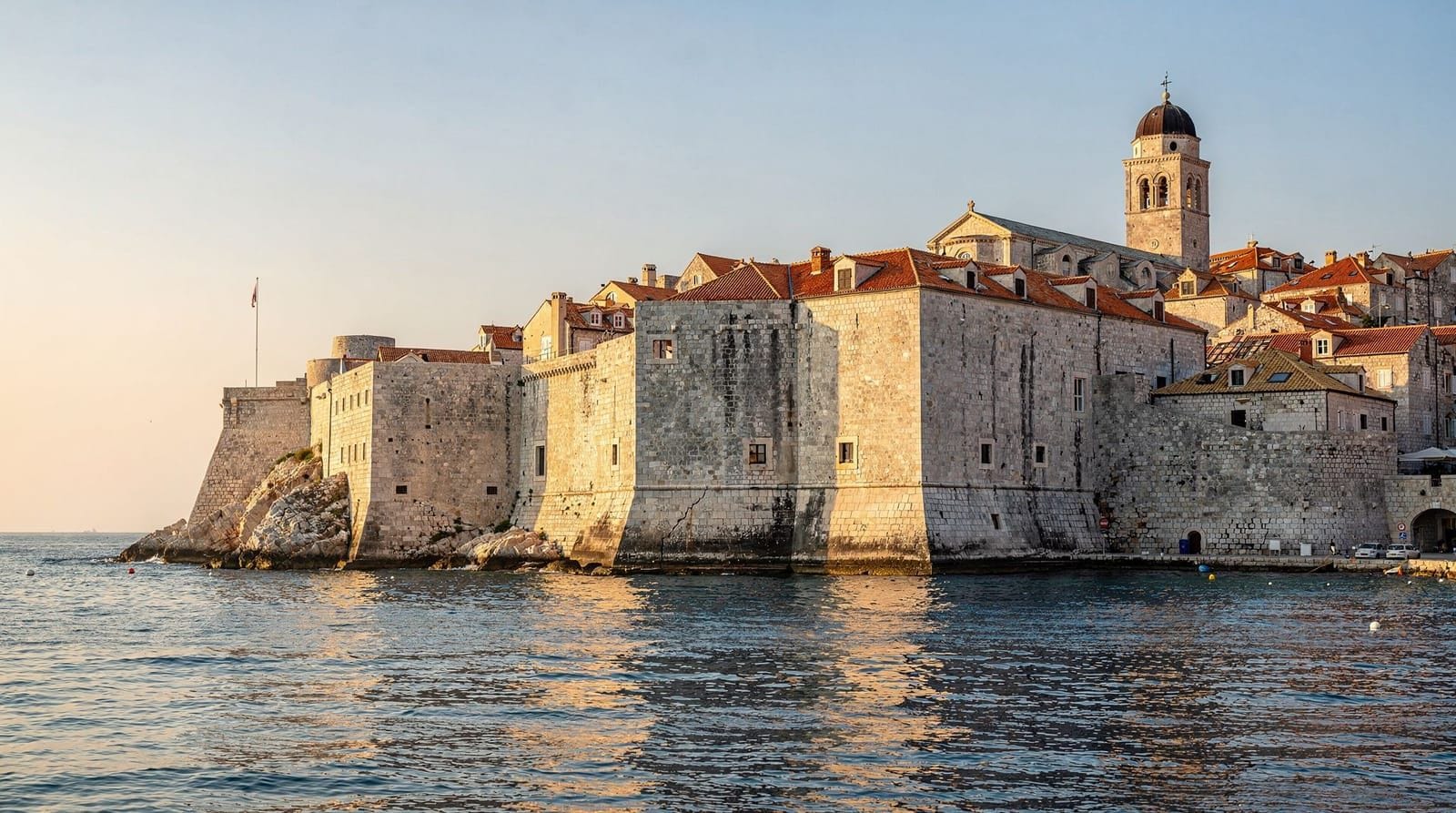
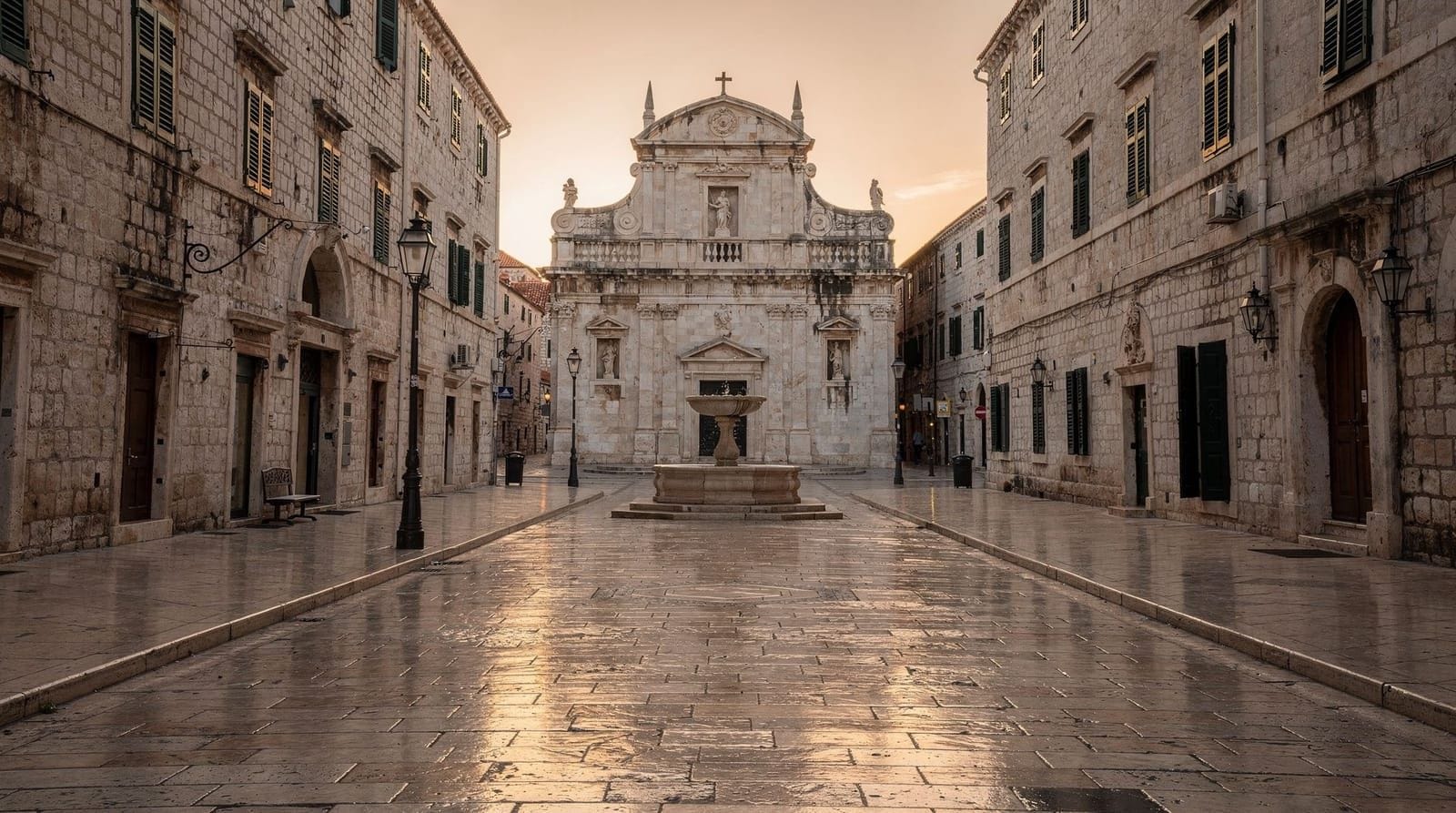
Understanding this layered history changes what a walk through Split’s Old Town or Dubrovnik’s Old Town means. The Roman walls, Venetian bell towers, Habsburg-era buildings and 20th-century war damage (still visible on some Dubrovnik roof tiles, deliberately left unreplaced as a memorial) are not separate attractions — they are the same stones telling successive chapters of the same story. The Homeland War Museum sites, the UNESCO listings across the coast, and even the reason Croatian culture feels distinctly Central European in the north and Mediterranean-Venetian on the coast all trace back to this history of shifting rule.
Frequently asked questions about Croatia
Who were the first people to live in Croatia?
The prehistoric inhabitants of the Croatian territory included Illyrian tribes (Iron Age, from around the 8th century BC onward) and, in coastal areas, Greek colonists who founded settlements like Tragurion (Trogir), Pharos (Stari Grad, Hvar) and Issa (Vis) from the 4th century BC. The Illyrians were gradually absorbed or displaced by Roman conquest from the 2nd century BC onward.Why does Croatia have so much Roman architecture?
The eastern Adriatic coast and its hinterland formed the core of the Roman province of Dalmatia from the 1st century BC. Pula, Zadar, Split (built around Diocletian's Palace), Salona near Split (the provincial capital) and Narona in the Neretva region were all major Roman cities. The mild climate and quality local limestone produced durable construction; geographic isolation preserved many structures from later demolition or reuse.When did Croats arrive in Croatia?
Slavic peoples (including those who would become Croats) migrated into the Balkans and the eastern Adriatic during the 7th century AD, during the broader migrations that followed the collapse of Roman power. The name 'Croat' (Hrvat) appears in written sources from the 9th century onward. The ethnic and linguistic identity consolidated gradually over the early medieval period.Why was Croatia part of Yugoslavia?
After World War One, the collapse of the Austro-Hungarian Empire left the South Slavic lands (Croatia, Slovenia, Bosnia, Serbia, Montenegro, Macedonia) without a state framework. The Kingdom of Serbs, Croats and Slovenes (later Yugoslavia) was created in 1918 as a union of South Slavic peoples. After World War Two, Josip Broz Tito's communist partisans established the Socialist Federal Republic of Yugoslavia, which included Croatia as a constituent republic until its dissolution in 1991.What happened in Croatia during the 1990s war?
Following Croatia's declaration of independence in June 1991, the Yugoslav People's Army and Serbian irregular forces launched a war aiming to prevent Croatian independence and to establish a Serbian-controlled territory (Republic of Serbian Krajina) within Croatian land. The war lasted from 1991 to 1995. Vukovar in Slavonia was effectively destroyed during an 87-day siege in 1991; Dubrovnik was besieged and shelled in 1991–92. Croatian military operations (Operation Flash and Operation Storm in 1995) ended the war and recaptured most occupied territory.What is the Croatian relationship with Venice?
Venice controlled most of Dalmatian Croatia from 1420 until the Napoleonic dissolution of the Venetian Republic in 1797. Four centuries of Venetian rule left a profound architectural legacy — the Gothic-Renaissance buildings in Zadar, Split, Trogir, Korčula, Hvar and Dubrovnik (which remained independent) show Venetian influence throughout. The Lion of St. Mark (the Venetian symbol) appears on gates, towers and buildings along the entire Dalmatian coast.When did Croatia join the EU?
Croatia became the 28th member of the European Union on 1 July 2013. It entered the Schengen Area on 1 January 2023, the same day it replaced the kuna with the Euro. It is the only post-Yugoslav state besides Slovenia to have joined the EU.Where can I see Croatia's Roman history in person?
Split's Diocletian's Palace is the most complete Roman survival — a still-inhabited 4th-century imperial palace you can walk through freely. The Pula Arena is one of the best-preserved Roman amphitheatres anywhere. Zadar's forum and the Church of St Donatus are further well-preserved Roman-era sites on the coast.
Top experiences
Bookable activities with verified prices and instant confirmation on GetYourGuide.
Top experiences
Best-rated activities across GetYourGuide and Viator.

From Zadar: Plitvice Lakes with Boat Ride & Zadar Old town tour
- Viator

3Hour ALL-INCLUSIVE Sunset Dolphin Watching from Medulin onSandra
- Viator

Dolphin Watching & Sunset Boat Tour With Drinks & optional Dinner
- Viator

Fantastic DOLPHIN & SUNSET TOUR with dinner ( Pula-NP BRIJUNI )
- Viator

Medulin :All-Inclusive Pirate Boat Dolphin Watching Sunset Cruise
- Viator

Zadar Highlights: Old Town, Sea Organ & Local Tastings
- Viator