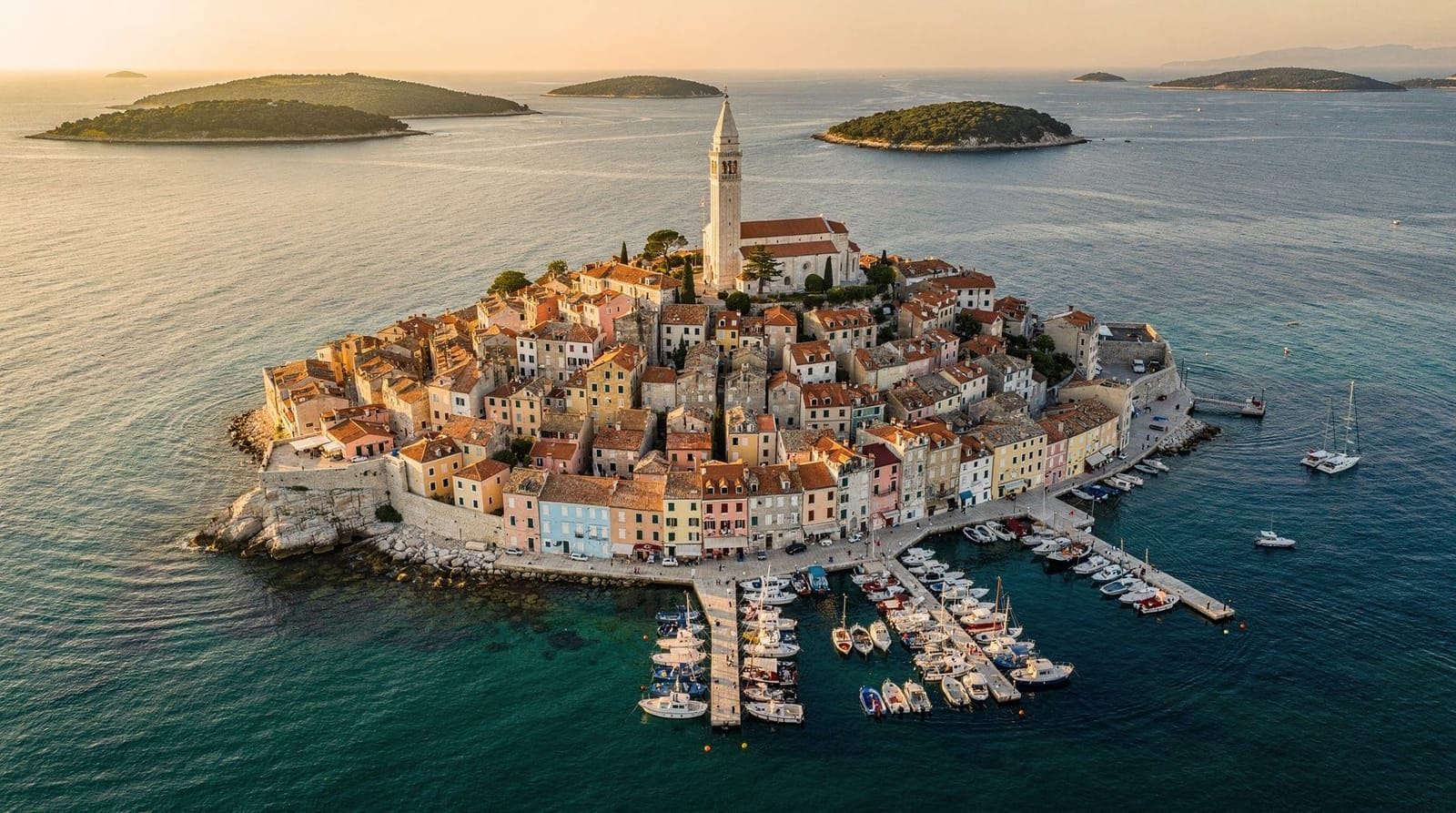
Roman Pula: the complete guide to Croatia's ancient city
Pula: Arena entry ticket and guided tour
What Roman sites are in Pula, Croatia?
Pula (ancient Pola) has one of the most complete Roman city centres outside Italy: the Pula Arena (amphitheatre, 1st century AD), the Temple of Augustus (27 BC–14 AD), the Arch of the Sergii (27 BC), the Twin Gates, the Small Roman Theatre remains, and the forum square still functioning as the city's main square.
Ancient Pola: Rome’s forgotten city in the Adriatic
Polensium — which the Romans called Pola and which is now Pula — was established as a Roman colony in the 1st century BC and grew into a prosperous city of perhaps 30,000 people by the imperial period. It was the administrative and commercial capital of the province of Istria, positioned at the tip of the Istrian peninsula to control the northern Adriatic approaches.
| Where | Pula, southern tip of the Istrian peninsula |
| Cost | Around €14 Arena entry; €3–8 for the smaller Roman sites |
| Time needed | Half a day for the highlights; a full day with the museum |
| Getting there | Pula Airport (8km), or 45min–4hrs by bus from Rovinj/Rijeka/Zagreb |
| Best time | June or September; the Film Festival runs in July |
What Pula has that almost no other Roman city outside Italy possesses is a near-complete set of its principal monuments: the amphitheatre, the main forum square (still the city’s civic centre), a fully intact temple, a triumphal arch, and the circuit of its main gates. Unlike Rome, where centuries of construction, destruction and medieval repurposing have buried the Roman city under layers of later history, Pula’s Roman monuments sit at street level, surrounded by ordinary city life. You eat lunch in front of the Temple of Augustus. You walk through the Arch of the Sergii on your way to a café.
Pula Arena (Pulska Arena)
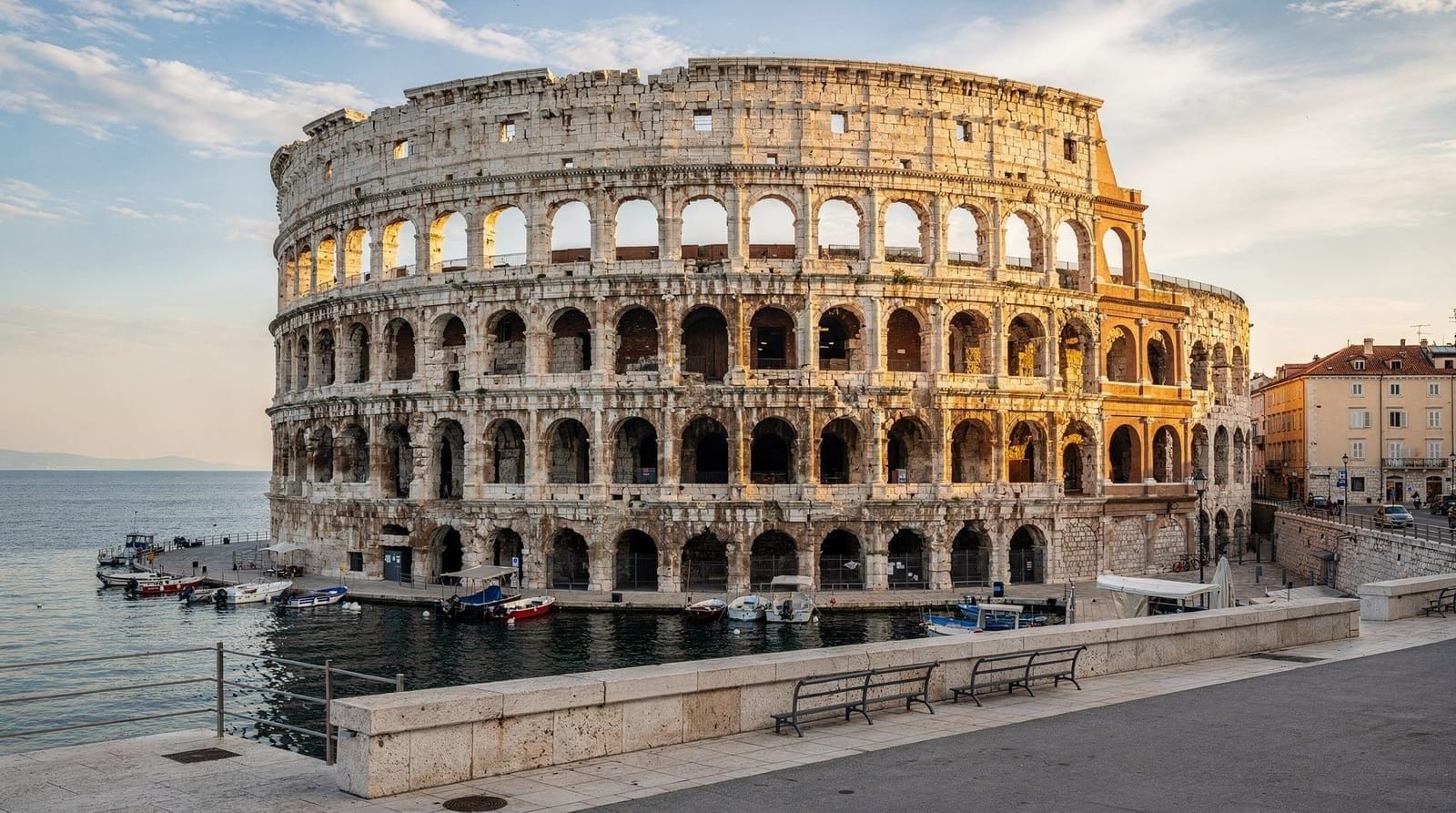
The arena is the reason most people come to Pula, and it delivers. Completed in the 1st century AD (probably during the reign of Vespasian, who also completed the Colosseum in Rome), the oval amphitheatre measures 132 metres by 105 metres. Its outer wall is 32 metres high and all four sides — including their decorative arched galleries — survive intact. Four hollow towers on the outer wall were originally filled with water; historians believe they may have supported an awning (velarium) to shade spectators.
The interior has been more heavily altered — the original seating (stone and wooden tiers) is gone, leaving the elliptical arena floor open. But the network of underground passages and chambers that serviced the arena (for gladiators, animals, stage machinery and equipment) is accessible and forms part of the museum experience inside.
The Arena Museum occupies the underground level and covers the history of gladiatorial combat in the Roman world, the olive oil trade (for which Istria was famous in antiquity), and the arena’s later use through the centuries. The museum is included in the entry ticket.
Entry (2026): Around €14 self-guided; guided tour slightly more. Open daily year-round; summer hours extend to 8pm or later on days with evening events. On event days (concerts, film festival), the arena may close earlier for setup; check ahead.
A note on the Film Festival: The Pula Film Festival (Pulski filmski festival), held since 1954, is Croatia’s most prestigious cinema event and one of Europe’s oldest film festivals. Screenings take place in the arena itself, under the stars, on a giant screen set against the ancient stone walls. The atmosphere is extraordinary. The festival usually runs for one week in mid-to-late July.
The Temple of Augustus (Augustov Hram)
In the forum at the centre of Pula’s old town stands a temple that is, by any standard, exceptional. The Temple of Augustus was built between 27 BC and 14 AD — during the emperor’s own lifetime — on the north side of the forum. It was dedicated to Rome and Augustus and served as an active religious site until Christianity made such dedications obsolete.
Three of its four original sides survive intact: the front colonnade (Corinthian order, six columns) is complete, the two flanking sides have most of their columns, and the rear wall (which once adjoined an identical twin temple, now long gone) is preserved. The interior now houses a small museum of Roman stone sculpture — fragments from the forum and surrounding area.
Entry is minimal — around €3–5. The contrast between the precision of the Roman Corinthian capitals and the medieval and Habsburg-era buildings surrounding the forum is one of the pleasures of the site. Sitting at the café tables that occupy the forum square, looking at the temple, you are sitting more or less where Pola’s citizens gathered for two thousand years.
Arch of the Sergii (Slavoluk Sergijevaca)
Just off the forum, on the western approach to the old city, the Arch of the Sergii is a single-opening triumphal arch erected by Salvia Postuma Sergia in honour of three members of her family — Lucius Sergius Lepidus, Gnaeus Sergius and Gaius Sergius — who served Rome in the military campaigns that followed the Battle of Actium (31 BC).
The arch is relatively small but its decorative programme is well-preserved: acanthus scrollwork, Nike (Victory) figures, the family portraits in the medallions, and an inscription giving the dedication. The inner face (facing the old town) and outer face are both accessible from the street — it stands in open public space.
A celebrated drawing of the arch by Andrea Palladio survives from the 16th century. James Joyce lived briefly in Pula in 1904–05 while teaching English; he reportedly found the arch impressive.
Twin Gates (Porta Gemina) and the city gates
The Porta Gemina (Twin Gates) on the eastern side of the old town was one of the secondary entrances to the Roman city — a double-arched gateway dating from the 2nd or 3rd century AD. Unlike the Arch of the Sergii, it is a functional gate rather than a commemorative arch; its two arches allowed simultaneous inbound and outbound traffic. The Pula Archaeological Museum is located just outside it.
The Porta Herculea (Hercules Gate) on the western side of the old town is the oldest preserved Roman gate in Pula — a single arch with a carving of Hercules’ head in the keystone and an inscription giving the names of the two Roman officials who oversaw construction of the city in the 1st century BC. It is modest in scale but historically significant as the earliest datable monument in the city.
Pula Archaeological Museum (Arheološki muzej Istre)
Housed in an Austro-Hungarian building above the old Roman theatre site (some Roman stage remains are visible in the garden), the archaeological museum covers prehistoric Istria, the Roman period, the early Christian era and the medieval period. Its collections include mosaics, glass, weapons, personal objects and inscriptions from across the peninsula.
Entry is around €6–8. The garden, with its scattered Roman stonework and the remains of the theatre’s stage wall, is accessible with the museum ticket and worth a quiet 20 minutes. The museum is a 10-minute walk from the forum.
Roman Pula beyond the highlights
Pula is a working city of around 56,000 people — not a heritage theme park. The Roman monuments coexist with an Austro-Hungarian old town grid, a working harbour, a mid-century Yugoslav residential quarter and the usual infrastructure of a regional capital. This makes it more interesting, not less.
Worth noticing:
The Roman theatre remains on the hillside behind the forum. The stage wall is largely gone, but the cavea (seating semicircle) cut into the hillside is still visible in the topography. The Austro-Hungarian fortress (Kastel) on the hill above uses some Roman foundations.
Roman water infrastructure: The Roman city had an aqueduct; sections of its distribution system have been found under the old town streets. The forum area was also served by a Roman cistern.
Early Christian mosaics: At the Church of St. Mary Formosa (6th century), fragments of Byzantine-era floor mosaics survive — a reminder that the transition from pagan Roman to Christian Byzantine Pula was relatively swift and left its own monuments.
Mosaic of Punishment of Dirce: Probably Pula’s finest surviving Roman mosaic — a 3rd-century floor mosaic depicting the Greek myth of Dirce’s punishment, now displayed in a building near the Arch of the Sergii. Entry is included with some combined tickets.
Practical visitor information
Getting to Pula: Pula Airport (PUY) is 8km from the city centre; seasonal flights connect it to London, Dublin, Zurich and other European cities. Bus connections to Zagreb (3.5–4 hours), Rijeka (2.5 hours) and Rovinj (45 minutes) are regular. Driving through Istria, Pula sits at the southern tip of the peninsula — easily combined with Rovinj (35km north) and Poreč (55km north).
When to visit: June and September are the sweet spots for Istria — warm (25–28°C), without the August peak crowds. The Film Festival in July is a special occasion. The arena also hosts concerts and events throughout summer.
Where to eat nearby: The streets around the forum and market have a good concentration of konobas serving Istrian classics — fuži pasta with truffles, boškarin beef, fresh Adriatic fish. Prices are noticeably lower than in Rovinj’s more polished old town, a side benefit of Pula being a working city rather than a purely tourist-oriented one.
Combining Pula with the rest of Istria: A standard Istrian circuit runs Pula → Rovinj (coastal, most scenic) → Poreč (the Euphrasian Basilica) → Motovun or Grožnjan (inland hill towns) → back to Pula. Three to five days covers this comfortably. See our Istria vs Dalmatia comparison for broader context, and the day trips from Rovinj guide if you’re basing yourself further up the coast.
Pula beyond the Romans: what to do next
Once you’ve covered the Roman sites, Pula rewards a slower pace. The cycling routes through inland Istria start within easy reach of the city, threading through vineyards and hilltop villages that the amphitheatre crowds never see. Food-focused visitors should time a trip for autumn, when Istrian truffle season brings tasting menus and truffle-hunting excursions to the region’s konobas. Pula’s own old town — beyond the strictly Roman monuments — has a lively market, a working harbour and an Austro-Hungarian naval history worth an unhurried afternoon.
Roman Pula for families
Children generally respond well to the Arena — the scale is immediately impressive, and the underground passages have a genuine sense of exploration about them. The Archaeological Museum is less engaging for young children but the garden, with scattered stonework to spot, works as a break. Combine a Roman-sites morning with an afternoon at one of Istria’s beaches or a gentle bike ride for a balanced family day; the Istria vs Dalmatia guide has more on planning a family-friendly regional itinerary.
Frequently asked questions about Roman Pula
How much does it cost to enter Pula Arena?
The Pula Arena charges around €14 for adults with a self-guided visit (2026); a guided tour with entry costs slightly more. The Arena Museum inside is included in the entry price. Children under 7 are generally free. The ticket is available at the gate or online.Is Pula Arena a UNESCO World Heritage Site?
No — the Pula Arena is on Croatia's UNESCO Tentative List but has not yet been formally inscribed. This is a common source of confusion. Croatia's inscribed UNESCO sites are Dubrovnik, Diocletian's Palace/Split, Plitvice, Trogir, Šibenik Cathedral, the Eufrazijeva Basilica in Poreč, Stari Grad Plain and the Cetina sites.How big is the Pula Arena compared to the Colosseum?
The Pula Arena could hold roughly 23,000 spectators when full; the Colosseum in Rome held approximately 50,000. In physical size, the Colosseum is larger. However, the Pula Arena is the sixth-largest surviving Roman amphitheatre in the world and one of the best-preserved — all four exterior walls and their towers still stand, which is not the case for the Colosseum.Can you see events at Pula Arena today?
Yes. The arena is an active venue for summer concerts, opera performances and the Pula Film Festival (held every July–August since 1954). Acts from Placido Domingo to Sting and Robbie Williams have performed here. Summer events are listed on the Pula Arena website; book well in advance.What else is Roman in Pula beyond the Arena?
The Temple of Augustus (intact on three sides, with its original Roman porch), the Arch of the Sergii (a triumphal arch commemorating three members of the Sergii family, 1st century BC/AD), the Twin Gates (Porta Gemina), remains of the Roman theatre on the hillside, the forum square (still the town centre), and scattered wall sections throughout the old town.How long does it take to explore Roman Pula?
The Arena itself takes 45–90 minutes. Combining it with the Temple of Augustus, the Arch of the Sergii, a walk of the forum and old town lanes, and the small archaeological museum takes a comfortable full morning or afternoon. Allow a full day if you also visit the hill-top Venetian fortress.Is Pula worth visiting compared to other Istrian towns?
Pula is Istria's largest city and its Roman heritage is unrivalled in the region. It is less immediately pretty than Rovinj or Motovun but has more depth — the layers of Roman, Byzantine, Venetian and 20th-century Austrian-Hungarian history create a richer city to explore. Most visitors combine Pula with Rovinj and the rest of Istria.
Top experiences
Bookable activities with verified prices and instant confirmation on GetYourGuide.
Top experiences
Best-rated activities across GetYourGuide and Viator.

From Zadar: Plitvice Lakes with Boat Ride & Zadar Old town tour
- Viator

3Hour ALL-INCLUSIVE Sunset Dolphin Watching from Medulin onSandra
- Viator

Dolphin Watching & Sunset Boat Tour With Drinks & optional Dinner
- Viator

Fantastic DOLPHIN & SUNSET TOUR with dinner ( Pula-NP BRIJUNI )
- Viator

Medulin :All-Inclusive Pirate Boat Dolphin Watching Sunset Cruise
- Viator

Zadar Highlights: Old Town, Sea Organ & Local Tastings
- Viator