Croatia Airports Guide 2026 — DBV, SPU, ZAG, ZAD & PUY
Which airport should I fly into in Croatia?
Fly into Split (SPU) for central Dalmatia and the islands. Fly into Dubrovnik (DBV) if based in the south. Fly into Zagreb (ZAG) for the capital, Plitvice and Istria. Zadar (ZAD) is excellent for Ryanair connections and Plitvice Lakes. Pula (PUY) is convenient for Istria.
Croatia has five international airports of significance, plus a smaller facility at Rijeka. Choosing the right entry point makes a real difference — the wrong airport adds unnecessary transfers and costs. Here is a clear-eyed assessment of each.
| Best for coast | Split (SPU) or Dubrovnik (DBV) |
| Best for budget flights | Zadar (ZAD) |
| Best year-round hub | Zagreb (ZAG) |
| Best for Istria | Pula (PUY) |
| Typical airport-to-city cost | Bus €4–€10, taxi €10–€45 |
Dubrovnik Airport (DBV) — Čilipi
IATA: DBV | Location: Čilipi, 20 km southeast of Dubrovnik Best for: Travellers based primarily in Dubrovnik or southern Dalmatia
Dubrovnik is one of the most popular summer-beach airports in Europe. In July and August, it handles extraordinary volume relative to its size — long queues at immigration, crowded arrivals halls, and severe taxi shortages during peak evening arrivals. Travel tip: if arriving on a late-evening flight in peak summer, pre-book a transfer.
Getting to Dubrovnik city
- Atlas Express bus: ~€10, departs every 30 minutes in summer, 30–35 minutes to Pile Gate bus stop. Most reliable scheduled option.
- Taxi: €35–€45, 20–30 minutes. Metered or via app (Bolt). Avoid unmarked taxis outside the terminal.
- Pre-booked transfer: Fixed price, driver meets arrivals hall. Recommended for families or heavy luggage. See our Dubrovnik airport transfers guide for options.
Airline coverage
Year-round: British Airways (London Heathrow), Lufthansa (Frankfurt, Munich), Austrian (Vienna), Croatia Airlines. Summer seasonal: easyJet, Ryanair, Jet2, Norwegian, TUI, Vueling and many more from across Europe. US connections via major European hubs.
Facilities
Small but functional. Two cafes, a duty-free shop, one restaurant post-security. Car rental desks from all major companies. ATM in arrivals hall. Wi-Fi free.
Split Airport (SPU) — Kaštela
IATA: SPU | Location: Kaštela, 25 km northwest of Split city centre Best for: Central Dalmatia, island hopping, Hvar, Brač, Vis, Korčula
Split is the busiest passenger airport in summer and the best gateway for the central Dalmatian archipelago. The ferry terminal in Split is the hub for island hopping — a short bus or taxi from the airport gets you directly to the ferries.
Getting to Split city
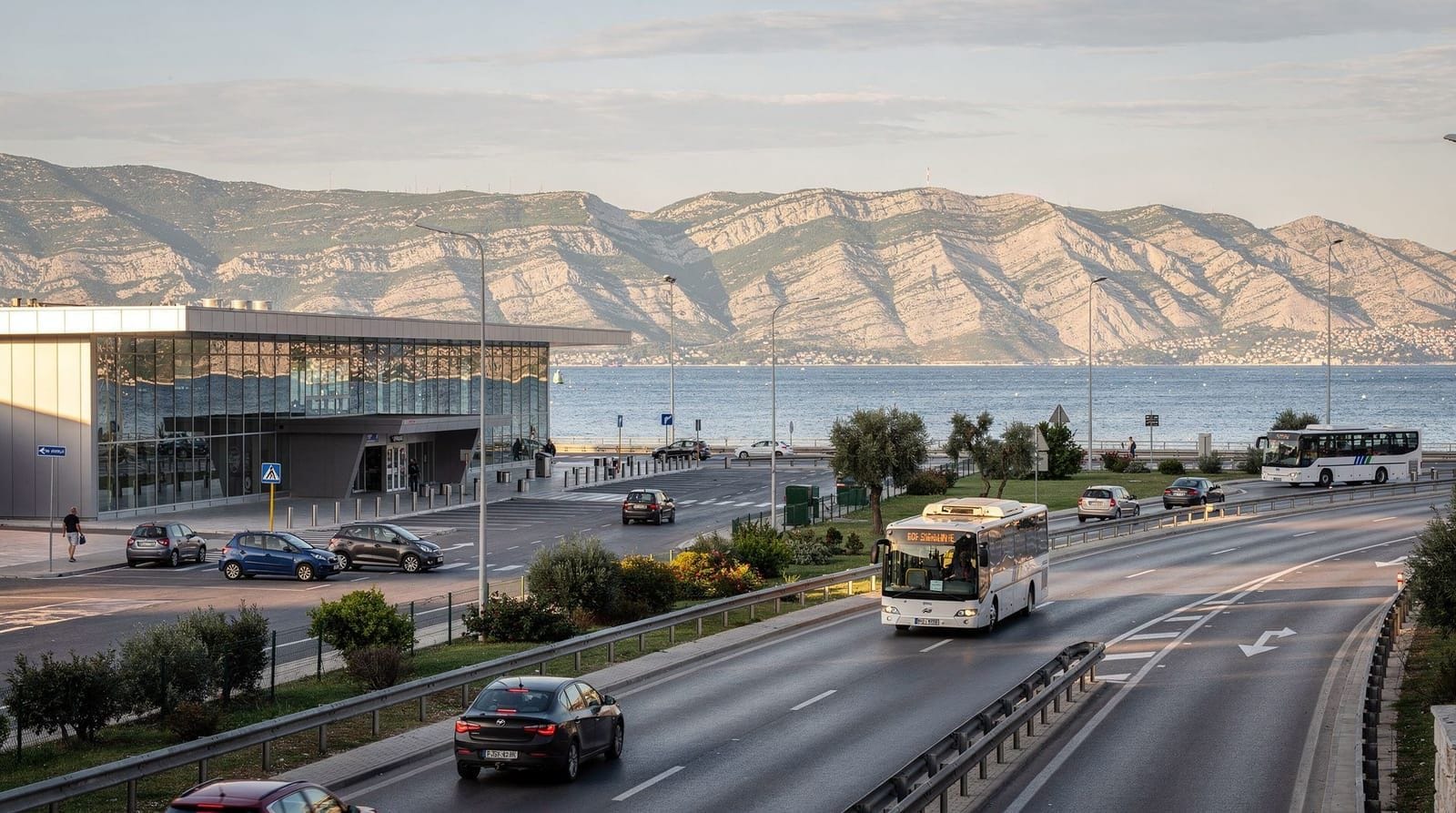
- Promet Split bus: ~€8, regular departures to the city bus station near the Riva waterfront. Journey time: 25–40 minutes depending on traffic.
- Taxi: €25–€35, 30–45 minutes in normal traffic. Summer traffic on the coastal approach can add time.
- Car rental: All major companies have airport desks. An excellent pick-up point for Dalmatian road trips.
See the full Split airport transfers guide.
Airline coverage
Ryanair, easyJet, Wizz Air, British Airways, Lufthansa, KLM, Norwegian, Air France, Eurowings, TUI. In summer, direct flights from across Western Europe. Less year-round coverage than Zagreb — some routes are seasonal only.
Facilities
A significantly expanded terminal (upgraded 2022) with multiple cafes, restaurants, duty-free, car rental desks, and good Wi-Fi. More comfortable than Dubrovnik in peak season.
Zagreb Airport (ZAG) — Franjo Tuđman
IATA: ZAG | Location: 17 km southeast of Zagreb city centre Best for: Zagreb city breaks, Plitvice (day trip), Istria, year-round travel
Zagreb is Croatia’s main international hub — the only airport with significant year-round scheduled traffic from major global carriers. It’s the most convenient if exploring Zagreb, travelling to Plitvice Lakes, or heading to Istria before the coastal routes.
Getting to Zagreb city
- AirRide (Croatia Airlines) bus: ~€7, every 30 minutes to Zagreb Bus Station (Autobusni kolodvor), 25–35 minutes. Then taxi or tram to your hotel.
- Taxi / Bolt: €25–€40, 20–30 minutes. Bolt app works well in Zagreb.
Airline coverage
The widest range of carriers in Croatia — Croatian Airlines hub, Lufthansa, Air France, KLM, British Airways, Turkish Airlines, Qatar Airways, Emirates (connecting services). Many intercontinental options available with a single connection.
Facilities
The most complete airport in Croatia. Multiple restaurants, cafes, bookshops, duty-free, full car rental presence, business lounge (Croatia Airlines premium). Smooth for connections to other European hubs.
Zadar Airport (ZDU / ZAD)
IATA: ZAD | Location: Zemunik Donji, 8 km east of Zadar Best for: Budget travellers (Ryanair stronghold), northern Dalmatia, Plitvice day trips
Zadar was one of Ryanair’s original Croatian routes and remains heavily served by budget carriers. The airport is small and basic but handles surprisingly high volumes in summer. It’s a smart choice for travellers focusing on Zadar, northern Dalmatia, or accessing Plitvice Lakes (around 1.5 hours by car).
Getting to Zadar city
- Liburnija bus: ~€3, regular service to Zadar bus station. 15–20 minutes.
- Taxi: €10–€15.
- Car rental: Limited on-site options in the small terminal; book in advance.
Airline coverage
Ryanair (dominant, multiple UK and European cities), easyJet, Vueling, Wizz Air. Fewer carrier options than Split or Dubrovnik but competitive prices on Ryanair routes.
Pula Airport (PUY)
IATA: PUY | Location: 7 km northeast of Pula Best for: Istria-based trips — Rovinj, Poreč, Motovun, Pula itself
Pula is the gateway to Istria. If your trip is focused on Rovinj, Pula, Poreč and the inland truffle villages, Pula Airport saves hours of overland travel.
Getting to Pula and Istria
- Bus to Pula city centre: ~€4, 20 minutes.
- Car rental: Highly recommended for Istria — the rural villages are inaccessible without wheels. All major rental desks at the airport.
Airline coverage
Seasonal (summer only): Ryanair, easyJet, British Airways, TUI, Jet2. Very limited in winter — check availability carefully for off-season travel.
Choosing the right airport
| If your base is… | Fly into |
|---|---|
| Dubrovnik, Korčula, Pelješac | DBV |
| Split, Hvar, Brač, Vis | SPU |
| Zadar, Plitvice from north | ZAD |
| Zagreb, Plitvice from capital | ZAG |
| Istria (Rovinj, Pula, Poreč) | PUY |
| Multi-city (Split in, Dubrovnik out) | SPU + DBV one-way |
The one-way itinerary (fly Split, fly out Dubrovnik) is one of the most efficient ways to see central and southern Dalmatia — no retracing your route, and you can island-hop from Split southward to Dubrovnik by catamaran.
Rijeka Airport (RJK) — the overlooked option
A small airport on Krk island (yes, the island — connected by bridge), Rijeka Airport (RJK) handles very limited scheduled traffic in 2026. Once served by Ryanair, routes have contracted significantly. Check current airline availability before considering Rijeka as an entry point — it is not a reliable option for most travellers but worth a look for those focusing on the Kvarner islands.
Getting between airports in Croatia
There is no shuttle service directly connecting Croatian airports. Travellers flying into one airport and departing from another (a common one-way itinerary, e.g. fly into Split, fly out of Dubrovnik) use public transport or private transfer between cities.
Split → Dubrovnik: Bus (4–5 hours), car (3–4 hours), or the coastal catamaran (5–6 hours with island stops). All practical; see Split to Dubrovnik.
Zagreb → Split: Bus (5.5–6 hours) or car (3.5–4 hours). See Zagreb to Split.
Pula → Split: No direct or simple public transport link. Car is the practical option (3.5–4 hours via A8/A9 and A1) or arrange private transfer.
Visa and entry at Croatian airports
Croatia joined the Schengen Area on 1 January 2023. Immigration at Croatian airports now follows Schengen rules:
- EU/Schengen nationals: Use EU/EEA fast lanes at passport control — often minimal queuing.
- Non-Schengen visitors (US, UK, Canada, Australia): Standard passport check. The new EES (Entry/Exit System), rolling out from 2025, requires biometric fingerprinting and facial scan at the first Schengen entry point. This is a Europe-wide system; Croatia’s airports are adapting their infrastructure.
- ETIAS (when implemented): An online pre-travel authorisation for visa-exempt non-EU nationals will eventually be required — check the latest status before travel as implementation has been delayed.
Baggage reclaim and customs
Baggage reclaim at Croatian airports is generally fast by European standards. The main bottleneck is immigration, not reclaim, at Dubrovnik and Split in peak summer.
Customs follows EU rules: travellers from within the EU have no restrictions on goods. Non-EU arrivals have duty-free allowances (alcohol, tobacco, gifts). Currency: there is no obligation to declare amounts under €10,000; above that, declaration is required at EU borders.
Currency and ATMs at airports
All five airports have ATMs in the arrivals hall. Croatia adopted the euro on 1 January 2023 — no currency conversion needed for eurozone visitors. Use bank ATMs rather than standalone exchange bureau machines (worse rates). Decline “conversion” (DCC) if asked — always pay in euros.
Currency exchange desks exist at Zagreb and Split airports but offer unfavourable rates. If you need cash, use the ATM.
Connecting flights via Croatian airports
Zagreb is the only airport with meaningful international connecting traffic. Croatia Airlines codes share with Lufthansa, Air France, KLM and other Star Alliance and SkyTeam partners, enabling smooth connections to long-haul routes from Frankfurt, Vienna, Amsterdam and Paris.
Split and Dubrovnik are primarily point-to-point leisure destinations — not built for connections. Transferring between flights at these airports is technically possible but risky: baggage is checked through, but the airports are small and any delay could cause a missed connection.
Minimum connection time at Zagreb (ZAG): 60–90 minutes for domestic-to-international; 90–120 minutes for international-to-international (considering immigration).
Travelling to/from the airport with children or reduced mobility
Dubrovnik (DBV): The Atlas bus has limited luggage space with a pram or pushchair; taxis and private transfers handle these more easily. The terminal has lift access and accessible toilets.
Split (SPU): The upgraded 2022 terminal is well-designed with full accessibility. The shuttle bus has level entry; cars can be pre-booked with accessible vehicle options.
Zagreb (ZAG): Modern infrastructure, lifts and automated walkways. The AirRide bus has space for prams and wheelchairs.
All airports have assistance desks for passengers with reduced mobility — contact the airline in advance (Condition of Carriage assistance) to arrange wheelchair support, priority boarding and ground transfer at the aircraft.
Airport security and pre-departure tips
Croatian airports follow standard EU security procedures since Croatia’s Schengen accession in 2023. Practical notes:
Liquids: The 100ml/3.4oz rule applies at all Croatian airports. Clear plastic bag; containers no larger than 100ml. Duty-free purchases in sealed bags from other EU airports are allowed through security.
Electronics: Laptops and large electronics out of bags at security. Dubrovnik and Split can have slow security lines in peak season — start queuing 15 minutes before your check-in estimate.
Shoes: Removal of shoes is not universally required at Croatian airports (unlike the US) but is occasionally asked. Wear slip-on shoes if doing multiple airport connections.
Departure tax: Included in your airline ticket price — no separate payment needed at the airport.
Duty-free: All Croatian airports have post-security duty-free shops, though the selection at smaller airports (Zadar, Pula) is limited. Zagreb has the widest selection.
Airport food: what to expect
Zagreb (ZAG): Multiple options — a sit-down restaurant, a cafe chain, a sandwich bar, and duty-free with Croatian wines and spirits. Quality is the best of the five airports.
Split (SPU): Good selection post-2022 expansion. A Croatian konoba-style restaurant, a cafe, a bakery. Local Dalmatian brandies (lozovača, travarica) available in duty-free.
Dubrovnik (DBV): More limited — one cafe, one restaurant, duty-free. Gets extremely crowded in July–August mornings. Arrive with adequate time to eat before your flight.
Zadar (ZAD): A single cafe and kiosk. Eat before arriving if possible.
Pula (PUY): Basic — cafe and small duty-free. Limited hot food options.
Lounges at Croatian airports
Zagreb: Croatia Airlines has a dedicated business lounge (Salon A) for business-class and premium card holders. Air France-KLM Flying Blue Platinum holders may also access via their partnership.
Split and Dubrovnik: No dedicated airline lounges. Some pay-per-entry lounge options exist via Priority Pass — check your card benefits before travelling. Alternatively, airport cafes provide reasonable seating and Wi-Fi.
Getting connectivity at Croatian airports
SIM cards: Available at newsagents and phone shops in arrivals at Zagreb and Split (less so at Zadar and Pula). Croatian mobile operators (A1, T-Mobile, Tele2) offer tourist SIM cards with data packages for 7 or 30 days. For most travellers, a Croatian or EU-roaming SIM covers the whole trip.
eSIM: Increasingly the better option — buy online before travel from providers like Airalo or Holafly (specific Croatia eSIM plans available). Activate before landing to have connectivity from the moment you step off the aircraft.
Airport Wi-Fi: All five airports have free Wi-Fi. Credentials are typically shown on a sign in the arrivals hall or available from the information desk. Quality at Zagreb is best; Dubrovnik in peak season can be overwhelmed.
Booking flights: one-way vs return itineraries
For anyone covering more than one region, an open-jaw itinerary (fly into one airport, out of another) is usually the smarter booking. Flying into Split and out of Dubrovnik — or the reverse — lets you travel the Dalmatian coast in one direction without doubling back, and fares for open-jaw tickets on the same airline are often comparable to a standard return. The same logic applies to Zagreb-in, Pula-out for a north-to-Istria route, though fewer airlines offer that specific combination. Check both directions when pricing, as one leg is sometimes noticeably cheaper on a budget carrier while the other suits a full-service airline better.
Seasonal flight availability: what changes between summer and winter
The gap between Croatia’s summer and winter flight networks is dramatic, and it catches out travellers planning shoulder-season or winter trips based on a peak-summer search. Split, Dubrovnik and Pula lose the majority of their budget-carrier routes once the summer schedule ends (typically late October), leaving Zagreb as the only airport with meaningfully consistent year-round international connections. A traveller planning a February trip to Dubrovnik, for instance, may find far fewer direct options than a July search suggested, and connecting through Zagreb or another European hub becomes the more realistic routing. If your trip dates are flexible and you’re weighing shoulder season against peak summer, check flight availability for your specific dates before committing to the itinerary — the price difference in accommodation (see Croatia shoulder season) can be offset by a less convenient or pricier flight routing outside the main season.
Frequently asked questions about Croatia Airports Guide 2026
Which is Croatia's busiest airport?
Split Airport (SPU) has overtaken Dubrovnik as Croatia's busiest in recent years by passenger volume in peak summer. Zagreb Airport (ZAG) is the main hub year-round with the most scheduled routes.Does Dubrovnik Airport have direct flights from the USA?
Seasonal direct transatlantic flights operate to Dubrovnik in summer from some US cities (typically New York/JFK via United or Delta codeshares). Most North American travellers connect via London, Frankfurt, Amsterdam or Zurich. Check current routing for your travel dates.How far is Dubrovnik Airport from the old town?
Around 20 km from the old town, south of the city. The Atlas Express bus connects the airport to Pile Gate in around 30 minutes. A taxi costs approximately €35–€45.Is there a bus from Split Airport to the city?
Yes — the Promet Split airport shuttle runs to the city bus station (Riva waterfront area) for around €8. Journey time: 25–35 minutes. Taxis cost €25–€35.Which airlines fly to Croatia?
Ryanair, easyJet and Wizz Air dominate low-cost routes. British Airways, Lufthansa, KLM, Air France and Austrian Airlines operate hub connections. Croatia Airlines covers domestic routes and international connections from Zagreb.Is Zagreb Airport far from the city?
Around 17 km southeast of the city centre. Croatia Airlines / AirRide buses run to Zagreb bus station (Autobusni kolodvor) every 30 minutes for ~€7. A taxi costs €25–€35.Is Zadar Airport convenient for Plitvice Lakes?
Yes — Zadar is around 1.5–2 hours from Plitvice by car, making it a practical option if flying in specifically for the national park. Organised day trips from Zadar to Plitvice are also widely available.Should I fly into one airport and out of another?
For a coastal itinerary covering more than one region, yes — an open-jaw ticket (fly into Split, out of Dubrovnik, or the reverse) avoids backtracking and lets you travel the coast in one direction. Fares are often comparable to a standard return; compare both directions when booking, as budget carriers sometimes price one leg much lower than the other.
Top experiences
Best-rated activities across GetYourGuide and Viator.

Mostar and Herzegovina Tour with Kravica Waterfall from Split & Trogir
- Viator

Mostar & Kravice waterfalls full-day guided tour from Split
- Viator

Split airport to Split Private transfer to 8 pax (Door to Door any location)
- Viator

Zagreb to Split Group Transfer with Plitvice Lakes guided Tour
- Viator

Zadar: Zrmanja River Kayaking, with optional transfer from Zadar
- Viator

Mostar and Kravica Waterfall Discovery Day Trip from Split or Trogir
- Viator