Croatia Ferries Guide 2026
Split: Blue cave and 5 islands tour
How do ferries work in Croatia?
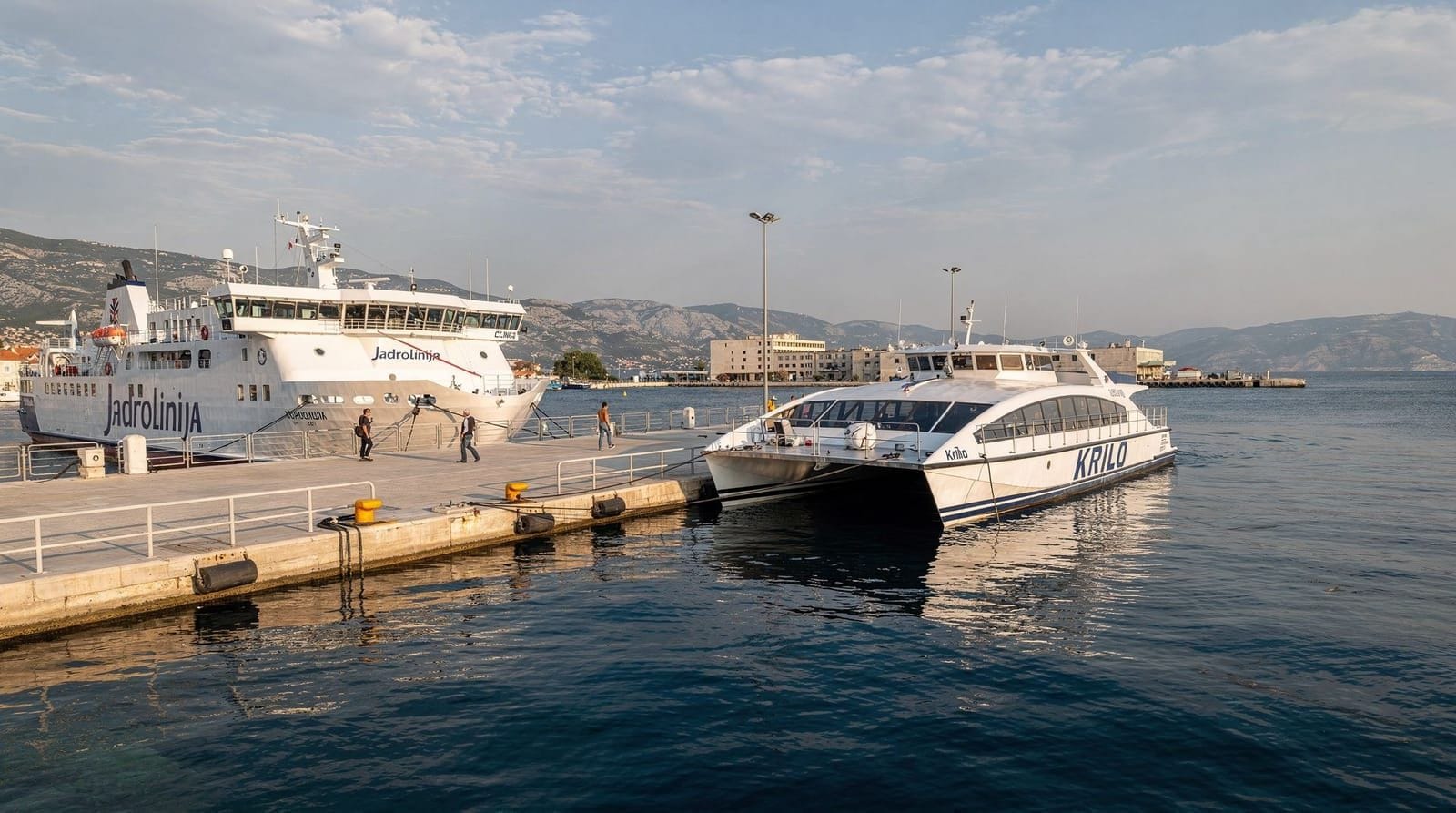
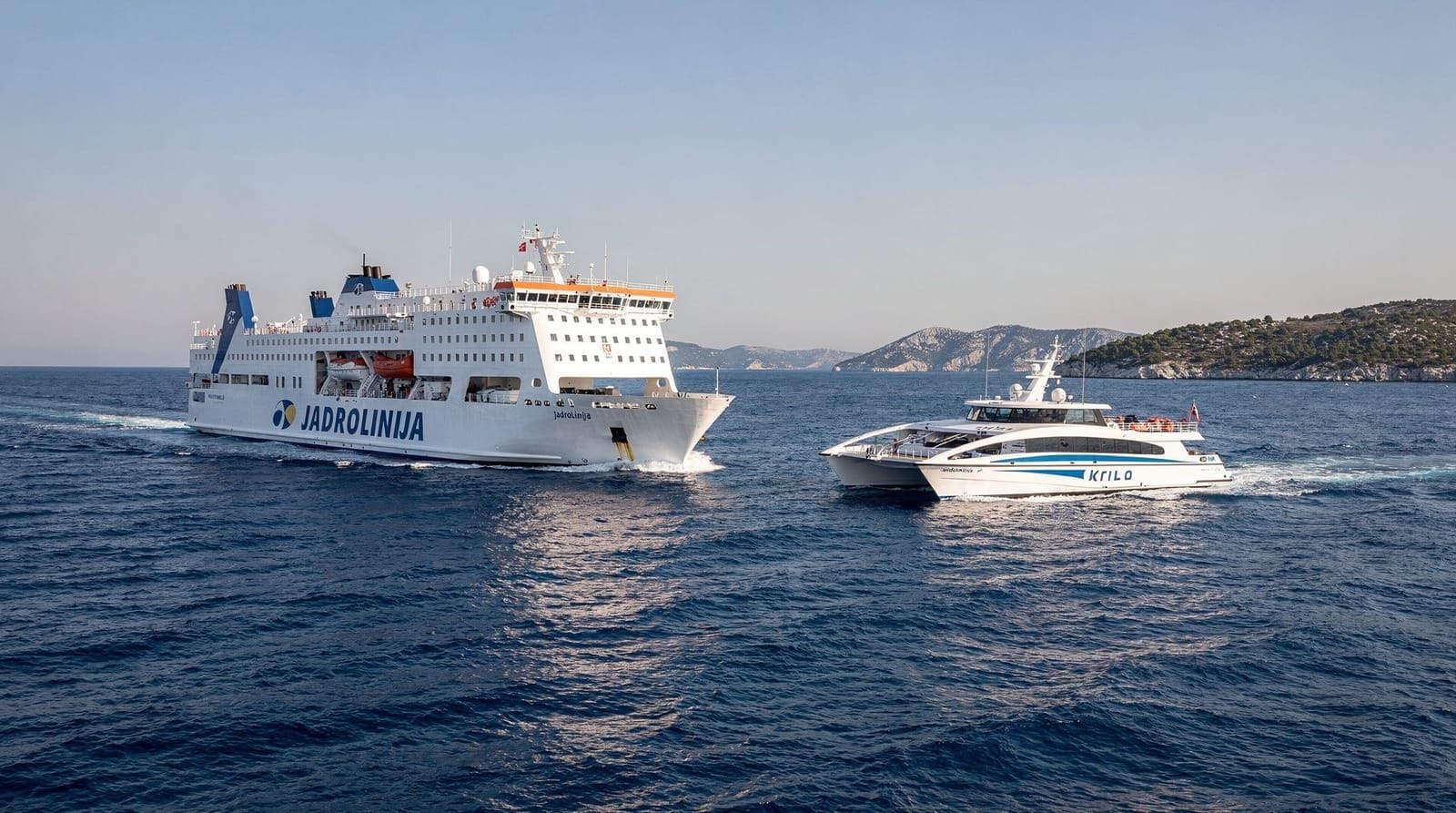
Jadrolinija operates the widest network of car ferries and catamarans connecting Split, Dubrovnik, Hvar, Brač, Korčula, Vis and the smaller islands. Fast passenger-only catamarans (Krilo, TP-Line) are quicker on some routes. Book car spaces in advance in summer; foot passengers rarely need to pre-book except on the busiest catamarans.
Croatia’s ferry network is one of the most extensive in the Mediterranean — a seaborne highway connecting dozens of inhabited islands to the mainland. For first-time visitors it can look bewildering: multiple operators, split between car ferries and catamarans, seasonal timetable changes, and routes that weave in unexpected directions. This guide cuts through the noise and tells you what you actually need to know.
| Main operator | Jadrolinija (car ferries + catamarans) |
| Split–Hvar | ~1h40 car ferry, ~50 min catamaran |
| Booking | Advance for car spaces in July–Aug; foot passengers usually flexible |
| Cost | Foot passenger €6–€27 depending on route |
| Best for cyclists | Car ferries only — most catamarans exclude bikes |
How Croatia’s ferry system is structured
Two types of vessel dominate the Adriatic. Car ferries (trajekti) are roll-on/roll-off ships that carry vehicles as well as foot passengers; they’re slower, more frequent on busy corridors, and cheaper per passenger than fast boats. Catamarans (katamarani) and high-speed passenger ferries carry only foot passengers — no cars, often no bikes — but shave 20–40 minutes off many routes.
Jadrolinija is the state-owned national operator and the backbone of the system. It runs the majority of car ferry crossings and a large proportion of fast catamarans. Every major island has at least one Jadrolinija link to the mainland; many have several. The company also operates a long-distance coastal service — a slower overnight-style connection linking Rijeka, Zadar, Split, Hvar, Korčula and Dubrovnik — popular with travellers who want to see the coast without hiring a car.
Krilo (Kapetan Luka / KSC) and TP-Line compete on the lucrative catamaran routes, particularly the Split–Hvar, Split–Korčula and Dubrovnik–Hvar corridors. They’re foot-passenger only, often price-competitive with Jadrolinija’s equivalent boats, and occasionally a few minutes faster. Timetables change yearly; always check both operators before booking.
Key routes and journey times (summer 2026)
Split ↔ Hvar (Stari Grad)
The workhorse of Dalmatian island travel. Jadrolinija car ferries depart from Split Trajektna Luka every one to two hours in summer — up to around 18 sailings a day in peak. Journey time: approximately 1 hour 40 minutes to Stari Grad. Foot passenger: around €6–€9. Car + driver: around €35–€50 depending on vehicle length. Fast catamarans to Hvar Town (not Stari Grad) take 45–60 minutes; foot only; €10–€14.
Split ↔ Brač (Supetar)
Short car-ferry crossing to Supetar, the largest town on Brač. Journey time: 50 minutes. Jadrolinija only. Very frequent in summer (hourly). Foot passenger: ~€5. Car + driver: ~€30.
Split ↔ Vis
Vis is the most remote of the central Dalmatian islands — no bridge, no catamaran cars. Jadrolinija car ferries take 2 hours 20 minutes. Fast catamarans cut this to around 1 hour. Summer frequency: 3–5 sailings per day. Foot passenger car ferry: ~€8.
Split ↔ Korčula
Several connections: direct catamarans (Jadrolinija and Krilo) take 2.5–3 hours. The slow car ferry goes via Hvar and Lastovo. Korčula can also be reached from Dubrovnik.
Dubrovnik ↔ Korčula / Mljet / Elaphiti Islands
Jadrolinija catamarans run northward from Dubrovnik to Korčula (2 h), Mljet (1.5 h) and onward. The Elaphiti Islands (Šipan, Lopud, Koločep) have their own short ferry service from Dubrovnik’s Gruž harbour.
Split → Dubrovnik (coastal catamaran)
The showcase route: a Jadrolinija fast catamaran departs Split in the morning, calling at Hvar, Korčula, and Mljet before arriving in Dubrovnik. Journey: approximately 5–6 hours total. Foot-passenger only. This is how many independent travellers island-hop south — see our Split to Dubrovnik guide for the full breakdown.
Dubrovnik ↔ Montenegro and the Elaphiti Islands day-trip circuit
While not strictly a ferry in the scheduled-timetable sense, day-trip boats from Dubrovnik’s Old Town harbour serve the Elaphiti Islands (Koločep, Lopud, Šipan) on a semi-regular summer schedule, and organised boat tours run to Montenegro’s Kotor Bay. These differ from Jadrolinija’s scheduled network — check whether you need a scheduled ferry (for independent island stays) or a tour boat (for a one-day loop) before booking, as the two are often confused by first-time visitors.
Choosing between a scheduled ferry and a guided boat tour
For a single day exploring the islands near Split or Dubrovnik without the logistics of researching timetables and ports, a guided boat tour bundles transport, stops and commentary into one booking. This suits travellers with limited time or those uncomfortable navigating an unfamiliar ferry terminal. For multi-day island stays — sleeping on Hvar, Korčula or Vis rather than just passing through — the scheduled Jadrolinija or Krilo network is the only sensible option, since tours are structured around same-day return.
Booking and ticketing
Online: Jadrolinija’s website sells tickets for most routes. Krilo’s site handles its own catamaran reservations. For comparison shopping, the aggregator Ferryhopper lists multiple operators side by side. Book car spaces at least a week ahead in July–August.
At the port: For car ferries on less pressured routes, you can buy foot-passenger tickets at the quayside kiosks on the day. Arrive 30 minutes before departure for boarding organisation.
Mobile apps: Jadrolinija has an official app. Tickets are usually emailed as QR codes — show them at the gangway.
Prices in 2026: The Croatian government subsidises Jadrolinija for islanders, which keeps foot-passenger fares competitive. Prices increase slightly year-on-year but remain among the most affordable ferry networks in the Mediterranean.
Car ferry practicalities
If you’re driving, arrive at the car ferry terminal early — 30–45 minutes for familiar routes, an hour in high season. Cars queue in lanes marked by destination; marshals direct loading. Payment is usually at the quayside booth before you queue or online. Pets travel in the vehicle or in designated deck areas.
On board, you can leave the car deck once the vessel moves. Jadrolinija ferries have cafeteria-style restaurants (not gastronomic, but functional), outdoor deck seating and basic duty-free kiosks. Crossings are usually calm inside the island archipelago; longer open-water sections (Split–Vis in rough weather) can get choppy.
Catamarans and fast boats: what to know
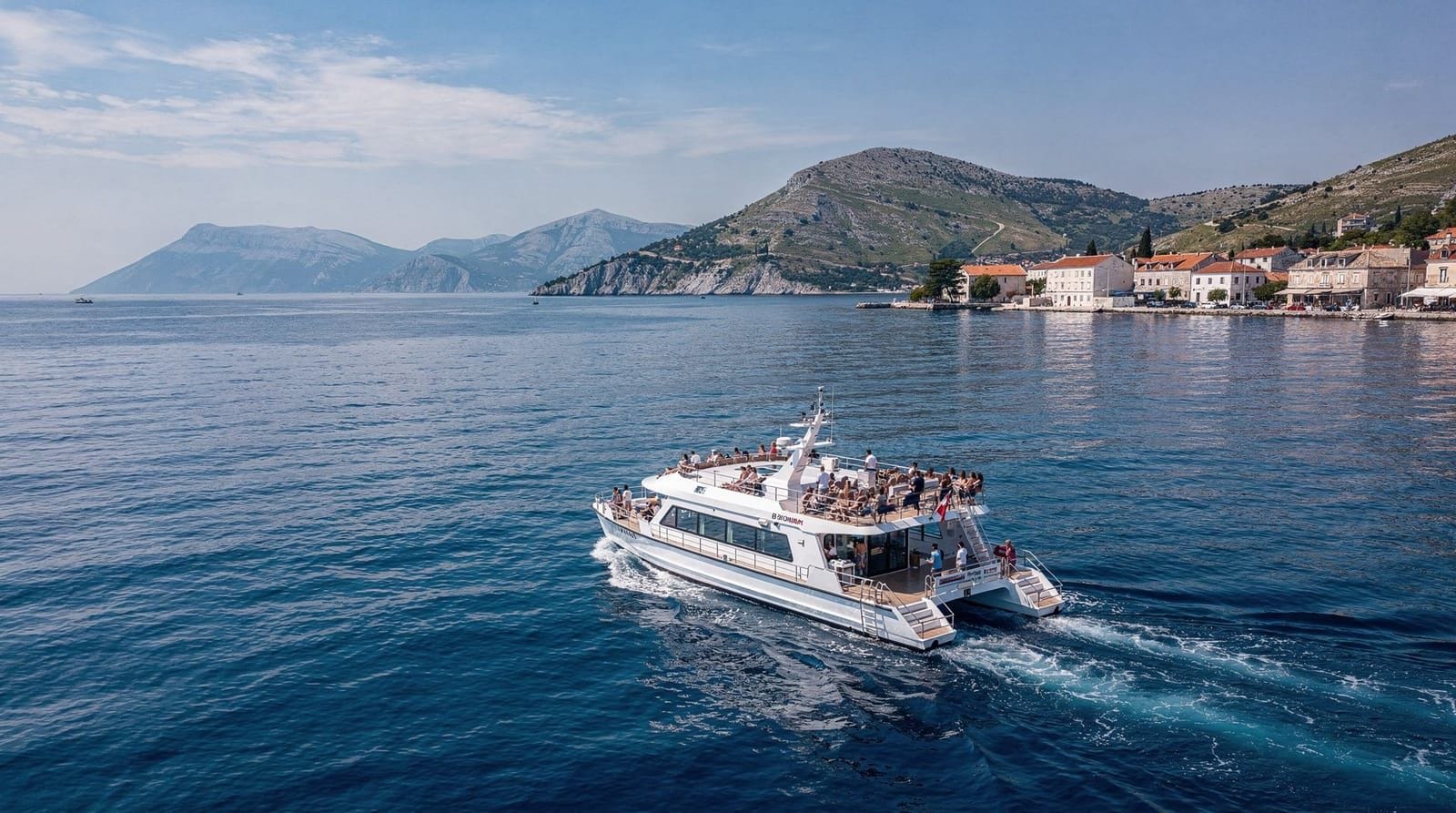
Catamarans feel more like a budget airline than a ferry. You board and find a seat — there’s rarely open deck access in motion (sea spray). Journey times are significantly shorter. However:
- Luggage: Oversized bags may be stored in the hold, but space is limited. Travel light if you’re doing island hopping.
- Rough sea: Catamarans are faster but feel the swell more. If you’re prone to motion sickness, the car ferry is smoother.
- Foot passengers only: You cannot bring a car. If your trip depends on the vehicle, check whether a car ferry alternative exists for your route.
Seasonal considerations
Summer (June–September) is full schedule: maximum sailings, all routes open, highest prices for car spaces. The Jadrolinija high-season timetable is usually published in late April or early May. Download or screenshot the relevant pages — internet at small island ports can be unreliable.
Shoulder season (May, October) sees reduced but adequate frequency. Winter drops dramatically: some island routes run once or twice daily, a handful of smaller islands become much harder to reach. If visiting in winter, confirm timetables directly.
Overnight coastal service
Jadrolinija’s overnight coastal ferry (brodska linija) is a slow connection linking Rijeka with Split and Dubrovnik. This isn’t a cruise ship — it’s a working ferry with basic reclining seats, cabins of various classes, and a functional restaurant. Cyclists and overlanders love it. The journey from Split to Dubrovnik takes 9–10 hours overnight. Book cabins months ahead in summer.
Tips from frequent Adriatic travellers
Check the port, not just the town. Hvar has two ferry ports: car ferries go to Stari Grad (the main port on the north side of the island), while catamarans dock at Hvar Town. These are 20 km apart by road — a significant difference if you’re on foot.
Foot passengers can be flexible. If a sailing is cancelled or full, the next one is usually 1–2 hours later on busy corridors. Carry cash for the kiosk; not all terminals have reliable card readers.
The island bus connection. On Hvar, Korčula and Brač, local buses (rijetko) connect the ferry port to the main town. Frequency is low; check timetables and consider a taxi if timing is tight.
If you’re planning to use ferries for multi-day island hopping through central Dalmatia, the Blue Cave and 5 Islands day tour from Split is a good introduction to the archipelago without the logistics of self-booking each hop. For those approaching from Dubrovnik, a hop-on hop-off Elaphiti Islands boat tour shows how ferry-based exploration actually works in practice.
The northern routes: Kvarner and Istria
While Dalmatian routes dominate the tourist itinerary, Croatia’s northern ferry network deserves mention. The Kvarner Gulf — between Istria and Dalmatia — contains the islands of Krk, Cres, Lošinj and Rab.
Krk is connected to the mainland by a road bridge (no ferry required), making it the easiest Croatian island to reach by car. Other Kvarner islands are served by frequent, short ferry crossings from Valbiska (Krk) or Brestova (Istria) to Merag (Cres/Lošinj). The Jadrolinija route Rijeka–Mali Lošinj–Zadar runs seasonally and makes a beautiful slow coastal journey.
Rab is accessed from Jablanac (Velebit coast) or from Stinica by car ferry — both short crossings under 20 minutes. The island of Pag is connected by bridge in the north and by a short ferry in the south (Žigljen–Prizna).
For Kvarner-focused itineraries, the Opatija and Rijeka area makes a practical base, with ferries to Cres, Lošinj and Rab within easy reach.
Navigating the Split Ferry Terminal
Trajektna luka Split (Split Ferry Terminal) is the busiest in Croatia and can feel chaotic on summer mornings. Here is how to navigate it:
The terminal complex is beside the bus station on Split’s harbour. Inside the main building are ticket offices for Jadrolinija (and separate desks for Krilo and TP-Line, usually nearby). Look for departure boards showing current day’s sailings.
For foot passengers: Buy your ticket at the relevant counter, keep the printed ticket, and find the departure pier (gat). Piers are numbered and signposted by destination. Catamarans to Hvar Town depart from different piers than car ferries to Stari Grad — this is the most common point of confusion.
For drivers: Vehicle lanes begin before the terminal building. Follow signs for your destination island — marshals will direct you into the correct lane. Payment for vehicles is at the dedicated car-passenger booths before the loading ramp. The queue for the Split–Hvar Stari Grad car ferry can be 30–60 cars long in peak summer morning hours.
What to bring: Arrive with printed or downloaded ticket QR codes. Mobile signal can be overwhelmed at peak times. Carry the exact amount in euros for kiosk purchases — change is provided but queues slow with large notes.
Island-specific ferry notes
Hvar
Two ports, two ferry systems. Stari Grad (car ferry, Jadrolinija from Split, 1h40m) is on the north coast. Hvar Town (catamarans from Split, 50 min) is the main tourist hub on the south coast. They are 20 km apart — an important detail when planning transport from the port to your accommodation. From the Stari Grad car-ferry port, a local bus connects to Hvar Town in about 25 minutes; frequency is low, so time your arrival accordingly.
Brač
The car ferry goes to Supetar on the north coast. For Bol and the famous Zlatni Rat beach on the south coast, either drive across the island (30 km) or take the seasonal summer catamaran from Split directly to Bol.
Korčula
The town of Korčula (medieval old town) is served by catamarans from Split and Dubrovnik, and by a car ferry from Orebić (on the Pelješac Peninsula) — a short 15-minute crossing. If you’re on the Pelješac Peninsula, this Orebić crossing is the quickest way onto the island.
Vis
A dead end in ferry terms — no through-route onward by sea. You go in and come back to Split. This remoteness is precisely what makes Vis the most unspoilt major Dalmatian island. Plan a minimum of two nights to justify the crossing.
Mljet
Jadrolinija connects Mljet (Polače) with Dubrovnik to the south and Split to the north. The island is positioned at the end of the coastal catamaran route — easily incorporated as a stop if travelling from Split to Dubrovnik by sea.
Ferries for cyclists
Croatia is an increasingly popular cycling destination, particularly in Istria and along the Adriatic cycling route. Bicycles are accepted on Jadrolinija car ferries for a small surcharge (typically €2–€5). They are generally not permitted on catamarans. If cycle touring the coast and islands, plan your routes around car-ferry ports rather than catamaran stops.
Key cycle-friendly ferry crossings: Split–Supetar (Brač, 50 min), Split–Stari Grad (Hvar, 1h40m), Zadar–Ancona (overnight, Italy to Croatia). The Rijeka–Zadar–Split–Dubrovnik overnight coastal service also accepts bicycles.
Ferry food and drink
On Jadrolinija car ferries, the cafeteria serves hot coffee, sandwiches, pastries and basic hot meals. Prices are slightly higher than in town (as expected) but not outrageously so. A coffee costs around €2; a grilled sausage sandwich €4–5. Beer is available on longer crossings.
On catamarans, service is minimal — a trolley or small kiosk selling soft drinks, coffee and packaged snacks. For longer catamaran crossings (Split–Korčula, 2.5 hours), bring your own food.
Water: Carry a water bottle. The Adriatic sun on an open ferry deck is fierce in summer, and dehydration catches out unprepared travellers on longer crossings.
Connections to Italy
Jadrolinija and the Italian operator SNAV run overnight car ferries between Ancona (Italy) and Split, Zadar, and occasionally Šibenik. Crossings take 10–14 hours and have cabins (various classes), vehicle decks and restaurants. This is a practical option for overlanders and campervans arriving from Italy or driving a Europe-wide road trip.
The Bari (Italy) to Dubrovnik route is served seasonally by SNAV. Neither is a daily service — check seasonal schedules well in advance and book early, as these routes are popular with motorhome communities.
Frequently asked questions about Croatia Ferries Guide 2026
Do I need to book Croatia ferries in advance?
For car ferries in July–August, yes — car spaces sell out days ahead. Foot passengers can usually turn up, though online booking guarantees your ticket on busy catamarans. Outside peak season, advance booking is rarely necessary.Can I bring a car on all Croatia ferries?
Only on Jadrolinija's roll-on/roll-off car ferries. Catamarans run by Jadrolinija, Krilo and TP-Line are foot-passenger only — no bicycles with panniers and no cars.How much do Croatia ferries cost?
A foot-passenger ticket Split–Hvar runs €6–€9 on a car ferry, or €10–€14 on a fast catamaran. Car + driver on the same route costs roughly €35–€50 in peak season. The coastal catamaran Split–Dubrovnik (via Hvar, Korčula, Mljet) is around €27 for foot passengers.Is Jadrolinija or Krilo faster?
Krilo and TP-Line catamarans are generally faster than conventional car ferries on the same routes and sometimes comparable to Jadrolinija's own catamarans. The trade-off: no car transport and fewer islands served.When do summer ferry schedules start?
Full summer timetables typically kick in from early June and run through late September. Some routes operate year-round with reduced winter frequency; a few links (Hvar Stari Grad–Split) are essentially daily all year.Can I take a bicycle on the ferry?
Yes, on car ferries for a small surcharge (typically €2–€5). Most catamarans do not accept bicycles.Are there overnight ferries in Croatia?
Yes. Jadrolinija runs overnight coastal services connecting Rijeka–Zadar–Split–Hvar–Korčula–Dubrovnik (seasonal). Cabins book up early; a deck seat is the budget option.Which is better for island hopping — car ferry or catamaran?
Catamarans are faster and better if you don't need a vehicle and want to cover more islands in less time. Car ferries are the better choice if you're prone to seasickness, need a car on the island, or want to cycle-tour, since most catamarans exclude bikes and feel the swell more.
Top experiences
Bookable activities with verified prices and instant confirmation on GetYourGuide.
Top experiences
Best-rated activities across GetYourGuide and Viator.

Mostar and Herzegovina Tour with Kravica Waterfall from Split & Trogir
- Viator

Mostar & Kravice waterfalls full-day guided tour from Split
- Viator

Split airport to Split Private transfer to 8 pax (Door to Door any location)
- Viator

Zagreb to Split Group Transfer with Plitvice Lakes guided Tour
- Viator

Zadar: Zrmanja River Kayaking, with optional transfer from Zadar
- Viator

Mostar and Kravica Waterfall Discovery Day Trip from Split or Trogir
- Viator