Tipping in Croatia
Do you tip in Croatia?
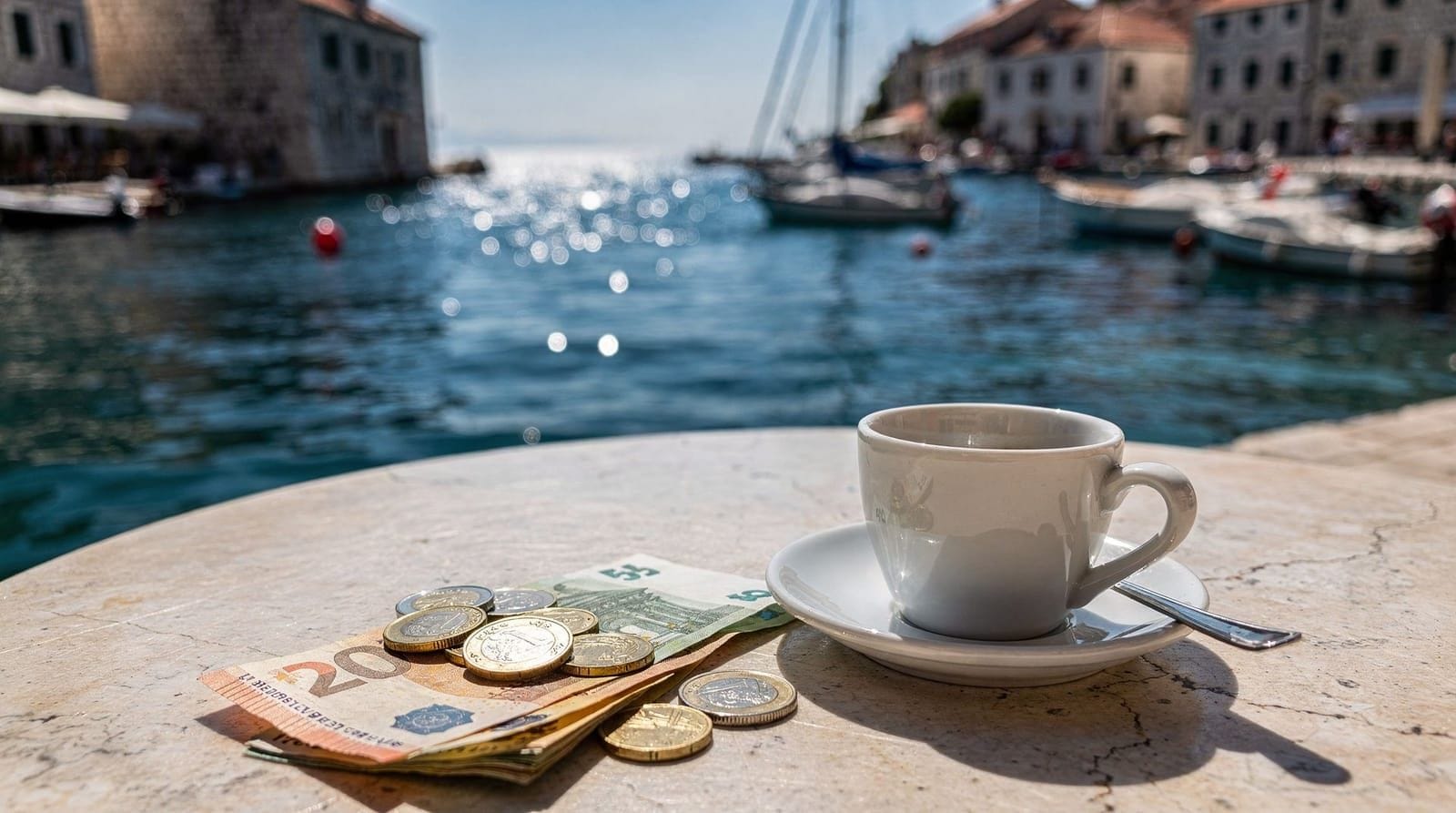
Tipping is customary but not obligatory in Croatia. Around 10% in restaurants when satisfied, or simply round up the bill. For tours and guides, €5–10 is appropriate. Tips are not expected for casual drinks or takeaway. Always tip in cash directly to the person.
| Restaurants | ~10% or round up, cash only |
| Cafés/bars | Not expected |
| Tour guides | €5–10/person half or full day |
| Taxis | Round up or €1–2 |
| How to pay | Always cash, handed directly |
Tipping culture in Croatia: the basics
Croatia is not a heavy tipping culture. It sits somewhere between the no-tip expectation of Japan and the social-contract tipping culture of the United States: tipping is appreciated and increasingly common in tourist areas, but it is a genuine gesture of thanks rather than a structural wage supplement.
Service charges are rarely added automatically to bills in Croatia. If you see a “servis” line on your bill, check whether it was added without being mentioned — this is uncommon and some establishments in heavy tourist areas have adopted it. More usually, the bill you receive is simply the sum of what you ordered.
The practical result: you tip when you genuinely want to express thanks for good service. You tip nothing if you do not. Nobody will chase you down the street or give you a meaningful look.
Restaurants
How much: Around 10% for good service, or round up to a round number that feels appropriate for the meal.
Examples:
- Bill of €34 → leave €38 or €40
- Bill of €62 → leave €68 or €70
- Bill of €24 → leave €27 or €28
When to tip more: An exceptional meal, a particularly attentive server who took time to explain the menu, or a restaurant that went out of its way to accommodate a request.
When not to tip: Poor service, wrong orders that were not corrected, rude staff. This is rare in Croatia’s restaurant scene, but the point is that tipping is contingent on the experience, not automatic.
How to tip: Always in cash. Do not add a tip to the card amount if paying by card — in most Croatian restaurants, this goes to the till, not to the server. Instead, pay the bill by card and hand the cash tip directly to your server as you leave.
If you are paying cash, you can either:
- Tell the server the total including the tip when they come to take the money (“Keep the change” — “Nema kusura” in Croatian)
- Leave the tip on the table after paying
Cafés and bars
General rule: Not expected for a coffee or a drink. Some people round up to a convenient amount (€3 for a €2.80 coffee; leaving the coins for a beer). This is friendly but not required.
Exceptions: At a cocktail or beach bar where you are being served at your seat over an extended session, a small tip at the end (€2–4 for a table of two over two hours) is a reasonable gesture.
In the coffee-culture context of Croatia — the long kavica ritual where a single espresso can last an hour — there is no social pressure around tipping.
Taxis and rideshare
Amount: Round up to the nearest euro for short rides; €1–2 for a typical city trip; €3–5 for a longer transfer if the driver was helpful.
Uber operates in Zagreb and Split. Rideshare gratuities can be added in-app, but cash tipping is more likely to reach the driver directly.
Airport transfers: For a comfortable private transfer (hotel shuttle, private taxi) on a long journey, €3–5 is a generous and appreciated tip.
Tours and guides
Tours are the situation in Croatia where tipping has the clearest expectation — not mandatory, but normal for a good experience.
Group tours (boat excursion, national park guided tour, walking tour): €5–10 per person is typical for a half-day or full-day tour that was good. More if it was exceptional.
Private tour guides: €15–20 per person (or per couple) is appropriate for a day with a private guide. Some travellers tip €10 minimum per person for genuinely excellent private guiding.
Boat captains: On a sailing excursion, kayaking tour or private boat trip, €10–20 for the captain (and similar for any additional crew) is appropriate. For a multi-day sailing charter, a crew tip of 5–10% of the charter fee is the norm if crew is included.
Shore excursion guides and bus drivers: On cruise-ship excursions or organised coach tours, €5–10 per person per day is standard if you are happy with the experience.
Walking tour guides (free tours): Zagreb, Split and Dubrovnik all have “free” walking tours where the guide works on tips. A tip of €8–15 per person for a 2-hour tour is the appropriate exchange for what is effectively a paid experience.
Hotels
Porters: €1–2 per bag if they carry your luggage.
Room cleaning: €1–3 per night if you are staying multiple nights. Leave it daily (not all in one go at the end) in cash, placed clearly so the cleaning staff know it is for them. An envelope on the pillow works well.
Concierge: If they secured a difficult reservation or went significantly out of their way, €5–15 is generous and appropriate.
Check-in/check-out staff: No tip expected.
Spas and wellness
A tip of 10–15% for massage therapists, beauticians and other spa workers is appreciated. Similar to restaurant tipping: not obligatory, but a meaningful gesture for good work.
What NOT to do
Do not add tips to card payments and assume they reach the server. In Croatia, card payments often go to the business account; tipping via card terminal is unreliable. Cash in hand, given directly, is the only way to ensure the right person receives the tip.
Do not tip in advance to encourage better service — this is not the Croatian way and can create awkwardness.
Do not feel obligated to tip if service was poor. The zero-tip is a perfectly acceptable form of feedback in Croatia. Unlike in the US, servers in Croatia do not depend on tips to reach a liveable wage.
How to say it in Croatian
- “Keep the change” — “Nema kusura” (lit. “No change”)
- “This is for you” — “Ovo je za vas”
- “Thank you very much” — “Hvala lijepa”
Simply saying “Hvala” (thank you) while handing the cash makes the intention clear.
Tipping amounts: quick reference
| Situation | Amount |
|---|---|
| Restaurant, good service | ~10% or round up |
| Café/bar | Round up or nothing |
| Taxi | Round up or €1–2 |
| Group tour guide (half/full day) | €5–10 per person |
| Private guide (full day) | €15–20 per person |
| Boat captain | €10–20 |
| Free walking tour guide | €8–15 per person |
| Hotel porter | €1–2 per bag |
| Room cleaning | €1–3 per night |
| Spa/massage | 10–15% |
Tipping and your overall Croatia budget
Tips are a small line item compared to the rest of a Croatia trip budget, but worth factoring in if you’re travelling with guided tours or eating out regularly. See the Croatia daily costs guide and is Croatia expensive for the bigger financial picture, and the Croatia budget tips guide or Croatia on a budget if you’re trying to trim costs elsewhere. For context on where money in Croatia comes from and goes, the money in Croatia guide covers currency, cards and ATMs.
Tipping at konobas and local restaurants
Konobas — Croatia’s traditional family-run taverns — are where tipping culture feels most genuine. Because these are often small, owner-run businesses rather than chains, a cash tip for a memorable meal (a generous pour of homemade rakija, an unprompted extra course, real warmth from the family running the place) goes directly to the people who earned it. See our konoba guide for how to find the good ones. The same 10% guideline applies, but the gesture tends to land more personally in a small konoba than at a large tourist-zone restaurant on the Riva or Stradun.
First-timer tipping mistakes to avoid
Visitors new to Croatia sometimes import tipping habits from home that don’t translate well. Americans often over-tip out of habit (20% is unnecessary and can seem excessive); visitors from some Northern European countries under-tip out of a “service charge included” assumption that doesn’t generally apply in Croatia. If you’re building a broader sense of Croatian customs before you arrive, the first time in Croatia guide covers etiquette beyond tipping — greetings, dress norms and dining customs that round out the same practical picture.
Frequently asked questions about Tipping in Croatia
Is tipping mandatory in Croatia?
No — tipping is not mandatory in Croatia. Service charges are not automatically added to bills (check the receipt). Tips are a gesture of genuine satisfaction, not a cultural expectation built into the wage structure as in the US.How much do you tip in a Croatian restaurant?
Around 10% when satisfied with the service and food, or simply round up to a round number. On a €48 bill, leaving €52–54 is typical. You can leave exactly nothing if service was poor — there is no social pressure equivalent to American tipping culture.Should I tip taxi drivers in Croatia?
Rounding up to the nearest euro or a small amount (€1–2 for a short journey) is appreciated but not expected. For a longer transfer, €2–5 is a nice gesture for good service.How do you tip for a tour or guided experience?
€5–10 per person for a half-day or day tour with a guide who gave a good experience. For private guides, €15–20 is more appropriate. For a boat captain on a sailing day, €10–20 is generous and appreciated.Do you tip in bars and cafés in Croatia?
Not expected for a coffee or a beer. Some people round up or leave small change. Tipping for drinks is not the norm — unlike in the UK where leaving coins at a bar is common, or the US where bartender tipping is significant.Should I tip hotel staff in Croatia?
Not expected at check-in or check-out. Leaving €2–3 per night for room cleaning staff (daily, in cash, in an envelope or left clearly on the pillow) is a considerate gesture but not obligatory. Porters: €1–2 per bag is fair.How should I tip in Croatia — card or cash?
Always cash, and directly to the person. Adding a tip to a card payment in Croatia is unreliable — it may be pooled, kept by the business, or simply not reach the server. Hand the tip directly in cash.
Top experiences
Best-rated activities across GetYourGuide and Viator.

Mostar and Herzegovina Tour with Kravica Waterfall from Split & Trogir
- Viator

3Hour ALL-INCLUSIVE Sunset Dolphin Watching from Medulin onSandra
- Viator

Dolphin Watching & Sunset Boat Tour With Drinks & optional Dinner
- Viator

Fantastic DOLPHIN & SUNSET TOUR with dinner ( Pula-NP BRIJUNI )
- Viator

Medulin :All-Inclusive Pirate Boat Dolphin Watching Sunset Cruise
- Viator

Mostar & Kravice waterfalls full-day guided tour from Split
- Viator