Croatia budget tips
What are the best ways to save money in Croatia?
The biggest savings come from timing (shoulder season saves 30–50% on accommodation), destination choice (Zadar and Šibenik cost less than Dubrovnik), eating at konobas rather than tourist restaurants, using buses and foot-passenger ferries, and booking group tours over private.
The tips that actually move the needle
Not all budget tips are created equal. Some save €2 on a coffee; others save €400 on a week’s accommodation. This guide focuses on the ones that make a real difference, with the biggest-impact items first.
| Biggest lever | Shoulder-season timing (30–50% off accommodation) |
| Cheapest meal | Pekara burek, ~€1.50–3 |
| Cheapest intercity transport | Bus, from €6 |
| Realistic daily saving | €20–40/person vs peak-season, full-price travel |
| See also | Croatia daily costs for full budget ranges |
1. Travel in shoulder season
This is the single highest-impact decision for your total Croatia spend.
Accommodation in Dubrovnik in August: €200–400+ per night for a decent double room. The same room in May: €90–150. For two people, one week — that difference funds your flights.
The sweet spots: Late May–June and September–early October. Full services running, warm enough to swim (sea is 18–22°C in June; 23–24°C in September), crowds manageable, prices 25–40% below peak.
October (first two weeks) is an excellent alternative for those without the sea-temperature concern — minimal crowds, dramatically lower prices, beautiful autumn light.
Full context in Croatia shoulder season.
2. Choose Zadar or Šibenik over Dubrovnik
Zadar has a beautiful walled old town on a peninsula, the unique Zadar Sea Organ, excellent ferry connections to the northern Dalmatian islands, a good food scene, and is 20–35% cheaper than Dubrovnik or Split for comparable accommodation.
Šibenik is even less touristy, sits between Split and Zadar on the coast, has a UNESCO cathedral and medieval fortress, and prices that reflect its lower profile.
You can visit Dubrovnik as a day trip on the bus (€10–16 each way) rather than paying Dubrovnik accommodation rates. Many experienced travellers do exactly this.
3. Eat the konoba daily menu
The konoba — the traditional Croatian tavern — typically offers a daily lunch menu (ručak or dnevni menu): soup, a main course (usually grilled meat or fish), dessert and a small drink, for €10–18.
A tourist restaurant on the Dubrovnik Old Town Stradun charges €25–35 for a main course alone.
The food at a good konoba is often better. The rule: walk one street back from the sea view and the prices drop by 30–50%.
4. Use buses rather than trains or planes
Croatia’s intercity bus network is comfortable, frequent and cheap. Buses connect all the main tourist centres:
- Zagreb–Split: €15–22 (5 hours)
- Split–Dubrovnik: €10–16 (4 hours)
- Zadar–Split: €8–12 (2 hours)
- Split–Šibenik: €6–10 (1.5 hours)
The only rail routes worth considering are Zagreb and the interior (Zagreb–Rijeka, Zagreb–Osijek). For the Dalmatian coast, there is essentially no viable train network.
Intra-island transport: local buses on larger islands (Hvar, Brač, Korčula) are inexpensive (€2–5 for most routes); taxis and private transfers are 10–20x more.
5. Use foot-passenger ferries — leave the car on the mainland
Taking your car on the ferry to a Croatian island adds €20–35 per crossing for the vehicle (in addition to the passenger ticket). On Hvar and Vis, you cannot drive through the main old towns anyway.
Taking the foot-passenger catamaran (foot only, no cars) is faster, cheaper and drops you right in the town centre. Many islands have local bus services or moped rental for those who want to explore beyond the main town.
The only situation where a car on the ferry pays off: a longer island stay where you plan to drive around substantially and the island has good roads (Brač or Krk, for example).
For ferry options and routes, see the Croatia ferries guide.
6. Find the local bakery (pekara)
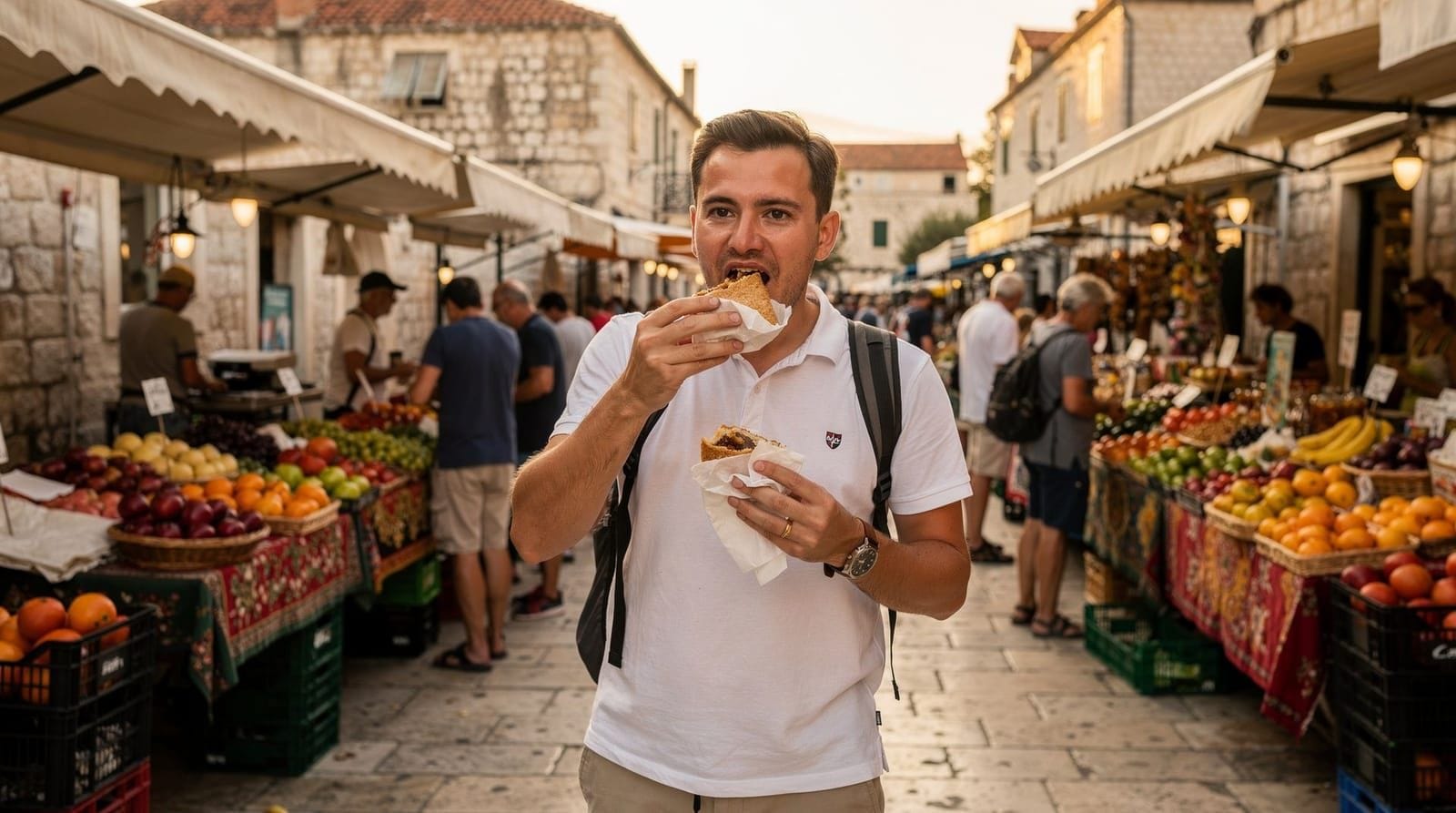
Every Croatian town has a bakery. Burek — phyllo pastry with cheese, meat or potato filling — is €1.50–3 for a substantial portion and is breakfast, lunch and snack for budget travellers. Local bread and filled rolls are similarly cheap.
The pekara is the single most reliable cheap food option in Croatia and is genuinely delicious.
7. Shop at the morning market
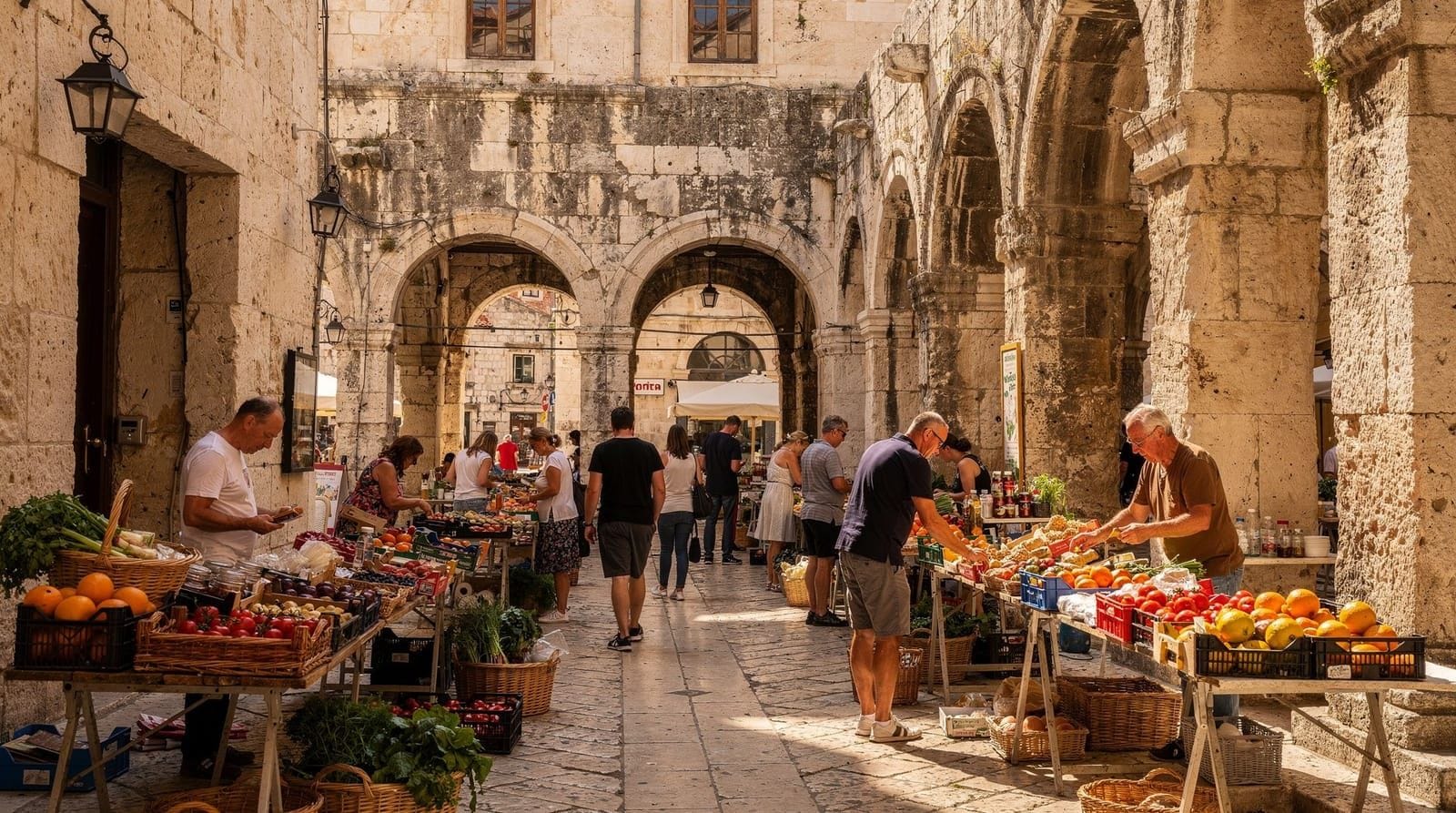
The outdoor market (tržnica or pijaca) sells fresh produce, local cheese, olives, bread and sometimes fish and honey at significantly lower prices than supermarkets or restaurant equivalents.
Buy provisions in the morning for picnics, hostel breakfasts and apartment-kitchen cooking. In Dalmatia, local cheese (sir), prosciutto (pršut) and olives make a market picnic that outclasses many restaurant meals.
8. Book group tours, not private
Private boat excursions, private guided tours and private transfers all cost 5–10x more than the group equivalent for essentially the same experience.
A group Blue Cave + 5 islands speedboat tour from Split: €50–80 per person. A private speedboat for the same route: €400–600+. The difference in experience is marginal for most visitors.
Where private tours genuinely add value: families with young children (the flexibility matters), very specific specialist interests, accessibility needs, or situations where the group tour timetable does not fit your schedule.
9. Use bank ATMs and avoid DCC
Avoid Euronet standalone yellow ATMs — they offer poor exchange rates and charge high fees.
Use bank ATMs: Erste, PBZ, ZABA, Splitska Banka.
When paying by card, always choose to be charged in euros (EUR) rather than your home currency. The Dynamic Currency Conversion (DCC) rate offered is typically 3–8% worse than your card’s rate.
Full detail in money in Croatia.
10. Stay outside the old towns
Accommodation inside Dubrovnik’s Old Town carries a significant premium. Accommodation in the suburbs (Lapad, Babin Kuk, Ploče) — 10–20 minutes by bus — costs 30–50% less. The bus into the Old Town runs regularly.
Similarly: staying in Split’s old Diocletian Palace area is more expensive than staying 10 minutes’ walk out. Staying in Stari Grad rather than Hvar town on the island of Hvar is 30–40% cheaper.
11. Use the apartment kitchen
Self-catering for even one meal a day reduces costs substantially. An apartment with a kitchen (usually the same price or slightly more than a private room) enables:
- Supermarket breakfast (€3–5 for bread, eggs, fruit, yogurt)
- Market picnic lunch (€6–10 for cheese, tomatoes, olives, prosciutto, bread)
- One restaurant dinner (budget freed up by not eating every meal out)
For two people sharing an apartment, self-catering breakfast and lunch + one restaurant dinner per day can save €20–30/day versus eating every meal out.
12. Visit Plitvice in shoulder season
Plitvice Lakes entry fees are tiered by season:
- January–March and November: ~€10–15
- April and October: ~€15–25
- May, June and September: ~€25–35
- July–August: ~€35–40
Going in April or October saves €15–25 per person on the entry fee. For a family of four, that is €60–100 — enough for several good meals.
The park is also dramatically less crowded in shoulder season, which improves the experience as much as it reduces the cost.
13. Take the airport shuttle bus, not a taxi
Most Croatian airports have shuttle bus services to the city centre:
- Split: Pleso Prijevoz bus to the city centre, ~€8 one way (taxi: €20–30+)
- Dubrovnik: Atlas shuttle to the city, ~€7–10 (taxi: €25–40+)
- Zagreb: Airport shuttle to the city, ~€6–8 (taxi: €25–35+)
On a round trip for two, the bus saves €30–60 over taxis.
14. Carry your own water bottle
Croatian tap water is safe to drink nationwide and is good quality. Buying 1.5-litre bottles of water multiple times a day (€1.50–3 each) adds up. Carry a reusable bottle and refill it at tap water points (many public spaces have drinking water fountains, particularly in Zagreb and the larger coastal towns).
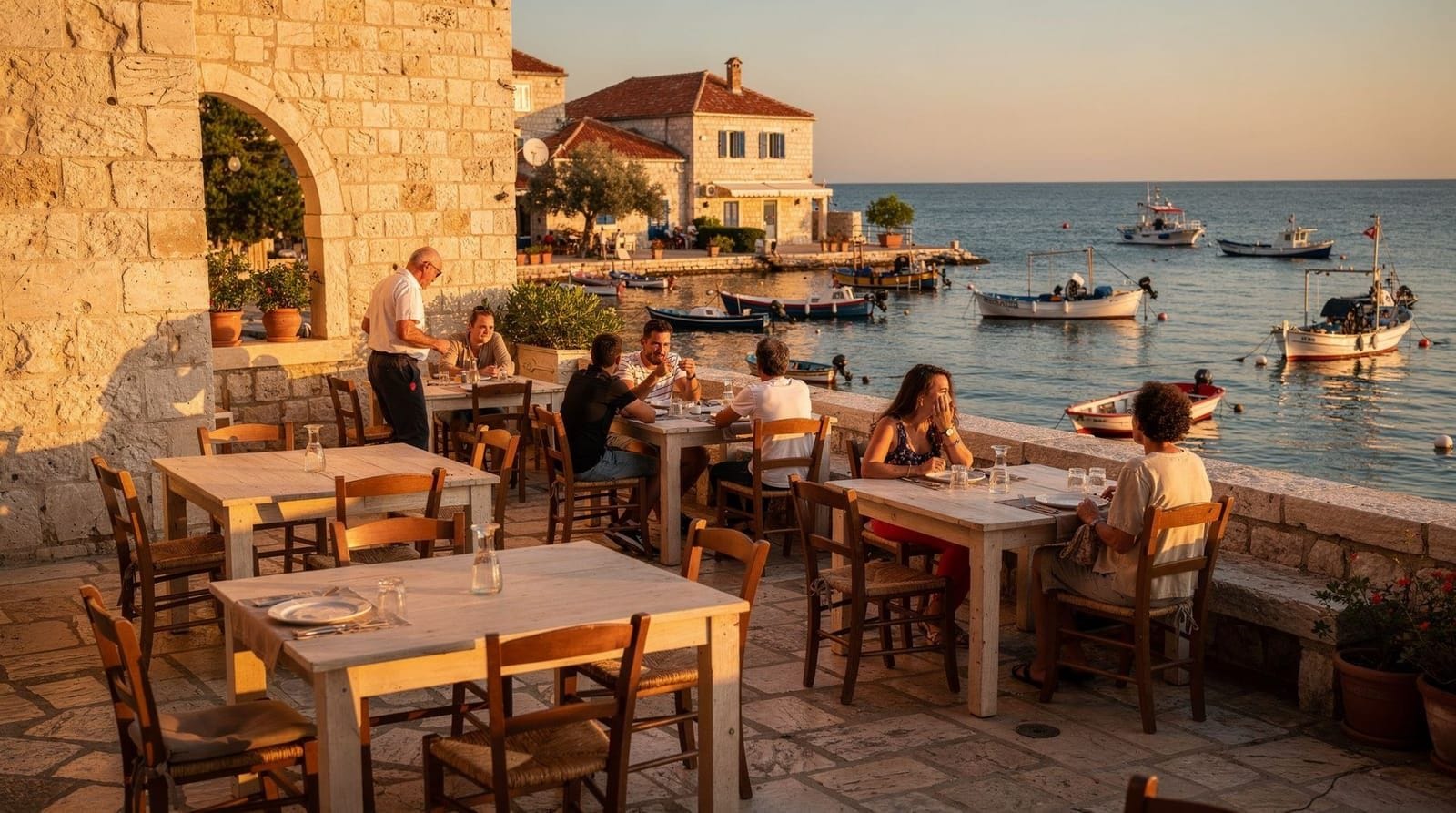
15. Avoid seafront tourist restaurants
The mark-up at restaurants with sea views, particularly in the Old Towns of Dubrovnik and Split, is substantial. The konoba or trattoria one or two streets back serves food of equivalent or better quality at 30–50% lower prices.
The best indicator: if there is a laminated picture menu and a host outside beckoning you in, walk on.
16. Use public transport on islands
Hvar town, Jelsa and Stari Grad on the island of Hvar are connected by a regular local bus service. The bus from the ferry terminal to Hvar town costs around €3; a taxi costs €10–15.
Similarly, public buses on Brač, Korčula and Krk are inexpensive and cover most tourist destinations on the islands.
17. Book directly where possible
Booking.com, Airbnb and similar platforms take 10–20% commission from accommodation providers. Many family-run guesthouses (sobe) and apartments offer the same room at a lower direct price if you contact them by email or phone.
Look for the property directly online once you have found it on a booking platform. Ask if they offer a direct-booking discount — many do, particularly for stays of 5+ nights.
18. Drink local wine and beer
Croatia has excellent local wine: Plavac Mali from Dalmatia, Malvazija from Istria, Graševina from Slavonia. A bottle in a konoba costs €12–25; import wines cost 50–100% more.
Karlovačko, Ožujsko and Pan are Croatia’s main beers — all drinkable, all cheap (€2.50–4 for a half-litre in a bar).
Avoid cocktails at tourist bars in Hvar town unless you have budgeted for it — cocktails run €10–18 and add up fast.
19. Ferry book ahead for car, walk-on for feet
If you need to take a car on a ferry, book in advance (jadrolinija.hr) — particularly for July–August when car spaces sell out. Booking costs the same as at the terminal; running the risk of a sold-out ferry costs time and stress.
For foot passengers, same-day purchase is almost always available. You do not need to book ahead unless a route is very popular at a very specific time.
20. Visit free sights first
Many of Croatia’s best experiences are free or very cheap:
- Zadar Sea Organ and Greeting to the Sun: free
- Split’s Diocletian’s Palace streets and courtyards: free (underground chambers ~€12)
- Dubrovnik’s Stradun (Placa): free to walk
- Zagreb Upper Town: free (funicular ~€2)
- Croatian beaches: free
- Hiking trails (most): free
- Markets: free to browse, cheap to buy from
Budget the paid entry fees (Plitvice, Dubrovnik walls, specific museums) into your plan; treat everything else as an add-on.
Putting it together: a realistic budget week
Combining the highest-impact tips above — shoulder season, konoba lunches, buses over cars, and staying just outside the old towns — a realistic budget for two people for a week in Dalmatia (Split-based, one island day trip, one Plitvice day) lands around €700–950 excluding flights, versus €1,400–2,000+ for the same trip done at peak-season prices with taxis and waterfront dining throughout. See Croatia daily costs for the full per-day breakdown by travel style, and is Croatia expensive for how it compares to other Mediterranean destinations.
Frequently asked questions about Croatia budget tips
What is the single biggest money-saving tip for Croatia?
Travel in May, June, September or early October instead of July–August. The same accommodation that costs €200 in August costs €90–120 in May. This single change can save €500+ on a week's trip for two people.How do I eat cheaply in Croatia?
Eat the konoba daily lunch menu (€10–18 for three courses including a drink). Shop at local markets for breakfast and snacks. Find the bakery (pekara) — burek costs €1.50–3 and is excellent. One restaurant meal and one market meal daily is the effective budget eating strategy.What is the cheapest way to travel between Croatian cities?
Intercity buses are cheap and comfortable. Zagreb–Split: €15–22. Split–Dubrovnik: €10–16. Foot-passenger ferry to islands: Split–Hvar foot passenger ~€6. Avoid car rental unless doing a road trip that genuinely requires it.How do I avoid ATM fees in Croatia?
Use bank ATMs (Erste, PBZ, ZABA) rather than Euronet standalone machines. Always pay in euros on your card, not your home currency (decline DCC). A Wise, Revolut or Starling card (UK) or Charles Schwab (US) avoids foreign transaction fees.Are there free beaches in Croatia?
Almost all Croatian beaches are free to access. Sunbed rental is optional. Swimming from rocks is free everywhere and is how locals use the sea. Avoid paying beach clubs if the free alternative is available nearby.Is it cheaper to visit Plitvice in shoulder season?
Yes — Plitvice entry fees are tiered by season: around €10–15 in November–March and €35–40 in July–August. Visiting in April, May or October saves €20–25 on the entry fee per person alone.Should I take a car on the ferry in Croatia?
Only if you genuinely need a car on the island. The car ferry surcharge (€20–35 extra on Split–Hvar) adds up. Island rental cars and scooters are available on larger islands; many coastal island towns are walkable. Travelling as a foot passenger is significantly cheaper.What is a realistic budget week in Dalmatia if I follow these tips?
For two people combining shoulder-season timing, konoba lunches, buses and foot-passenger ferries, a week in Dalmatia (Split base, one island day, one Plitvice day) typically runs €700–950 excluding flights, compared to €1,400–2,000+ for the same trip at peak-season prices with taxis and waterfront dining throughout.
Top experiences
Best-rated activities across GetYourGuide and Viator.

Mostar and Herzegovina Tour with Kravica Waterfall from Split & Trogir
- Viator

3Hour ALL-INCLUSIVE Sunset Dolphin Watching from Medulin onSandra
- Viator

Dolphin Watching & Sunset Boat Tour With Drinks & optional Dinner
- Viator

Fantastic DOLPHIN & SUNSET TOUR with dinner ( Pula-NP BRIJUNI )
- Viator

Medulin :All-Inclusive Pirate Boat Dolphin Watching Sunset Cruise
- Viator

Mostar & Kravice waterfalls full-day guided tour from Split
- Viator