Trogir Old Town: the complete visitor guide
Split: Half-day blue lagoon, Ciovo and Trogir boat tour
Why is Trogir a UNESCO World Heritage Site?
Trogir (ancient Tragurion) was inscribed in 1997 for its exceptionally well-preserved medieval urban fabric — a mixture of Hellenistic, Roman, Romanesque, Gothic and Renaissance architecture on a small island connected to the mainland and to Čiovo by bridges. Its Cathedral of St. Lawrence (Katedrala Svetog Lovre) contains the finest Romanesque portal in the Adriatic region, carved by Radovan in 1240.
The island that kept its shape
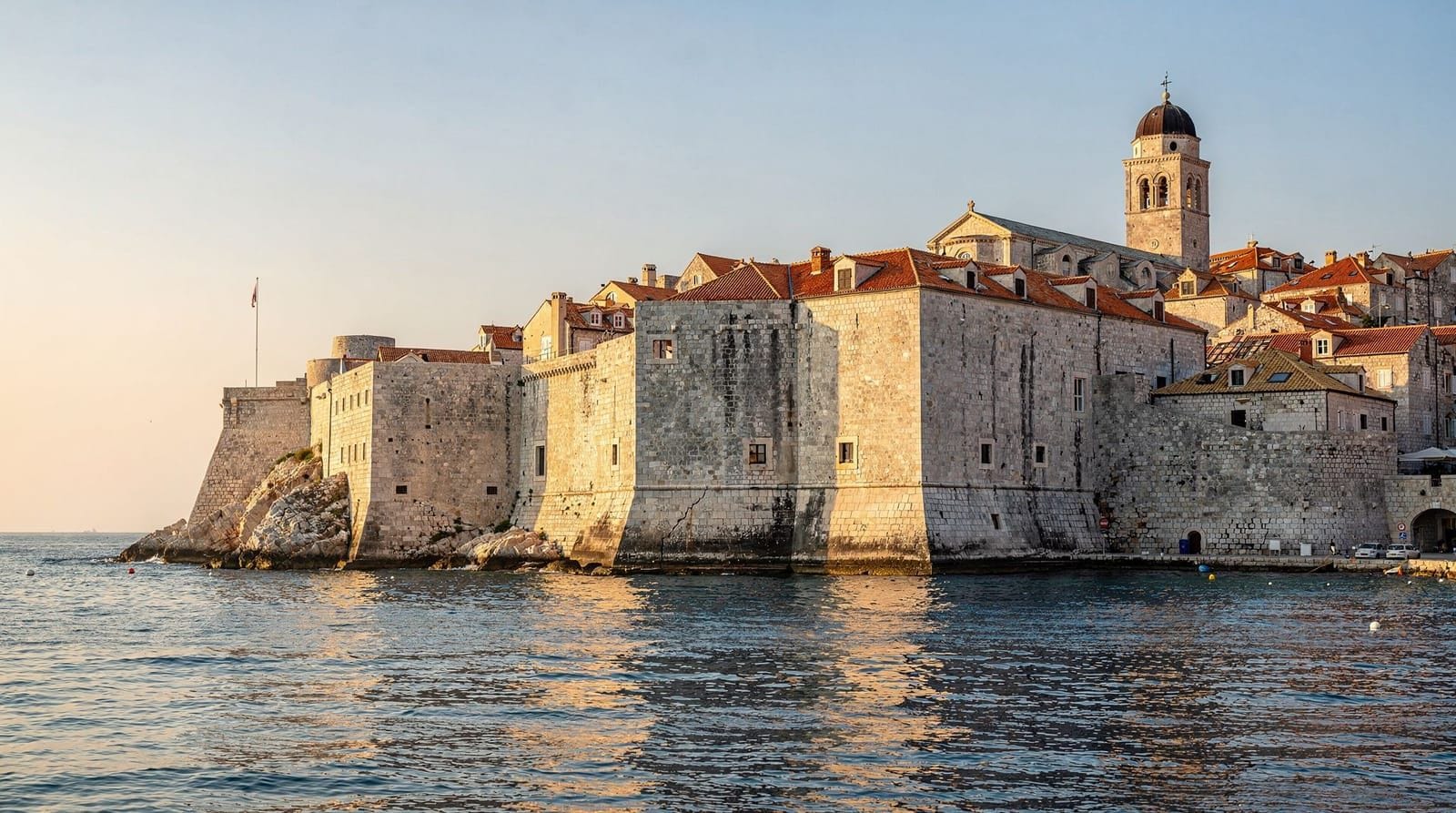
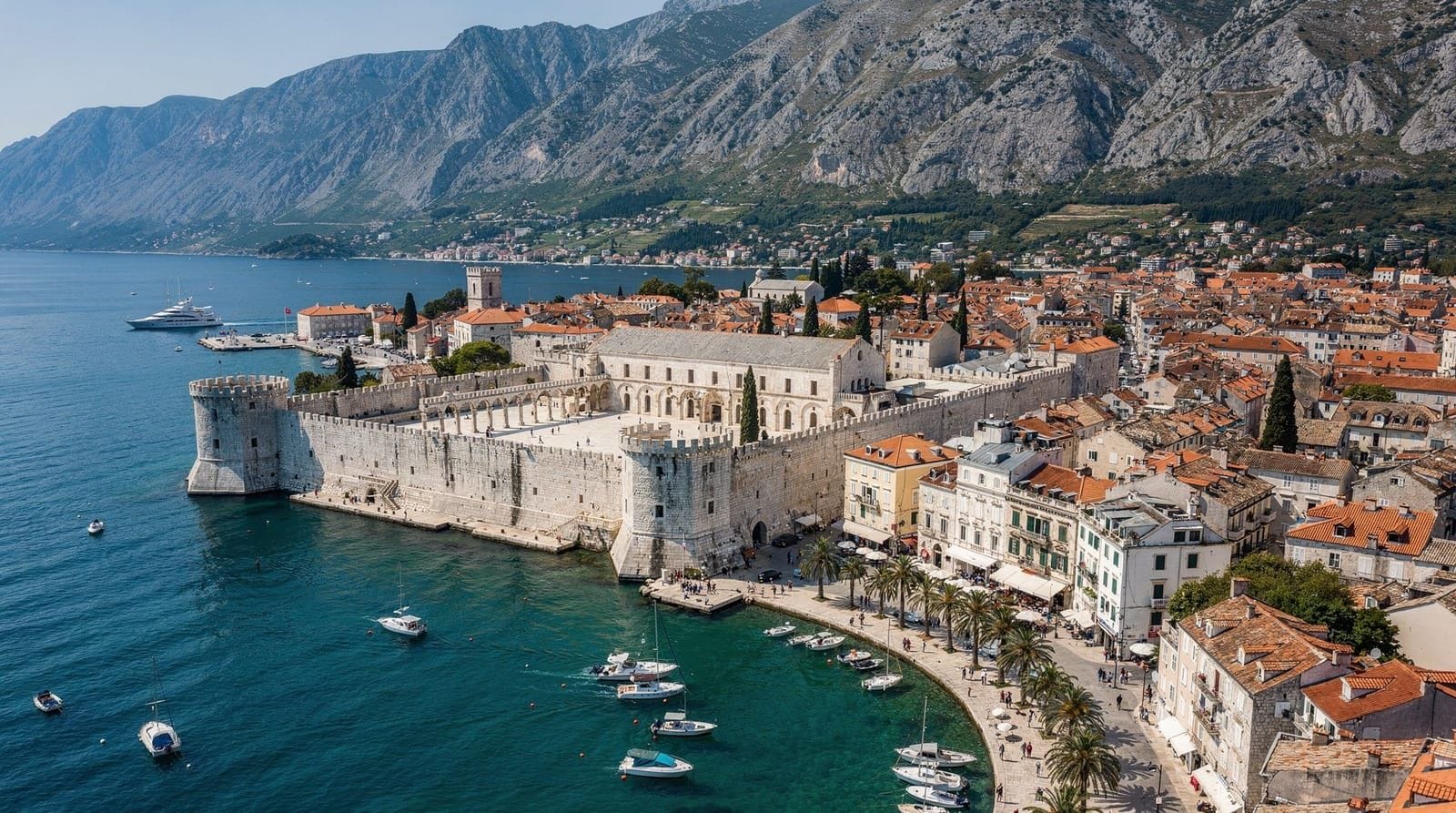
Trogir is built on a small island connected to the mainland by one bridge and to the larger island of Čiovo by another. The island measures roughly 300 by 200 metres — small enough to walk across in five minutes. Within that footprint sits a medieval town whose layered architecture represents 2,300 years of continuous occupation, from its founding as the Greek colony of Tragurion around 384 BC to its current life as a UNESCO World Heritage Site and a genuinely inhabited Croatian town.
The old town is not a museum piece. People live in those medieval houses; laundry dries in lanes that were laid out in the 13th century; cats sleep in doorways that were carved by Romanesque stonecutters. This aliveness is what distinguishes Trogir from a preserved ruin, and it is what makes a morning there more interesting than the statistics of its heritage would suggest.
| Where | Small island old town, 27km / about 45 minutes from Split |
| Cost | Free to wander; cathedral + tower around €6-8; fortress around €3-5 |
| Time needed | Half day (3-4 hours) minimum; full day with a swim on Čiovo |
| Getting there | Bus line 37 from Split (45-60 min) or car via the A1 (about 30 min) |
| Best time | Early morning or early evening — avoid the 10am-2pm cruise-ship window |
Getting oriented
The old town island is small enough to walk without a map, but understanding its layout helps. The main orientation points:
The Riva (waterfront promenade): runs along the north side of the island, facing the mainland. This is where the ferry dock, most of the cafés and restaurants, and the tourist information office are located.
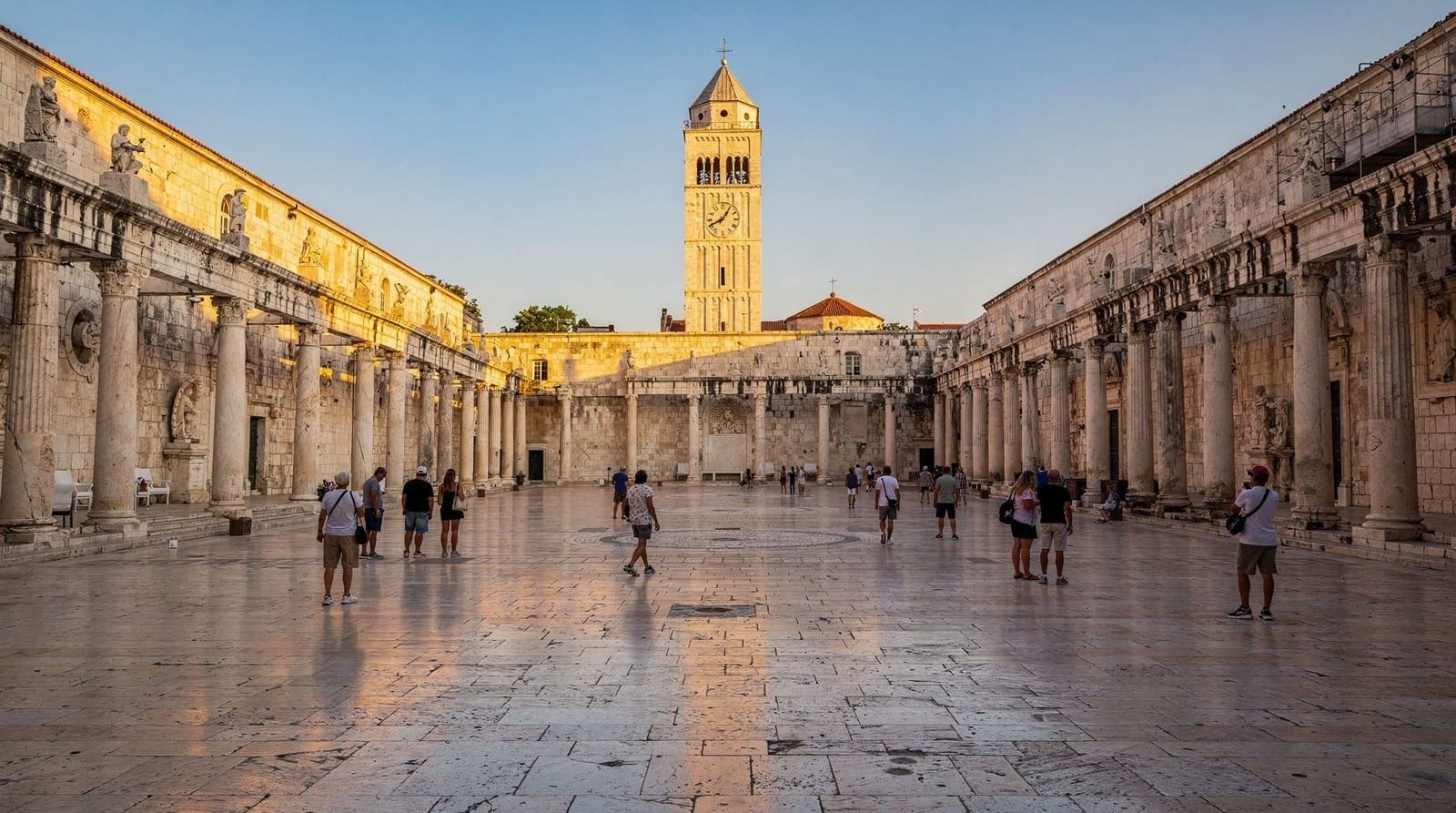
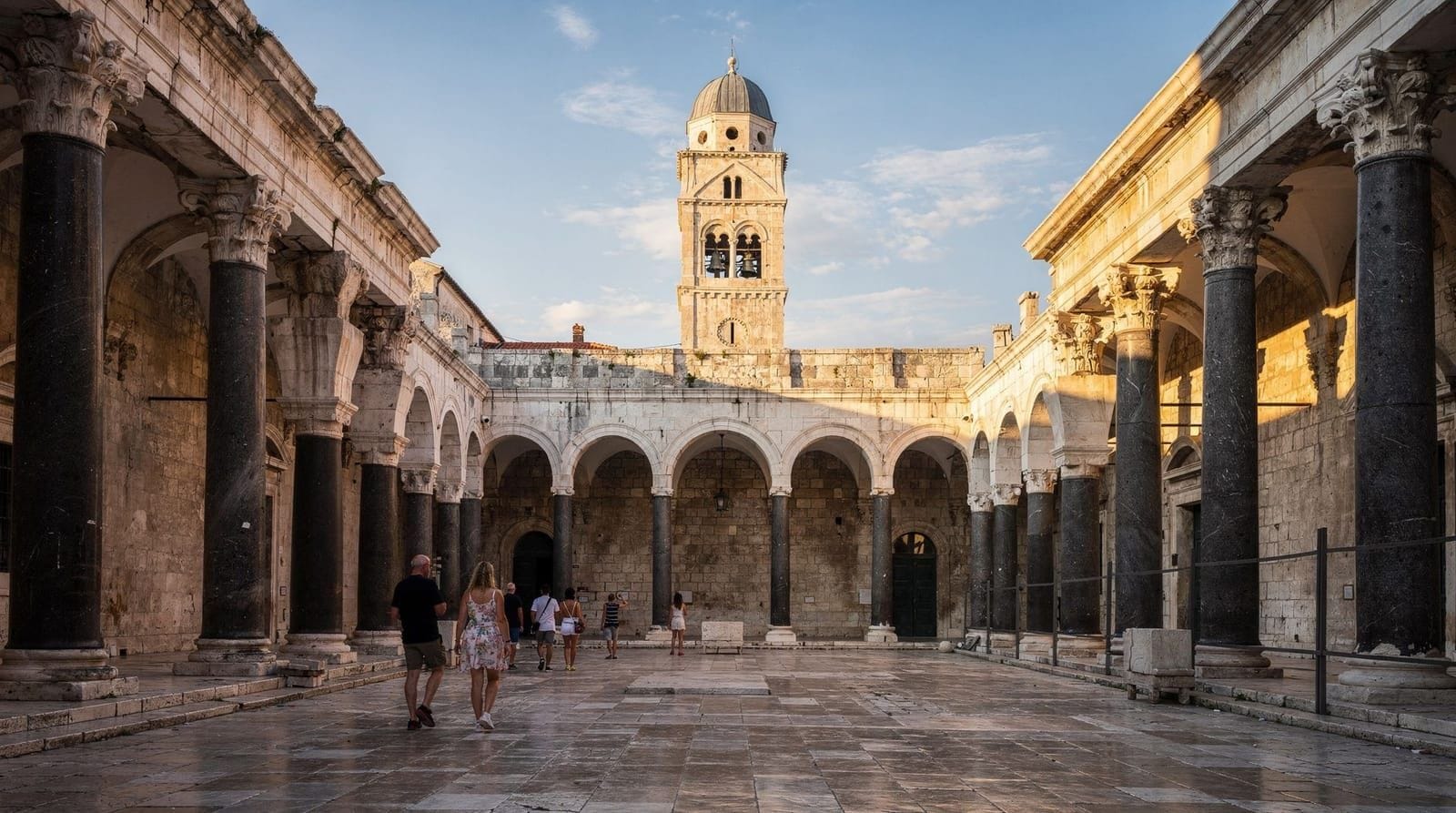
The Cathedral Square (Trg Ivana Pavla II): the central civic space of the old town, where the cathedral, the Loggia, the clock tower and the town hall (Vijećnica) all face each other.
The south waterfront: faces the island of Čiovo across a narrow channel; quieter than the Riva.
Kamerlengo Fortress: at the western tip of the island; the most dramatically sited structure in town.
The Cathedral of St. Lawrence (Katedrala Svetog Lovre)
The cathedral is the reason Trogir is on the UNESCO list, and the reason to spend more than a cursory visit. Construction of the present building began in the late 13th century on the foundations of an earlier church (itself on a Roman site); the main construction period extended into the 16th century, with contributions from several master builders in different styles.
The centrepiece of the exterior — and of medieval Adriatic sculpture generally — is the west portal, completed in 1240 by the master sculptor Radovan (Majstor Radovan). An inscription records his name and the date, making this one of the few signed and dated works of medieval Croatian art.
The portal’s programme reads outward from the central door: at the base, two lions (one devouring a human figure, one standing on a human form) with the figures of Adam and Eve on the column shafts above them. In the tympanum (the arched space above the door), a Nativity scene is flanked by elaborately carved figures of the months of the year — each month depicted through its characteristic agricultural activity (January warming himself at a fire, September harvesting grapes). The carving throughout is of exceptional quality; the faces of the figures have a Gothic expressiveness that prefigures the realism of the next century.
The interior is Gothic with later Renaissance additions. The Chapel of St. John the Baptist (15th century), on the left side of the nave, was commissioned by the Ursini family and executed by Nikola Firentinac and collaborators — the same Florentine sculptor who completed Šibenik Cathedral. It is one of the finest Renaissance funerary chapels in Dalmatia: three articulated bays of sculptural architecture, with a painted altarpiece and a carved sarcophagus.
The cathedral treasury includes medieval goldsmithing, sacred objects and a collection of wooden polychrome statues.
The bell tower (campanile) is three storeys high and can be climbed for views over the island. The three storeys represent three different stylistic periods: Romanesque at the base, Gothic in the middle, Renaissance at the top — a compressed history of Adriatic architecture in vertical form. Entry to the tower: a few euros additional to the cathedral entry (total entry around €6–8 for cathedral and tower combined).
The City Loggia and Clock Tower
The Loggia (Gradska Luka), facing the cathedral across the square, dates from the 15th century. It served as the public meeting place and court of the commune — a Renaissance open arcade with Gothic remnants. A carved relief inside, known as the Justice Relief (15th century, attributed to Firentinac’s workshop), depicts Justice flanked by figures; it is one of the best-preserved pieces of civic sculpture in Dalmatia.
The clock tower rises from the medieval church of St. Sebastian, converted to a civic use. The clock is a later addition; the tower itself is 14th–15th century.
Kamerlengo Fortress (Tvrđava Kamerlengo)
At the western tip of the island stands the Venetian fortress of Kamerlengo, built in the 15th century and named after the Venetian financial official (camerlengo) who administrated the city. The fortress is triangular in plan with three towers; the main tower (Torre Camerlengo) rises from the westernmost point.
Entry costs around €3–5. The interior space is used for summer events — open-air theatre, concerts and gladiatorial re-enactments are regular summer programming. The walls offer views over the channel to Čiovo and south along the coast. The adjacent round tower (Kula Svetog Marka) stands separately in the channel, accessible at low water via a breakwater.
The old town lanes
Beyond the major monuments, Trogir’s most rewarding quality is simply the texture of its lanes. The medieval street grid is remarkably intact — many streets are barely wide enough for two people to pass comfortably. Gothic windows with carved tracery survive in domestic buildings; Venetian-era coats of arms are set into wall faces; occasional Roman column drums have been built into medieval construction.
Worth looking for: the small Romanesque church of St. Barbara (Crkva Svete Barbare) near the main square, which houses a lapidary collection of Roman and medieval stonework. The well-head in a small courtyard near the cathedral (most old Dalmatian towns have at least one original well-head surviving). The south waterfront, less visited than the Riva, which gives views across the channel to Čiovo and a quieter atmosphere in the afternoons.
Combining Trogir with Split and the coast
Trogir is most naturally combined with Split — the 27km distance and frequent bus service make it a half-day excursion from Split, or a logical stop between Split and Šibenik if you are travelling the coast by car. Many visitors pair it with a morning at Diocletian’s Palace and an afternoon in Trogir, returning to Split for dinner.
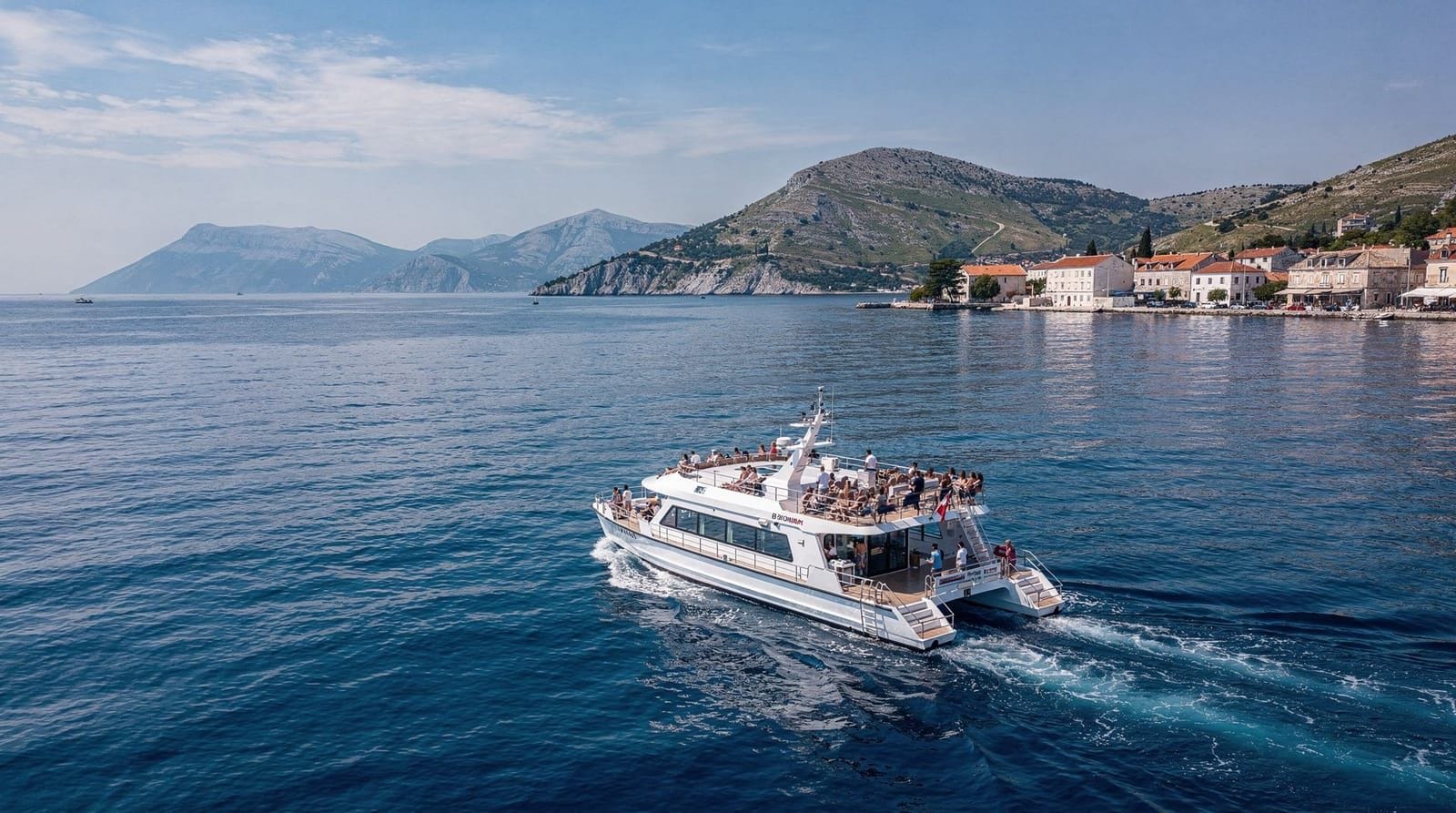
From the Trogir waterfront, boat tours depart for the Blue Lagoon on Čiovo — a sheltered cove with excellent swimming. In summer, half-day boat trips combine the Blue Lagoon with Trogir’s old town and are popular from Split. See our day trips from Split guide for options.
Eating and swimming after the sightseeing
Trogir’s waterfront restaurants along the Riva are convenient but priced for the view; a short walk into the interior lanes finds smaller konobas with lower prices and often better food. Grilled fish sold by weight, black risotto, and simple pasta with seafood are reliable choices — see our Dalmatian cuisine guide and Croatian seafood guide for what to order and roughly what to expect to pay.
For swimming, the old town itself has no beach, but Čiovo island — connected by the south bridge — has several pebble coves within a 15-20 minute walk, and the Blue Lagoon boat trips depart from the Trogir waterfront in summer. If you would rather base your beach day elsewhere, the best beaches near Split guide covers options a short drive away.
Trogir versus Split and Šibenik
If you are deciding how to split limited time along this stretch of coast, here is how the three compare:
| Trogir | Split old town | Šibenik | |
|---|---|---|---|
| Size | Tiny — walkable in 5 minutes | Larger, built inside a Roman palace | Medium, hillside layout |
| Crowds | Light to moderate | Heavy, year-round | Light |
| Headline sight | Radovan’s cathedral portal | Diocletian’s Palace | St James Cathedral |
| Time needed | Half day | Full day | Half day |
| Best for | Quiet UNESCO wandering | History depth plus nightlife | An off-the-radar cathedral town |
For a fuller picture of what else counts as UNESCO-listed on this coast, see our Croatia UNESCO sites guide and the Šibenik Cathedral guide.
Brief history of Trogir
4th century BC: Greek colonists from Issa (Vis island) found Tragurion on the island at the mouth of the Jadro river.
1st century BC: Roman control; Tragurium becomes a municipium. The forum is established on what is now the main square.
1st–5th century AD: Roman period; the basic urban layout is established.
7th century: Slavic and Avar invasions; Trogir survives as a Byzantine town while the Roman city of Salona is destroyed.
1000: Venice gains nominal control over Dalmatia; Trogir oscillates between Venetian, Hungarian, and local control over the following centuries.
1213: Trogir accepts Hungarian suzerainty; a period of communal autonomy and cultural flourishing follows. The cathedral is begun.
1420: Venice takes definitive control of Trogir; it remains Venetian until 1797. The Kamerlengo Fortress is built in this period.
1797: Venetian Republic abolished by Napoleon; Trogir passes to Austria, then France, then Austria again.
1918: Trogir joins the new Kingdom of Serbs, Croats and Slovenes; later Yugoslavia.
1997: UNESCO inscription.
Frequently asked questions about Trogir Old Town
How do I get from Split to Trogir?
Local bus line 37 runs from Split bus station (Autobusni kolodvor, 15 minutes west of the centre) to Trogir in about 45–60 minutes, departing every 20–30 minutes. The journey costs around €2–3. By car it is 27km via the coastal road (40–50 minutes) or faster via the A1 motorway (30 minutes). Taxi from Split centre is approximately €30–40.How much time do you need in Trogir?
A half-day (3–4 hours) is enough to walk the old town, visit the cathedral interior and tower, and walk the city walls. A full day allows more relaxed exploration of the lanes, the Kamerlengo Fortress, lunch at the waterfront, and the museum collections. Trogir is easily visited as a day trip from Split.Is Trogir crowded in summer?
Trogir is significantly less crowded than Split or Dubrovnik, even in July–August. Cruise ships do call, and the old town is very compact, so peak hours (10am–2pm) can feel busy. Morning arrivals and evening visits are much more relaxed. The town has a genuine residential community that moderates the tourism atmosphere.What is Radovan's portal?
The west portal of Trogir Cathedral (completed 1240 by master carver Radovan) is the finest piece of Romanesque sculpture on the eastern Adriatic. Its carved programme includes a Nativity scene, figures of Adam and Eve flanking the doorway columns, months of the year depicted in the tympanum frieze, and lions at the base. The detail and quality of the carving is outstanding for the period.Is the Trogir Cathedral tower worth climbing?
Yes — the climb is steep and narrow (a tight spiral staircase) but the views over the roofline, the island and the Adriatic are excellent. Entry to the tower is a few euros extra beyond the cathedral entry fee. There is no lift; the climb is not suitable for visitors with mobility limitations.Can you swim near Trogir old town?
There are no beaches within the old town itself, but the island of Čiovo (connected by the south bridge) has several decent pebble beaches within a 15–20 minute walk. The Pantan area north of the causeway is also accessible. Trogir combines well with a beach day if you have a full day.What is the best restaurant in Trogir old town?
A recommendation engine I am not — restaurant quality in Trogir shifts with ownership and season. The standard advice: avoid the most prominently tourist-facing places directly on the main square, and look for smaller konobas in the interior lanes. Fish and seafood is the obvious choice; the local preference is for simplicity — grilled fish, olive oil, local wine.Is Trogir worth visiting if I have already seen Split's old town?
Yes, and the two complement each other rather than repeat one another. Split's old town is built inside a Roman palace and feels lived-in and layered; Trogir is a compact medieval island with a single dominant monument in Radovan's cathedral portal. Trogir is calmer, smaller and easier to see fully in a couple of hours, which makes it a natural half-day add-on rather than a competing destination.Can I combine Trogir with Sibenik in one day?
It is possible but tight. Trogir to Sibenik is roughly 45-60 minutes by car along the coastal road, and each town deserves at least half a day. If you are travelling by car and starting early from Split, a Trogir morning followed by a Sibenik afternoon works; relying on buses for both in one day is more rushed and best avoided.
Top experiences
Bookable activities with verified prices and instant confirmation on GetYourGuide.
Top experiences
Best-rated activities across GetYourGuide and Viator.

From Zadar: Plitvice Lakes with Boat Ride & Zadar Old town tour
- Viator

3Hour ALL-INCLUSIVE Sunset Dolphin Watching from Medulin onSandra
- Viator

Dolphin Watching & Sunset Boat Tour With Drinks & optional Dinner
- Viator

Fantastic DOLPHIN & SUNSET TOUR with dinner ( Pula-NP BRIJUNI )
- Viator

Medulin :All-Inclusive Pirate Boat Dolphin Watching Sunset Cruise
- Viator

Zadar Highlights: Old Town, Sea Organ & Local Tastings
- Viator