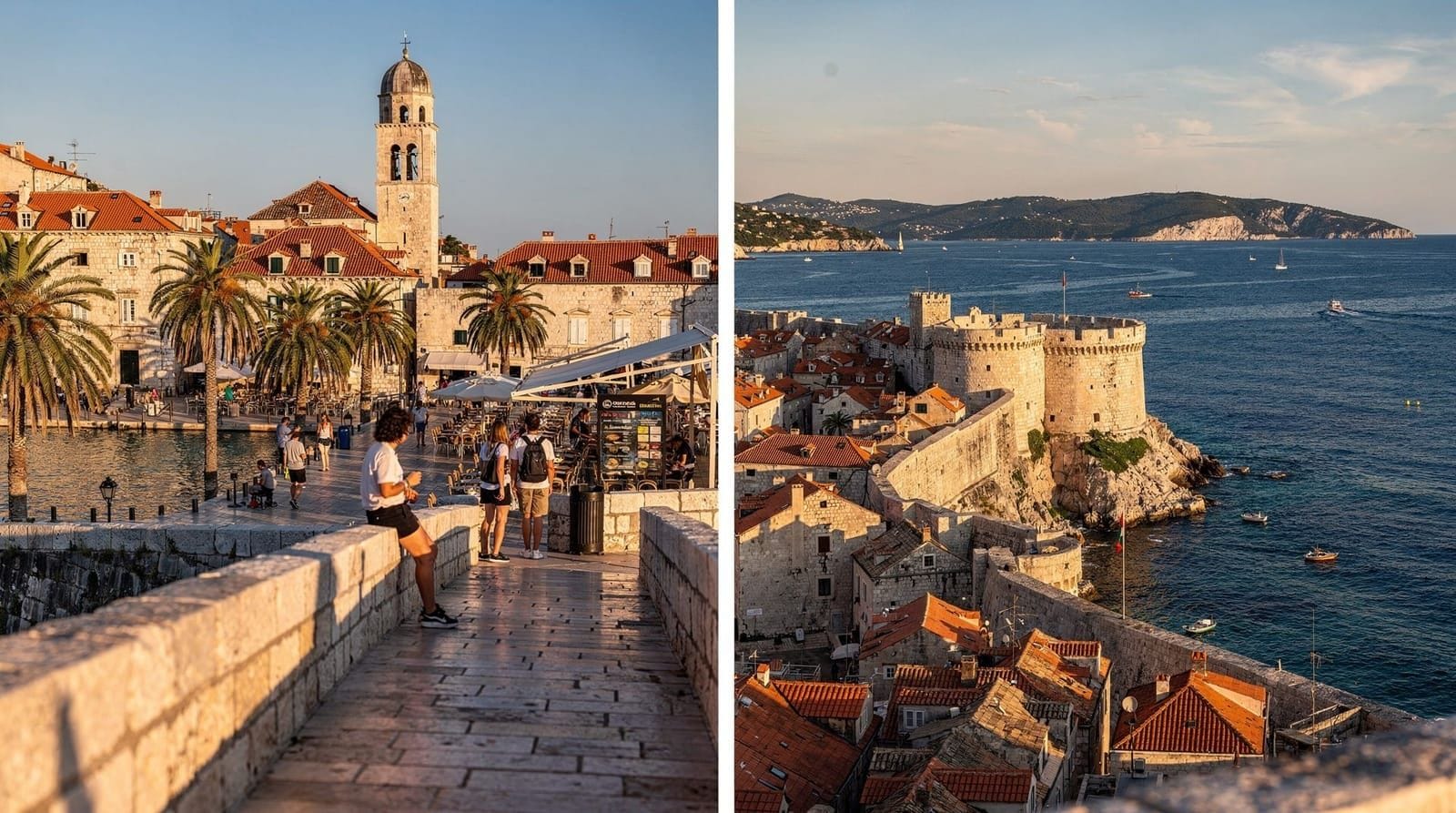
Split Old Town: the complete visitor guide
Split: Old town small group walking tour
What is the old town of Split?
Split's old town is built within and around Diocletian's Palace, a late-Roman imperial complex completed around 305 AD. The entire area — the palace precincts and the medieval extensions to the north and west — forms a UNESCO World Heritage Site inscribed in 1979. Around 3,000 people live and work inside the palace walls today.
| Where | Diocletian’s Palace, central Split |
| Cost | Free to walk; paid sights €3–15 each |
| Time needed | A full day for the highlights; 2–3 days at a relaxed pace |
| Getting there | Walkable from Split ferry terminal / bus station |
| Best time | Early morning or evening to avoid midday crowds and heat |
A Roman palace that became a city
Split is, among other things, the best answer to the question of what happens to a Roman imperial palace after the empire collapses. The answer — in Split’s case — is that it becomes a town. Then it grows beyond the walls. Then it becomes Croatia’s second-largest city. But the original palace, completed around 305 AD for the Emperor Diocletian, remains at its heart, lived in and argued over and converted to new uses for 1,700 years without interruption.
Dioklecijanova palača is the reason Split has UNESCO status; it is also the reason Split is unlike any other city on the Adriatic. You drink your coffee in a Roman vestibule. You sleep in rooms whose walls are 4th-century stone. You walk streets whose alignment has not changed since Diocletian’s architect laid them out. The layers are not preserved behind glass — they are in use.
The old town: structure and layout
Split’s old town (stari grad) is larger than Diocletian’s Palace alone. It comprises:
The palace proper: The walled quadrilateral south of the main east–west axis, running roughly from the Golden Gate (north) to the Bronze Gate (south), Silver Gate (east) to Iron Gate (west). Within this area: the Peristyle courtyard, the Cathedral, the baptistery, the vestibule, and the cellars. Medieval buildings occupy almost every surface of the palace interior.
Medieval extensions: The town grew outside the western and northern palace walls from the 11th century onward. Narodni trg (People’s Square) and the area around it represent the medieval town centre outside the palace.
The Riva waterfront: Running along the south side of the old town, the Riva is a 20th-century creation — the Bronze Gate used to open directly onto water; the current promenade was reclaimed from the sea.
The Peristyle (Peristil): heart of the palace
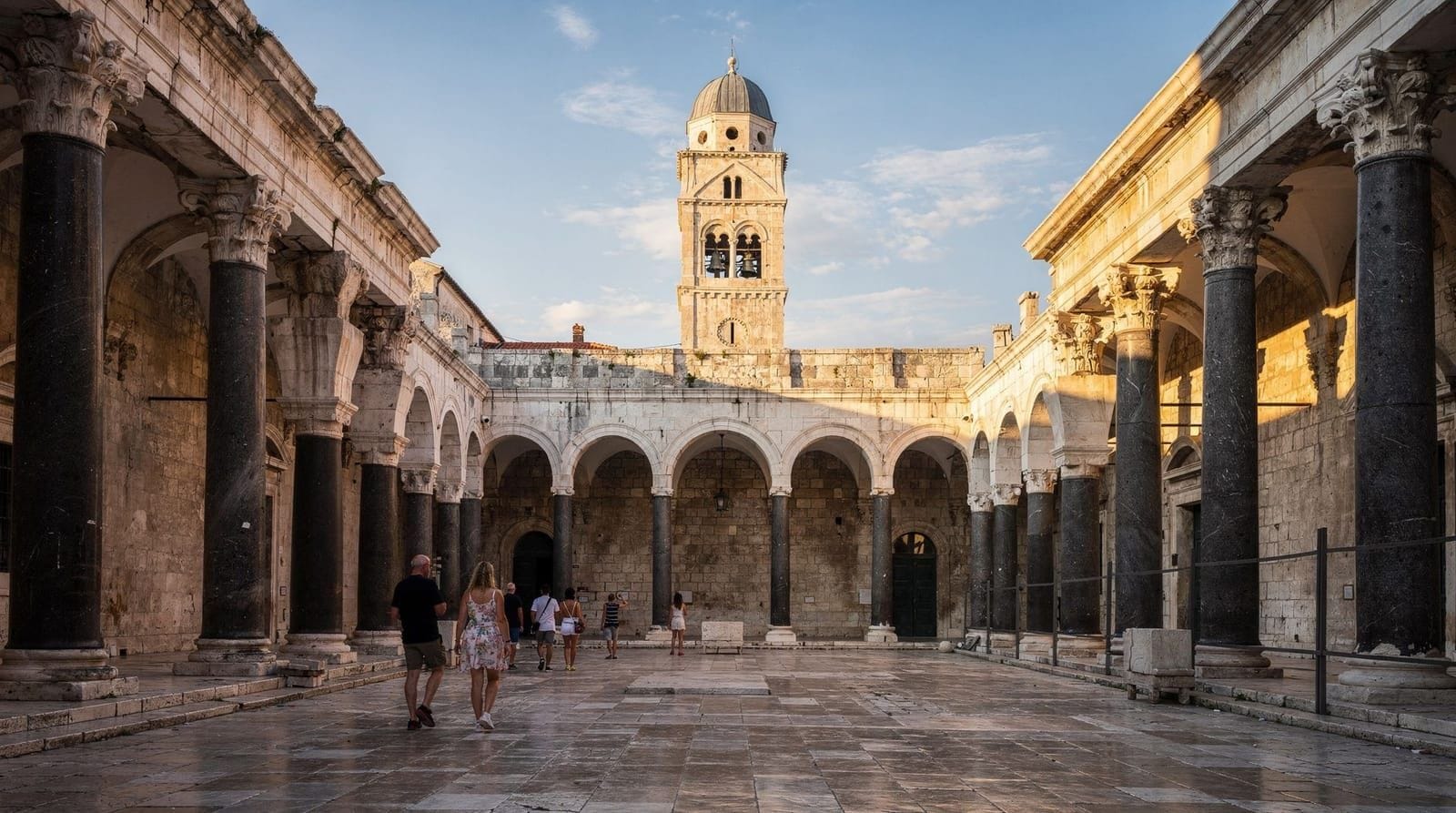
The Peristyle — the formal ceremonial courtyard of Diocletian’s palace — is the spatial and cultural centrepiece of Split. Flanked by Roman colonnades (original) with the mausoleum (now the cathedral) on its east side and the Jupiter Temple (now the baptistery) on its west, the Peristyle is simultaneously an ancient monument and a functioning public square where residents drink morning coffee and tourists photograph each other.
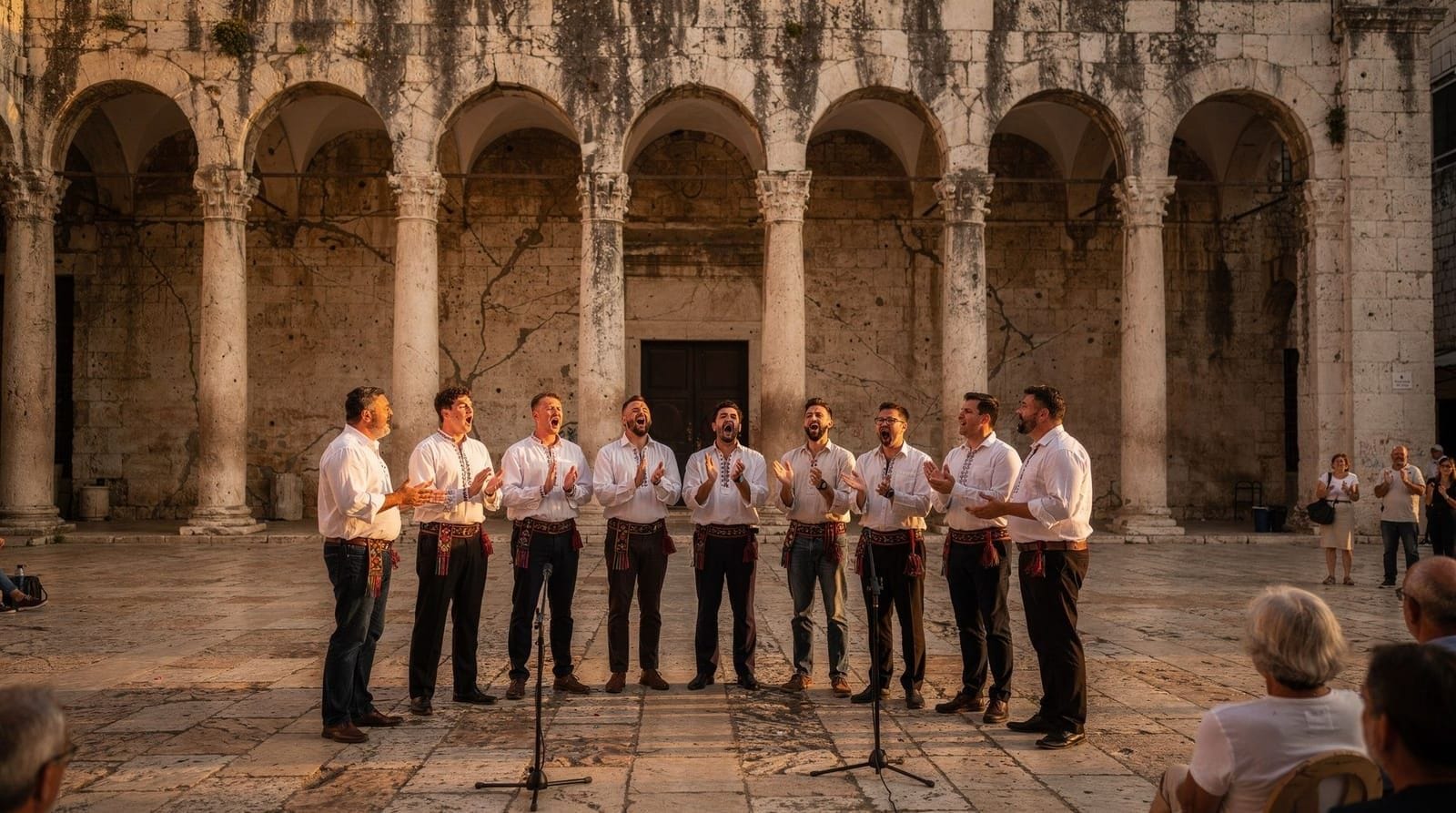
The columns and entablature are largely original Roman work; the paving stones have been worn smooth by seventeen centuries of feet. The vestibule (the domed circular entrance to the imperial apartments) opens from the south side; it is free to enter and has excellent acoustics — spontaneous klapa singing sometimes occurs here.
In summer, outdoor concerts and classical events are held in the Peristyle. The setting — floodlit ancient columns, warm Mediterranean night — produces an atmosphere difficult to replicate anywhere else.
The Cathedral of St. Domnius (Katedrala Svetog Duje)
The Cathedral of St. Domnius is Diocletian’s mausoleum converted into a Christian cathedral — one of history’s tidier ironies, since Diocletian launched the last major Roman persecution of Christians in 303 AD. The conversion happened sometime in the 7th century.
The octagonal exterior is almost entirely original Roman work; inside, medieval and Baroque additions layer over the ancient fabric. The coffered dome and the decorative frieze at cornice level (with portraits of Diocletian and his wife Prisca — among the finest examples of 3rd-century Roman portrait carving) are original. The 13th-century carved wooden doors by Andrija Buvina — depicting scenes from the life of Christ in alternating diamond panels — are among the finest Romanesque woodwork in the Adriatic.
The bell tower (12th–16th century) can be climbed; the view from the top over the palace complex and the Adriatic is worth the vertigo-inducing spiral stair.
Entry with tower: around €5–8.
The Palace Cellars (Podrumi)
The cellars occupy the full footprint of the imperial apartments above and mirror their layout exactly. Originally used for storage and services, they were gradually filled with rubble and forgotten; excavation began in the 20th century.
The main access is through the Bronze Gate on the Riva promenade. The vestibule (main hall) is free; the paid section (€10–12) includes additional vaulted rooms with archaeological displays and the network of underground passages. The scale of the underground space — cathedral-like vaulting extending in multiple directions — conveys the ambition of the original palace construction better than anything at street level.
In summer, the cellars sometimes host art exhibitions; occasional theatrical events use the underground spaces.
The Four Gates
Walking to all four gates frames the palace rectangle and connects the old town at its edges.
Zlatna vrata (Golden Gate): The north gate, the grandest and most ceremonial. The external approach faces the main road north; just outside stands Ivan Meštrović’s large bronze statue of Grgur Ninski (Gregory of Nin), a 10th-century bishop who campaigned for the use of the Croatian language in liturgy. The big toe is polished by visitors’ touch.
Srebrna vrata (Silver Gate): The east gate, leading into the small square of Pazar where a daily market operates. Less visited, less congested — a quieter entry and exit point.
Željezna vrata (Iron Gate): The west gate, adjacent to the medieval church of Our Lady of the Belfry, which incorporates the gate into its structure. The clock tower above the gate is medieval.
Mjedena vrata (Bronze Gate): The south/sea gate, opening onto the Riva. This was the main water entrance; the current ground level has risen since Roman times, and the gate now opens at pavement level into the entrance to the palace cellars.
Narodni trg and the western old town
Narodni trg (People’s Square) was the civic centre of medieval Split, built outside the western palace wall as the town expanded. The 15th-century Vijećnica (Town Hall), with its Gothic arches and triple arcade, is the most architecturally distinguished building on the square; it now houses the Ethnographic Museum.
The narrow lanes between the palace wall and the medieval town to the west have a different character from the palace interior — more medieval in feeling, with Gothic windows and Venetian-era details in the domestic architecture. The church of St. Francis (Sveti Frane), south of Narodni trg, has a cloister with a simple medieval atmosphere.
The Riva
The Riva is Split’s living room — the kilometre-long promenade south of the old town where the city takes its morning coffee, its evening passeggiata and its summer café culture. The promenade was redesigned in 2006–07 in a controversial project that replaced the historic pavement with a uniform white stone surface; opinion about the redesign remains divided. What is indisputable is the social function: from early morning to midnight, the Riva is where Split is.
The view from the Riva across the water to the island of Brač (in clear weather) gives a sense of Split’s position — a mainland city facing an island world it has always depended on and connected with by ferry.
Day trips from Split
Split functions as an excellent base for the region. Within easy reach:
Trogir: 27km west, bus or boat. Medieval island town, UNESCO site, best in the morning. Full guide: Trogir Old Town.
Hvar: Ferry from Split port (50 minutes to Hvar Town by catamaran; 1.5 hours to Stari Grad by car ferry). The most cosmopolitan of the Dalmatian islands. Guide: Hvar.
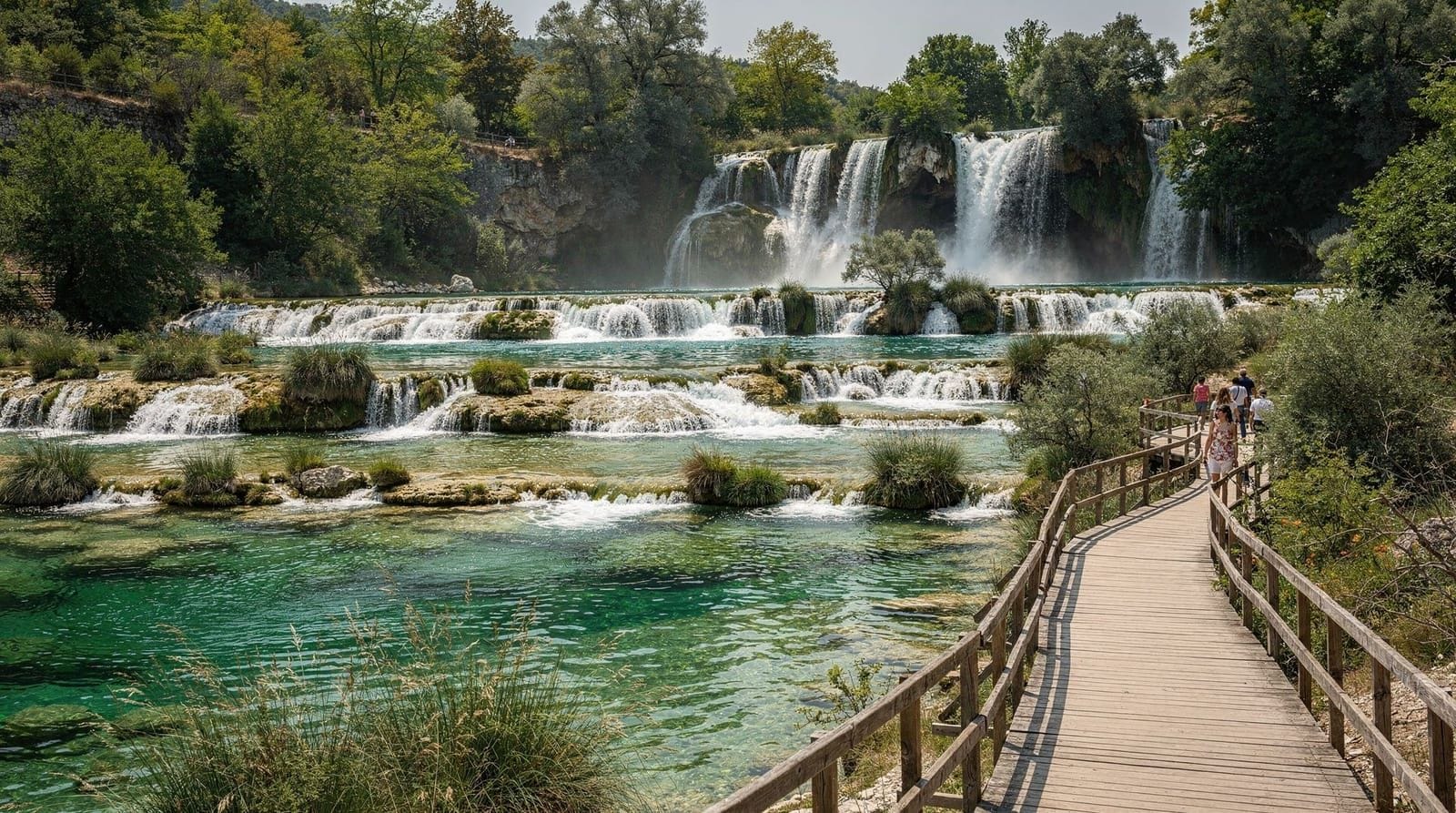
Krka National Park: 60km north, best reached by organised tour or by car via Šibenik. The Skradinski Buk waterfall is the main attraction. Guide: Krka National Park.
Brač and Zlatni Rat: Car ferry to Supetar on Brač (1 hour), then bus to Bol and Zlatni Rat — Croatia’s most photographed beach. Guide: Zlatni Rat beach.
See our day trips from Split guide for the full range of options.
Where to stay in the old town
Staying inside the palace walls means falling asleep and waking up surrounded by 1,700-year-old stone — genuinely atmospheric, but with trade-offs. Rooms are often small (the buildings were never designed as hotels), soundproofing can be limited given the narrow lanes and evening bar noise, and luggage transport means the last stretch on foot over uneven paving. The upside is unbeatable: you’re steps from the Peristyle at dawn before the tour groups arrive, and the evening atmosphere on your own doorstep is hard to replicate from a suburban hotel. If you prefer modern comfort, the area around the Riva and just outside the palace walls offers similar proximity with easier access and more predictable quiet.
Split old town in one day: a suggested route
Morning (before 10am): Enter through the Golden Gate area, see the Grgur Ninski statue, walk through to the Peristyle while it’s still quiet, then the Cathedral of St. Domnius and the bell tower climb.
Midday: Palace cellars via the Bronze Gate, then out onto the Riva for lunch with a sea view.
Afternoon: Narodni trg and the western lanes, the Ethnographic Museum if time allows, then a wander through the Silver Gate toward the Pazar market for local colour.
Evening: Back to the Riva or the Peristyle for the passeggiata, dinner in one of the palace’s converted courtyard restaurants.
This pacing avoids the worst of the midday heat and crowds in the Peristyle and cathedral, both of which are markedly quieter before 10am.
Split old town for families
The flat, largely traffic-free lanes of the palace make Split’s old town genuinely manageable with children and pushchairs, unlike some of Croatia’s steeper hill towns. The cellars’ underground spaces and the climbable bell tower both appeal to older children, while Bačvice beach, a short walk away, gives younger children a break from sightseeing. Combine an old-town morning with a Bačvice afternoon for a balanced family day, and see the Croatia family guide for wider planning.
Frequently asked questions about Split Old Town
How long should I spend in Split old town?
A comfortable full day covers the main sights: the Peristyle, the palace cellars, the Cathedral of St. Domnius, the four gates, and a walk of Narodni trg. Two days allows a more leisurely exploration including the museums, the Riva waterfront, and neighbouring day trips to Trogir. Split also works as an extended base (3–5 days) for day trips to Hvar, Brač, Krka and Trogir.Is Split old town free to visit?
Walking the streets of the old town is entirely free. The main paid sights: palace cellars (€10–12), Cathedral of St. Domnius and tower (€5–8), baptistery (€3–5), the Ivan Meštrović Gallery (€10–15) and the Archaeological Museum (€6–8). A combined old-town ticket covering several palace sights is sometimes available for around €15–20.What is Narodni trg?
Narodni trg (People's Square), to the west of the palace complex, is the civic centre of medieval Split. It was built outside the western wall of the palace as the town expanded in the Middle Ages. The 15th-century Gothic-Renaissance town hall (Vijećnica), a Venetian-era clock tower and the Ethnographic Museum occupy its sides. It is the hub of café culture and evening promenading in Split.What is the Riva in Split?
The Riva (officially Obala Hrvatskog narodnog preporoda) is Split's main promenade, running along the seafront south of the old town. Lined with cafés, bars and restaurants with outdoor seating facing the Adriatic, it is the social centre of Split's public life — especially in the evening, when the passeggiata (korzo in Croatian) takes over the pavement.Is Split better than Dubrovnik?
Different in character. Split is a real city — population around 160,000, Croatia's second largest — with a functioning urban life beyond tourism. Dubrovnik is smaller, more scenic, more preserved and more touristed. Split is more manageable, cheaper and has a more authentic Dalmatian atmosphere. Our Split vs Dubrovnik comparison covers the choice in detail.What is there to do in Split old town at night?
The old town has an active bar and restaurant scene centred on the palace lanes and Narodni trg. The Peristyle holds occasional outdoor concerts. The Bacvice beach (15 minutes east of the old town) has an evening entertainment scene in summer. Split's nightlife is more genuine and less touristically inflated than Dubrovnik's.Can I swim near Split old town?
The closest beach to the old town is Bacvice (15 minutes on foot east of the Riva) — a sandy bay famous as the site of competitive picigin, a uniquely Split beach game played in shallow water. Other beaches accessible from Split include Firule and Trstenik. The islands of Brač and Hvar, accessible by ferry from Split, have better beach options.
Top experiences
Bookable activities with verified prices and instant confirmation on GetYourGuide.
Top experiences
Best-rated activities across GetYourGuide and Viator.

From Zadar: Plitvice Lakes with Boat Ride & Zadar Old town tour
- Viator

3Hour ALL-INCLUSIVE Sunset Dolphin Watching from Medulin onSandra
- Viator

Dolphin Watching & Sunset Boat Tour With Drinks & optional Dinner
- Viator

Fantastic DOLPHIN & SUNSET TOUR with dinner ( Pula-NP BRIJUNI )
- Viator

Medulin :All-Inclusive Pirate Boat Dolphin Watching Sunset Cruise
- Viator

Zadar Highlights: Old Town, Sea Organ & Local Tastings
- Viator