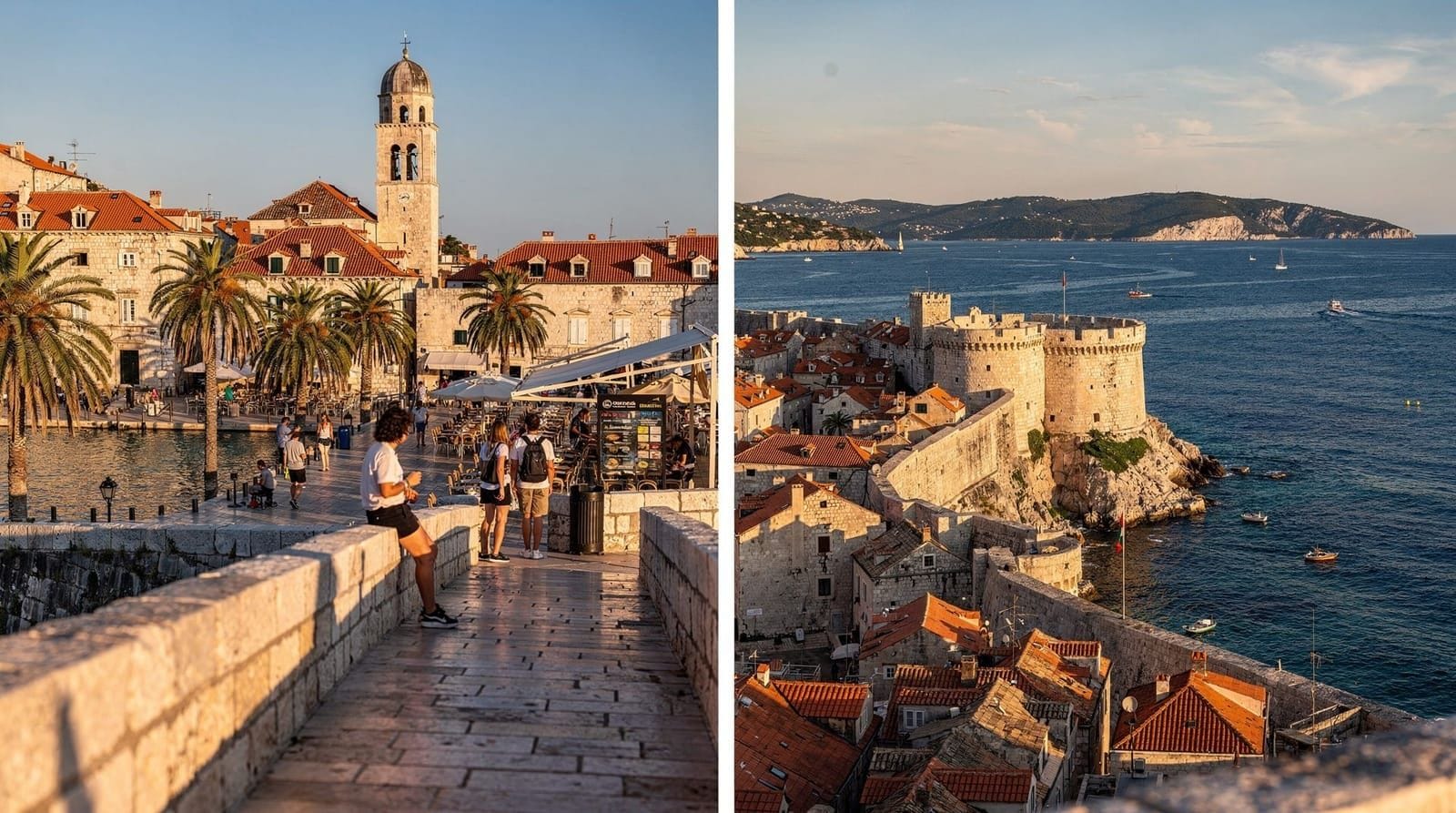
Diocletian's Palace, Split: the complete guide
Split: Diocletian's Palace and old town guided walking tour
What is Diocletian's Palace in Split?
Dioklecijanova palača is a late-Roman fortress-palace built around 305 AD as the retirement residence of Emperor Diocletian. Today it is a living neighbourhood — 3,000 people live inside its walls — and a UNESCO World Heritage Site. The palace cellars, cathedral (converted from Diocletian's mausoleum), and four original gates are the principal highlights.
The palace that became a city
There is nowhere in Europe quite like Dioklecijanova palača. Built between 295 and 305 AD as the retirement residence of the Roman Emperor Gaius Aurelius Valerius Diocletianus — the man who created the empire’s tetrarchic system and launched its last great persecution of Christians — the palace was constructed on a peninsula jutting into the Adriatic, on a site Diocletian apparently chose for its resemblance to his native Salona region.
What happened next is the thing. Diocletian died around 316 AD, and the palace passed through various imperial hands. Then, in the 7th century, as the Roman city of Salona was destroyed by Slavic and Avar invasions, its surviving population moved into the vacant palace complex and began converting it into a town. They bricked up Roman doorways, built medieval houses inside Roman colonnades, turned the emperor’s mausoleum into a cathedral and his temple into a baptistery.
The result — still inhabited by some 3,000 people today — is a living palimpsest of 1,700 years, a UNESCO World Heritage Site since 1979, and one of the most extraordinary urban spaces in the Mediterranean.
| Where | Split old town, on the Riva waterfront |
| Cost | Streets free; cellars around EUR 10–12; cathedral treasury/tower around EUR 5–8 |
| Time needed | 2–3 hours independently; 3–4 hours with cellars, cathedral and baptistery |
| Getting there | Walkable from the ferry terminal, bus station and Riva promenade |
| Best time | Before 9am or after 6pm to avoid the worst of the crowds |
The original palace: dimensions and design
The palace was enormous by any standard. Its roughly rectangular footprint measures approximately 215 metres (east–west) by 180 metres (north–south), enclosing around 3.5 hectares. The walls are up to 2 metres thick and stood around 17 metres high; 16 towers punctuated the perimeter.
The design combined a military fortress with an imperial residential complex. The northern half (the in-sensum) functioned more like a Roman military camp, with the main ceremonial gates on the north (Zlatna vrata, Golden Gate), east (Srebrna vrata, Silver Gate) and west (Željezna vrata, Iron Gate). The southern half contained the imperial apartments and faced the sea; the Bronze Gate (Mjedena vrata) opened directly to the water at what was once dock level.
Diocletian’s personal quarters occupied the southeast quadrant, above the cellars that survive in near-perfect preservation. The mausoleum — the octagonal structure that became the cathedral — stood in the southeast quadrant alongside it. Two temples (one to Jupiter, one to an uncertain deity) occupied the western side of the Peristyle, the grand ceremonial courtyard.
The Peristyle (Peristil)
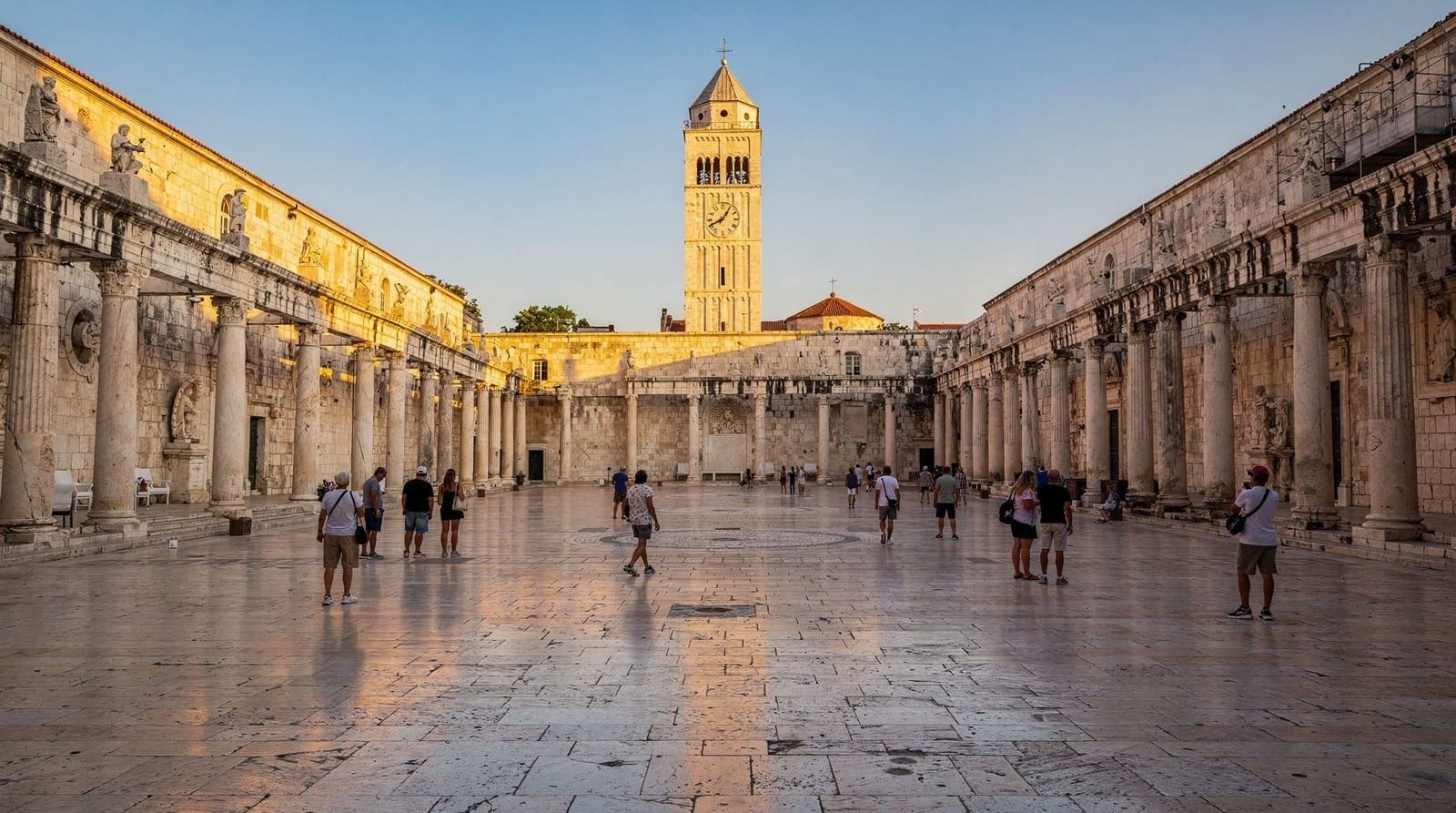
The Peristyle is the spiritual and spatial centre of the palace — a colonnaded courtyard that served as the formal approach to Diocletian’s apartments and to his mausoleum. Its columns, arches and entablature are original Roman work; the paving stones have been worn smooth by centuries of foot traffic.
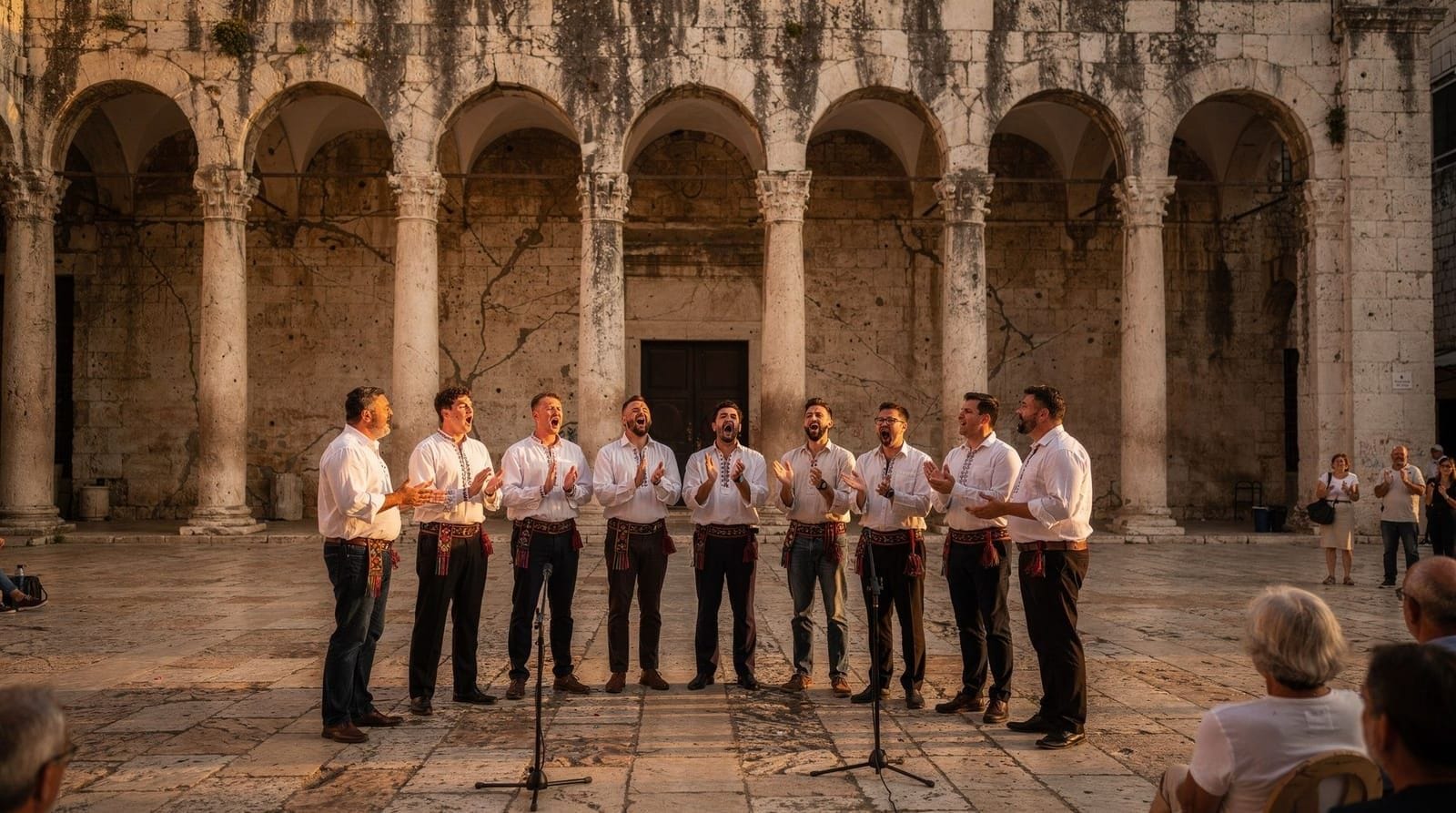
Today the Peristyle is both a tourist gathering point and a genuine public square. In summer, outdoor classical concerts are held here. Café tables occupy what were once ceremonial spaces. The contrast between the gravity of the setting and the ordinariness of café life is quintessentially Split.
The entrance to the cathedral (formerly the mausoleum) is on the east side of the Peristyle. The entrance to the baptistery (formerly the Temple of Jupiter) is through a small vestibule to the west.
The Cellars (Podrumi Dioklecijanove palače)
The palace cellars are the single most important thing to pay for in Split. They occupy the full footprint of Diocletian’s imperial apartments above and mirror their layout precisely — which means that walking through the cellars gives you a spatial understanding of the apartment plan that no surface-level visit can provide.
The original function of the cellars was storage and infrastructure: the vaulted rooms held supplies, supported the floor of the apartments above, and contained utilities. After the palace was abandoned as an imperial residence, the cellars were gradually filled with rubble and forgotten. Excavation began in the 20th century and continues to this day.
The main entrance is through the Bronze Gate on the Riva. Entry costs around €10–12 in 2026. The main hall (vestibul) is free to enter and gives a dramatic first impression. Within the paid area, several rooms have permanent exhibitions about the palace’s history and archaeology. The space is also used for art exhibitions and events.
The Cathedral of St. Domnius (Katedrala Svetog Duje)
The octagonal mausoleum of Diocletian — built to house the emperor who persecuted Christians — has been a Christian cathedral since the 7th century. The irony is not lost on the Croatians; it is one of history’s tidier reversals.
The structure preserves its original Roman shell almost intact: the coffered dome, the decorative frieze at cornice level (with portraits of Diocletian and his wife Prisca), and the granite columns of the peristyle entrance. Medieval and Baroque additions layer over the Roman fabric — the 13th-century wooden doors (Andrija Buvina’s carved doors, depicting scenes from the life of Christ) are among the finest Romanesque woodwork in the Adriatic. The bell tower (12th–16th century) can be climbed for a view over the palace complex; the experience is tight and steep, the view worth it.
Entry to the cathedral treasury and tower costs around €5–8.
The Baptistery (Temple of Jupiter)
The small temple on the west side of the Peristyle vestibule was converted into a baptistery at some point in the early medieval period. It retains its original Roman coffered ceiling — almost perfectly preserved — and its barrel-vaulted entrance passageway. The font dates from the 11th century; a statue of St. John the Baptist is attributed (dubiously, some say) to Ivan Meštrović.
It is a small space but one of the best-preserved Roman religious interiors in the world. Entry is a few euros; queue times are generally short.
The four gates
Walking to each gate gives a sense of the palace’s scale and the layers of construction over the centuries.
Zlatna vrata (Golden Gate) — the north gate, the grandest of the four, faces the road to Salona (now Solin). Outside it stands a large bronze statue of Grgur Ninski (Gregory of Nin) by Ivan Meštrović; the big toe is rubbed to a shine by visitors seeking good luck. The gate’s upper level can be accessed from inside the palace.
Srebrna vrata (Silver Gate) — the east gate, partially restored, with a small square outside that is one of the less-visited entry points and therefore less congested.
Željezna vrata (Iron Gate) — the west gate, integrated into the medieval church of Our Lady of the Belfry. The clock tower above is a medieval addition; the gate below is original Roman.
Mjedena vrata (Bronze Gate) — the south/sea gate, now the entrance to the cellars from the Riva promenade. The least monumental externally but historically the gate Diocletian himself most likely used.
Practical visitor information
Getting there: Split is served by Split Airport (SPU), 25km from the city centre; buses and taxis connect it to the old town in 30–50 minutes. The ferry terminal, catamaran docks and bus station are adjacent to the old town on the Riva. See our Split airport transfers guide.
When to visit: The palace is open 24 hours (the streets, that is). The cellars open around 8am–9pm in summer, shorter hours off-season. July–August brings maximum crowds; the site is genuinely uncomfortably busy at midday in August. Morning visits (before 9am) or evening visits (after 6pm when day-trippers leave) are significantly more pleasant.
Guided tours: A 1.5-hour walking tour of the palace and old town costs roughly €20–35 per person with a local guide. Several operators depart from the Peristyle. Book in advance in summer.
Combined visits: Split is an excellent base for day trips to Trogir (27km west), Krka National Park (60km north) and Šibenik (75km north).
What’s inside the palace at a glance
| Site | Cost | Time needed | Highlight |
|---|---|---|---|
| Peristyle & streets | Free | 30–45 min | Roman colonnades doubling as a public square |
| Cellars (Podrumi) | Around EUR 10–12 | 45–60 min | Full mirror of the imperial apartment layout above |
| Cathedral of St Domnius | Around EUR 5–8 | 30–45 min | Diocletian’s mausoleum turned cathedral, bell tower climb |
| Baptistery (Temple of Jupiter) | A few euros | 10–15 min | Near-perfect Roman coffered ceiling |
| Four gates | Free | 20–30 min to see all | Golden Gate’s Grgur Ninski statue and lucky toe |
Beyond the palace walls
The palace is the reason most visitors come to Split, but it sits inside a wider old town worth the rest of your day. Just beyond the western gate, the Split old town guide covers the Riva promenade, the Pazar market and the neighbourhoods locals actually eat and drink in. Fans of the Game of Thrones filming locations will recognise several corners of the palace immediately — the GoT Split locations guide maps out exactly where. And if you are deciding how Split fits into a longer Dalmatian trip, both the split vs Dubrovnik guide and the 7-day Croatia itinerary help place the palace within a realistic schedule.
Frequently asked questions about Diocletian's Palace, Split
How long does Diocletian's Palace take to visit?
The palace complex can be walked in 2–3 hours independently. To include the cellars (Podrumi), cathedral, baptistery and the Peristyle courtyard properly, allow 3–4 hours. A full old town of Split exploration with the palace takes a comfortable full day.Is Diocletian's Palace free to enter?
The open-air palace streets and the Peristyle courtyard are free to walk. The cellars (Podrumi Dioklecijanove palače) charge around €10–12 entry. The Cathedral of St. Domnius charges a separate entry of around €5–8 for the treasury and cathedral tower climb. The baptistery (former Jupiter temple) is a few euros extra.Do you need a guided tour of Diocletian's Palace?
A guided tour adds considerable depth — the Roman-to-medieval-to-present layering is genuinely hard to parse without a guide who can point out which wall is 4th century, which is 9th century and which was added in the 18th. That said, excellent free self-guided resources and signage make an independent visit worthwhile.Where exactly is Diocletian's Palace in Split?
The palace forms the southern half of Split's old town, right on the waterfront (Riva). The main entrance for visitors arriving from the Riva is the Bronze Gate (Porta Aenea), a sea-level entrance that opens directly into the palace cellars. The city bus station, ferry terminal and catamaran port are all within a few minutes' walk.What was Diocletian's Palace used for after Roman times?
After Diocletian died (around 316 AD) the palace continued as an imperial residence for a time, then gradually became a functioning town. In the 7th century, refugees from the destroyed Roman city of Salona moved inside the walls. The mausoleum was converted into a cathedral; temples became churches. Medieval houses were built directly into and on top of Roman structures. This continuous inhabitation is what makes Split unique.Can you sleep inside Diocletian's Palace?
Yes. Several hotels and dozens of apartments are located within the palace walls. Staying inside the old town puts you minutes from the main sights. Hotels inside the walls range from boutique properties to simple guesthouses.Is Diocletian's Palace better than the Colosseum in Rome?
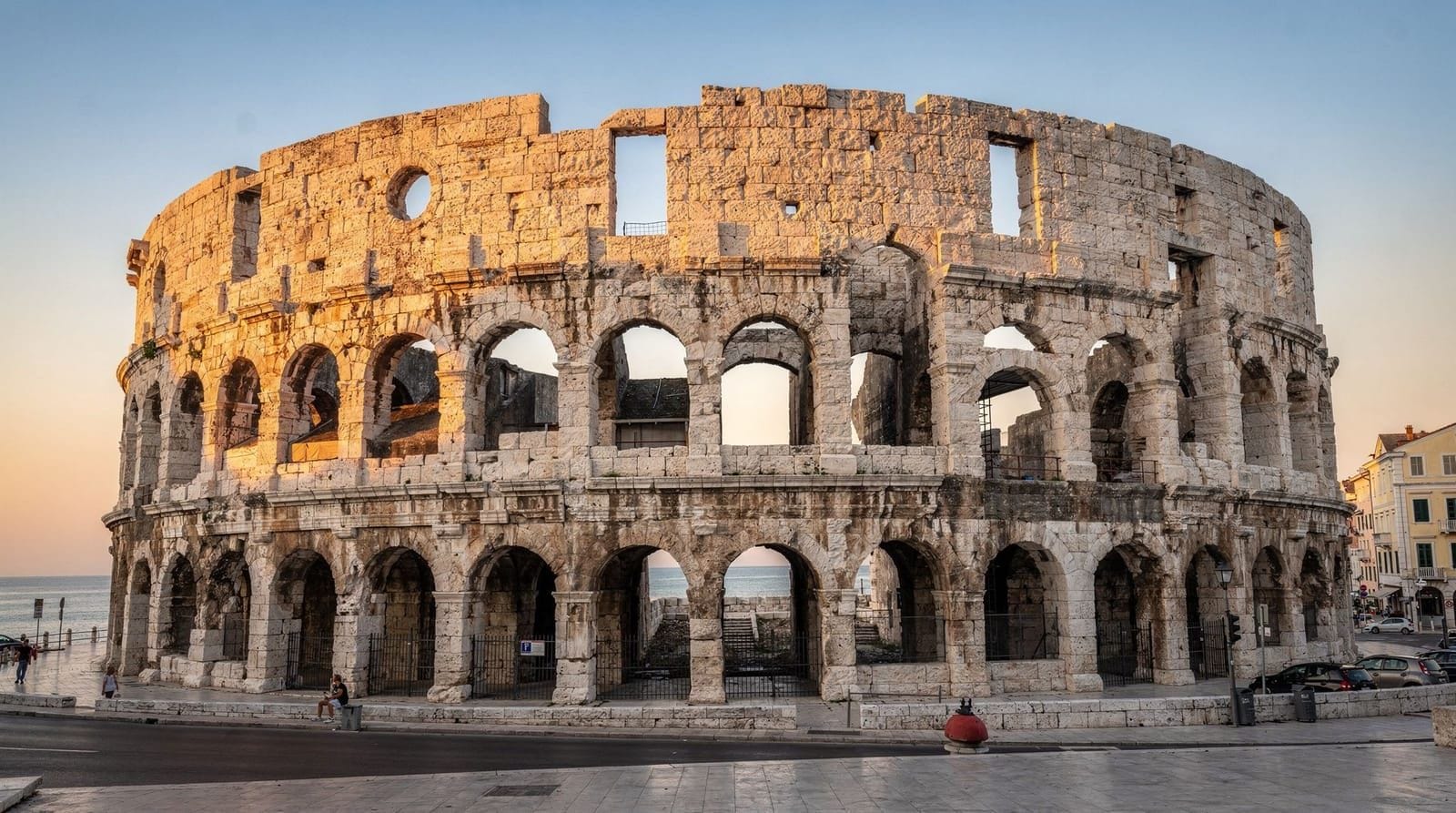
Different in kind rather than directly comparable. The Colosseum is a single preserved monument. Diocletian's Palace is an inhabited town. If the living-history aspect — coffee shops in Roman vaults, laundry hanging between ancient stones, a medieval cathedral built inside an emperor's tomb — appeals to you, Split's palace is more viscerally interesting than any roped-off ruin.What time of day is best to photograph Diocletian's Palace?
Early morning, before about 8:30 am, when the cruise-ship and day-tripper crowds have not yet arrived and the low light rakes across the Peristyle's columns. Golden hour in the evening, after most tour groups have left for dinner, is the second-best window, particularly for the Bronze Gate and the Riva waterfront. Midday in July and August is the worst time both for crowds and for flat, harsh light.Should I buy a combined ticket for the cellars, cathedral and baptistery?
Combined or discounted multi-site tickets are sometimes available seasonally at the ticket booths near the Peristyle and Bronze Gate — ask when you arrive, since availability and pricing change year to year. If no combined ticket is on offer, paying separately for the cellars and the cathedral treasury and tower is still worthwhile; both are inexpensive relative to what they add to the visit.
Top experiences
Bookable activities with verified prices and instant confirmation on GetYourGuide.
Top experiences
Best-rated activities across GetYourGuide and Viator.

From Zadar: Plitvice Lakes with Boat Ride & Zadar Old town tour
- Viator

3Hour ALL-INCLUSIVE Sunset Dolphin Watching from Medulin onSandra
- Viator

Dolphin Watching & Sunset Boat Tour With Drinks & optional Dinner
- Viator

Fantastic DOLPHIN & SUNSET TOUR with dinner ( Pula-NP BRIJUNI )
- Viator

Medulin :All-Inclusive Pirate Boat Dolphin Watching Sunset Cruise
- Viator

Zadar Highlights: Old Town, Sea Organ & Local Tastings
- Viator