Šibenik Cathedral of St. James: the guide
Split: Krka waterfalls and Sibenik tour with free wine tasting
Why is Šibenik Cathedral a UNESCO World Heritage Site?
The Cathedral of St. James (Katedrala Svetog Jakova) was inscribed in 2000 as an outstanding example of Gothic-Renaissance ecclesiastical architecture. Its distinction lies in being built entirely of interlocking stone blocks — no brick, no mortar — by Croatian master Juraj Dalmatinac and his successor Nikola Firentinac over more than a century (1431–1535). The 72 sculpted portrait busts on its exterior apse are unique in European cathedral architecture.
The cathedral built without mortar
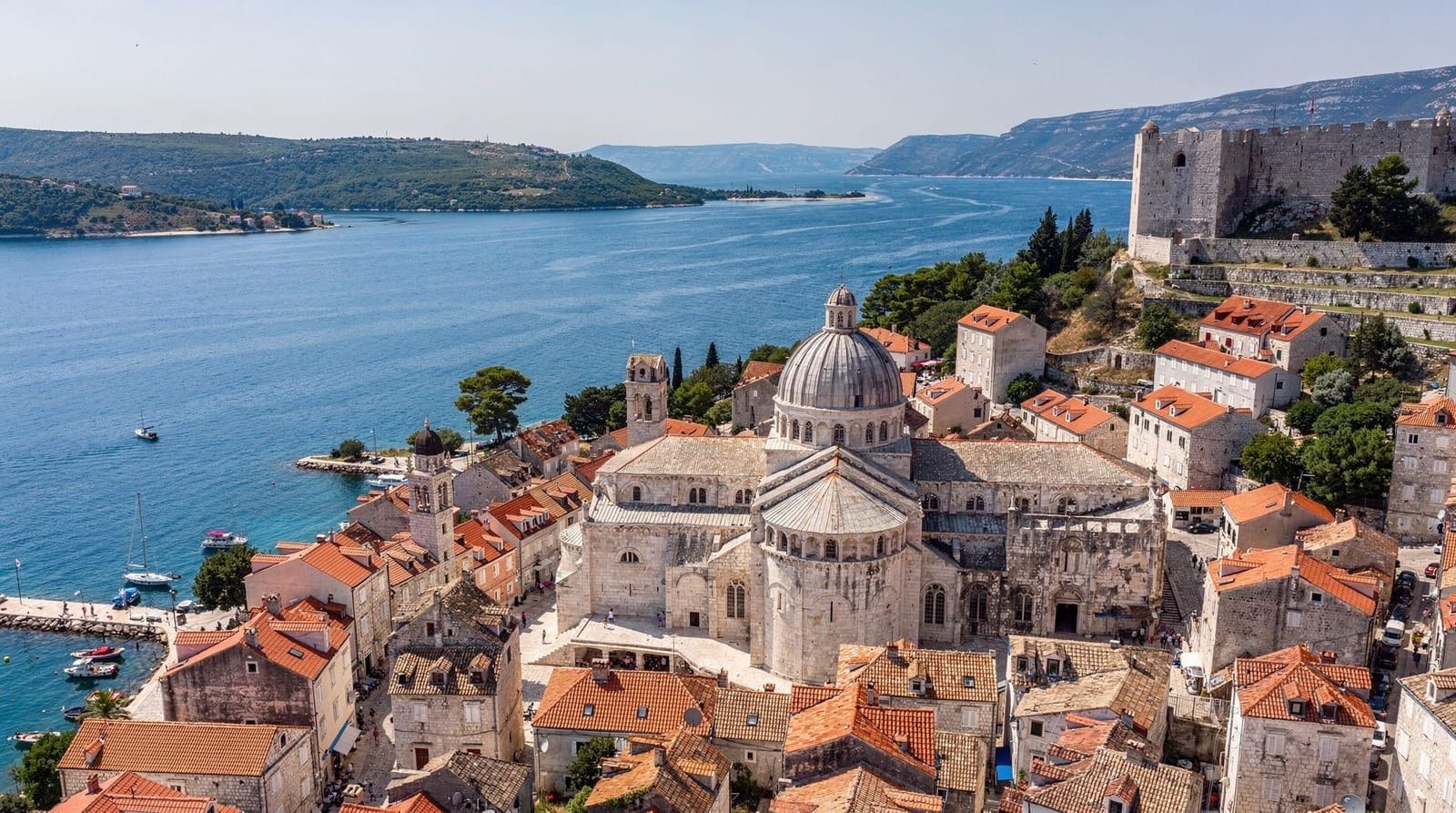
The Katedrala Svetog Jakova stands at the heart of Šibenik’s old town as one of the most technically and artistically ambitious buildings of 15th-century Europe. Its distinction is absolute: it is the only cathedral in the world built entirely of stone — no bricks, no mortar — the entire structure being an interlocking assembly of pre-cut limestone blocks that support one another through weight, geometry and the precision of their fitting.
| Where | Šibenik old town, 75km north of Split |
| Cost | Around €5 adult entry |
| Time needed | 30–45 minutes for the cathedral; half a day with the old town |
| Getting there | 1hr by bus/car from Split; 1hr from Zadar |
| Best time | June or September; combine with Krka in the afternoon |
That achievement took more than a century, two master architects, and the combined skills of generations of Dalmatian and Italian stonemasons. The result — inscribed on the UNESCO World Heritage List in 2000 — is a building that belongs simultaneously to the Gothic tradition and the emerging Renaissance, a testament to the cultural crossroads that was 15th-century Dalmatia.
History: a cathedral built in stages
Construction of the cathedral began in 1431, replacing an earlier Romanesque church on the same site in the old town. The project was locally ambitious from the start — Šibenik was a prosperous commune with aspirations to architectural dignity — but the early progress was slow and the initial design modest.
Juraj Dalmatinac (known in Italian sources as Giorgio Orsini; born in the Zadar area, trained in Venice) took over the commission in 1441 and transformed the project. He was the most significant sculptor-architect working in Dalmatia in the 15th century — his other major project, the Chapel of St. Anastasius in the Cathedral of Split, demonstrates the same virtuosic combination of architectural invention and sculptural skill.
Dalmatinac conceived the cathedral’s most remarkable features: the all-stone construction technique (in which blocks were cut to interlock so precisely that no mortar is needed), the elaborate decorative programme of the exterior, and the frieze of portrait busts on the apses. He worked on the project until his death around 1473–1475, by which point the nave walls were largely complete.
Nikola Firentinac (Niccolò di Giovanni Fiorentino, a Florentine sculptor who had worked in Venice and Dalmatia) took over after Dalmatinac’s death and completed the building between 1475 and 1535. He added the upper portions of the nave, the barrel vault, and the remarkable dome — a ribbed structure whose form shows clear Florentine Renaissance influence (a departure from Dalmatinac’s more Gothic approach to the lower sections). The combination of two distinct stylistic personalities in one building, visible if you know where to look, is part of what makes Šibenik Cathedral so rich.
The exterior: the portrait frieze
Walk around the exterior of the three apses at the east end of the cathedral. What you see — at head height, running the full circuit — is a frieze of sculpted portrait busts: 72 to 74 faces (depending on counting method) rendered in Dalmatian limestone with a naturalism that is extraordinary for mid-15th century sculpture.
These are not saints or biblical figures. They are real people — the inhabitants of 15th-century Šibenik: merchants, craftsmen, a bishop, nobles, women, elderly men, young faces, faces with beards and without, faces expressing arrogance, thoughtfulness, uncertainty. The individuality of each portrait is remarkable. No two faces are alike. Juraj Dalmatinac is believed to have carved many or most of them himself, possibly using the actual residents of Šibenik as models.
The iconographic programme is unusual and was apparently controversial at the time — using representations of real, living people on a cathedral exterior was not the convention. It gives the building an immediacy and humanity that purely conventional programmes often lack.
Also on the exterior: elaborate decorative detail in the window frames, the portal (the main entrance portal is earlier work, by a local master, with a scene of the Last Judgement), and the polychrome effect achieved by using stone from different Dalmatian quarries (Brač, Korčula, the local Šibenik area).
The interior: nave, baptistery, treasury
The interior of the cathedral is relatively restrained by the standards of its exterior — which is perhaps the right balance. The nave is high and Gothic in proportion, with plain stone vaulting that allows the spatial quality of the building to speak without distraction. Light enters through relatively small windows, keeping the interior cooler and more contemplative than many Adriatic churches.
The great prize of the interior is the Baptistery of St. John (Krstionica Svetog Ivana), accessed through a door in the right-hand aisle. This is a small, separate room that represents Dalmatinac’s virtuosity at its most concentrated: a ribbed stone vault of exceptional delicacy, its arching ribs meeting in decorative bosses of carved foliage; walls carved with relief figures of putti (cherubs) holding garlands; a central baptismal font on a stepped base with carved figures of six apostles. The effect is of a jewellery box rather than a functional ecclesiastical space.
The Treasury on the upper level (when accessible) holds sacred objects — reliquaries, chalices, vestments — including a particularly fine silver reliquary from the Ragusan workshops and items dating back to the original pre-cathedral church.
Šibenik’s other fortresses
The cathedral is the centrepiece but Šibenik’s old town deserves more time than a single monument allows. The hilltop Tvrđava Svetog Mihovila (Fortress of St. Michael) offers panoramic views over the city, the Krka estuary and the offshore islands. In summer it hosts the Šibenik Medieval Festival and open-air concerts in its courtyard. Entry is around €5–7; the climb (steep but manageable) takes 15 minutes.
The Tvrđava Svetog Nikole (Fortress of St. Nicholas) at the entrance to the Šibenik Channel is a UNESCO-listed site in its own right — part of the Venetian defence works of the 16th century that are jointly inscribed across multiple Adriatic sites. It is accessible only by boat (tours from the Šibenik harbour in summer).
Practical visitor information
Getting to Šibenik: From Split (75km south), take the A1 motorway or the coastal road (slower but more scenic). By bus, Split–Šibenik takes 1.5–2 hours; regular service. From Zadar (85km north), similar journey time by road or bus.
When to visit: Šibenik lacks the extreme summer congestion of Split or Dubrovnik. July–August is busier but manageable. The old town is small enough that even in peak season it feels less pressured than the larger Dalmatian cities.
Combining with Krka: The Lozovac entrance to Krka National Park is 15km from Šibenik — a 20-minute drive or a shuttle bus from the city centre (summer only). Combining the cathedral (morning) with Krka (afternoon) makes an excellent full day from Split.
Local food: Šibenik’s old town has several good restaurants on and around the cathedral square. Try the local dish of lamb or veal peka (slow-cooked under a peka lid) at one of the better konobas in the surrounding streets. See our Dalmatian cuisine guide for context.
Photographing the cathedral: The portrait frieze photographs best in the soft light of early morning or late afternoon, when raking light picks out the carving detail on each face — midday sun flattens the relief. The Peristyle-facing side is busiest with tour groups; the apse end (facing the smaller square behind the cathedral) is usually quieter and gives the clearest view of the full frieze circuit.
Juraj Dalmatinac: the man behind the stone
Understanding the cathedral requires knowing something about its chief architect. Juraj Dalmatinac occupies a place in Dalmatian cultural identity comparable to what Michelangelo holds in the Italian imagination — a native genius who was simultaneously embedded in international artistic currents.
Born in the Zadar area, he trained in Venice under the sculptor Bartolomeo Bon (who worked on the Ca’ d’Oro among other projects). He returned to Dalmatia and applied Venetian Gothic technique to local stone and local ambition. His work appears across the Dalmatian coast — the Minčeta Tower in Dubrovnik’s city walls was also his design.
The Šibenik Cathedral was his masterwork. The portrait frieze, the baptistery, and above all the structural innovation of the all-stone construction set him apart from his contemporaries. A statue of him stands in front of the cathedral today — a 20th-century tribute to a 15th-century innovator.
Šibenik in the wider UNESCO story
The cathedral is one of several Dalmatian UNESCO sites built or shaped in the same 15th–16th century period, alongside Split’s old town (Diocletian’s Palace) and Trogir’s old town. Seeing all three in sequence — Split’s Roman-into-medieval layering, Trogir’s compact island town, Šibenik’s singular Gothic-Renaissance cathedral — gives a clearer picture of Dalmatia’s architectural range than any single stop alone. Our Croatia UNESCO sites guide maps the full list, and the Croatia history guide has more context on the Venetian and Dalmatian cultural crossover that produced Juraj Dalmatinac’s generation of builders.
Fitting Šibenik into a Dalmatia itinerary
Šibenik works best as a half-day stop rather than a dedicated base for most itineraries. Travellers following the Croatia 7-day or Croatia 10-day itinerary typically slot it in between Split and Zadar, or as a day trip from Split alongside Krka — see the day trips from Split guide for how it fits alongside other options like Trogir and the Krka waterfalls.
Frequently asked questions about Šibenik Cathedral of St. James
Who built Šibenik Cathedral?
The cathedral was begun by a local master in 1431, then transformed by Juraj Dalmatinac (Giorgio Orsini, a Croatian-born sculptor trained in Venice) from 1441 onwards. After his death, Nikola Firentinac (a Florentine) took over and completed the dome and upper portions in Renaissance style. The building thus spans and blends two architectural periods.How much does it cost to enter Šibenik Cathedral?
Entry to the cathedral is around €5 for adults (2026). The interior, including the baptistery and treasury, is included. A combined Šibenik heritage ticket is sometimes available covering the cathedral and other old-town sites.What are the 72 portrait busts on the cathedral?
On the exterior of the cathedral's three apses runs a frieze of 74 sculpted heads (traditionally cited as 72, though counts vary slightly depending on counting method). These are portraits of real people — local Šibenik residents, merchants, nobles, clergy and possibly the sculptor's contemporaries. They are carved with remarkable individuality and are considered one of the finest examples of 15th-century portrait sculpture in Europe.Is Šibenik worth visiting beyond the cathedral?
Yes — Šibenik is an underrated city. Its old town is compact and well-preserved, the fortress of St. Michael (Tvrđava Svetog Mihovila) offers views and open-air concerts, and the nearby Krka National Park (15km) is one of Croatia's most beautiful natural sites. Šibenik is significantly less crowded than Split or Dubrovnik.How do I get to Šibenik?
By road: Šibenik is on the A1 motorway, 75km north of Split (1 hour) and 85km south of Zadar (1 hour). By bus: regular services from Split, Zadar and Zagreb. By ferry: Šibenik has a small ferry terminal but is not a major ferry hub. Most visitors arrive by bus or car.Can I combine Šibenik with a visit to Krka National Park?
Easily — Šibenik is 15km from the Lozovac park entrance. Most organised day trips from Split or Zadar combine Krka waterfalls with a stop in Šibenik. If you have your own transport, the combination takes a full day from Split.What is the interior of Šibenik Cathedral like?
The nave is relatively austere in decoration — Gothic proportions, stone vaulting, light filtering through plain windows. The baptistery (accessed from the right-hand aisle) is a jewel: a separate room with a ribbed stone vault of exceptional delicacy, a baptismal font with carved figures, and beautifully worked stone detail throughout. The treasury contains several pieces of Ragusan and Venetian goldsmithing.
Top experiences
Bookable activities with verified prices and instant confirmation on GetYourGuide.
Top experiences
Best-rated activities across GetYourGuide and Viator.

From Zadar: Plitvice Lakes with Boat Ride & Zadar Old town tour
- Viator

3Hour ALL-INCLUSIVE Sunset Dolphin Watching from Medulin onSandra
- Viator

Dolphin Watching & Sunset Boat Tour With Drinks & optional Dinner
- Viator

Fantastic DOLPHIN & SUNSET TOUR with dinner ( Pula-NP BRIJUNI )
- Viator

Medulin :All-Inclusive Pirate Boat Dolphin Watching Sunset Cruise
- Viator

Zadar Highlights: Old Town, Sea Organ & Local Tastings
- Viator