Croatian seafood guide: what to eat, how it's cooked, and where to find it
Split: Small group food tour with private option
What seafood is Croatia best known for and what should I order?
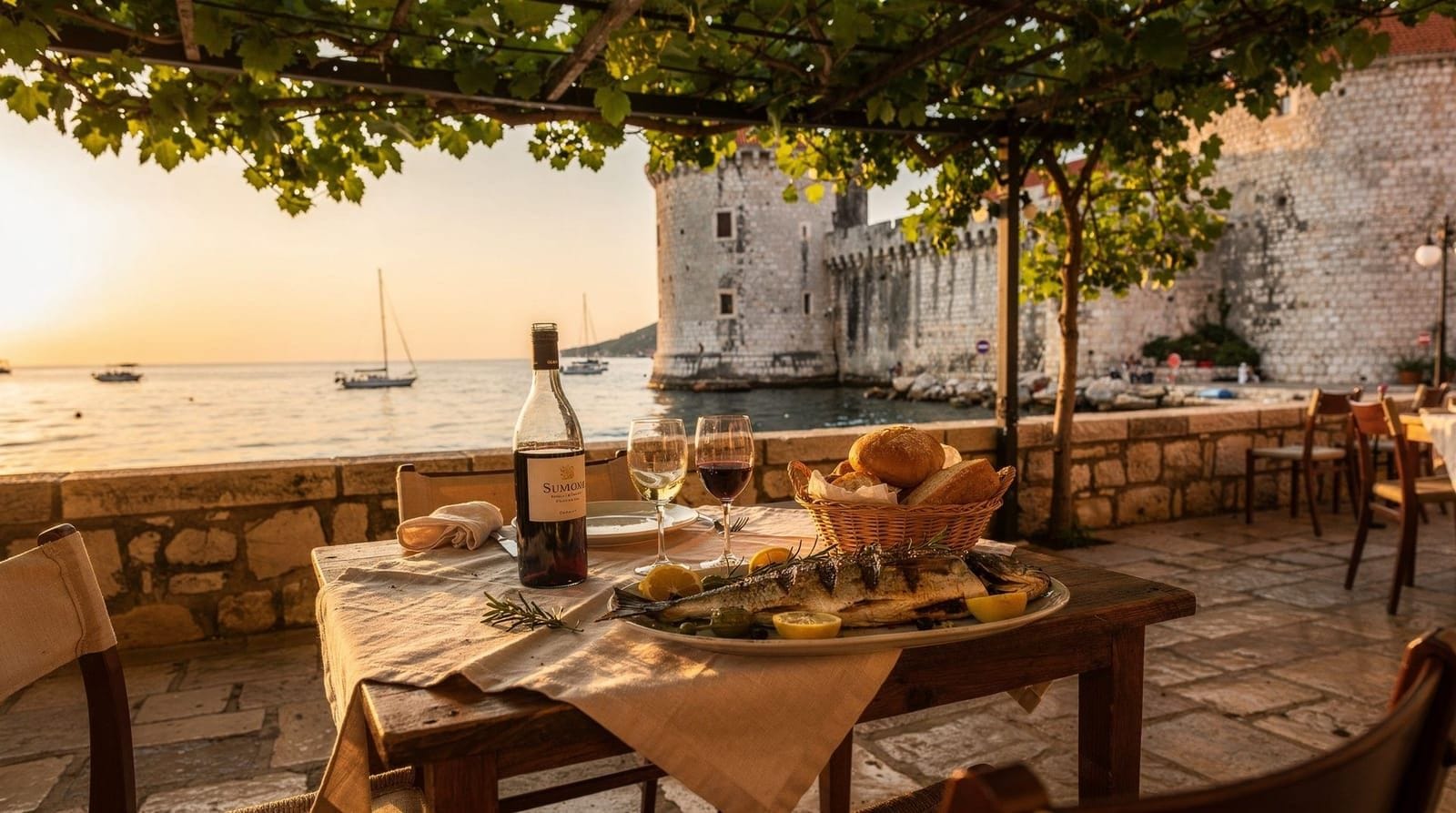
Croatia's best seafood is its simplest: whole fish grilled over an open fire (na zaru), octopus either grilled or under the peka bell, fresh mussels cooked in a white wine buzara broth, and the oysters from Ston bay on the Peljesac peninsula. The fish to prioritize are brancin (sea bass), zubatac (dentex, a firm white fish with extraordinary flavor), and komarcha (gilthead bream). Order them whole, priced by the kilo, cooked with olive oil and herbs. Farmed fish (uzgojeni) is cheaper; wild fish (divlji) is worth the premium.
In brief: The Adriatic is one of Europe’s clearest and most biodiverse seas, and Croatian coastal cooking is built around respecting that. The best seafood here is also the simplest: a whole wild fish, olive oil, open fire. Understanding species names, pricing mechanics, and preparation methods lets you eat extraordinarily well without being steered toward the tourist menu.
| Order this | Whole grilled fish (na žaru), priced by the kilo |
| Best value fish | Palamida (in season) or komarcha |
| Splurge fish | Zubatac (dentex), EUR 60–80/kg |
| Must-try shellfish | Kamenice (Ston oysters), buzara mussels |
| Best season | Spring and autumn — fresher, cheaper, less crowded |
The Adriatic and why it matters
The Adriatic Sea is relatively shallow — maximum depth around 1,200 m in the south — and enclosed, which concentrates marine life but also makes it sensitive. Croatia’s coastline, with over 1,200 islands forming natural bays and channels, creates ideal conditions for shellfish farming (the Pelješac channel, the Lim Channel in Istria) and for wild fish habitat (the rocky underwater terrain around the islands).
The islands and the Croatian current patterns keep the water clean. The sea here is genuinely among the clearest in the Mediterranean — the reason visibility when snorkeling can exceed 20 m in some areas. That clarity is a proxy for the quality of what lives in it.
Croatian fishing is predominantly small-scale. Artisan fishing boats (barke) from coastal villages go out daily or overnight, and the catch comes to the fish market — ribarnica — in the morning. What you eat at a coastal konoba at lunch was in the sea that morning or the previous night. This is not marketing copy; it is the mechanical reality of how the supply chain works.
The fish: species by species
Brancin (European sea bass / Dicentrarchus labrax)
The most widely available quality fish in Croatia, appearing on virtually every konoba menu and available year-round. Brancin is elegant, with white flesh, moderate fat, and a clean flavor that absorbs olive oil and herbs beautifully when grilled whole. Wild brancin (divlji) has a firmer texture and stronger flavor than farmed; the price difference (wild: EUR 45–65/kg, farmed: EUR 25–35/kg) reflects this. If the menu lists “uzgojeni brancin” that is farmed; if it just says brancin, ask.
Preparation: Almost always grilled whole (na žaru) with olive oil, lemon, and blitva (Swiss chard) with potatoes. No sauce. It needs none.
Zubatac (Dentex / Dentex dentex)
The finest table fish of the Adriatic according to local consensus, and the most expensive. Dentex has firm white flesh with a distinctive flavor — richly savory, sweet at the edges — that rewards simple cooking. It is almost exclusively wild (farmed dentex is extremely rare). A 600g zubatac for one person at EUR 60–80/kg runs EUR 36–48 before sides. Worth it once, at a konoba that sources well.
The name derives from the prominent teeth; ask to see the fish before ordering to confirm it is zubatac and not a cheaper substitute. Larger specimens (over 1 kg) are generally better quality than very small ones.
Komarcha (Gilthead bream / Sparus aurata)
The everyday quality fish: widely farmed but also wild, consistent in texture, excellent on the grill. A good wild komarcha has slightly more fat and flavor than wild brancin. Farmed versions are reliable and inexpensive at EUR 20–30/kg. On Hvar, Brač, and Vis, you are likely eating wild komarcha from local waters; in tourist restaurants in Dubrovnik, farmed is more common. Ask.
Palamida (Atlantic bonito / Sarda sarda)
The fisherman’s fish — oily, dark-fleshed, seasonal (summer into early autumn), and cheap. Palamida is polarizing: at its absolute freshest (hours from the sea), it is extraordinary, with deep savory flavor. More than a day old and it becomes strong and disappointing. The rule: only order palamida at a konoba where you can verify it was caught that morning. Priced at EUR 15–25/kg, it is the most affordable quality fish.
Preparations: grilled whole, pan-fried, or marinated raw in lemon juice (palamida na lešo or carpaccio-style). Excellent marinated.
Salpa, arbun, pic, fratar
These smaller fish (salpa is the sheep’s head bream; arbun is the pandora; pic is a small grouper relative; fratar is a two-banded bream) are the daily catch fish — served whole, typically grilled, at lower prices than brancin or zubatac. They appear on menus at smaller konobas and at fish markets sold whole for home cooking. All are good when fresh; fratar in particular has a clean, mild flavor. Prices: EUR 15–30/kg.
Grdobina (Scorpionfish / Scorpaena scrofa)
Ugly on the outside, extraordinary inside. Grdobina (also called škrpina on some menus) has very firm, sweet white flesh — some say the finest flavor of any Adriatic fish. It is bony, which deters casual eaters, but experienced Croatian diners consider it a prize. Used primarily in fish soup (riblja juha) or brodet, where its gelatin enriches the broth. When offered as a whole grilled fish, take it.
Tune (Tuna / Thunnus thynnus)
Bluefin tuna passes through the Adriatic on seasonal migrations. When available fresh at port restaurants, it is served as tataki, carpaccio, or a thick grilled steak. Not everyday fare — more of a special occasion find. The commercial tuna fishery is regulated. Look for it at ports with active fishing fleets (Komiža on Vis, Vrboska on Hvar) in summer.
The shellfish and cephalopods
Kamenice (Oysters from Ston)
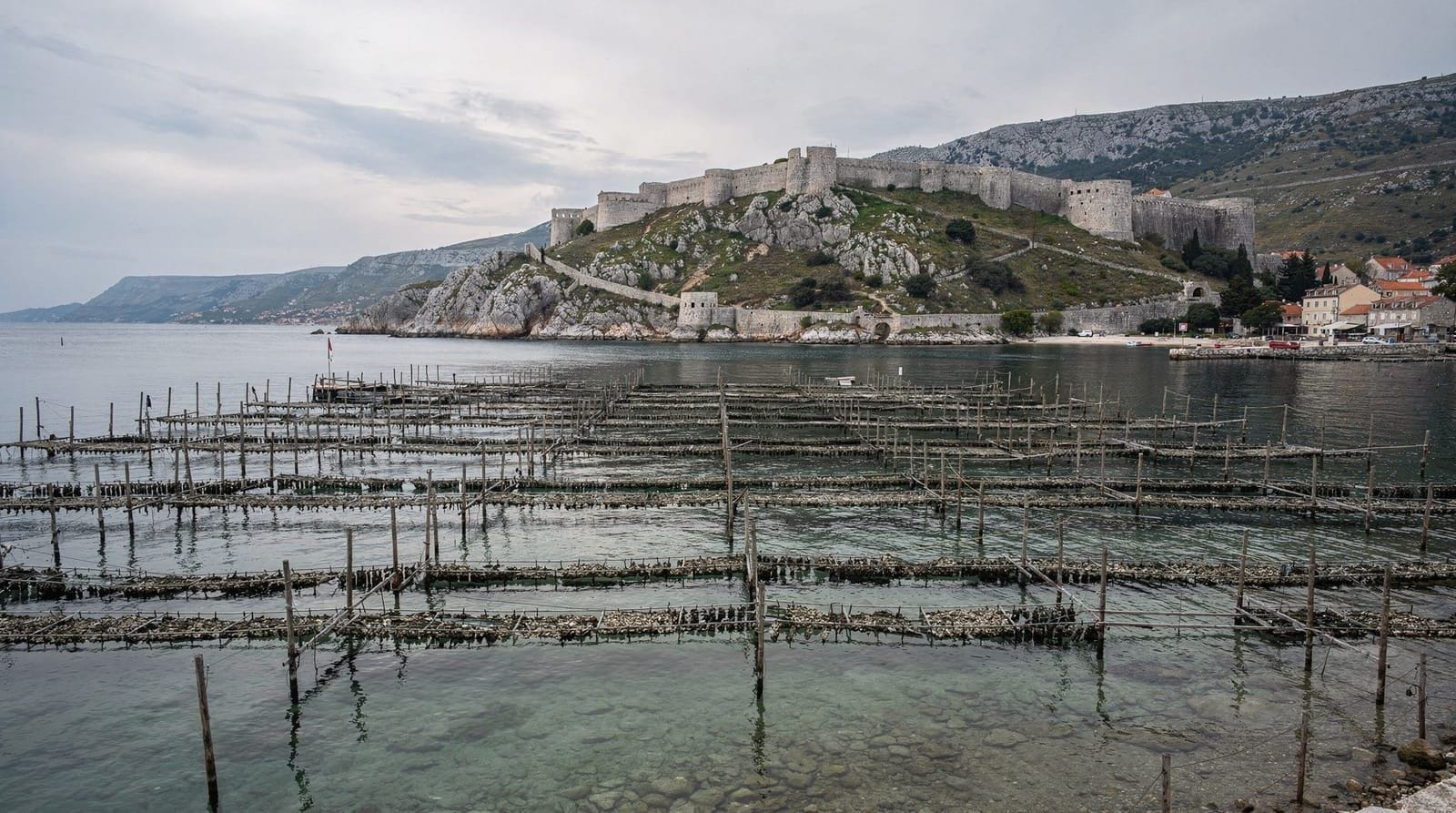
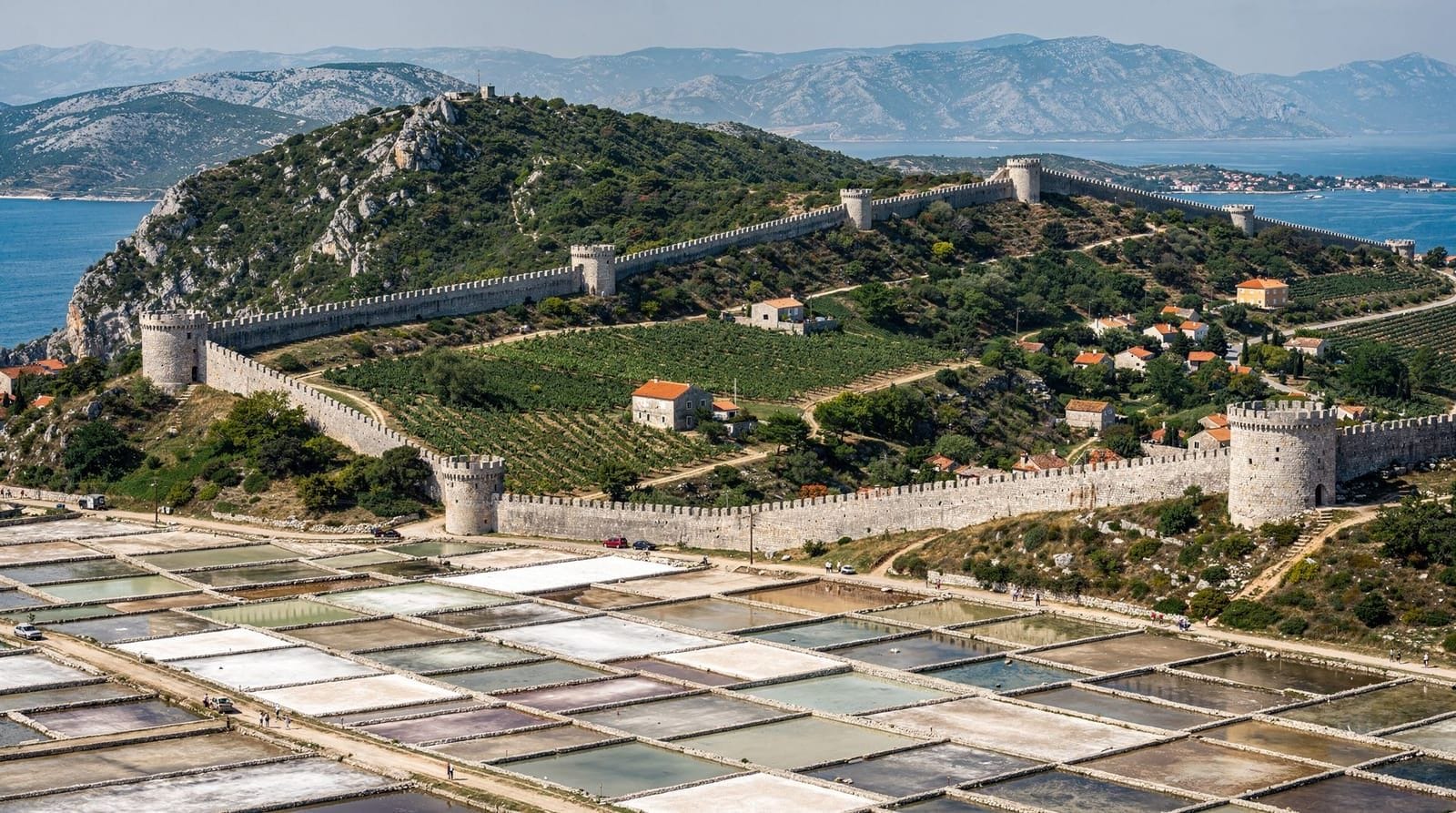
The oysters from Mali Ston bay on the Pelješac peninsula are Europe’s genuinely great wild oysters — European flats (Ostrea edulis) grown in clean, tidal waters fed by the Neretva River. They are smaller than Irish or Brittany oysters, with a distinct mineral and oceanic flavor that reflects the bay they grow in. Eaten raw with lemon, grilled with garlic butter, or in a white wine sauce.
The full story is in the oysters of Ston guide. The short version: buy and eat them in Ston town, where the konobas are directly connected to the oyster beds. Price: EUR 1.50–2.50 per oyster at source.
Dagnje (Mussels)
Farmed mussels from the Pelješac channel and the Lim fjord in Istria are excellent: clean water produces plump, sweet mussels with no off-flavors. The standard preparation is buzara — opened in a pan with olive oil, garlic, white wine, breadcrumbs, and parsley. The buzara broth is as important as the mussels themselves; it is consumed with bread and taken seriously by anyone who knows what they are eating.
Mussels on the half-shell with a squeeze of lemon are the simpler preparation. A portion of 500g of mussels (roughly 15–20 mussels) costs EUR 8–14 depending on location. The most expensive are in Dubrovnik; the best value are in Ston or in the Lim Channel area.
Skampi (Scampi / Norway lobster)
Large freshwater prawns, technically a marine crustacean, cooked most often na buzaru — the same white wine and garlic treatment as mussels. Skampi in buzara is one of the most consistently excellent dishes in Croatian seafood cooking. The broth from scampi buzara has an intensity that surpasses even mussel buzara. Prices: EUR 15–30 per portion depending on size and provenance. The best come from the Kvarner gulf — look for “kvarnerski skampi” on menus around Opatija, Rijeka, and the Kvarner islands.
Lignje (Squid)
Squid appear on every konoba menu in Croatia in two forms: lignje na žaru (whole squid grilled, usually with garlic and parsley) and lignje punjene (stuffed squid — filled with their own tentacles, breadcrumbs, garlic, and parsley, then grilled or baked). Both are reliable, inexpensive (EUR 12–18 for a portion), and consistently good when fresh. Avoid restaurants serving thawed squid — it develops a rubbery texture that no amount of cooking corrects.
Hobotnica (Octopus)
Octopus is the cephalopod of Dalmatia. Every konoba has it in some form; the three canonical preparations are:
Hobotnica salata — Octopus salad. The octopus is boiled until tender (1–1.5 hours), cooled, sliced, and dressed with olive oil, lemon, capers, finely sliced red onion, and fresh parsley. The best versions include boiled potato cubes. Served cold. Deeply satisfying, works as a starter or a light main.
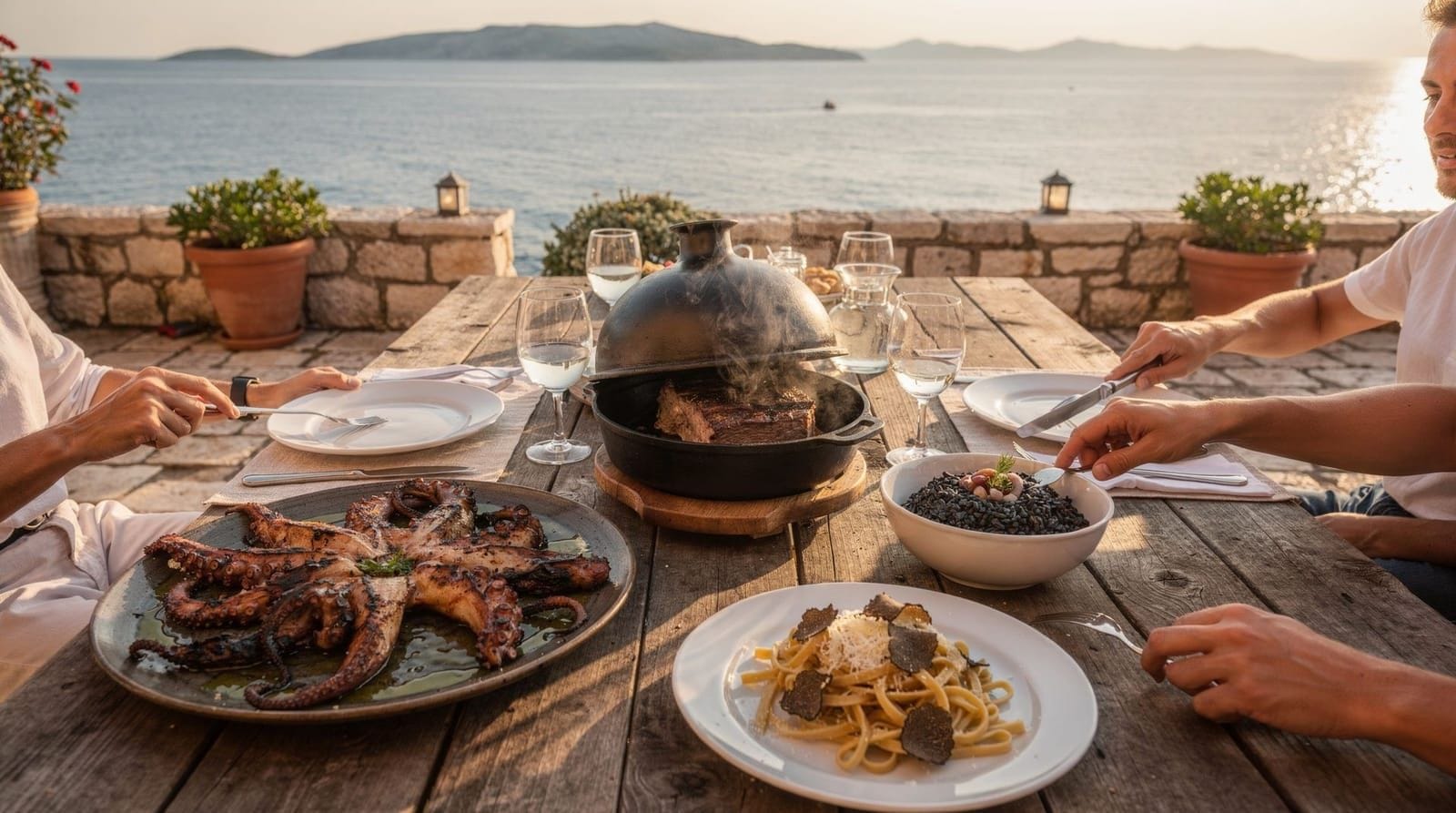
Hobotnica na žaru — Grilled octopus. The octopus is tenderized (either frozen, then thawed, or pounded), blanched briefly, then finished over charcoal until the exterior chars and crisps. Served with olive oil, lemon, and blitva or roasted potatoes. The charring and the tenderizing technique are critical — badly handled octopus is the most common seafood disappointment in Croatia.
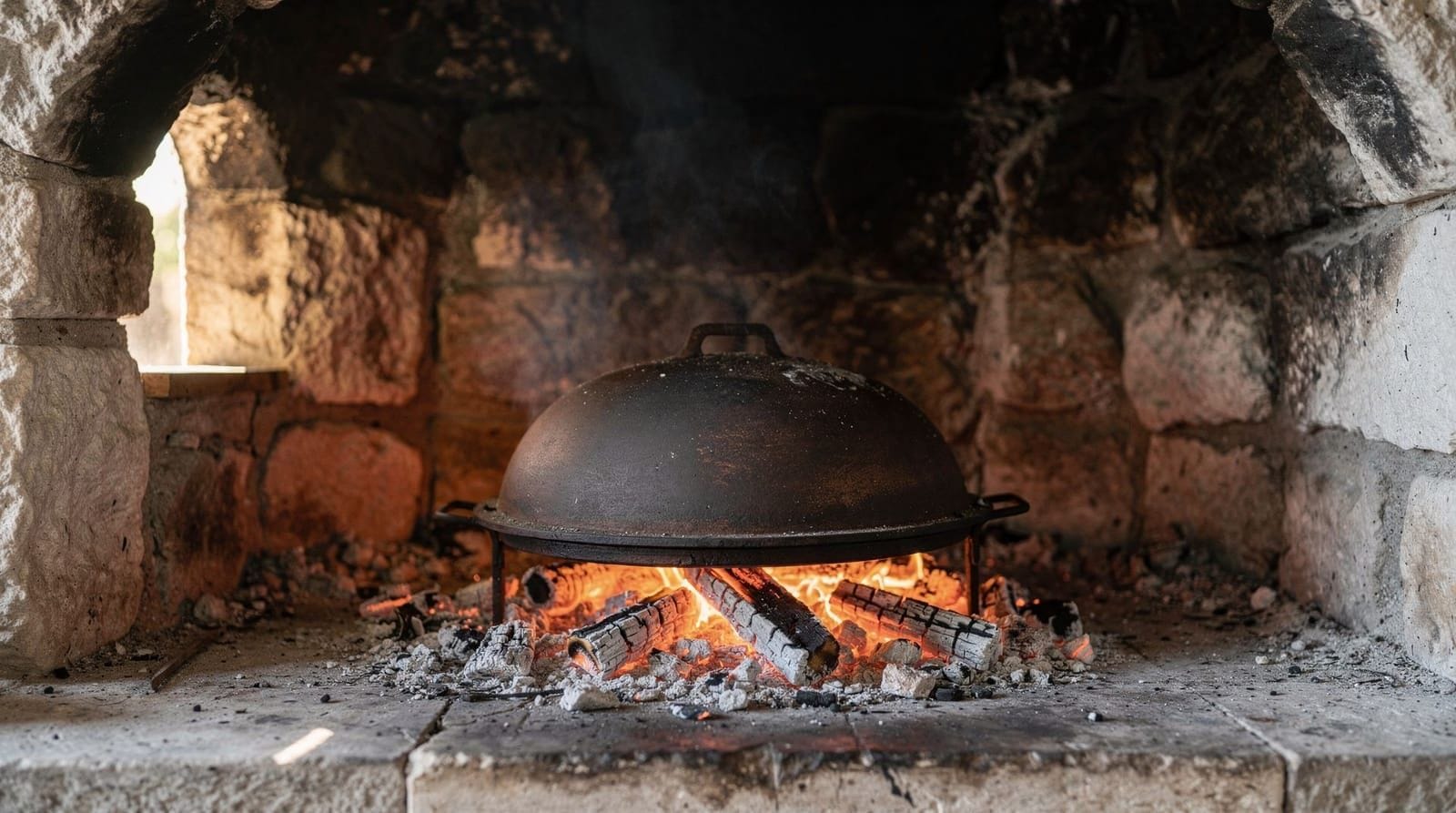
Hobotnica ispod peke — Octopus under the iron bell, slow-cooked with potatoes, tomatoes, garlic, and olive oil for 90 minutes. The most dramatic and the most rewarding preparation. Must be ordered in advance. Full guide: peka in Croatia.
Preparation methods: reading the menu
Na žaru — On the grill. Open charcoal fire. The standard method for whole fish, octopus, and squid. The best preparation for fresh fish; look for charcoal scent and grill marks that indicate actual fire rather than a gas plancha.
Ispod peke — Under the iron bell, over embers. See peka guide for full details.
Na buzaru — In the buzara style. White wine, garlic, olive oil, breadcrumbs, parsley. Standard for shellfish and scampi.
Na lešo — Boiled or poached, finished with olive oil. Used for octopus (first stage before grilling) and sometimes for white fish when simply prepared. Lešo fish with olive oil and blitva is a traditional and excellent preparation.
Na brudet / brodeto — Braised in a fish stew. Multiple fish species cooked together in wine, tomato, onion, and garlic, served with polenta. A communal dish from a single pan.
Prsani / pohani — Breaded and fried. Common with squid rings and small fish (cipol, gavun). Not the signature preparation but reliably good when the oil is fresh and the fish very fresh.
Fish markets: buying and eating at the source
Split ribarnica
The fish market in Split occupies a covered hall on the edge of the Pazar market, just outside the eastern gate of Diocletian’s Palace. It opens around 6 am and the best fish sells out by 9–10 am in summer. The market is a working market for locals — vendors weigh and cut to order. You can buy whole fish, cleaned and scaled if you ask, or point to what you want and ask the vendor to fillet it.
What you see: the daily catch depends entirely on season and what the boats brought in. In summer, you will typically find brancin, komarcha, palamida, squid, octopus, various bream species, and shellfish. In winter, the selection contracts but quality can be higher as demand drops.
Zadar ribarnica
Zadar has an excellent fish market in the old town, near the market area. Zadar’s proximity to the Kornati islands and the open Adriatic gives it access to high-quality wild fish. The market is less touristy than Split’s.
Zagreb ribarnica (Dolac)
Zagreb’s Dolac market lower hall has a fish counter — which surprises many visitors. The fish comes from the coast by refrigerated truck overnight and arrives fresh. Quality is good; prices are slightly higher than on the coast because of transport. For a landlocked capital, it is exceptional.
Seafood eating: what to know before you order
The fish market menu vs. the tourist menu. In any busy tourist port, there are two types of restaurants: those serving whatever sold that morning at the ribarnica, and those serving defrosted frozen fish with a charming terrace. The first has a short menu that changes daily; the second has a long menu with photos. Seek the first. Ask “sta imate danas?” (what do you have today?) — if the answer is a specific list of 3–4 fish, you are in the right place.
The weight pricing system. This confuses visitors consistently. Whole fish is weighed raw and priced accordingly. The fish you see on the counter at 600g weighs about 450–480g after cleaning; the cooked portion at the table weighs 350–400g. This is normal. Always ask for the price of the specific fish before ordering — “koliko kosta ova riba?” (how much does this fish cost?) is sufficient.
Sides. Grilled fish in Dalmatia comes almost always with blitva i krumpir — Swiss chard and potato boiled together with garlic and olive oil. This is the traditional side dish and it is very good. You can swap for salad or roasted vegetables at most restaurants if you prefer.
Olive oil. Good grilled fish needs only good olive oil. The olive oil at a proper Dalmatian konoba is cold-pressed local oil — pour it over the fish, the blitva, the bread. Do not look for butter or heavy sauces.
Seafood food tours
Navigating the market, understanding species, and finding the right konoba is significantly easier with a local guide who knows what is good that day. In Split, food tours that include the fish market and a konoba lunch with fresh catch are particularly useful for first-time visitors:
The Real Split food tour focuses specifically on local knowledge and avoids tourist traps — the guides know which konobas are sourcing from the morning market:
Seasons and what to eat when
Spring (April–May): The best season for small oily fish — sardine (sardina), ansova (anchovy), and gavun (sand smelt) are at their fattest before spawning. Order them grilled whole, unsauced, with olive oil. Squid are abundant and good. Mussels and oysters from Ston are plump.
Summer (June–August): Peak demand, peak prices. Some species are protected during summer spawning (check current regulations — Croatia updates these periodically). Palamida is in season. Grilled octopus everywhere. Shellfish still available but some coastal mussels slow their growth in warm water. This is the season for the whole grilled fish experience at a terrace over the sea.
Autumn (September–October): The return to quality. Fish rebuild condition after spawning; catches increase; prices drop slightly after peak tourist season. The best month for zubatac. Lobster (jastog) season is active on the outer islands. Octopus salad and peka dominate. Oyster quality at Ston is recovering toward its best.
Winter (November–March): Low tourist season means lower prices and more attentive service. Kvarnerski skampi are at their best in winter and early spring. Fish soup (riblja juha) appears more frequently as weather cools. Mussels and oysters from Ston hit peak quality in winter — cold water produces the most intensely flavored shellfish.
Sustainability: what to know before you order
The Adriatic’s biodiversity is genuinely under pressure from overfishing and warming waters, and a handful of practical choices make a real difference without requiring you to give up seafood on a Croatia trip. Prstaci (date mussels) are illegal to harvest and sell in Croatia — if a restaurant offers them, decline; their extraction destroys the rock formations they grow in and recovery takes decades. Bluefin tuna fishing is tightly regulated; if it’s on the menu it should come from a licensed source, and reputable restaurants will say so if asked.
More generally, favouring species that are abundant and fast-growing — mussels, squid, smaller daily-catch fish like arbun and fratar — over slower-growing, heavily fished species is a small but meaningful choice. Farmed brancin and komarcha (clearly marked “uzgojeni” on menus) are a genuinely sustainable option too, and considerably cheaper than wild — worth choosing deliberately rather than only as a budget compromise.
Cooking your own catch: buying at the market for a rental kitchen
If your accommodation has a kitchen, buying directly from a ribarnica and cooking it yourself is genuinely one of the best-value seafood experiences in Croatia — a whole fish that costs €12–25 at market can become a €50+ restaurant dish once you add a terrace view and table service. The vendors at Split’s and Zadar’s fish markets will clean and scale fish on request at no extra charge; ask “mozete li ocistiti?” (can you clean it?) if you want it prepped for the grill.
For those without a kitchen but staying somewhere with a barbecue or grill access, buying fish at the morning market and grilling it yourself that evening — with just olive oil, salt and lemon — reproduces the essential Dalmatian seafood experience without the markup. Bring your own bag or cooler if buying in warm weather; a market-bought fish left in a hot car for a few hours loses quality fast.
What to avoid ordering
A handful of menu items are reliable warning signs of a tourist-oriented, lower-quality kitchen rather than somewhere sourcing well. Pre-breaded, deep-fried “seafood platters” with a long list of species at a flat price are almost always a sign of frozen, bulk-sourced product rather than the day’s catch — a genuine mixed grill from fresh fish is priced by weight, not as a fixed-price combo. Similarly, be cautious of menus offering the exact same seafood dishes year-round with photos — the best Croatian seafood kitchens have shorter, changing menus that track what actually came in that morning.
If a restaurant can’t or won’t tell you whether a fish is wild or farmed, or can’t confirm the price before it’s cooked, that’s a reasonable signal to look elsewhere, particularly in the busiest tourist ports where the incentive to upsell is highest.
Pairing seafood with Croatian wine
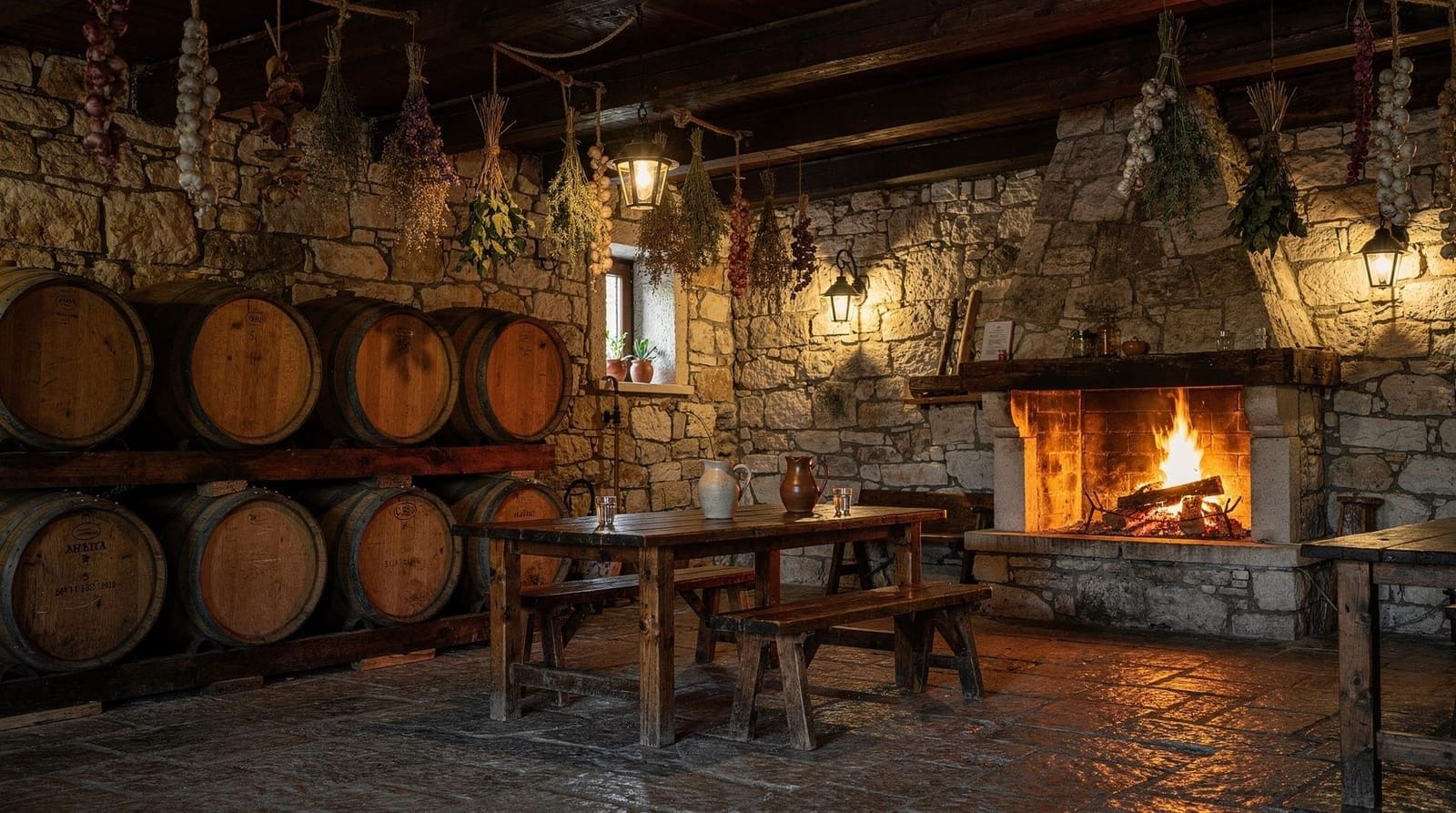
The coast’s wine tradition developed specifically to accompany this food, and a few pairings are worth knowing. Pošip from Korčula is the classic match for whole grilled white fish — mineral, dry, with enough acidity to cut through olive oil. Istrian Malvazija pairs particularly well with shellfish and buzara-style dishes, its citrus notes echoing the lemon that typically finishes the plate. For heavier dishes like brudet or peka-cooked seafood, a lighter red or even a rosé (gemišt-style, cut with sparkling water) works better than a full-bodied Plavac Mali, which is built more for red meat than fish. The Croatian wine guide has the fuller picture if wine is as much a priority as the seafood itself.
Frequently asked questions about Croatian seafood guide
What is the best fish to order in Croatia?
Zubatac (dentex) is widely considered the finest Adriatic table fish — firm white flesh, excellent flavor when grilled whole, and almost never farmed. It commands a premium (EUR 60-80/kg at good restaurants) and is not always available. Brancin (sea bass) and komarcha (gilthead bream) are more consistent in quality and availability and excellent grilled. Palamida (Atlantic bonito) is the fisherman's fish — seasonal, inexpensive, and delicious when very fresh, usually pan-fried or marinated.How is fish priced in Croatia?
Whole fish is sold by weight — po kili (per kilogram). The fish is weighed raw and the price quoted before cooking. A single brancin for one person weighs 350-550g; at EUR 35-55/kg, that is EUR 12-30 for the fish before sides, wine, and bread. Always ask the price before confirming. Many restaurants will bring the fish to the table on a plate for you to see before it goes on the grill — this is standard practice, not a sales gimmick.What are dagnje and how are they cooked?
Dagnje are mussels — farmed extensively in the Peljesac channel, Mali Ston bay, and Lim Channel in Istria. The standard preparation is buzara: mussels opened in a wide pan with olive oil, garlic, white wine, breadcrumbs, and parsley. The broth is extraordinary and bread for mopping is non-negotiable. A portion (500g of mussels) costs EUR 8-14. Mussels on the half-shell with lemon are also common. Mali Ston bay mussels and oysters together constitute one of Croatia's finest local food products.What is hobotnica and how is it usually prepared?
Hobotnica is octopus — one of the defining ingredients of Dalmatian seafood cooking. The most common preparations are: hobotnica salata (octopus salad — boiled octopus with potato, onion, olive oil, capers, and parsley, served cold), hobotnica na zaru (grilled octopus, usually tenderized first by freezing or beating), and hobotnica ispod peke (octopus under the peka bell — see the peka guide for full details). Octopus in Croatia is almost always very fresh and handled well.What is buzara?
Buzara is the classic Dalmatian shellfish cooking method — not quite a stew, not quite a braise. Shellfish (mussels, clams, scampi, crab) go into a wide pan with olive oil, garlic, white wine, a handful of breadcrumbs, and fresh parsley. The pan is covered and shaken over high heat until everything opens and the liquid emulsifies with the breadcrumbs into a thick, intensely flavored sauce. Order buzara specifically and always ask for bread. The sauce is the point.When is the best time to eat seafood in Croatia?
Spring and autumn are the best seasons. In spring, small oily fish (sardines, anchovies) are at their fattiest before spawning; squid are abundant; mussels and oysters are plump from cold-water feeding. In autumn, the water cools after summer, fish rebuild condition after spawning, and truffle season in Istria pairs naturally with seafood. Summer seafood is good but not at its peak — some species are protected during summer spawning periods, and demand exceeds supply in the peak tourist months, pushing up prices and sometimes quality down.Are there fish markets in Croatia and can I buy fresh fish?
Yes. The fish market (ribarnica) in Split is behind the Pazar market, open from around 6 am until noon or until sold out (usually by 10-11 am in summer). The fish in Zagreb (also called ribarnica in Dolac market lower hall) comes from the coast and arrives daily — surprisingly fresh for a landlocked city. Rovinj's market has excellent Istrian catch. Buying fresh fish and cooking it yourself (or taking it to a local restaurant that will cook your purchase for a small fee — ask) is the cheapest route to excellent seafood.
Top experiences
Bookable activities with verified prices and instant confirmation on GetYourGuide.
Top experiences
Best-rated activities across GetYourGuide and Viator.

Krka National Park Tour with tour Guide & Wine tasting from Split & Trogir
- Viator

Dolphin Watching & Sunset Boat Tour With Drinks & optional Dinner
- Viator

Fantastic DOLPHIN & SUNSET TOUR with dinner ( Pula-NP BRIJUNI )
- Viator

Dubrovnik Guided Group Tour with Ston Oyster tasting from Split & Trogir
- Viator

Zadar Highlights: Old Town, Sea Organ & Local Tastings
- Viator

Zadar: Luxury Island Boat Tour, Snorkeling & Unlimited Wine
- Viator