Day Trips from Rovinj: Pula, Poreč, Venice, Motovun and Istrian Hilltowns
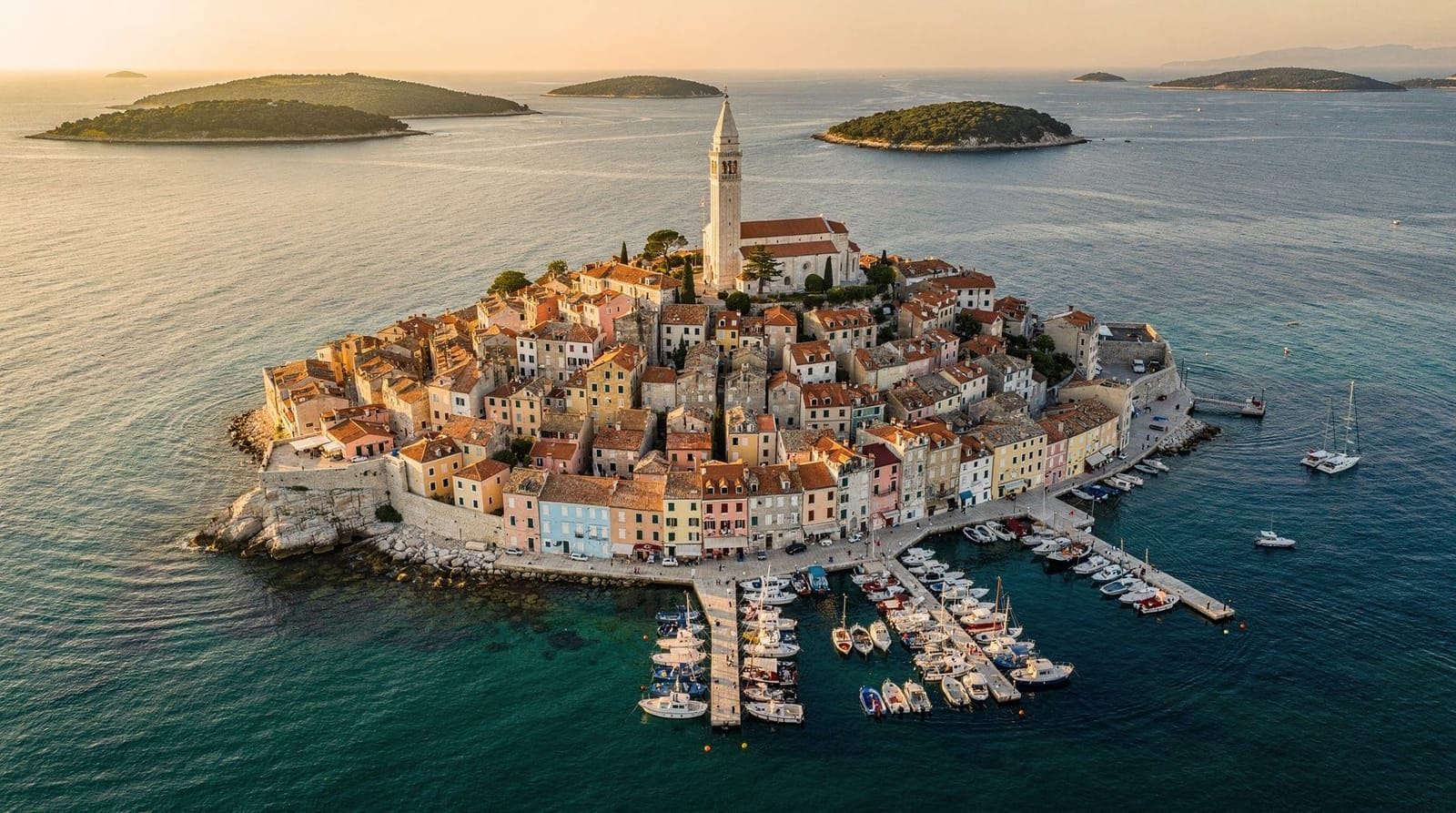
Rovinj: A day in Venice by speedboat
What are the best day trips from Rovinj?
Pula (45 min by car — Roman amphitheatre and town) is the easiest. Venice by speedboat (2.5 h, runs in season) is the most unusual. Poreč with the Euphrasian Basilica (30 min north) suits art and history lovers. The Motovun and Grožnjan hilltown circuit needs a car and half a day. Brijuni Islands require a guided day-boat tour.
Rovinj as a day-trip base
Rovinj is one of Istria’s most beautiful towns — a cluster of ochre and terracotta buildings on a small peninsula, crowned by the Baroque church of St Euphemia. It is a destination in itself, but it sits in a part of Europe where remarkable things are short drives or boat trips away.
Istria’s compact geography is an advantage: Pula is 40 km south, Poreč is 30 km north, Venice is 2.5 hours by fast boat. The Istrian interior — with its medieval hilltowns, truffle forests and Malvazija vineyards — is 30–60 minutes inland. A visitor with 4–5 nights in Rovinj can cover an enormous amount of ground without spending more than 2 hours in transit on any day.
| Where | Pula, Poreč, Venice, Motovun, Lim Fjord, Brijuni Islands |
| Cost | Around EUR 4–10 (bus/ferry) up to EUR 80–120 (Venice catamaran) |
| Time needed | Half-day (Lim Fjord, Poreč) to a full day (Venice, hilltown circuit) |
| Getting there | Car for the interior; bus or boat for Pula, Poreč, Venice, Brijuni |
| Best time | June and September for lighter crowds and reliable boat schedules |
Comparing the day trips
| Trip | Travel time | Needs a car | Best for |
|---|---|---|---|
| Poreč | 30–40 min | No — bus works | UNESCO mosaics, short trip |
| Lim Fjord | 20–30 min | No — boat tour | Scenery, oysters, relaxed |
| Pula | 45 min | No — bus works | Roman amphitheatre, city |
| Motovun & hilltowns | 50–70 min | Yes | Truffles, wine, medieval villages |
| Brijuni Islands | 30 min + boat | No — via Fažana | National park, Tito history |
| Venice | 2.5–3 h by boat | No — catamaran | A genuinely different day |
Pula — Roman amphitheatre and city
Distance from Rovinj: 40 km / 45 min by car
Best for: Roman history, architecture, free beaches, city atmosphere
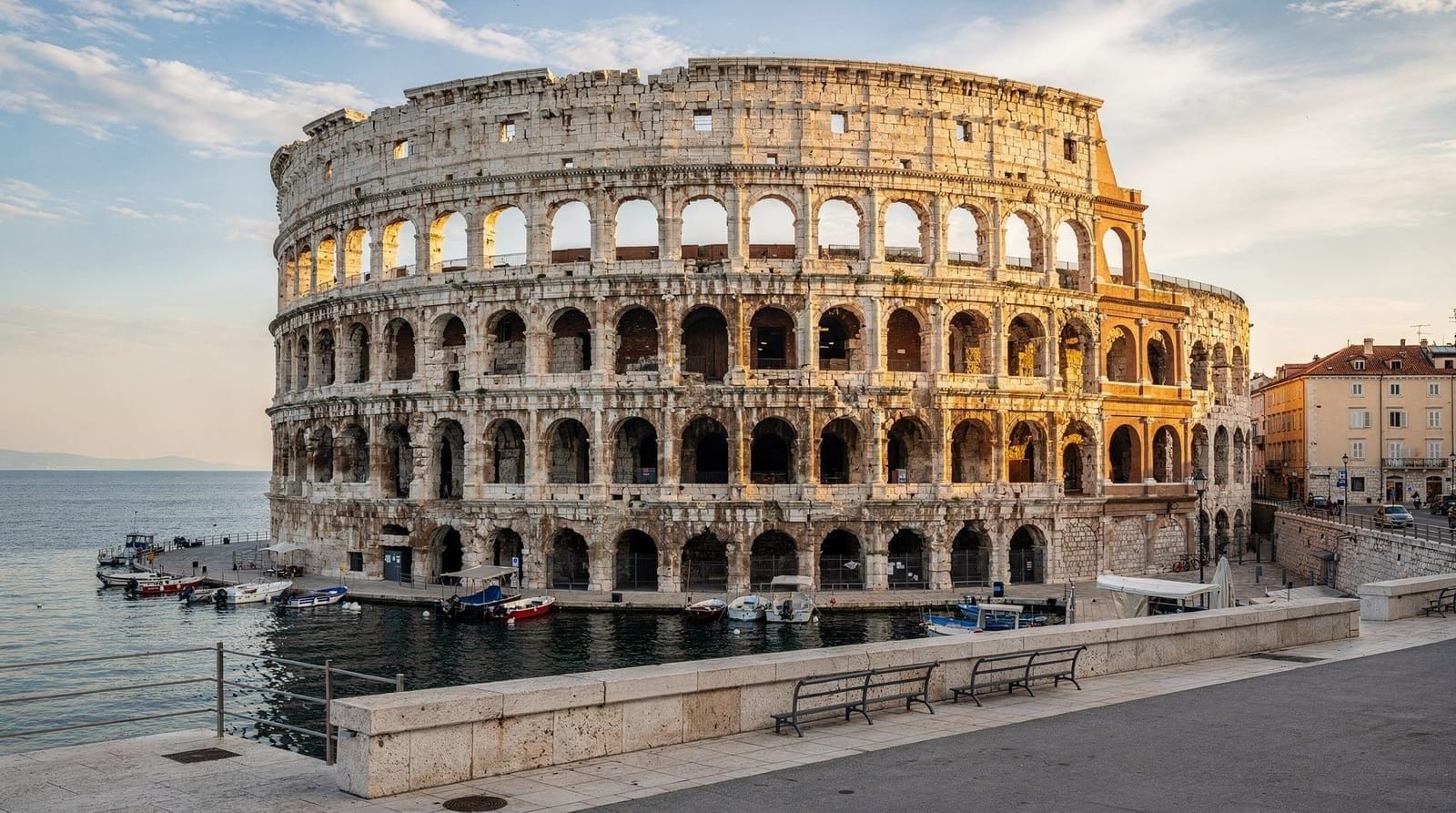
Pula is the largest city in Istria and the keeper of one of the best-preserved Roman amphitheatres in the world. The Arena — built in the 1st century AD, with a capacity of 20,000 — stands on the edge of the old town facing the sea, intact to the third storey of its outer wall. It is used for concerts today and free to walk around outside, or €10–15 to enter.
The rest of Pula’s Roman inheritance: the Triumphal Arch of the Sergii (1st century BC), the Temple of Augustus on the Forum (still standing after 2000 years and partially intact inside), the city walls, and the mosaic floor of a Roman villa. The old town itself is lived-in and not over-touristed — less precious than Dubrovnik or Split.
Beyond Roman Pula: The Kamenjak peninsula at the southern tip of Istria (20 km from Pula) has some of the clearest, most dramatic rocky coastline in Istria — protected nature park, no development, swimming from rocks and small coves. Worth a detour if you have a car. The Premantura village and Cape Kamenjak make a beautiful afternoon after the morning in Pula’s Roman core.
Getting there: By car, 40 km on mostly good roads. By local bus, Rovinj–Pula takes just over 1 hour and runs several times daily. The Pula bus station is about 1.5 km from the amphitheatre.
Venice — the most extraordinary Rovinj day trip
From Rovinj: 2.5–3 h by seasonal catamaran
Best for: one of the world’s great cities, a genuinely different day
A day in Venice from Rovinj is one of the more extraordinary things available to an Istrian traveller. Venezia Lines (and similar operators in season) runs high-speed catamarans from Rovinj (and Pula) across the Adriatic to Venice — a crossing of about 2.5 hours. Departures typically leave at 8 am; the return is in the late afternoon, arriving back in Rovinj by early evening.
You get approximately 6–7 hours in Venice. That is enough for: walking from Santa Lucia station or Piazzale Roma through the sestieri to St Mark’s Square (45 min walk, seeing the real Venice along the way), the Doge’s Palace, a gondola or vaporetto on the Grand Canal, lunch at a cicchetti bar away from the tourist circuit, and a quiet wander through Dorsoduro or Cannaregio before the return boat.
Cost: Return tickets are typically €80–120 per person. Expensive by Croatian day-trip standards but not by Italian travel standards — Venice entry fees and vaporetto passes add up anyway.
Season: The service runs approximately May to early October. Check current schedules before booking — departure times and operators change year to year. Book ahead in July–August.
What it is not: A relaxed meander. Venice deserves days, not hours. This is best treated as a teaser — or a second visit when you already know Venice and want specific things from your hours there.
Poreč — Euphrasian Basilica and coastal town
Distance from Rovinj: 30 km / 30–40 min by car
Best for: UNESCO Byzantine mosaics, old town walk
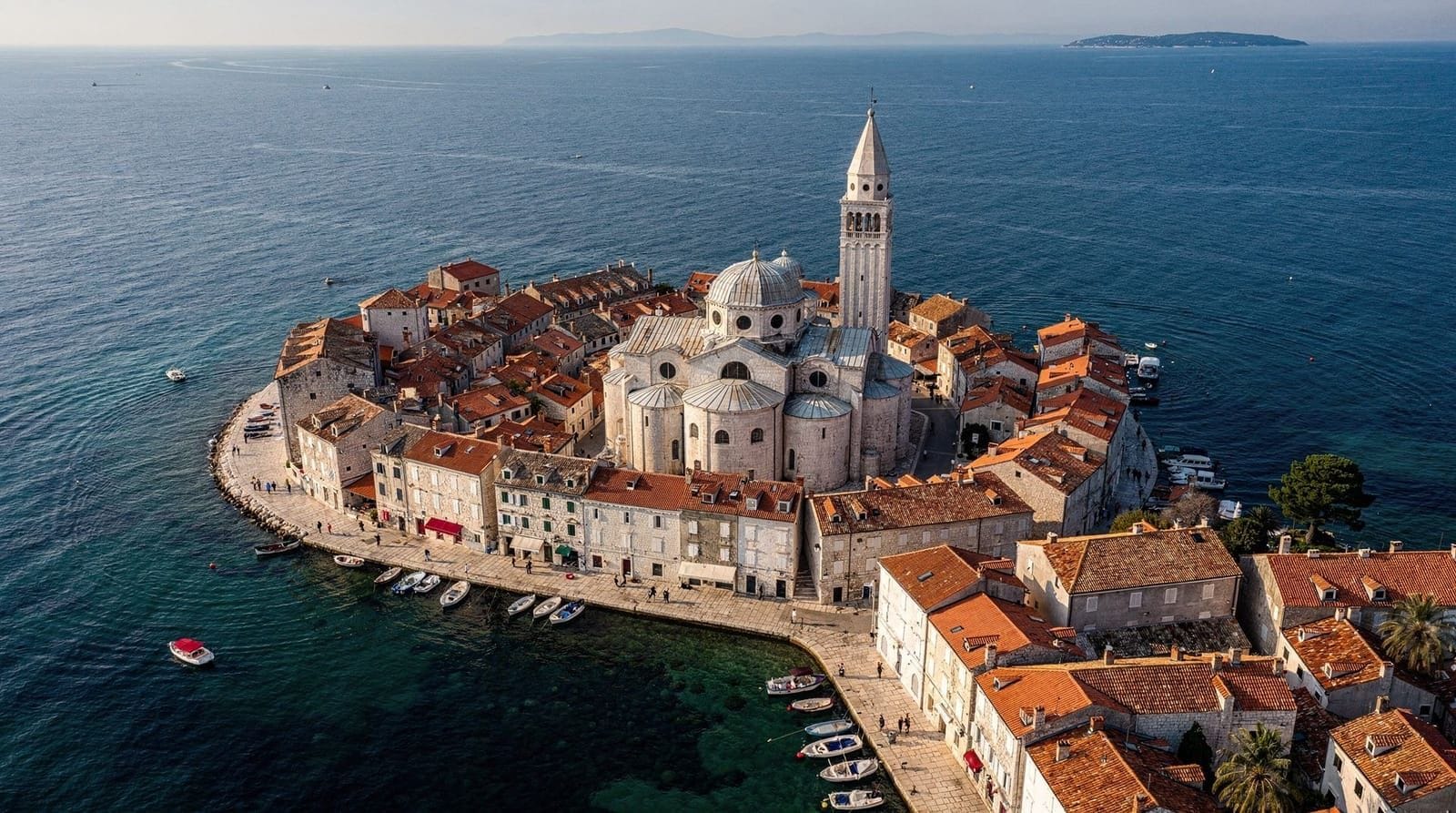
Poreč is a 30-minute drive north of Rovinj. The Euphrasian Basilica dates to the 6th century AD and is a UNESCO World Heritage Site: its golden apse mosaics rank among the finest Byzantine art surviving outside Ravenna and Constantinople. The complex — atrium, baptistery, bishop’s palace and the basilica itself — is compact and rewarding to explore in 1–2 hours.
The old town of Poreč (Parentium in Roman times) has a surviving grid of Roman streets, a Marafor square with temple fragments, and a pleasant waterfront promenade. Poreč is more resort-oriented than Rovinj — busier and less atmospheric in summer — but the basilica alone justifies the trip.
Buses from Rovinj to Poreč run multiple times daily (~45 min). By car, the drive takes 30 minutes and there is paid parking near the old town.
See Euphrasian Basilica Poreč for the full art history and visiting detail.
Lim Fjord — the fjord at Rovinj’s doorstep
Distance from Rovinj: 10–12 km south
Best for: dramatic scenery, oysters, boat trip
The Lim Fjord (Limska draga or Limski kanal) is a narrow marine inlet cutting 10 km inland through limestone cliffs covered in pine and oak. Technically a drowned river valley rather than a true fjord, but the effect is similar — steep green walls falling into calm deep water. Oysters and mussels are cultivated here; the restaurant at the fjord’s base serves them fresh with local wine.
Boat tours from Rovinj run to the Lim Fjord regularly, often combined with a short stop at a “pirate cave” in the cliffs. The viewpoint above the fjord (accessible by car, signposted from the road between Rovinj and Vrsar) is free and gives an excellent aerial perspective.
A Lim Fjord half-day combines naturally with a Rovinj city morning or afternoon. It is a gentle, scenic excursion — not dramatic in an adrenaline sense, but beautiful in a quiet, unhurried way.
Motovun and the Istrian hilltowns
Distance from Rovinj: 45–60 km / 50–70 min by car
Best for: medieval villages, truffle country, wine, views
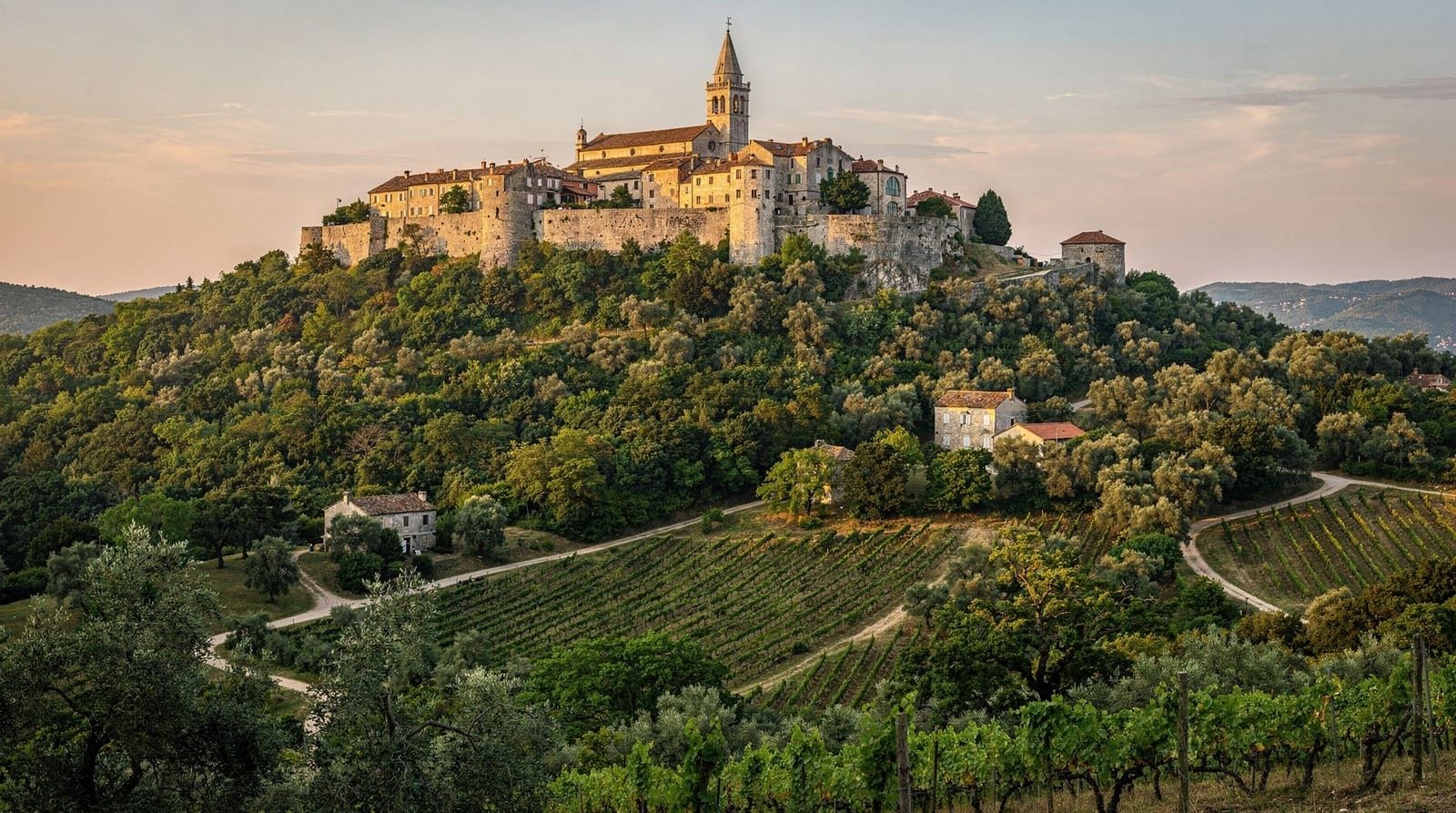
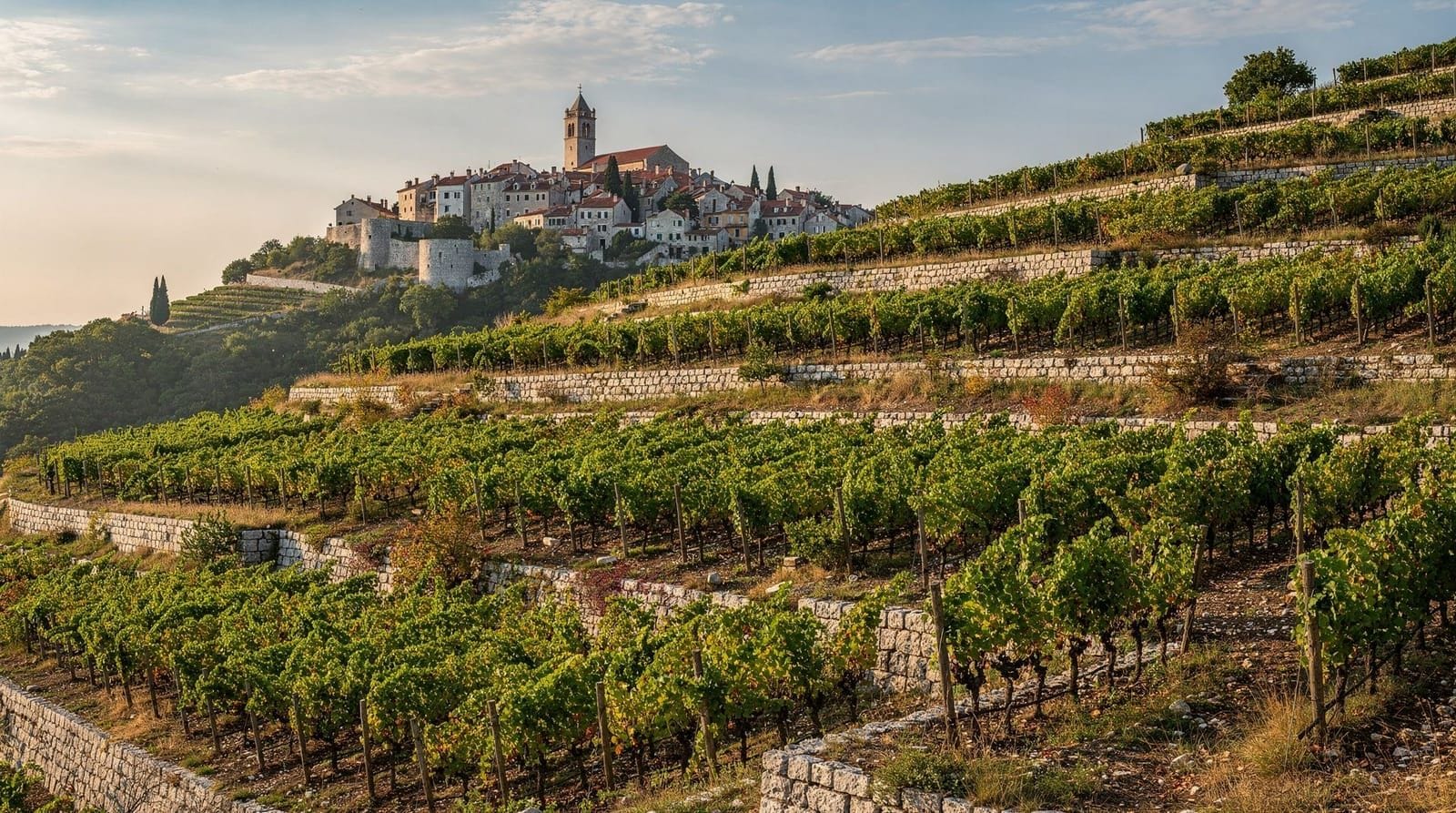
Motovun is the most visited Istrian hilltown — a medieval walled village rising 270 metres above the Mirna valley, with panoramic views across the surrounding truffle-forest landscape. The walk around the intact town walls takes 20 minutes; the old town inside is tiny (one main street) but genuinely medieval in atmosphere.
The drive from Rovinj to Motovun takes about 55 minutes inland via Pazin. From there, a good hilltown circuit adds:
Grožnjan: A hamlet turned artists’ colony — galleries, music events in summer, and one of Istria’s best preserved (and quietest) medieval town atmospheres.
Buzet: The “city of truffles” — a slightly larger town with good restaurants and a September Truffle Festival.
Oprtalj and Završje: Almost completely abandoned, ghost-town medieval settlements in remote valley positions — for the curious traveller who wants genuine remoteness.
A car is essential — no regular bus links these villages. The roads are narrow, winding and beautiful. Allow a full day for three stops plus a winery visit.
For the food angle: Istrian truffles guide and Istrian Malvazija wine.
Brijuni Islands — Tito’s island retreat
From Rovinj: Drive 30 min south to Fažana, then 15 min by boat
Best for: history, national park, unusual safari experience
The Brijuni (Brioni) Islands are a national park off the coast near Fažana, south of Pula. The main island, Veli Brijun, was the personal summer residence of Yugoslav leader Josip Broz Tito — a bizarre, fascinating slice of 20th-century history embedded in a beautiful national park.
Tito’s island received gifts from world leaders: animals that formed what became a safari park — zebras, ostriches and antelopes still roam freely on the island. The state villa, Tito’s private railway, Roman ruins from the 1st century AD, and a Byzantine fortress are all part of the same compressed landscape.
Visits are by official national park boat tour only, departing from Fažana. The tour is guided and covers the island by miniature train. From Rovinj, drive 30 minutes south to Fažana. See Brijuni National Park guide for full booking and visiting detail.
Practical Rovinj day-trip planning
Car hire: Strongly recommended for the Istrian interior — Motovun, Grožnjan, Buzet and Kamenjak are not reachable by public transport. For Pula and Poreč, local buses work fine.
Venice: Book the catamaran months in advance in July–August. The crossing can be cancelled in rough weather — check the operator’s cancellation policy.
Best season: June and September are ideal for Rovinj and all these day trips. July–August works but Poreč becomes heavily resort-crowded and Venice is at peak capacity.
Combine with sailing: Rovinj sits in a sheltered bay with Istria boat tours running regularly — the sailing day around the Rovinj islands and Lim Fjord is one of the nicer alternatives to a land day trip.
Building day trips into a longer Istria stay
Rovinj works well as a single base for four or five nights precisely because everything in this guide sits within an hour or two. If cycling is part of your plan, several of these routes overlap directly with our cycling Istria guide — the Motovun hilltown loop and the Lim Fjord viewpoint are both on established cycling routes as well as drivable ones. Travellers weighing up how much time to give Istria versus the rest of the coast should also read Istria vs Dalmatia before committing to a full week here. And if truffle season lines up with your visit, pair the Motovun hilltown day with the Istrian truffles guide for the best restaurants and shops along the route.
Frequently asked questions about Day Trips from Rovinj
How far is Pula from Rovinj?
About 40 km by road — roughly 45 minutes by car or a little over 1 hour by local bus. Pula is the obvious anchor day trip from Rovinj: a well-preserved Roman city with the most impressive Roman amphitheatre outside Italy, a triumphal arch, a Roman temple on the forum and a compact old town. A car gives more flexibility; buses run several times daily.Can I do a day trip from Rovinj to Venice?
Yes, in summer (approximately May–October). Venezia Lines and similar operators run a seasonal high-speed catamaran from Rovinj to Venice, with the crossing taking 2.5–3 hours. The day trip departs early morning and returns early evening, giving you around 6–7 hours in Venice. It is expensive (roughly €80–120 return) but genuinely exceptional as a day out — Venice from an Istrian base is a different experience than arriving by train or plane.What is Poreč and is it worth visiting from Rovinj?
Poreč is a coastal town 30 km north of Rovinj — about 30–40 minutes by car or bus. Its Euphrasian Basilica is a UNESCO World Heritage Site: a 6th-century Byzantine church with gold-mosaic apses that rival Ravenna. The old town behind it is genuinely attractive. Poreč is busier and more resort-like than Rovinj in summer, but the basilica alone justifies the trip for anyone interested in Byzantine art and history.What is Motovun and how do I visit from Rovinj?
Motovun is a medieval hilltown in the Mirna river valley in central Istria — about 50 km northeast of Rovinj, roughly 1 hour by car. It sits on a steep hill inside intact medieval walls, with panoramic views over the valley. Motovun is in the heart of Istria's black truffle region — the surrounding oak forests are some of the finest truffle habitat in Europe. No regular bus runs from Rovinj; you need a car or join an organised hilltown tour.What are the Brijuni Islands and can I visit them from Rovinj?
Brijuni (Brioni) is a small archipelago national park 2 km off the coast near Fažana, south of Rovinj. The main island was Tito's personal summer residence — today it is a national park with Roman ruins, a safari park (lions, zebras, elephants — gifts from world leaders to Tito), and a beautifully maintained natural landscape. Day trips run from Fažana by boat; the standard tour includes a small train tour of the island. From Rovinj, drive 30 minutes south to Fažana to join the tour.Is there a trip from Rovinj to the Lim Fjord?
Yes, and it is one of the most pleasant short excursions from Rovinj. The Lim Fjord (Limski kanal) is a drowned river valley — a fjord-like inlet 10 km south of Rovinj, cutting 10 km inland through forested limestone cliffs. It is used for oyster and mussel cultivation and has a small fishing village at its base. Boat tours from Rovinj run regularly; you can also drive to the viewpoint above the fjord for free.What Istrian hilltowns can I visit in a day from Rovinj?
Several, with a car: Motovun (truffle country, medieval walls), Grožnjan (a hilltop village turned artists' colony — peaceful, with galleries and a music festival in summer), Oprtalj and Završje are remote and nearly abandoned — ghost towns with panoramic views. Poreč and Novigrad are coastal alternatives to the inland hilltowns. A good loop covers 2–3 hilltowns plus a winery stop in about 6–7 hours.Which day trip from Rovinj should I prioritise if I only have one?
Pula, for most visitors — it is the shortest drive, needs no advance booking, and delivers one of the best-preserved Roman amphitheatres in the world. If your trip includes a full free day and budget allows, Venice is the once-in-a-while option that most other Croatian bases simply cannot offer. If you care about food and wine over sightseeing, spend the day inland around Motovun instead.Do I need to rent a car for day trips from Rovinj?
Not for Pula, Poreč or the boat trips to Venice, Lim Fjord and Brijuni, which are all reachable by bus or organised tour. A car becomes necessary for the Istrian hilltowns — Motovun, Grožnjan, Buzet, Oprtalj — since no regular public transport connects them. If your trip is mostly coastal, skip the rental; if you want the interior, budget a day for it.
Top experiences
Bookable activities with verified prices and instant confirmation on GetYourGuide.
Top experiences
Best-rated activities across GetYourGuide and Viator.

Mostar and Herzegovina Tour with Kravica Waterfall from Split & Trogir
- Viator

Mostar & Kravice waterfalls full-day guided tour from Split
- Viator

Mostar and Kravica Waterfall Discovery Day Trip from Split or Trogir
- Viator

Taste of Bosnia: Private Trebinje Gastro & Wine Tour
- Viator

From Split/Trogir: Mostar and Medjugorje Tour with Wine Tasting
- Viator

Split to Dubrovnik Private Transfer with Mostar Town
- Viator