The Best Places to Watch the Sunset in Croatia
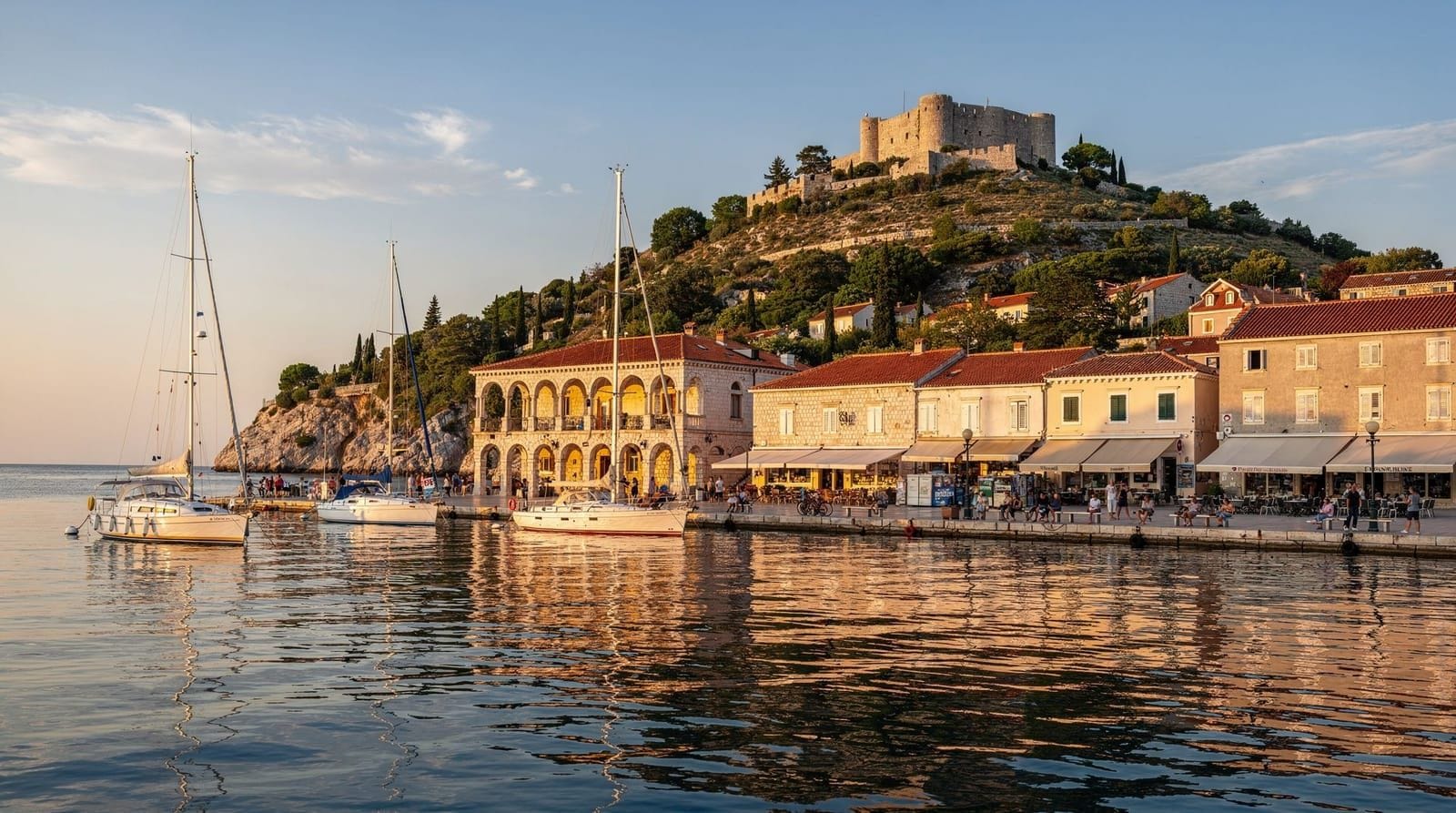
Croatia faces west across the Adriatic. This is a geographic fact with significant practical consequences: the sun sets over the water from almost any point on the coast. The quality of those sunsets depends less on direction than on the specific geometry of what’s in the frame — islands breaking the horizon, the colour of local stone, the altitude of your viewpoint, whether there are clouds to catch the light.
These are the places where that geometry works best.
| Best free viewpoint | Zadar waterfront, Sea Organ steps |
| Best paid viewpoint | Dubrovnik cable car, Srđ Hill |
| Best months | May–June and September for clear skies |
| Arrive by | 30–45 minutes before sunset at busy spots |
| Booking | Cable car online-ahead in July/August |
Zadar: The Architect Knew Something
Alfred Hitchcock called Zadar’s sunset the most beautiful he had ever seen. The quote is repeated so often in Croatian tourism material that it risks becoming meaningless — but he wasn’t wrong.
The combination of the waterfront setting, the open sea view, and the unusual quality of Adriatic light in this stretch of the coast produces an evening palette that’s hard to reproduce elsewhere. The Sun Salutation installation — a circular array of solar-powered LED panels embedded in the waterfront pavement, designed by Nikola Bašić — responds to the intensity of natural light, creating a slow light show as the sun falls. It’s one of the better pieces of public art in Croatia and functions best at exactly this hour.
The Sea Organ, built into the stone steps descending to the water nearby, produces continuous low harmonic sounds from the waves. Sitting on those steps in the last 45 minutes of light, listening to the organ and watching the sky change colour over the Kornati islands on the horizon, is one of the more genuinely peaceful things you can do on the Dalmatian coast.
Practical note: The waterfront walkway along Obala kralja Petra Krešimira IV is the right approach. Arrive by 7pm in summer to find a spot on the steps; the area fills up.
Dubrovnik: The Cable Car Advantage
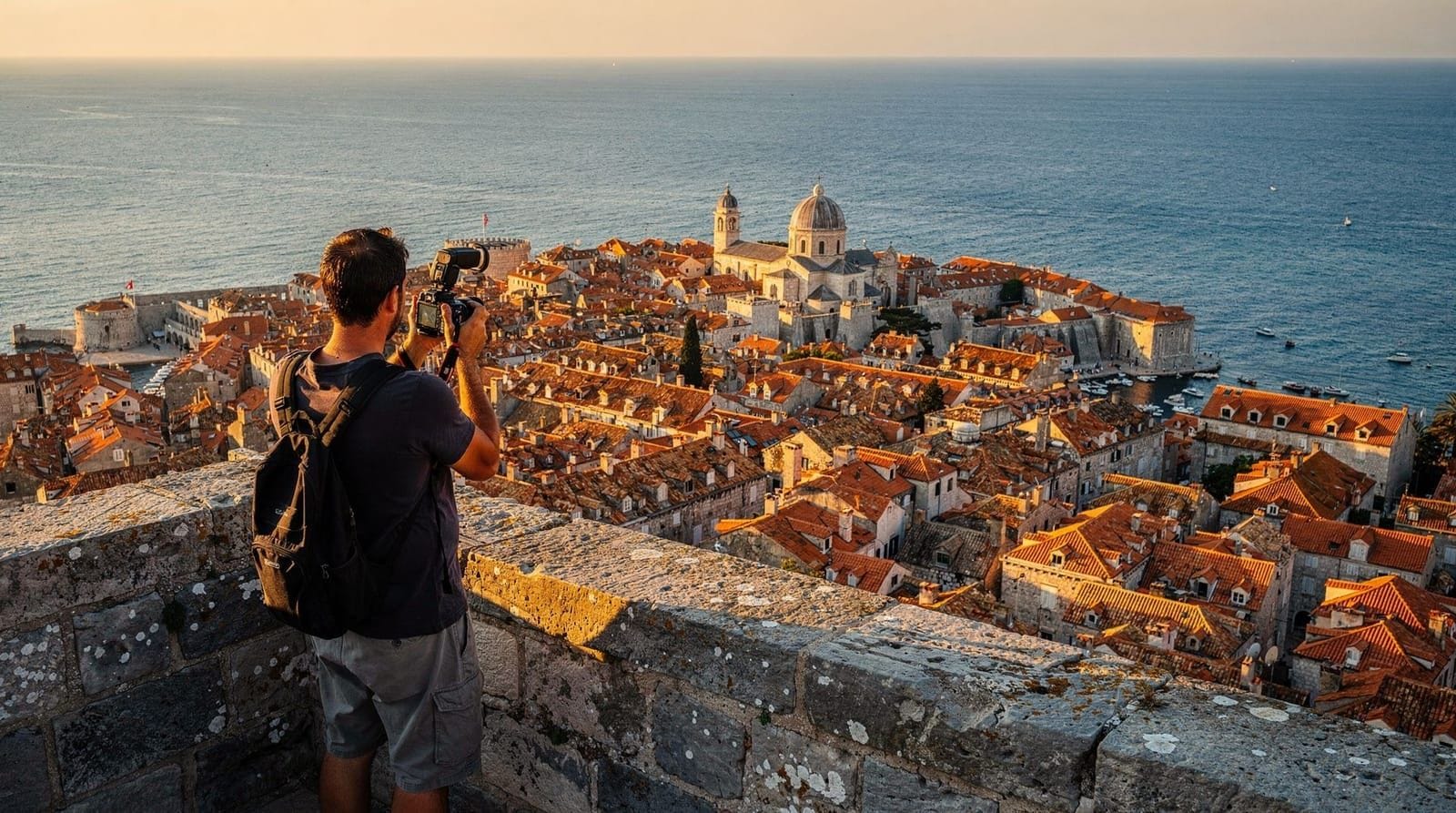
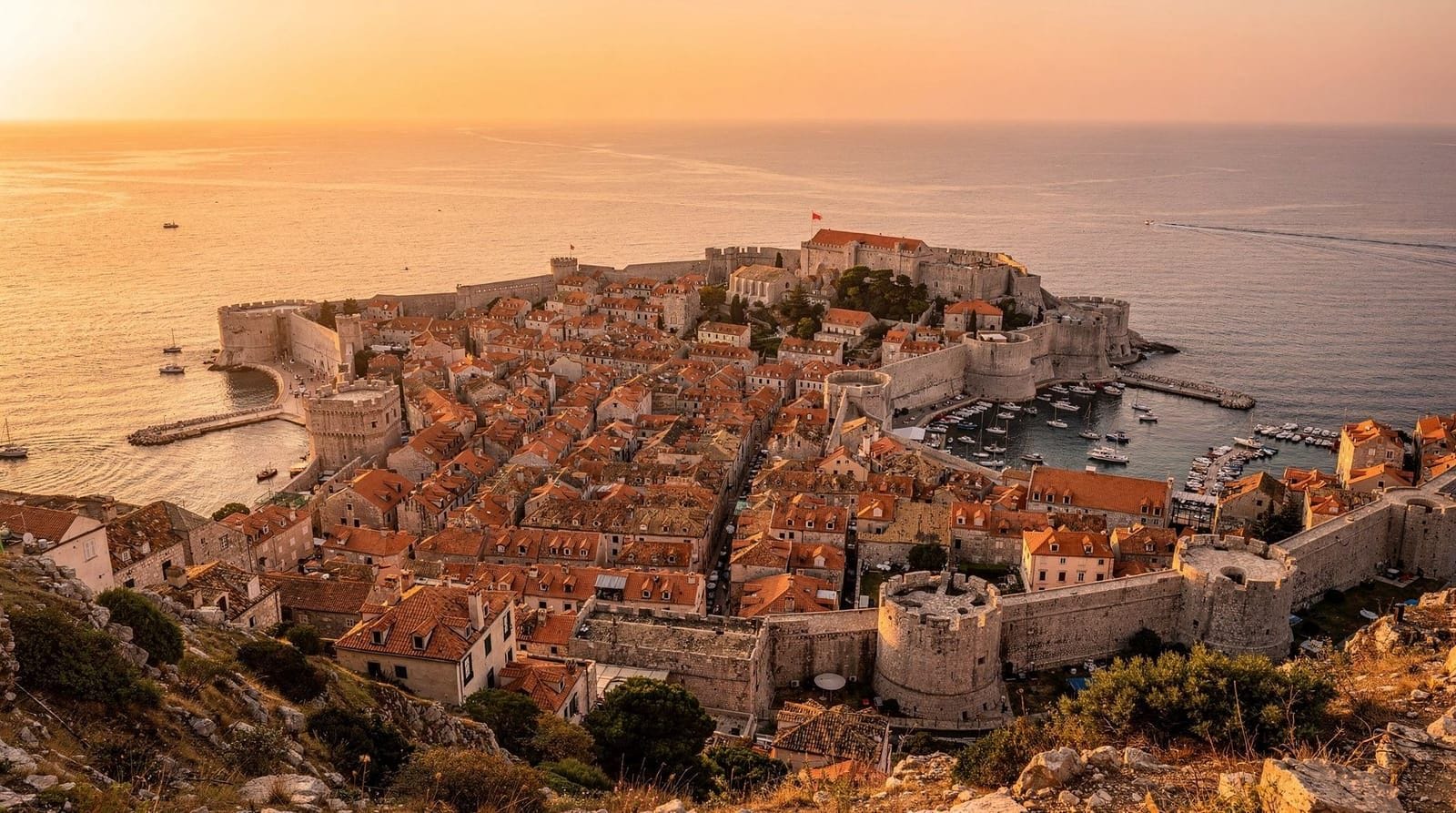
The problem with watching the sunset from inside Dubrovnik’s Old Town is that you’re at sea level, surrounded by walls. The light is beautiful on the limestone, but the view is enclosed. The cable car changes this entirely.
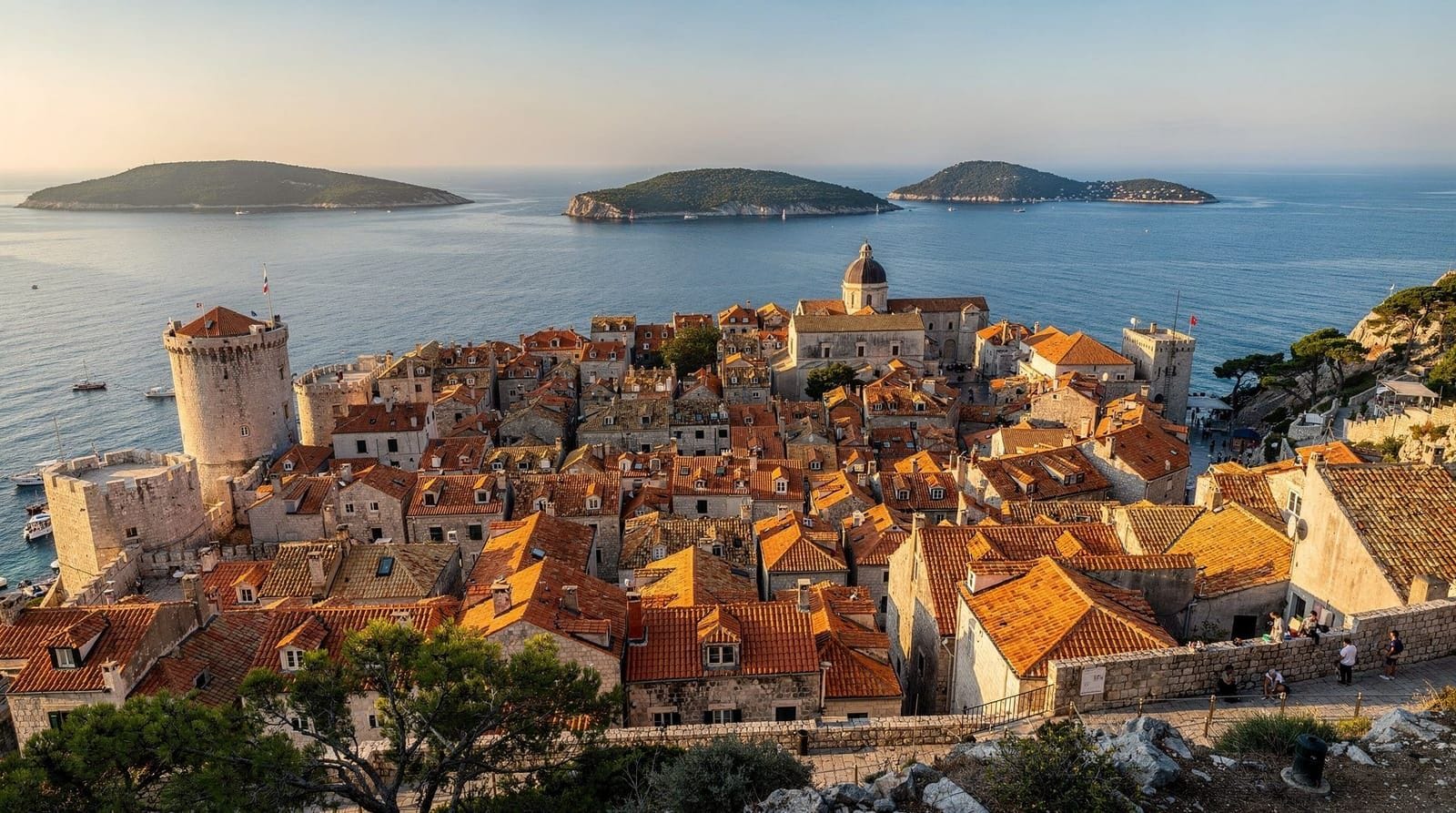
The Dubrovnik cable car climbs 405 metres to the summit of Srđ Hill, above and behind the Old Town. From the top, you see the entire Old Town laid out below — the terracotta rooftops, the walls, the harbour, the islands of Lokrum and the Elaphiti chain — with the Adriatic behind it all and the Herzegovinian mountains to the east catching the last light. It’s a perspective that the postcards approximate but don’t quite convey.
In summer, the last cable car runs late enough to stay for full dark (check the schedule for the current year). The restaurant at the top is predictably expensive; bring something to drink and claim a spot at the viewpoint wall.
The alternative for sunset on the city walls themselves is the southern stretch between the Bokar tower and the south maritime fortress — facing the open sea, with the late light catching the water. The walls close around 5:30–7pm depending on season, so check whether the closing time aligns with actual sunset for your travel dates.
Practical note: Book the cable car in advance online in July and August — the queue for walk-ups can be 45 minutes or more.
Hvar Town: The Fortress at the Top of the Hill
Hvar is the island most associated with a certain kind of Croatian summer: expensive cocktails, party boats, the Carpe Diem music program. But the view from the Spanish Fortress (Tvrdalj) above the town is one of the best sunset vantage points in Dalmatia and requires only a 15-minute uphill walk.
From the fortress walls, you look south and west over Hvar Town’s harbours, the Pakleni islands scattered in the water below, and the open Adriatic beyond. The Pakleni — a chain of small forested islands reachable by water taxi — become silhouettes as the light drops. The harbour below fills with yachts and the town’s white stone catches the orange and pink of the last hour.
The fortress itself (entry a few euros) has ramparts to walk and reliably good views from multiple angles. Come early enough to explore the fortress before the light gets low — the views from different sections of the wall vary significantly.
Primošten: The Church Peninsula
Primošten sits between Šibenik and Split — a small town on a round peninsula connected to the mainland by a short causeway. The old town occupies the entire peninsula with a church at the top. From the churchyard, the view sweeps over the archipelago of smaller islands and reefs that define this stretch of coast.
The particular appeal of Primošten is that it’s less visited than the major destinations. In June or September, you may watch the sunset from the churchyard with a handful of locals and other travellers who’ve stumbled upon it. The church itself — St George, white-walled, with a small bell tower — frames the view in a way that’s almost compositionally complete on its own.
Primošten is a 45-minute drive south of Šibenik or 45 minutes north of Split, making it an easy stop on the coastal route.
Vis Town: The Harbour in the Evening
The thing about Vis is that it was closed to outsiders for most of the 20th century, and the consequence is an island that feels like the Croatian coast used to feel before tourism discovered it. The town of Vis has a Renaissance loggia, an Austrian fortress, and a harbour where fishing boats still work. In the evening, the harbour fills with the smell of grilling fish from the waterfront konobas, the light turns the stone walls amber, and the boats rocking on the water complete the picture.
It’s not a dramatic sunset panorama in the cable car sense. It’s quieter — a working harbour doing what working harbours do at the end of the day, in the right light at the right hour.
Rovinj: The Istrian Harbour
In the north, Rovinj has its own sunset logic. The old town occupies a small peninsula with a baroque church at the summit. The western face of the old town — the side facing the open Adriatic — is made up of former palaces and fishermen’s houses that come in terracotta, ochre, yellow and faded red. When the evening light hits this facade from across the harbour, the colour intensity is remarkable.
The best vantage point is from the small jetty on the north side of the marina, looking back at the old town with the church at the top and the coloured facades catching the light. A slower option is to climb to the church itself (St Euphemia) and look west over the open sea and the offshore islands.
Omiš: The Canyon Mouth at Dusk
Omiš sits where the Cetina River gorge meets the Adriatic, 30 kilometres south of Split. The town itself is modest — a small settlement under a Mirabella fortress on a cliff above the river mouth. But the geography at dusk is specific and unusual: facing west from the beach or the clifftop, you see the sun descend over the open sea, while behind you the limestone walls of the Cetina canyon glow orange in the reflected light.
It’s not on the usual sunset itinerary because Omiš itself receives relatively few overnight visitors. But as a stop on the coastal road trip between Split and Makarska, the timing is right for catching the early evening light.
Korčula Town: Marco Polo’s Alleged Birthplace
The claim that Korčula is the birthplace of Marco Polo is historically contested, but the town itself is not. Korčula’s old town — a peninsula with a characteristic herringbone street layout — faces west across the Pelješac channel. The view from the town walls at sunset includes the Pelješac Peninsula darkening on one side, the open sea brightening on the other, and the silhouettes of other islands in the distance.
The town is quieter than Hvar; the sunset here is experienced from a terrace with local wine rather than from a rooftop bar with cocktails. Both have their place, but Korčula’s version is easier to enjoy without planning.
Sunset From the Water: The Boat Option
Every viewpoint above is on land, and land viewpoints share one limitation: you’re watching the sun set over the sea rather than being on it. A sunset boat cruise flips the geometry — the coastline, walls or islands become the backdrop instead of the vantage point, and the light hits the water directly around you rather than a distant horizon.
From Dubrovnik, the panoramic sunset cruise on a traditional karaka ship circles the old town walls as the light drops, giving a view of the fortifications from the sea that no land-based viewpoint can match. From Split, the Split sunset cruise covers the harbour and nearby islands with the Marjan peninsula silhouetted against the colour.
Boat sunsets have a practical advantage in peak summer too: no competing for space on a crowded viewpoint, and a breeze that makes the heat of the day bearable in a way a stone terrace does not.
The General Rule
Croatia’s sunsets follow a consistent logic. The best viewpoints have three things: elevation above sea level (to see the full horizon and the islands breaking it), an unobstructed western exposure, and enough distance from the main tourist crowd that you’re not watching someone else’s phone light up in front of you.
The cable car at Dubrovnik, the fortress above Hvar, and Primošten’s church peninsula all satisfy all three. Zadar’s waterfront satisfies the second and third but not the first — and makes up for the altitude in atmosphere.
The least predictable element is cloud cover. A cloudless Adriatic sunset in high summer can be beautiful but brief — the sun drops cleanly and the colour is gone in minutes. A partially cloudy evening in September, with high cirrus catching the post-sunset light and turning pink and purple above the horizon long after the sun has fallen, is the more memorable experience.
For photography notes and the practical details of golden hour in Dubrovnik, including the cable car logistics and the best wall section for light, see the dedicated guide. For a broader look at Croatia’s photo spots, including locations beyond the main tourist corridor, the guide covers both coastal and inland options.
The sunset is a good reason to stop. In Croatia, it’s also — consistently, reliably — worth the stop.