Croatian Ferry Schedules 2026: Jadrolinija, Krilo & Booking Tips
Croatia’s coastline is defined by its islands — 1,244 of them, though only about 50 are permanently inhabited. Getting between them means dealing with one of the Mediterranean’s most complex ferry networks. Understanding how it works, which operator to use, and when to book will save you hours of unnecessary stress.
This is a practical, up-to-date breakdown of Croatian ferry travel as it stands in 2026.
| Car ferries | Jadrolinija — the only option for vehicles |
| Foot-passenger fast option | Krilo, Kapetan Luka catamarans |
| Peak-season booking | Vehicle space 3–6 weeks ahead, seats 1–3 weeks ahead |
| Off-season | Reduced frequency, some catamaran routes suspended |
| Best value | Book direct on operator websites, not third-party aggregators |
Two Systems, Two Different Purposes
Croatian maritime transport splits into two distinct types, and confusing them is the most common mistake first-time travellers make.
Jadrolinija: The State Car Ferry Network
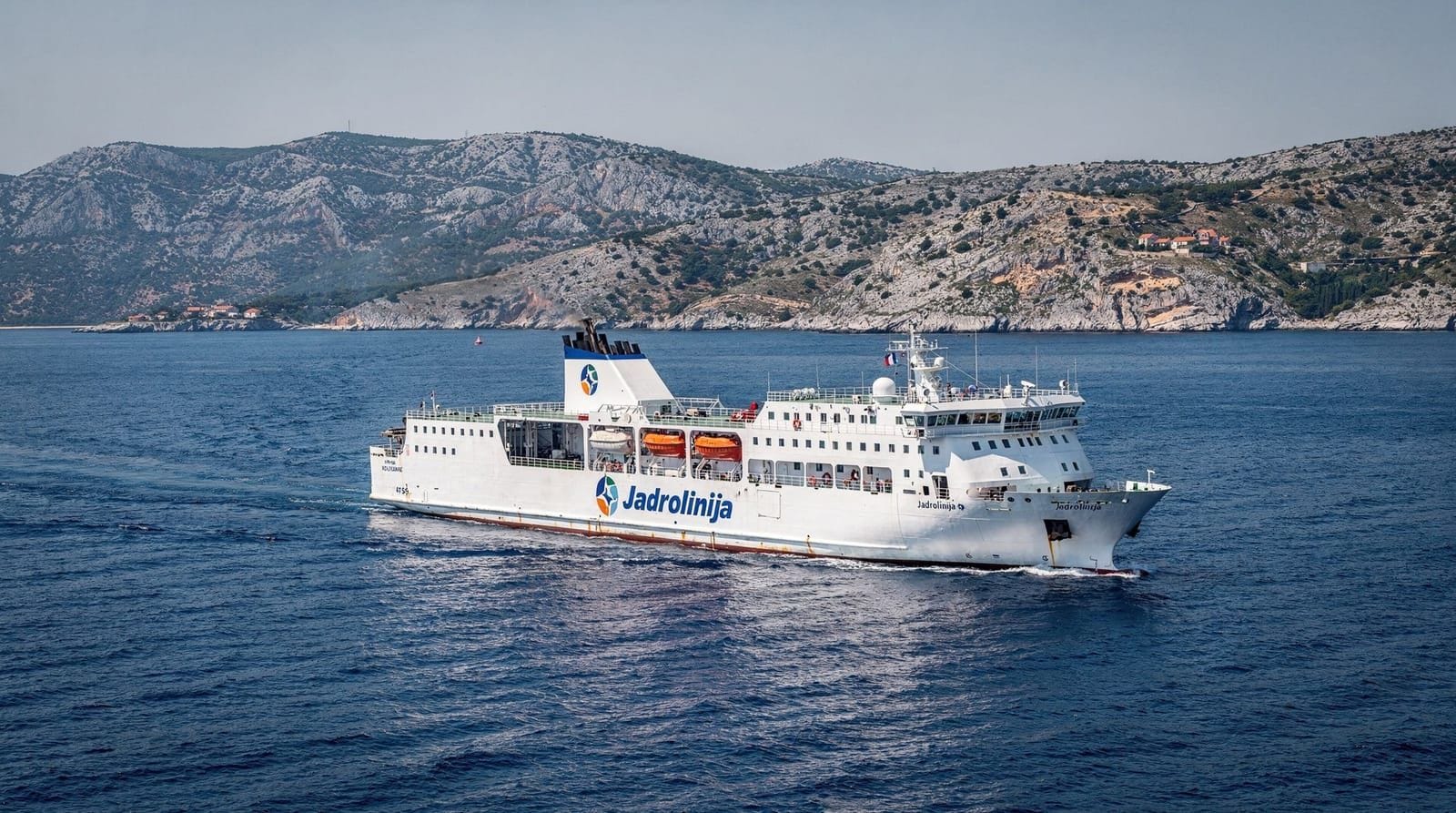
Jadrolinija is Croatia’s public ferry company, operating since 1947 and subsidised by the state as a public service. Its routes connect the mainland to inhabited islands that depend on ferry access for everyday life — delivering groceries, schoolchildren, postal services and cars.
Key characteristics:
- Carries cars and passenger vehicles. If you need your rental car or campervan on an island, Jadrolinija is the only option for most routes.
- Runs year-round, with reduced frequency in winter.
- Slower, typically 45 minutes to 3 hours depending on the route.
- Cheaper than fast catamarans for foot passengers; car transport adds significant cost.
- Book car space in advance during summer — foot passenger tickets are usually available at the port even on busy days, but vehicle space fills weeks ahead.
Major Jadrolinija car ferry routes from Split include: Split–Supetar (Brač, 50 min), Split–Stari Grad (Hvar, 2h), Split–Vis (2h 40min), Split–Korčula (3h 15min via Hvar). From Dubrovnik: Dubrovnik–Suđurađ (Šipan), with connections to the Elaphiti Islands.
Fast Catamarans: Krilo, Kapetan Luka and Others
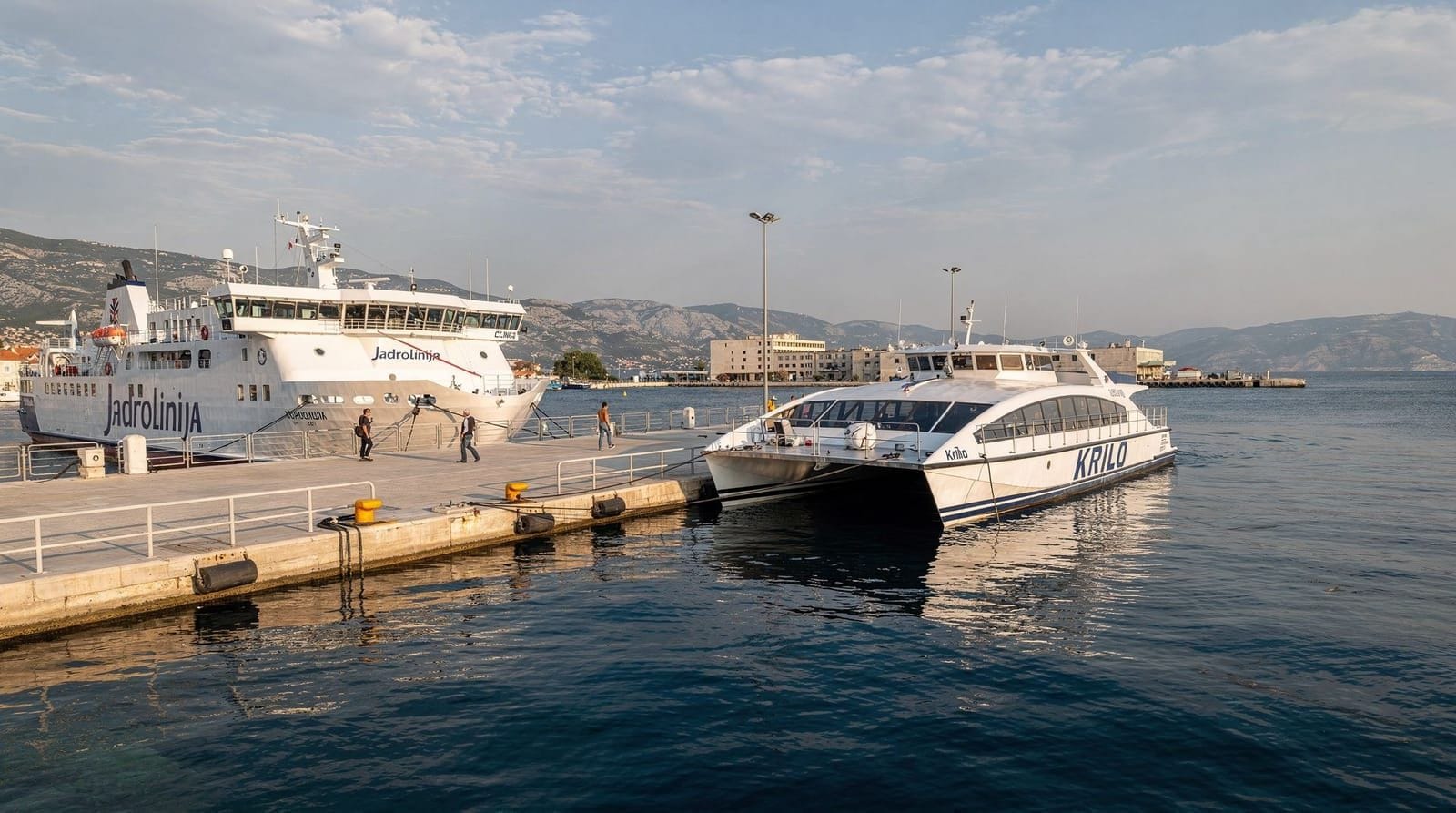
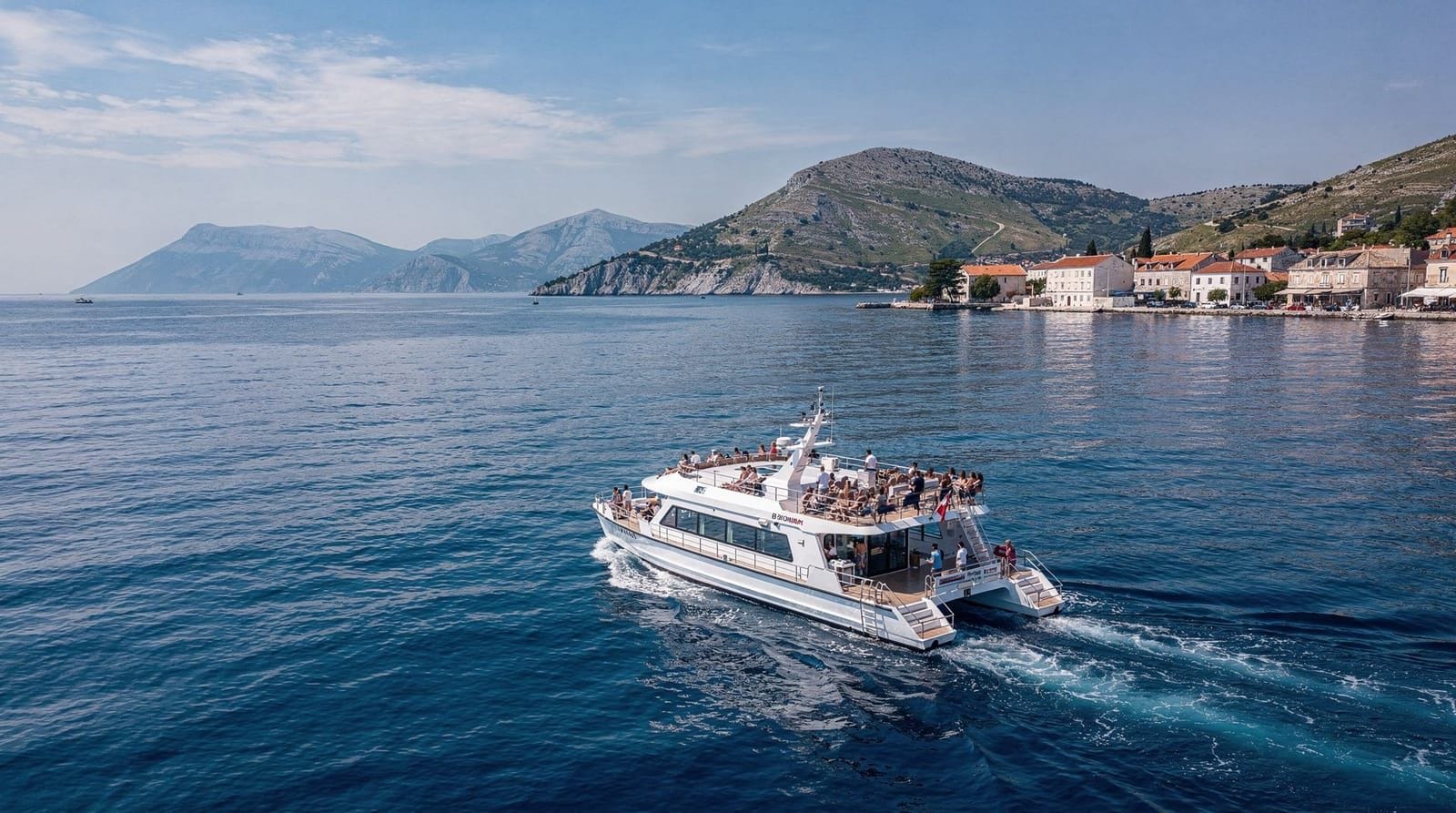
The fast catamaran network is fundamentally different. These are passenger-only, high-speed vessels — no cars, no motorcycles, no bicycles (officially, though some accept folded ones). They cover the same routes as Jadrolinija car ferries in roughly half the time.
Key operators:
- Krilo (operated by Miatrade): the most extensive private fast catamaran network, with Split as the main hub. Routes include Split–Hvar–Korčula–Dubrovnik and Split–Hvar–Vis.
- Kapetan Luka: operates Split–Brač–Hvar–Korčula and Split–Vis routes, among others.
- TP-Line: runs Makarska–Sumartin (Brač) and other shorter routes.
Fast catamarans are significantly more pleasant for foot passengers: air-conditioned interiors, assigned seats and a coffee bar. The journey from Split to Hvar by Krilo catamaran takes around 1 hour; by Jadrolinija car ferry, it’s 2 hours.
What Changed: 2025 Schedule Updates
The major structural shift in recent seasons has been an expansion of fast catamaran services alongside the legacy Jadrolinija network. Several routes have added departures, and the integration of booking platforms has improved significantly.
Practical changes that matter in 2026:
Online Booking Is Now Standard for Catamarans
Krilo and Kapetan Luka both offer full online booking via their websites, with seat selection and e-tickets. Book online as early as possible for peak summer travel — July and August departures, particularly on the Split–Hvar corridor, sell out days to weeks in advance. Walking up to the catamaran pier with no ticket in August is a gamble you will often lose.
Jadrolinija also offers online booking for car ferries, which is essential if you are transporting a vehicle in summer. Foot passenger tickets for Jadrolinija can generally still be purchased at the port, but this is not reliable for vehicle transport.
Season Lengths and Frequency
Croatian ferry schedules operate on a seasonal model:
- Winter schedule (roughly November–March): minimum frequency, sometimes just one or two daily departures on longer routes. Some catamaran services do not operate at all.
- Spring and autumn shoulder (April–May, October): increasing frequency, most routes operational.
- Summer peak (mid-June to mid-September): maximum frequency, additional departures added on popular routes.
The exact changeover dates shift each year, so always verify on the operator’s website rather than planning around last year’s schedule. A good rule: assume that anything you read about Croatian ferry schedules more than three months old may not reflect the current reality.
Route-by-Route Overview for Travellers
Split to Hvar
The most-used tourist corridor in Dalmatia. Two distinct endpoints matter:
- Split–Stari Grad (Jadrolinija, car ferry): the main route for vehicles; Stari Grad is on the quiet north side of Hvar island. 2 hours.
- Split–Hvar Town (Krilo/Kapetan Luka, catamaran): arrives directly in Hvar Town, the main tourist hub; no cars. Around 1 hour.
If you want to be in Hvar Town specifically and don’t have a car, take the fast catamaran. If you have a vehicle, take the Stari Grad car ferry and drive the 30 minutes to Hvar Town.
Split to Vis
Vis remains one of the most interesting islands in Dalmatia — further offshore than Brač or Hvar, historically restricted from tourism under Yugoslavia, and noticeably less crowded even now. The ferry takes 2h 40min by Jadrolinija; fast catamarans (Krilo) do it in around 2 hours. There are only a few daily departures in each direction even in peak season, so missing one can mean a significant wait.
A day trip from Split covering Vis, Hvar and the Blue Cave is a popular alternative for travellers who want to see multiple islands without managing their own ferry connections.
Split to Korčula
The main Jadrolinija service goes via Hvar and takes around 3 hours. Krilo operates a direct Split–Korčula–Dubrovnik catamaran (no cars). If you’re continuing south toward Dubrovnik, this route is very useful for consolidating legs of the journey.
Dubrovnik to the Elaphiti Islands
The Elaphiti Islands — Šipan, Lopud, Koločep — are clustered just northwest of Dubrovnik and accessible by Jadrolinija ferry from the Gruž harbour (not the Old Town; allow time to reach Gruž by bus or taxi from Old Town hotels).
Services are fairly frequent in summer, less so in winter. Day trips to the Elaphiti Islands are a popular excursion from Dubrovnik, and you can either self-navigate via Jadrolinija or join a guided boat tour.
A full-day Elaphiti Islands boat tour from Dubrovnik covers all three islands with swimming stops and is an easy alternative to planning the ferry connections yourself.
Split to Brač
The shortest and busiest crossing on the coast: Split–Supetar by Jadrolinija car ferry takes about 50 minutes and runs frequently, often hourly in summer. There’s no fast catamaran needed for most travellers on this route — the car ferry itself is quick enough, and Supetar is a short taxi or bus ride from Zlatni Rat beach at Bol. Because the crossing is so short and frequent, it’s the most forgiving route on this list if your original sailing is full — the next departure usually isn’t far behind, even on a busy August weekend.
Zadar to the Kornati Islands
The Kornati archipelago is not served by regular ferry in the same way as inhabited islands. Access is almost exclusively by organised boat tour or private charter — the islands have no permanent residents and no public transport. See the Kornati boat tour guide for options.
Booking Strategy by Season
April–June (Shoulder Season)
Most routes are operational and not yet fully booked. Foot passenger tickets can often be purchased on the day. Car spaces should be reserved 1–2 weeks ahead on busy routes. This is the best window for ferry travel without the summer stress.
July–August (Peak Season)
Book everything in advance:
- Car ferry vehicles: 3–6 weeks ahead for popular routes (Split–Stari Grad, Split–Vis).
- Fast catamaran seats: 1–3 weeks ahead for Split–Hvar, Hvar–Korčula, Split–Vis.
- Day-trip boats: at least 2–3 days ahead; more for popular Blue Cave and island combo tours.
Foot passenger spaces on Jadrolinija car ferries are harder to sell out than vehicle spaces, but on the busiest departures (Friday afternoons out of Split, Sunday afternoons back) they can fill too.
September–October (Shoulder Again)
Schedule begins to thin by mid-October. The fast catamarans start dropping frequencies after mid-September. But for most island routes, service remains adequate through October and is uncrowded. This is arguably the best time to travel by ferry in Croatia.
Practical Tips
Know which port you’re leaving from. Split has the main Jadrolinija terminal (across from the Old Town) and a separate catamaran pier. Dubrovnik ferries leave from Gruž harbour, 3 kilometres from the Old Town walls. Zadar’s ferry terminal is walkable from the old town peninsula. Always check the departure point, not just the city.
Arrive early in summer. Vehicle loading on Jadrolinija car ferries often starts 30–45 minutes before departure. Arrive late and you may be turned away even with a booking, particularly at Split.
Check the return. On smaller islands, there may be only two or three return sailings per day. Knowing your return time shapes your entire itinerary.
Weather cancellations happen. The Adriatic is generally calm in summer, but the bura (a cold northeasterly wind) can suspend catamaran services with little notice, particularly in spring and autumn. Jadrolinija car ferries are more weather-resistant but still affected by strong Jugo (southeasterly) winds. Build flexibility into your schedule if travelling in shoulder season.
The Pelješac Bridge changed some routing. The bridge opened in 2022 and now links mainland Dalmatia to the Pelješac Peninsula. If you’re driving between Dubrovnik and Split and were planning the old route through Neum (Bosnia), you no longer need to cross the border — take the bridge instead.
For a comprehensive look at island hopping strategy in Croatia, including sample itineraries by duration, see our full guide.
A Note on Ticket Platforms
Several third-party aggregators (Ferryscanner, Direct Ferries, Bookaway) list Croatian ferry routes. They are legitimate and sometimes useful for comparing options, but:
- They typically add a booking fee on top of the base ticket price.
- Buying directly from Jadrolinija.hr, Krilo.hr or kapetanluka.hr is cheaper and gives you the most reliable confirmation.
- Third-party platforms sometimes list routes that are seasonal or discontinued without clearly marking this.
For a complete breakdown of the Jadrolinija vs Krilo question including which to choose for specific journeys, see our dedicated Jadrolinija vs Krilo comparison guide.
Planning an island-focused itinerary? Our island hopping Croatia guide maps out how to combine ferries with accommodation, including the one-week Dalmatian circuit that most travellers find works best.