Split in a Day: A Complete One-Day Itinerary
| Start | 7:30am at the Pazar fish market |
| Finish | Sunset on the Riva, dinner in Varoš |
| Cost | Free walking + around 15–25 EUR for palace sights, more with a guided tour |
| Pace | Full, active day — comfortable shoes required |
| Best paired with | An overnight before or after, not squeezed between ferries |
Split is simultaneously Croatia’s best city and one of its most misunderstood destinations. Most visitors treat it as a ferry hub — a place to sleep before taking the boat to Hvar or Brač — and leave with the impression of a moderately pleasant coastal town. That’s a consequence of moving too fast.
The city deserves a full day at minimum. Diocletian’s Palace isn’t a ruin you look at from the outside; it’s a neighbourhood you walk through, eat breakfast in and buy vegetables at. The fish market behind the palace walls is one of the best in Dalmatia. Marjan Hill, five minutes by foot from the palace, has sea views that equal anything in the region. And the Riva — the broad marble waterfront promenade — is one of the better places in Croatia to sit in the evening and do nothing productive.
This itinerary works in a single day. Arriving the evening before and leaving the morning after is even better.
Context: Understanding Diocletian’s Palace
The most useful piece of background before arriving: the palace is not a monument in the usual sense. The Roman Emperor Diocletian built it as a retirement villa between 295 and 305 AD, occupying a 30,000 square metre peninsula on the Dalmatian coast. After his death, the palace gradually became inhabited — first by refugees after the collapse of the nearby city of Salona in the 7th century, then by a growing medieval town that built, rebuilt and repurposed the Roman structures until they were inseparable from the city around them.
The result is that the palace is fully lived-in. People’s apartments are built inside the Roman arches; restaurants occupy the old Roman cellars; the cathedral was converted from Diocletian’s mausoleum; the streets follow the original Roman grid. Nothing is reconstructed or museumified in the way that, say, a Roman site in France or England tends to be. This is what makes it exceptional.
7:30am — Morning at the Fish Market
The Pazar fish market operates outside the eastern (Silver) Gate of the palace, from early morning until stocks run out (usually by 11am). It’s the best market in Split and one of the most atmospheric in Dalmatia: crates of sea bream, dentex, red mullet and mackerel arranged in ice; shellfish vendors; older men arguing about fish prices in the Dalmatian dialect.
Walk through even if you’re not buying. The produce market adjacent to the fish stalls is equally good — summer tomatoes, figs, lavender, honey.
Breakfast in this area is cheap and excellent. The small cafes and buregdžinice (pastry shops) around the market sell burek (flaky pastry with cheese or meat), sandwiches and strong coffee. Eat here before the palace interiors fill up.
8:30am — Diocletian’s Palace: Peristyle and Cellars
Enter the palace through the Golden Gate (north), Silver Gate (east) or Bronze Gate (west, opening onto the harbour). The interior is dense and walkable — the main crossroads is the Peristyle, an elevated square in the palace’s southern half where the original Roman columns, sphinx and vestibule survive.
The Peristyle: The central gathering point of the old palace, now an open-air square surrounded by columns. The vestibule at the south end — a round domed space that once served as the ceremonial entrance to the Imperial quarters — still has its circular opening to the sky intact. Acoustically unusual; architecturally extraordinary.
The Cathedral of St Domnius: Built inside Diocletian’s octagonal mausoleum. The emperor was himself deified and interred here; centuries later, the building was converted into a Christian church dedicated to one of his martyrs. The campanile offers the best elevated view over the palace rooftops (tickets required). The treasury inside has medieval goldsmithing worth examining.
The Cellars (Substructure): The ground floor of the palace was built above a network of vaulted cellars that once supported the emperor’s private apartments above. These are now accessible for a fee and provide the clearest sense of the Roman structure’s scale. In Game of Thrones, the cellars were filmed as the dragon pits of Meereen — the connection is pointed out on every tour. For the full GoT trail in Croatia, see our Game of Thrones Croatia guide.
A small-group guided walking tour of Split’s Old Town covers the palace, cathedral, cellars and the connecting history in around 2 hours — more efficient than navigating the dense layers of history independently.
10:30am — Outside the Palace Walls: Narodni Trg and the Franciscan Monastery
The medieval town that grew up immediately outside the palace is equally interesting. Narodni Trg (People’s Square) is the medieval main square, just outside the Iron Gate. The 15th-century city hall on the north side is one of the better pieces of Gothic municipal architecture in Dalmatia.
The Franciscan Monastery, just inside the northern (Golden Gate) edge of the old town, has a small but well-organized treasury with medieval manuscripts and reliquaries. The cloister is peaceful and usually not crowded.
The Vestibül cafe, inside the palace’s domed vestibule space, is worth a coffee break purely for the setting — you’re sitting in the anteroom to a Roman emperor’s apartments, with an open sky circle above you.
12:00pm — Lunch
Two approaches:
Inside the palace walls: The restaurants in the cellars and basement arcades tend to be expensive relative to quality; the better value is in the first layer of streets immediately outside the palace to the north and east. Konoba Fetivi, Konoba Bili Brig and similar family-run restaurants in the Varoš (old fishermen’s quarter, west of the palace) offer traditional Dalmatian food at honest prices.
The Varoš quarter: The neighbourhood of narrow streets immediately west of the palace — stone houses, cats, drying laundry, small restaurants — is the most authentic neighbourhood adjacent to the tourist core. Worth walking through even if not eating.
1:30pm — Marjan Hill
Marjan is a forested peninsula immediately west of the old town, accessible by a 10-minute walk from the Riva. The hill’s summit offers one of the best coastal panoramas in Dalmatia: looking east back over Split and the palace, south over the Dalmatian islands (Brač closest, Hvar behind it, Vis in clear weather further), and west over the open sea.
The walking paths through Marjan’s pine forest are well maintained. The hill also has a small Ethnographic Museum, two old Romanesque chapels (Sv. Jere, Sv. Nikola), and several viewpoints accessible by road for those who don’t want to hike.
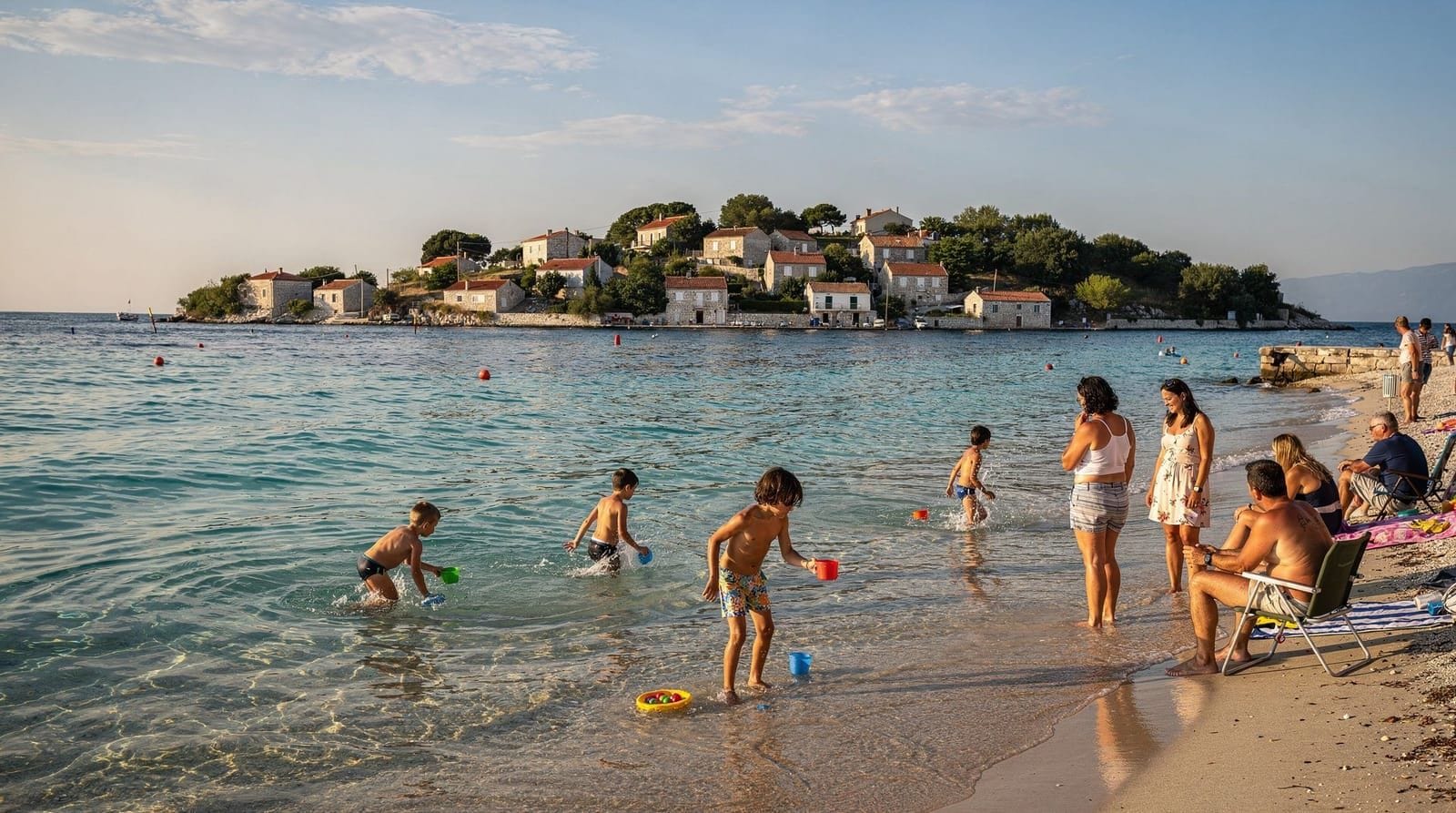
The descent on the western side of the hill leads to Bene cove — a rocky swimming area in a pine forest setting, one of the best in-city swimming spots in Croatia. In summer, it fills with locals and tourists; early morning or late afternoon it’s uncrowded.
Allow 2–3 hours for a full Marjan circuit including the summit viewpoints and a swim at Bene. For a quick version (just the viewpoint), an hour is sufficient.
4:00pm — Optional: Meštrović Gallery
Ivan Meštrović (1883–1962) is Croatia’s most significant sculptor and Split’s most famous cultural export. His former villa and studio on the western edge of the Marjan peninsula is now a museum housing the largest collection of his work in Croatia — monumental bronze figures, religious subjects and portraits.
It’s a 30-minute walk from the Marjan summit or a 15-minute walk from Bene. The building itself is part of the experience — Meštrović designed it as his home and workshop, and the integration of art and domestic space is as interesting as the individual pieces. Allow 1 hour.
6:00pm — Riva Waterfront and Early Dinner
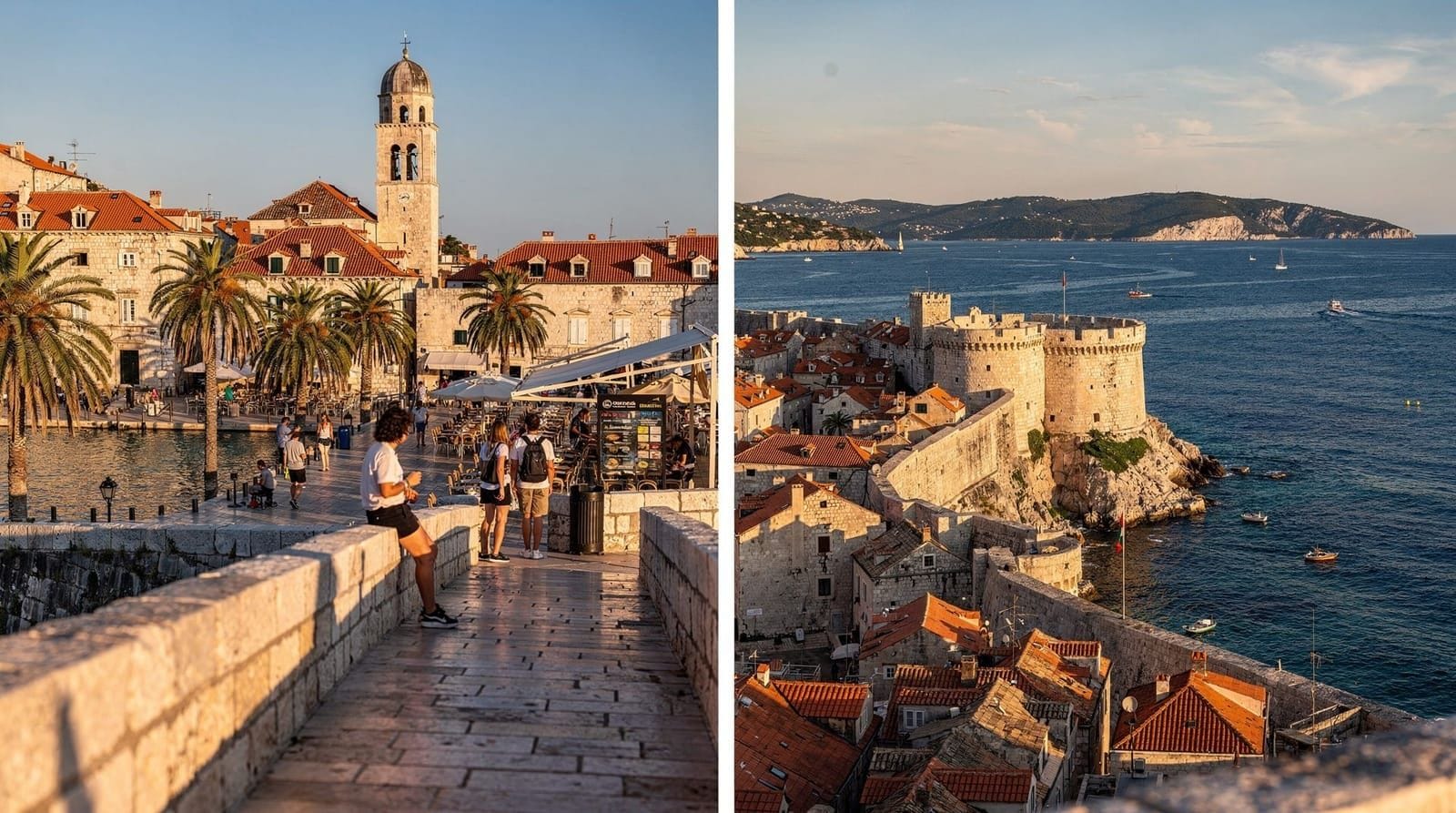
The Riva — the broad marble promenade between the palace’s Bronze Gate and the harbour — is where Split does its evening passeggiata. The palm trees, the cafes set up on the promenade, the view toward the islands, and the general social life of the city all converge here in the two hours before dinner.
Sit for a coffee or beer (the cafe chairs on the Riva face the water and the island views; prices are tourist-tier but the location is worth it once). Watch the ferries heading to Hvar, Brač and Vis. The Riva is at its best in the evening light.
Dinner in the old town or Varoš: the same rule as lunch applies — one street off the main tourist flow, prices are meaningfully lower and quality often higher. Fish and seafood from the morning’s market appear on evening menus; grilled brancin or orada with blitva and olive oil is the standard Dalmatian dinner and the thing to order. For context on how to navigate a traditional fish restaurant, our konoba guide explains the etiquette and what to expect on the bill.
If the Weather Turns
Split’s one-day plan above assumes reasonable weather, but the city has enough indoor options that rain doesn’t ruin the day — it just reorders it. The Cathedral of St Domnius, the palace cellars, and the Meštrović Gallery are all covered. The Ethnographic Museum inside the palace (small but well-curated, covering Dalmatian folk costume and coastal life) is a good wet-weather addition that most one-day visitors skip entirely in good weather. Swap the Marjan Hill circuit for a longer palace and museum block, and save Marjan for a clear morning if you’re staying a second day.
A Faster Version, If You’re Truly Pressed
Some visitors genuinely only have a half-day in Split — arriving on a morning flight and leaving on an afternoon ferry, for instance. In that case, compress to three stops: the Pazar fish market for a quick breakfast, the Peristyle and cathedral for the palace’s core, and the Riva for a coffee looking out at the islands before heading to the ferry terminal. This skips Marjan Hill and the Meštrović Gallery entirely, which is a real trade-off, but it captures the essential character of the city in under three hours. A guided walking tour is the most efficient way to do this compressed version well, since it removes the need to navigate the palace’s dense layout yourself.
What to Skip With Only One Day
The town of Trogir: Excellent, but 30 kilometres away and a separate commitment. Save it for a second day or as a stop en route to the airport.
A Plitvice Lakes day trip: Also excellent, but a 3-hour round trip in the car plus 4–5 hours at the park. It consumes an entire day and leaves Split itself unseen. If Plitvice is high on your list, allocate a separate day — see the Plitvice Lakes guide for the timing and ticket advice.
The boat tours: If you only have one day and want to actually see Split, resist the pull of the five-island tours and blue cave excursions. They’re genuinely good but they swap your full day for a boat trip. Do them on day two, or instead of the Split city day if the islands are the priority. The Blue Cave and 5 Islands tour from Split is the most popular option if you decide the islands take priority over the city.
For ferry connections: the main ferry terminal (Trajektna luka) is a 15-minute walk or 5-minute taxi from the Pile Gate entrance to the palace. Fast catamarans to Hvar Town leave from the Catamaran pier. If you’re departing to an island the morning after your Split day, check departure times the evening before and allow at least 30 minutes for the walk or transfer.
For everything Split offers beyond one day — where to stay, side trips, beach recommendations, and the islands reachable by day trip — see our Split destination guide and the day trips from Split guide.
The day at a glance
| Time | Stop | Duration |
|---|---|---|
| 7:30am | Pazar fish market + breakfast | 45 min |
| 8:30am | Diocletian’s Palace — Peristyle, Cathedral, Cellars | 2 hrs |
| 10:30am | Narodni Trg, Franciscan Monastery | 1 hr |
| 12:00pm | Lunch in Varoš | 1–1.5 hrs |
| 1:30pm | Marjan Hill circuit + Bene cove swim | 2–3 hrs |
| 4:00pm | Meštrović Gallery (optional) | 1 hr |
| 6:00pm | Riva waterfront, sunset, dinner | Open-ended |