Croatia in Photos: the landscapes, towns and light that make it worth the trip
There is no single Croatia in photographs. The country changes dramatically across roughly 600 kilometres of coastline and a considerable interior, and each region has its own visual logic: the baroque bell towers of Dalmatia, the Venetian watercolour facades of Istria, the karst limestone that turns white in full sun and silver in cloud, the deep greens of Plitvice where the forest meets the water.
This is a guide to understanding those different visual registers — what makes each place worth photographing, when the light works, and what the photographs you see in travel magazines are not quite showing you.
| Best light | First and last two hours of daylight, most locations |
| Best months | May, June, September for balance of light and crowds |
| Essential gear | Wide lens for old towns, polariser for water, telephoto for coastal panoramas |
| Toughest crowds | Dubrovnik walls and Plitvice boardwalks, 9am–6pm in July/August |
| Drone use | Restricted near old towns and national parks — check locally before flying |
Dubrovnik: city walls and the problem of the crowds
Every photograph of Dubrovnik’s old town faces the same compositional problem: the city is genuinely beautiful and also genuinely busy, and the crowds are visible in any photograph taken between 9am and 6pm in summer. The solutions are not secrets — early morning and evening — but they require actual effort.
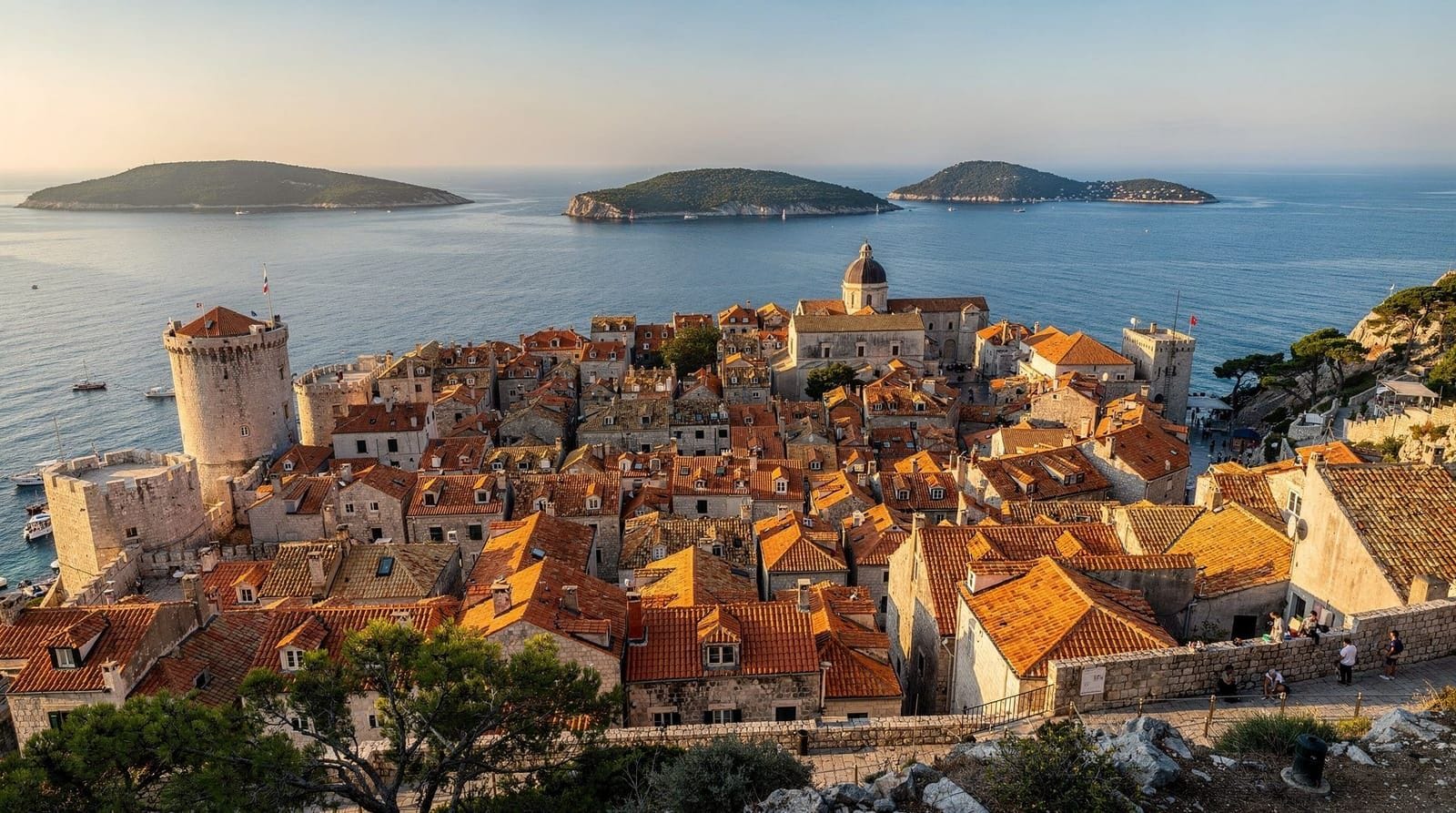
The view from Mount Srđ above the city, reached by cable car, gives the full panorama: the terracotta roofscape, the walls, the green Adriatic beyond, Lokrum island in the middle distance. This is the canonical Dubrovnik photograph and it earns its status. The cable car runs early and the morning light from the eastern side is dramatically better than afternoon haze.
The interior of the old town rewards close attention more than wide shots. The Stradun, the main limestone promenade, is mirror-polished from centuries of foot traffic and reflects light in ways that make it interesting throughout the day. The narrower alleyways — particularly those climbing the northern slope toward the walls — have the vertical layering of steps, arched passages and laundry lines that characterise the city’s actual daily texture rather than its tourist face.
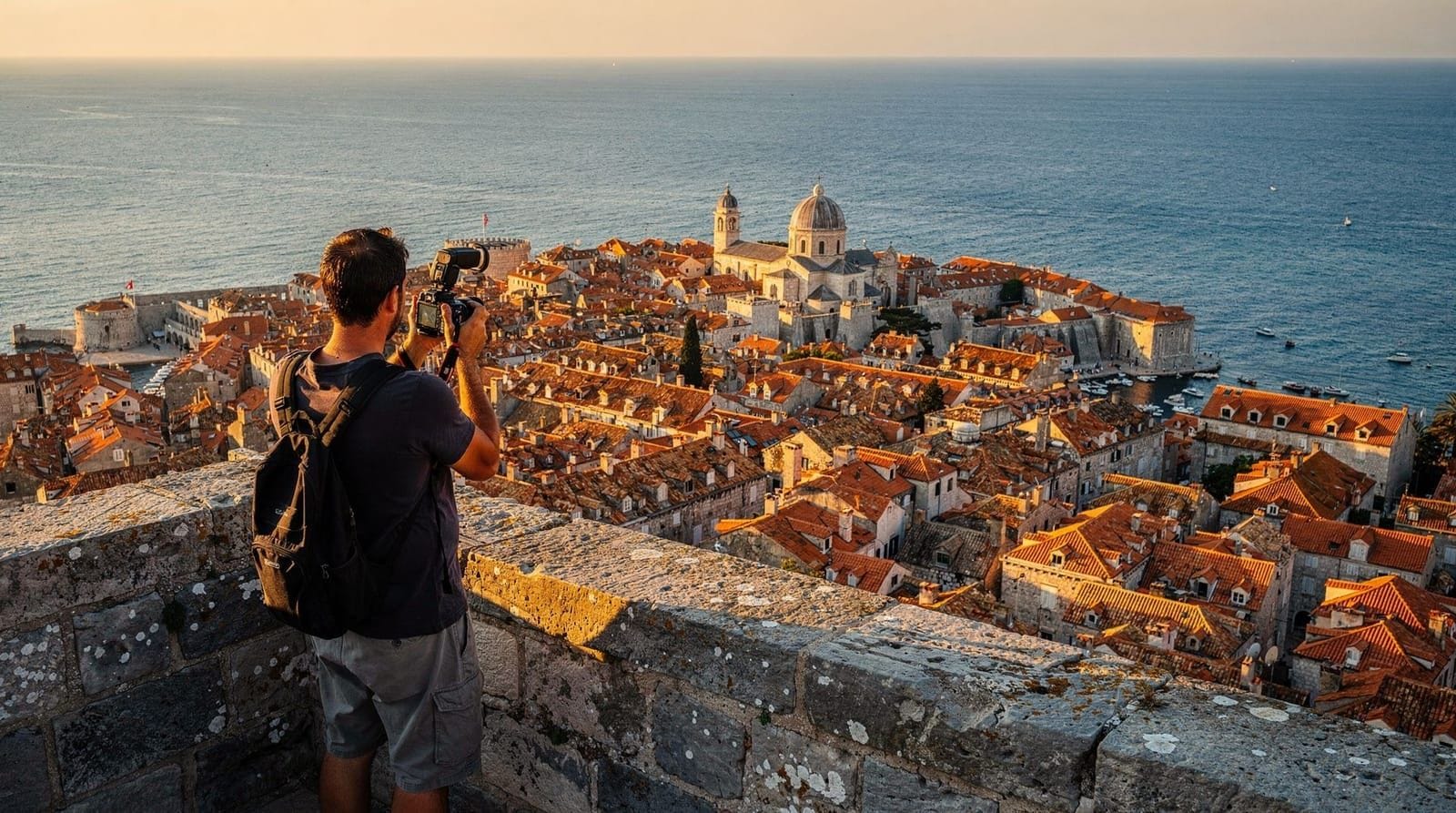
The city walls circuit at opening time is worth the early alarm. The walls at dusk, if you are staying overnight and can access the circuit in the late afternoon, produce an entirely different quality of light — warm, raking, turning the limestone amber.
Plitvice Lakes: the morning requirement
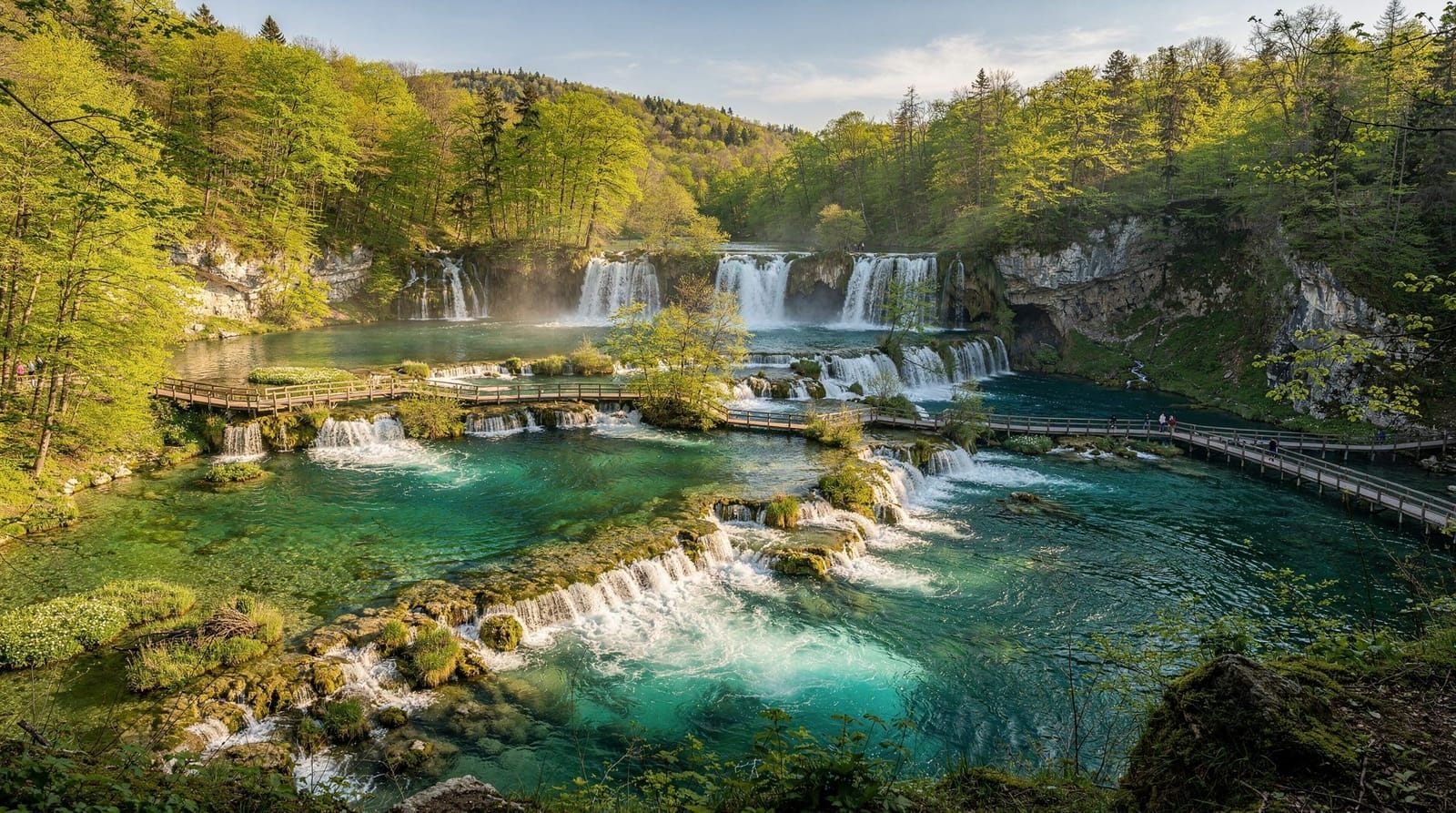
Plitvice is Croatia’s most photographed natural site and one of the most striking UNESCO landscapes in Europe. Sixteen terraced lakes connected by waterfalls cascade through a forested canyon; the water colour — shifting from green to turquoise to blue depending on mineral content, depth and sky — is genuinely unlike anything most people have seen before.
The photograph that appears on every Plitvice promotional image is taken from the wooden boardwalks at the water level, looking along a cascade toward the forest. It is a real view and not particularly embellished. What the promotional images do not show is that in July and August, those same boardwalks have a constant flow of people that is nearly impossible to exclude from any photograph.
The solution — again — is time of entry. The park opens at 7am; arriving at opening in June or September allows an hour on the lower lakes before the tour buses arrive. The light is also better: flat morning light through the forest canopy is softer than harsh midday sun.
The upper lakes are less visited than the lower lakes and have a quieter, more intimate character. The view across Prošćansko jezero from the upper end of the park, with the forest reflecting in still water, is not in most Plitvice brochures and is among the best landscape photographs in Croatia.
Rovinj: the hour before sunset
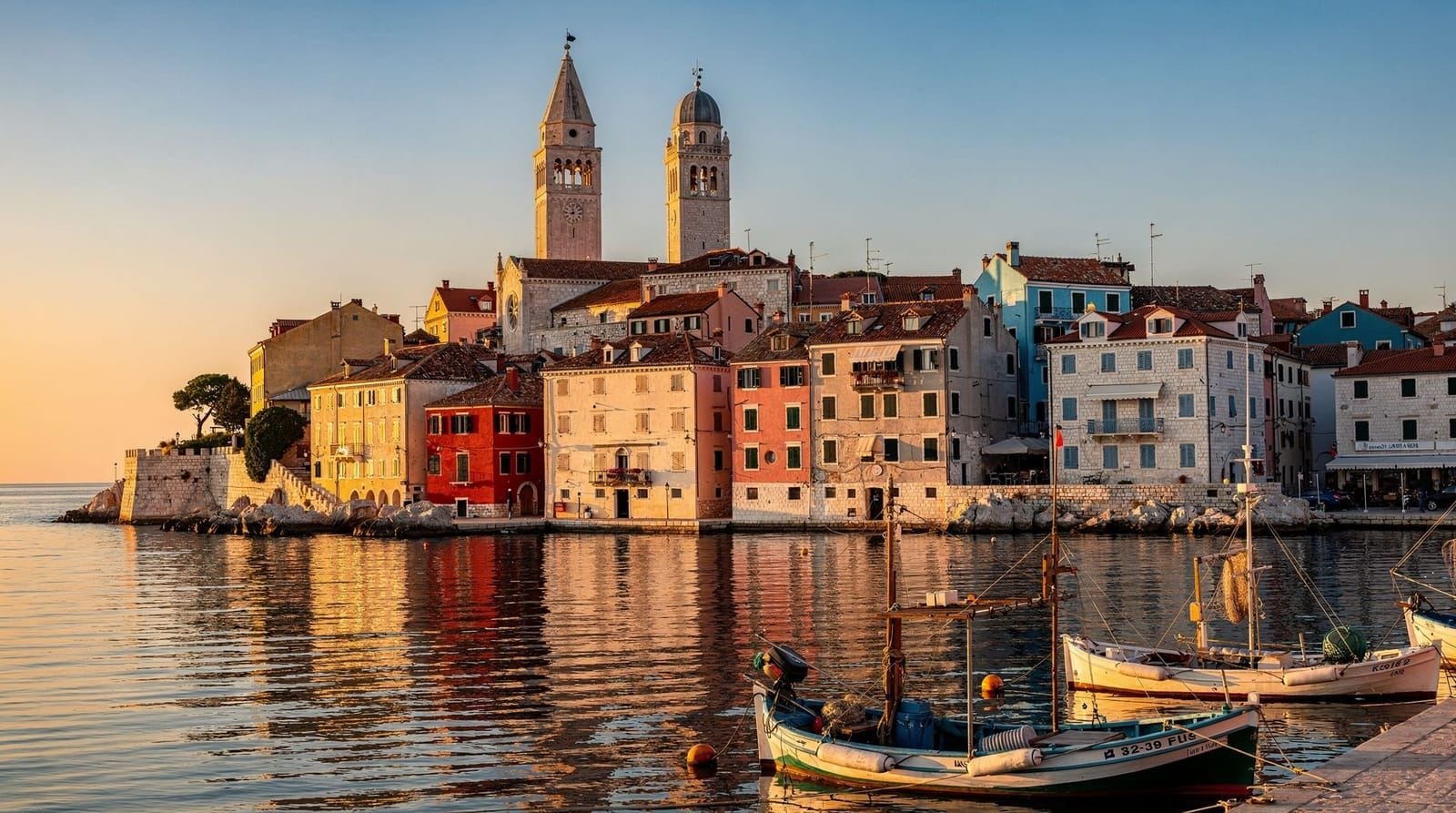
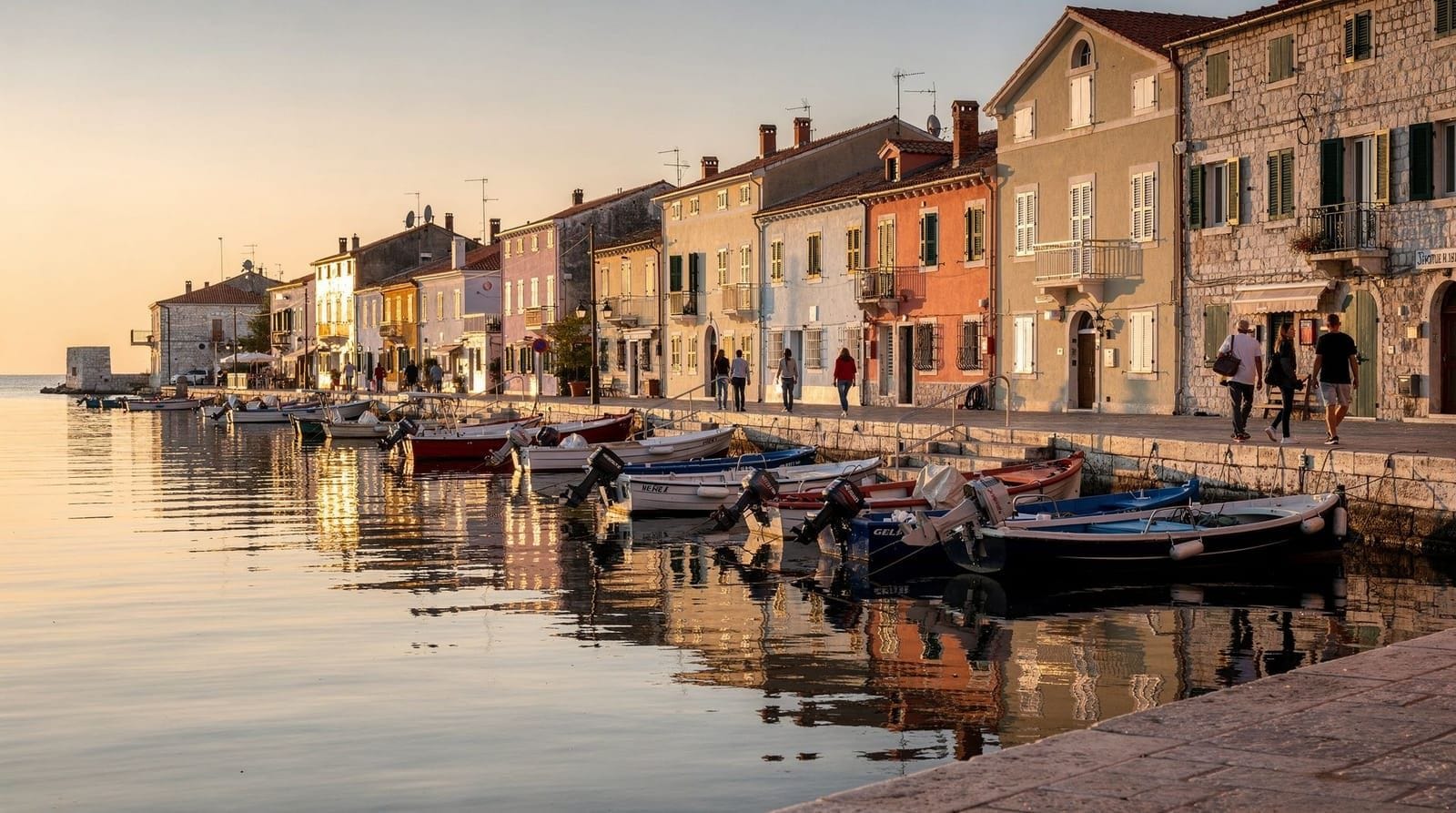
Rovinj was built for photography without knowing it. The coloured house facades — accumulated over centuries of Venetian-era construction — face west across the harbour, which means they catch afternoon and evening light directly. The view from the water, looking east toward the bell tower of Saint Euphemia rising above the cluster of rooftops, is the defining image of Istrian Croatia.
The best position for this photograph is from a boat in the harbour or from the breakwater to the south. The light from about two hours before sunset until just after is optimal; the facades turn from their daytime pastel into deeper ochre, rust and amber as the sun descends. The reflection in the calm harbour water doubles the effect.
The old town itself — the steep lanes climbing to the church — is best explored on foot. The light inside the narrow streets is unpredictable and requires willingness to work with dappled shade rather than clean exposures. Some of the best shots in Rovinj are details: an iron knocker on an ochre door, a washing line against a terracotta wall, fishing nets hung to dry on a stone balustrade.
Kornati: limestone at the edge of the possible
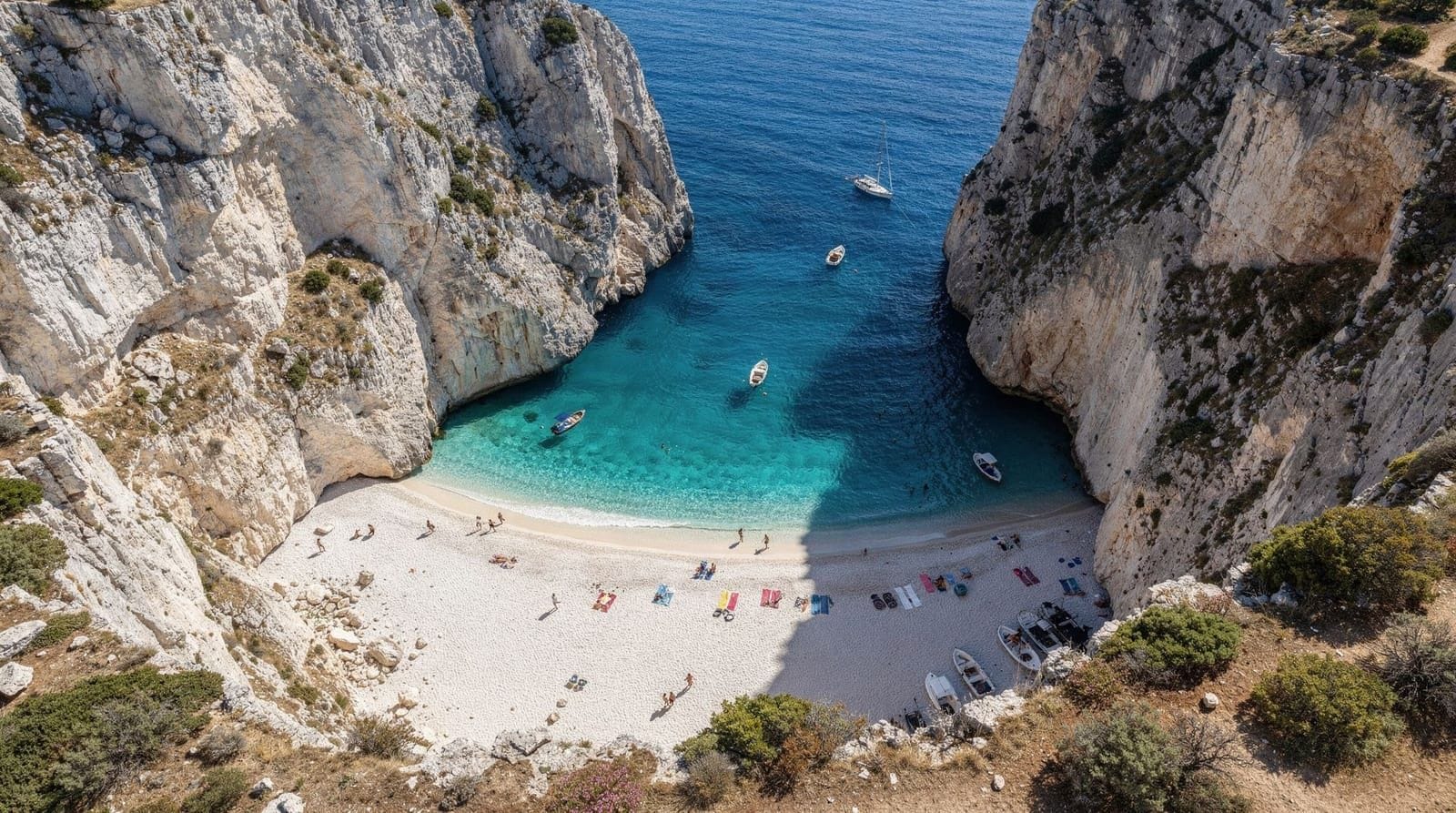
The Kornati archipelago — a national park of 89 islands and reefs about 35 kilometres offshore from Zadar — is one of the most photogenic landscapes in the Mediterranean. The islands are almost entirely bare limestone, swept clean by the bura wind, rising in white serrated ridges from the dark blue Adriatic. There is no fresh water, no permanent population and minimal vegetation.
Photographs of Kornati from the air are frequently mistaken for the Greek Cyclades or the Turkish coast. At water level, from a boat moving through the channels between islands, the scale becomes clearer: the cliffs rise 70 to 100 metres from the sea and the silence is complete.
The Kornati boat tour from Zadar or trip from Zadar to Kornati covers the main park area in a day. The light is best in the early morning and late afternoon when the white limestone catches a warm angle; midday sun bleaches the stone into a flat, overexposed white.
Pag: the austere interior
Pag is the visual inversion of the Croatian cliché. Where most of Dalmatia is green-blue-terracotta, Pag is white, bare and horizontal: the karst plateau stripped of soil by the bura wind and the saltpan economy, the limestone scraped to mineral whiteness. Stone walls divide fields without crops; the land looks bleached.
The saltpans near Pag town, working since the 14th century, are pink in summer when salt-tolerant algae colour the water. The geometric regularity of the pans against the white island backdrop is a genuinely unusual photograph. The old town of Pag, with its 15th-century grid plan and Renaissance church, is small enough to photograph completely in a morning.
Hvar and Korčula: island stone in the afternoon
Hvar photographs best from above. The Spanish Fortress overlooking the harbour gives the classic composition — white stone town, terracotta roofs, the Pakleni islands scattered in the blue water below — and the walk up takes only fifteen minutes. Late afternoon, when the fortress walls themselves pick up warm colour and the harbour below fills with anchored boats, is the strongest window. A short Hvar wine-tasting tour in the island’s interior is also a reliable way to reach the terraced vineyards and stone walls that rarely make it into standard harbour shots.
Korčula’s old town has a distinctive herringbone street plan designed to block the wind and diffuse direct sun — the effect is a town that photographs with unusually even, soft light even at midday, unlike the harsher contrast typical of Dalmatian streets. The cathedral bell tower, climbable for a fee, gives the clearest overview of the layout and the Pelješac channel beyond.
Zadar and Split: cities that work after dark
Both Zadar and Split reward staying past sunset rather than packing up with the light. Zadar’s Sea Organ and Sun Salutation installation are built for evening use — the LED patterns only read clearly once the sky has gone dark, and the waterfront crowd thins enough by 9pm to get a clean composition. In Split, Diocletian’s Palace lit from within after dark — the Peristyle square, the cellars, the narrow lanes with washing lines strung overhead — has a completely different texture from its daytime tourist-brochure version, closer to how the neighbourhood actually lives.
The Dalmatian light: what makes it different
Croatia’s coastal light has a quality that is frequently noted by photographers and rarely precisely explained. Part of it is the reflection off the Adriatic’s relatively shallow, clear coastal waters. Part is the white limestone that surrounds almost every Dalmatian town, acting as a natural diffuser and bouncing light into shadows. Part is the bora and maestral winds that regularly clear humidity from the air and leave a transparency uncommon in the Mediterranean.
The result is that even ordinary scenes — a fishing boat at a dock, a café terrace on a stone square, a cypress tree above a church wall — photograph better in Croatia than they might expect to. The technical conditions are favourable. The compositional work is still yours to do.
Notes on timing and equipment
May and June offer the best combination of light quality, manageable crowds and temperature for extended shooting days. September repeats the shoulder-season advantage and adds the golden grass and amber quality of early autumn light.
A wide lens (16-24mm equivalent) handles the cramped old town streets and waterfall boardwalks. A moderate telephoto (85-135mm equivalent) compresses coastal panoramas and isolates architecture details. A polarising filter improves water colour significantly — the difference between a Plitvice photograph with and without polarisation is considerable.
The Croatia photo spots guide catalogues specific viewpoints and access logistics for the locations discussed here and others. The Croatian Instagram spots guide covers the social media-oriented versions of the same locations, with practical notes on access and crowds.
| Month | Light quality | Crowds at key spots | Notes |
|---|---|---|---|
| April | Variable, some haze | Low | Plitvice waterfalls at full flow |
| May–June | Clean, strong | Moderate, rising | Best overall balance |
| July–August | Harsh midday, best mornings/evenings | Very high | Shoot only at the edges of the day |
| September | Golden, clear air | Moderate, falling | Second-best window of the year |
| October–March | Soft, low sun | Low | Dubrovnik walls and Zagreb interiors shine |
What photographs miss
The honest postscript to any Croatian photo essay is that the photographs do not convey the heat of July, the crowds at Dubrovnik’s Pile Gate, the sound of the Adriatic on a stone beach, or the particular quality of a grilled fish eaten at a table fifty metres from the boat that caught it an hour earlier. They suggest the geometry and the colour. The sensory texture — salt air, pine resin, the acoustic of a walled stone square — is what actually makes the place.
Visit with that in mind and you will leave with both good photographs and a more complete experience than the photographs alone could produce.