Croatian desserts and sweets: a guide to what's worth eating region by region
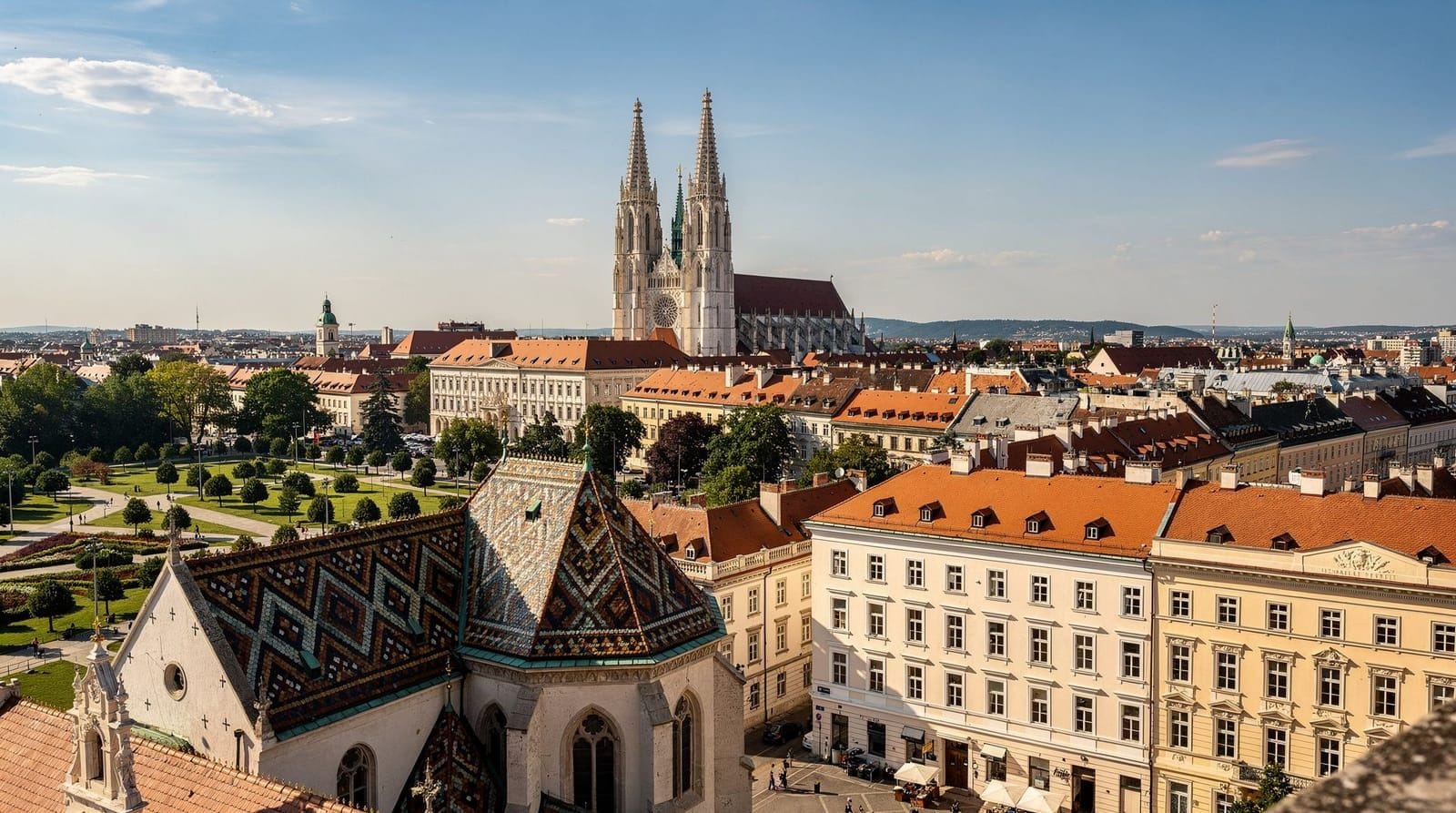
Zagreb: Restaurants and food walking tour
What are the most famous Croatian desserts?
Rozata from Dubrovnik (crème caramel with rose liqueur and maraschino), štrukli from Zagreb (baked or boiled cheese-filled pastry, UNESCO-listed), and fritule from Dalmatia (fried dough balls with lemon zest and rum) are the three regional classics most worth tracking down. Bajadera — the Kras chocolate-hazelnut confection from Šibenik — is the best-known commercially produced Croatian sweet and sold everywhere. Maraschino cherry liqueur from Zadar (historically made by Luxardo) deserves a place on any dessert list.
| Must-try | Rozata (Dubrovnik), štrukli (Zagreb), fritule (Dalmatia) |
| Best souvenir | Bajadera chocolate — sold everywhere, EUR 4–5 |
| Typical dessert price | EUR 4–8 per portion at a konoba or café |
| Seasonal specialty | Fritule and kroštule at Christmas/carnival |
| Best region for sweets overall | Zagreb (variety) or Dubrovnik (rozata) |
Sweet Croatia: why desserts here are worth paying attention to
Croatian desserts do not get the attention they deserve. The country’s food reputation runs on grilled fish, octopus under a peka bell, and Plavac Mali red wine — and rightfully so. But the sweet side of Croatian cooking is equally regional, equally serious, and often deeply rooted in history that extends well beyond the Adriatic coast. A Dubrovnik custard that borrows from the Venetian lagoon, a Zagreb cheese pastry with UNESCO heritage status, a cherry liqueur that was once exported across the Habsburg empire — these are not afterthoughts.
Understanding Croatian desserts means understanding the country’s regional fractures. Zagreb and the continental north look inland, toward Central European baking traditions: filled pastries, rolled doughs, warm cheese dishes. Dalmatia, shaped by the Venetians and the Adriatic, produces fried sweets, honey-based confections, and the celebrated rozata. Slavonia in the east draws on Hungarian and Ottoman influences — layered pastries, poppy seed rolls, walnut cakes. The desserts map almost exactly onto the historical borders.
What follows is a region-by-region guide to Croatia’s sweets — what they are, where they come from, and where to find the best versions.
Rozata — Dubrovnik’s rose custard
Rozata is the defining dessert of Dubrovnik and one of the most distinctive sweets in Croatia. The name comes from ružina vodica — rose water — which is the flavouring agent that separates it from ordinary crème caramel. The base is a simple custard of eggs, milk, sugar and cream, but the rose water and a measure of maraschino cherry liqueur transform it into something distinctly Adriatic.
The technique is the same as crème caramel: the custard is poured into ceramic ramekins over a layer of caramel, then baked in a bain-marie until just set, chilled, and turned out. The caramel forms a liquid glaze. The difference from the French version lies in texture and flavour: rozata is slightly softer, the set less firm, and the aroma is floral and faintly boozy from the maraschino.
A well-made rozata should tremble gently when touched, taste of rose without being perfumed to excess, and have a caramel that is bittersweet rather than too sweet. Café and konoba versions vary enormously — the best ones are made in-house, not from a packet mix. At most Dubrovnik konobas a rozata costs EUR 5–7. It appears as a dessert on nearly every traditional menu in the city.
The maraschino connection is worth noting. Maraschino liqueur was produced in Zadar from Marasca cherries — a sour cherry native to the Dalmatian coast — and perfected by the Luxardo distillery in the early 19th century. The Luxardo family relocated to Italy after World War II, but domestic producers in Croatia still make Maraschino from local Marasca cherries. In desserts it appears in rozata, cake glazes, and cherry-flavoured ice creams. The full story is told in the Zadar section below.
Štrukli — Zagreb’s cheese pastry and its UNESCO status
If you arrive in Zagreb without knowing about štrukli, your first encounter will likely be at a café in the Upper Town — someone at the next table receiving a golden, puffed pastry parcel that clearly required some effort to make. Štrukli is Zagreb’s most distinctive dish, a dough parcel stuffed with fresh skuta cheese (similar to cottage cheese or ricotta), eggs and sour cream, then either boiled or baked.
The boiled version (kuhani štrukli) is softer, more yielding — the dough becomes silky, the filling melts into it slightly. The baked version (pečeni štrukli) develops a golden crust and a crisp, slightly caramelised top, which most people prefer for the textural contrast. The dough itself is simple unleavened pasta dough, rolled thin enough to be translucent before filling.
Štrukli originated in the Zagorje region north of Zagreb — the rolling hills of Zagorje and Trakošćan where dairy farming has been central to the local economy for centuries. Fresh cheese (skuta or svježi sir) was abundant and cheap; štrukli became the way to stretch it into a proper dish. It is both savoury (no sugar, just cheese and sour cream, sometimes served as a main course) and sweet (with added sugar and vanilla, dusted with powdered sugar for dessert). In 2007, štrukli was added to Croatia’s list of intangible cultural heritage, and UNESCO recognition followed.
In Zagreb, it appears on café and restaurant menus across the city. The sweet baked version is the most dessert-appropriate; it is excellent with a small glass of dessert wine or after a main course at a konoba. Prices range from EUR 4–8 per portion. The Zagorje region around Trakošćan castle also produces excellent homemade versions at farmhouses and roadside restaurants.
Fritule — Dalmatian fried dough for Christmas and beyond
Fritule are a Dalmatian institution — small fried dough balls, roughly walnut-sized, flavoured with lemon zest, rum, and often pine nuts or raisins, fried until golden and dusted with powdered sugar. They are to Dalmatia what zeppole are to Naples or frittelle to Venice — a fried sweet that belongs to carnival season, Christmas markets and family celebrations, and which gets made by the tray-load in home kitchens throughout winter.
The word fritule (singular: fritula) comes directly from the Venetian frittella — a sign of how thoroughly the Venetian culinary vocabulary embedded itself in Dalmatian cooking. Commercially the most visible version is the round, plain-fried ball dusted with powdered sugar and sold in paper cones at seasonal markets. Home versions are more varied: some include a touch of rakija instead of rum, some fold in chopped dried figs or walnuts, some are flavoured with orange zest and vanilla.
In Split, fritule appear at the Advent market in December on the city’s main squares, at the Pazar market occasionally, and at a handful of konobas year-round. In Šibenik and smaller Dalmatian towns the Christmas version is still largely homemade. They are best within minutes of frying — reheated fritule are acceptable; cold fritule are not worth eating.
Fritule should not be confused with the similarly named fritule od srdelica (fried anchovies) — same word family, completely different dish.
Krostule and hrustule — the carnival ribbons
Less well-known than fritule but equally traditional across Dalmatia and Istria, krostule (also called hrustule in some areas) are thin strips of sweet dough twisted into loose knots or ribbons, deep-fried until crisp and pale gold, then dusted with powdered sugar. The dough is typically enriched with eggs, white wine and a little brandy or rum, which gives a slight richness and helps the texture stay crisp.
They are a Mardi Gras and carnival speciality — the word krostula echoes the Italian crostola — made in large batches because they store well in a tin for several days. Unlike fritule, which are soft and yielding, krostule are fully crisp, more like a refined fried cracker than a doughnut. They appear at market stalls in Split, Trogir and Hvar during the carnival season (February–early March) and at some family-run konobas as a dessert snack year-round.
Rafioli — Dubrovnik’s crescent pastry
Rafioli are another Dubrovnik speciality: small crescent-shaped pastries made from a short dough, filled with ground almonds, orange zest and rose water, then baked and dusted with powdered sugar. They are more delicate than the fried sweets of the rest of Dalmatia — closer in spirit to the almond pastries of Mediterranean tradition that stretch from Catalonia to Sicily.
The filling varies by family recipe but the core is always almonds, often with a small amount of maraschino, dried citrus peel, and sometimes a touch of rose water to link them thematically to rozata. Rafioli are sold at pastry shops in Dubrovnik’s Old Town, particularly around Christmas and Easter. They make excellent gifts — durable, refined, and representative of a specific local tradition rather than generic Croatian souvenir food.
Makovnjača and orehnjača — the rolled pastries of Zagreb and Slavonia
Continental Croatia’s most important sweet baking tradition is the rolled yeast pastry — a long dough log filled either with poppy seeds (makovnjača) or walnuts (orehnjača), baked until golden and sliced into thick rounds. These are the pastries that fill every Zagreb bakery at Christmas, every family kitchen across Slavonia and Zagorje in winter, and every market stall during Advent season.
The filling for makovnjača is ground poppy seeds mixed with sugar, honey, lemon zest and sometimes rum — sweet, dense, slightly bitter from the poppy. Orehnjača uses finely ground walnuts with sugar, vanilla, egg white and sometimes a little milk to bind. Both are made from the same enriched yeast dough (eggs, butter, milk, a little sugar), rolled thin, spread with filling, rolled up tightly and baked in a long loaf.
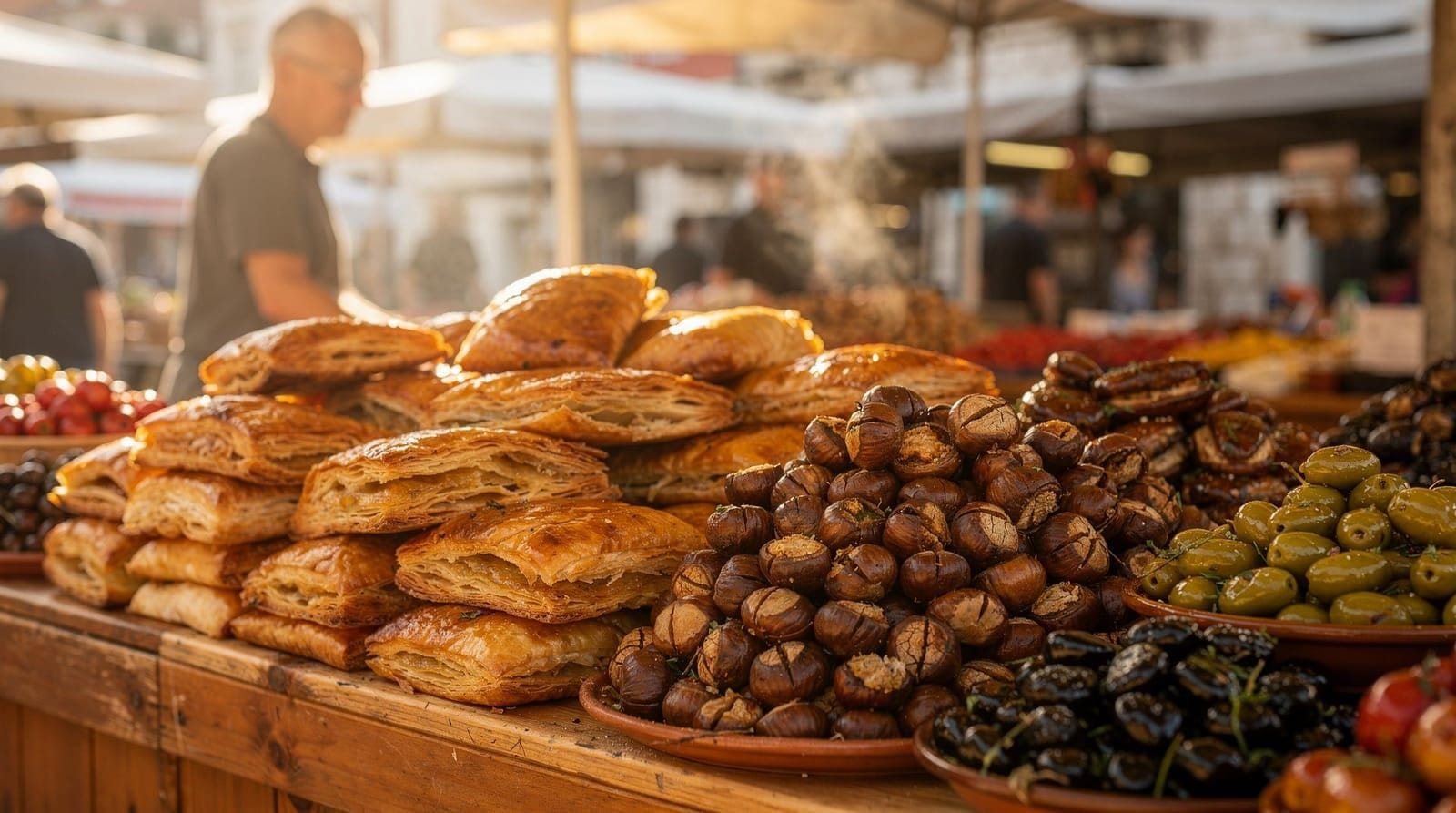
Both pastries come from the Central European baking tradition shared by Croatia with Austria, Hungary and Slovenia. They are sold year-round at Zagreb’s Dolac market, at the Advent market on Zrinjevac square in December (one of Central Europe’s better Christmas markets), and at pastry shops throughout the city. A slice costs EUR 2–4; a whole loaf from a market baker is EUR 8–15. They travel well and make good souvenirs.
Bajadera — Croatia’s most famous confection
Bajadera is the one Croatian sweet that almost every visitor encounters without seeking it out: it is sold at every supermarket, every airport shop, and most tourist gift stores in the country. Made by Kras, Croatia’s largest confectionery company, it is a layered chocolate-hazelnut block — similar in structure to a gianduja praline but with a slightly more pronounced hazelnut flavour and a firm, not melting, texture. Each piece is wrapped individually in gold foil.
The name Bajadera comes from the Portuguese word for a Hindu dancing girl (bayadère), adopted into European fashion and confectionery naming in the 19th century via French and German influence. Kras began producing it in the 1950s in its factory in Šibenik, and it became the country’s best-known commercial sweet product. The Šibenik connection is still celebrated locally.
A 200g gift box of Bajadera costs EUR 4–5 at Konzum or Spar. It is the most practical food souvenir from Croatia: shelf-stable for several months, compact enough to pack easily, and genuinely good rather than merely convenient. For visitors looking for something more artisanal, Kras also produces a range of regional chocolate bars and confections worth exploring, but Bajadera remains the flagship.
Paprenjaci — Zagreb’s honey-pepper biscuits
Paprenjaci are Zagreb’s most distinctive biscuit — small, spiced honey biscuits made with black pepper (papar, hence the name), cinnamon, cloves, lemon zest and honey. They are shaped in carved wooden moulds that produce intricate relief patterns on the surface: horses, figures, heraldic designs. The biscuits are hard and dry — meant to be nibbled slowly rather than bitten — and the combination of honey sweetness with the warmth of spice and the bite of pepper is unusual and memorable.
Paprenjaci have a documented history in Zagreb going back to the 16th century. They were a guild product, made by specialised confectioners (licitari), and remain associated with Croatia’s folk craft tradition. The painted gingerbread heart (licitar) is a related tradition from the same confectioners — UNESCO-listed since 2010 as intangible cultural heritage. Paprenjaci appear at Zagreb’s December Advent market in decorated tins and at artisan food shops year-round. A tin of assorted paprenjaci costs EUR 8–15 and makes an excellent gift.
Hvar lavender honey — the island’s most distinctive sweet
Hvar lavender honey deserves its own section because it represents something genuinely rare: a monofloral honey with an immediately recognisable character tied to a specific landscape. Hvar island cultivated lavender intensively from the 1920s through the mid-20th century — the scented purple fields became iconic images of the Adriatic. Cultivation declined as synthetic perfume chemistry displaced natural lavender oil, but small producers still maintain apiaries among the island’s remaining fields.
The honey is pale, almost white when creamed or set, with a floral and slightly powdery aroma — clearly lavender but without the medicinal quality of lavender essential oil. In texture it is softer than acacia honey, crystallising relatively quickly into a smooth cream. It is excellent drizzled over fresh soft cheese (bijeli sir or skuta), stirred into a tisane, or spread on good bread with butter. In cooking it can be used to glaze roasted vegetables or finish a simple cake.
Buy direct from producers at Hvar town market — prices are EUR 10–15 for 250g, cheaper than tourist shops. Look for labels specifying “lavandino med” or “med od lavande” and, if possible, ask the seller where the apiaries are located. The closer to the island interior (Velo Grablje or Humac area), the more likely you are to get genuinely monofloral honey.
Maraschino and the Zadar cherry liqueur tradition
Maraschino is not a dessert in itself but it belongs in any guide to Croatian sweets because it appears in so many of them — in rozata, in cakes, in fruit salads, drizzled over ice cream — and because its origins are tied to a specific corner of Dalmatian cuisine.
The Marasca cherry (Prunus cerasus var. marasca) is a small, dark, intensely sour cherry native to the Dalmatian coast around Zadar. Its juice is almost undrinkably tart fresh but transforms in fermentation and distillation into something remarkable. The Luxardo family, originally from Genoa, established a distillery in Zadar in 1821 and refined the production of Maraschino liqueur — a clear, faintly almond-scented cherry spirit — into a commercially successful export product. By the early 20th century Luxardo Maraschino was served in the finest cocktail bars in Paris, London and New York.
After World War II and the incorporation of Zadar into Yugoslavia, the Luxardo family relocated their business to Torreglia in the Veneto, where they still operate. Domestic Croatian production of Maraschino from local Marasca cherries resumed after independence. Several distilleries now produce Zadar Maraschino, sold in tourist shops and supermarkets for EUR 10–18 per 500ml bottle. It is worth buying and worth using in homemade rozata if you attempt the recipe.
A regional dessert map: what to find where
Zagreb and Zagorje: štrukli (baked, sweet or savoury), orehnjača and makovnjača at Christmas markets, paprenjaci year-round, Bajadera at every supermarket, artisan ice cream on the main squares.
Dalmatia (Split, Šibenik, Trogir, Makarska): fritule at Christmas and carnival markets, krostule year-round at konobas, crni rižot (but that is a main course), Bajadera everywhere, fresh Paški sir from Pag with honey as a dessert stand-in.
Dubrovnik and the south: rozata (the must-try), rafioli at pastry shops, maraschino in cocktails and desserts, the standard konoba dessert of ice cream and seasonal fruit.
Hvar and the central islands: lavender honey from local producers, fritule at winter markets, fig-based sweets (smokva) in summer — dried figs with almonds or walnuts pressed into logs are sold at markets and have been made on the island for centuries.
Zadar: maraschino liqueur in cocktails, drinks and desserts — the Zadar Cocktail (Maraschino, orange juice, prosecco) is the local aperitif and appears on every café menu.
Slavonia (Osijek and east): makovnjača and orehnjača are the standard celebration pastry; kuglof (German-tradition bundt cake) is the usual Sunday cake; cobanac (shepherd’s meat stew) is the main course, but dessert runs sweet and heavy.
Ice cream (sladoled) and artisan gelato culture
Croatia has a strong ice cream tradition shaped by Italian proximity and Adriatic summer tourism. The best coastal towns — particularly in Istria and Dalmatia — have artisan gelaterias that rotate flavours daily and use fresh local fruit. Standard tourist-area ice cream is ordinary; the good places are identifiable by a short menu, flavours that change weekly, and often a queue.
Flavours worth seeking specifically in Croatia: smokva (fresh or dried fig, available in summer at good shops), lavanda (lavender, particularly on Hvar), maraska (Maraschino cherry, concentrated and slightly boozy), and rogač (carob, slightly earthy and naturally sweet). The standard two-scoop cone costs EUR 2–3.50 depending on location — significantly more at prime tourist spots in Dubrovnik Old Town. Croatia street food has a fuller breakdown of ice cream culture and prices.
Buying Croatian sweets to take home
Bajadera (Kras): the simplest choice. Available everywhere, EUR 4–5 for a gift box, keeps for months.
Paprenjaci: available at Zagreb’s artisan markets and speciality food shops; a decorated tin travels well and keeps for weeks.
Lavender honey from Hvar: best purchased direct from producers at Hvar town market; protect the jar carefully for travel.
Maraschino liqueur: 200ml or 350ml bottles fit within most airline carry-on liquid limits; buy at duty-free or at Zadar shops for the best prices.
Rafioli: Dubrovnik pastry shops sell them in small boxes suitable for gifts; they keep for a week at room temperature.
Rogač (carob) products: increasingly available at Dalmatian markets and health food shops in Zagreb — bars, spreads and teas made from the Adriatic’s most abundant native fruit.
For the full picture of Croatian food across all regions — savoury and sweet — the Croatian food guide is the companion reference. For where to eat across Dalmatia’s konoba culture, the konoba guide covers etiquette, menus and recommendations in depth. If you are planning a week in Croatia and want to work desserts into an itinerary, the Croatia 7 days guide suggests when and where to make the stops count.
Desserts and coffee: a natural pairing
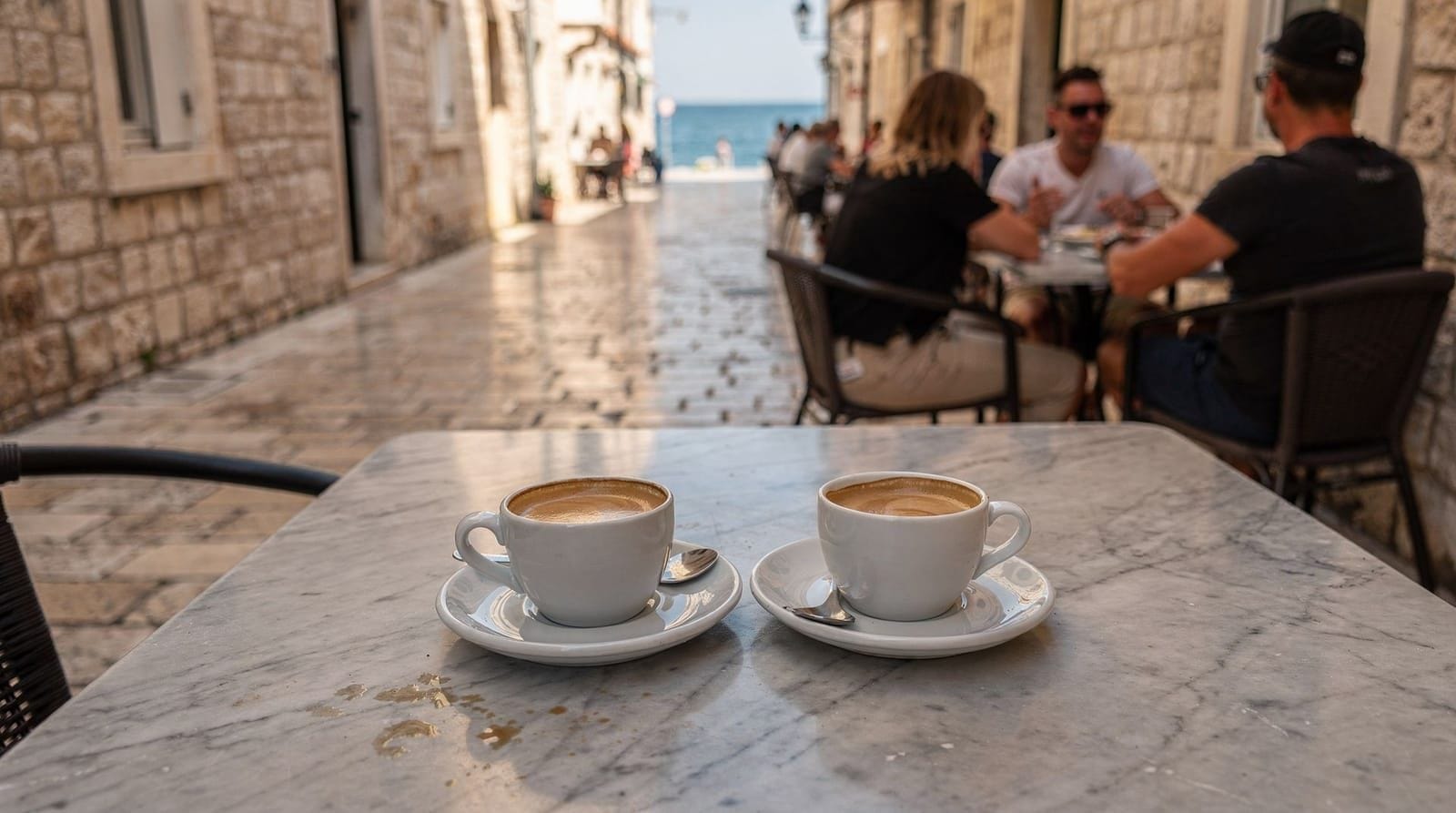
Croatian desserts rarely stand alone — they’re eaten alongside a kava, at a café table, as an extension of the Croatian coffee culture rather than a separate meal course. Štrukli and a bijela kava is the default Zagreb café order; rozata after a Dubrovnik konoba dinner is often taken with a small glass of maraschino rather than coffee. Understanding this pairing habit changes how you order: rather than a fixed three-course meal with dessert at the end, expect desserts to appear as a standalone café stop, mid-afternoon, as easily as after dinner.
Ice cream (sladoled) follows a slightly different rhythm — it’s an anytime, walking-around treat rather than a seated dessert, bought from a window and eaten on a promenade. This is one of the genuinely universal Croatian summer rituals, observed by tourists and locals with equal enthusiasm from Rovinj to Split to Dubrovnik.
Best towns for a dessert-focused day
If sweets are a specific priority rather than an afterthought, three bases reward the effort particularly well:
Zagreb offers the widest range in one city — Dolac market pastries, Tkalčićeva café štrukli, Zagorje-style rolled pastries at Christmas, and the historic paprenjaci tradition, all within walking distance of each other in the Upper and Lower Town.
Dubrovnik is a one-dessert town, but that one dessert (rozata) is worth building a stop around, and the Old Town’s density means multiple konobas serving good versions are within a few minutes’ walk of each other.
Hvar rewards a slower, more scattered approach — lavender honey from producers rather than shops, fig-based sweets at the town market, and fritule at winter markets if you happen to be visiting off-season.
Dietary notes: gluten, dairy and vegan options
Most classic Croatian desserts are built around wheat flour, eggs and dairy, which makes strict dietary avoidance genuinely difficult with the traditional repertoire — štrukli, rozata, fritule and the rolled pastries all rely on these three ingredients structurally, not incidentally. There is no easy substitution that preserves the dish.
That said, a few options work for restricted diets: Bajadera contains dairy and nuts but no eggs or gluten, making it viable for egg-free (though not nut-free or dairy-free) diets. Fresh fruit — figs, cherries in season, Dalmatian stone fruit — is abundant at markets and is the simplest gluten-free, dairy-free dessert option available everywhere. Sladoled (ice cream) shops in larger towns increasingly offer sorbetto (fruit-based, dairy-free) alongside cream-based flavours; ask specifically for sorbetto if avoiding dairy.
Zagreb and Split, with their larger and more internationally exposed café scenes, are more likely than smaller coastal towns to have a genuinely gluten-free or vegan cake option on the menu — worth checking ahead if this matters for your trip, as rural konobas will rarely have alternatives to the traditional recipe.
Frequently asked questions about Croatian desserts and sweets
What is rozata and how is it different from crème caramel?
Rozata is Dubrovnik's signature dessert — a crème caramel-style custard set with rose water (ružina vodica) and a splash of maraschino liqueur, cooked in individual ceramic ramekins and turned out with a light caramel glaze. The rose gives it a floral, perfumed quality absent from French crème caramel, and the texture is slightly softer, less set. A good rozata trembles gently when touched and should not taste of egg. Find it at most Dubrovnik konobas; prices are EUR 5–7 per portion.Is štrukli a dessert or a main course?
Both. Štrukli is Zagreb's most versatile dish — a pastry parcel filled with fresh skuta cheese (similar to ricotta), eggs and sour cream, then either boiled (kuhani štrukli, soft and yielding) or baked (pečeni štrukli, golden and slightly crisp). The savoury version is served as a starter or light main. The sweet version — with added sugar and vanilla — is served as a dessert, sometimes with a dusting of powdered sugar or a spoonful of sour cream alongside. It appears on every serious Zagreb café menu.Where can I buy Bajadera in Croatia?
Bajadera is made by Kras, Croatia's largest confectionery company, and sold in every supermarket (Konzum, Spar, Lidl), most airport shops, and tourist gift shops across the country. The classic format is a layered chocolate-hazelnut block, individually wrapped in foil. Gift boxes are available in larger Konzum stores in major cities. A 200g box costs around EUR 4–5. It is the most practical Croatian food souvenir — compact, shelf-stable, and genuinely good.What is maraschino and what does it have to do with Zadar?
Maraschino is a clear cherry liqueur made from Marasca cherries — a sour cherry variety native to the Dalmatian coast around Zadar. The liqueur was perfected in Zadar by the Luxardo family in the early 19th century and became one of the most exported spirits from the Austro-Hungarian empire. After World War II, Luxardo relocated to Italy. Today, domestic Maraschino is produced by several Croatian distilleries; you can buy it throughout Croatia. In desserts it appears in rozata, as a flavouring for cakes, and drizzled over ice cream.What are fritule and when are they served?
Fritule are small fried dough balls — roughly the size of a golf ball — flavoured with lemon zest, rum, and sometimes pine nuts or raisins. They are a traditional Dalmatian Christmas and carnival snack, similar to the Italian zeppole or Venetian frittelle. At seasonal markets and during Advent they are sold from street stalls in paper bags, dusted with powdered sugar. They are best eaten hot, within minutes of frying. Year-round you will find them at some konobas in Split, Šibenik and along the Dalmatian coast.What is lavender honey from Hvar and where can I buy it?
Hvar lavender honey is pale, almost white, with a floral aromatic quality that makes it immediately distinctive. The island's lavender cultivation peaked in the mid-20th century and has since declined, but small producers still maintain fields in the island interior. The honey is sold direct from apiaries, at Hvar town market, and in speciality food shops. A 250g jar costs EUR 10–15 from producers; tourist shops charge more. It is excellent drizzled over soft sheep's cheese or stirred into warm tea.What Croatian sweets can I bring home as gifts?
Bajadera (Kras brand) is the most practical — compact, wrapped, universally appreciated. Paprenjaci (honey-pepper biscuits) from Zagreb, sold in decorated tins, travel well. Lavender honey from Hvar is an excellent food gift if you can protect the jar. Maraschino liqueur in small bottles is available at airport shops and is within most liquid limits for carry-on (check current regulations). Rogač (carob) products from Dalmatian markets — chocolate bars, spreads — are increasingly available and unusual.
Top experiences
Bookable activities with verified prices and instant confirmation on GetYourGuide.
Top experiences
Best-rated activities across GetYourGuide and Viator.

Krka National Park Tour with tour Guide & Wine tasting from Split & Trogir
- Viator

Dolphin Watching & Sunset Boat Tour With Drinks & optional Dinner
- Viator

Fantastic DOLPHIN & SUNSET TOUR with dinner ( Pula-NP BRIJUNI )
- Viator

Dubrovnik Guided Group Tour with Ston Oyster tasting from Split & Trogir
- Viator

Zadar Highlights: Old Town, Sea Organ & Local Tastings
- Viator

Zadar: Luxury Island Boat Tour, Snorkeling & Unlimited Wine
- Viator