Ferry vs catamaran in Croatia: which to take and when
Should I take a ferry or catamaran between Croatian islands?
Ferry if you need to take a car, want the cheapest option, or are travelling on less-frequent schedules. Catamaran if speed and foot-passenger convenience matter more than cost or car access — catamarans are faster (30–50% quicker on most routes), run more frequently in peak season, and connect some islands directly that car ferries do not. For island-hopping without a car, catamarans are the default choice.
The Croatian island transport question
Travelling between Croatian islands involves a choice that every visitor eventually faces: ferry or catamaran? The two services are fundamentally different — in what they carry, how fast they go, how much they cost and what experience they deliver.
Understanding the distinction before you arrive makes planning island hopping far easier and prevents the frustration of arriving at a catamaran quay with a car, or waiting for a car ferry that runs twice a day when a catamaran runs five times.
| Best for cars | Conventional ro-ro ferry (Jadrolinija) |
| Best for speed | Catamaran (Jadrolinija, Krilo/KSC, TP-Line) |
| Typical foot-passenger cost | around €5–35 depending on route |
| Booking window | catamaran 24–48hrs ahead in peak season; car space 1–3 weeks ahead |
| Motion sickness | catamarans ride higher — ferries are the calmer option |
The big difference: cars
This is the single most important factor. Conventional ro-ro ferries carry cars. Catamarans do not.
If you have a rental car and want to take it from island to island, you have no choice: you must use a car ferry on whichever routes offer one. Not all islands are served by car ferries from all destinations; some are catamaran-only.
If you are travelling without a car — as most island-hoppers do, relying on local buses, taxis and bikes on the islands — catamarans open up a faster, more flexible and often more direct set of connections.
Jadrolinija: the national operator
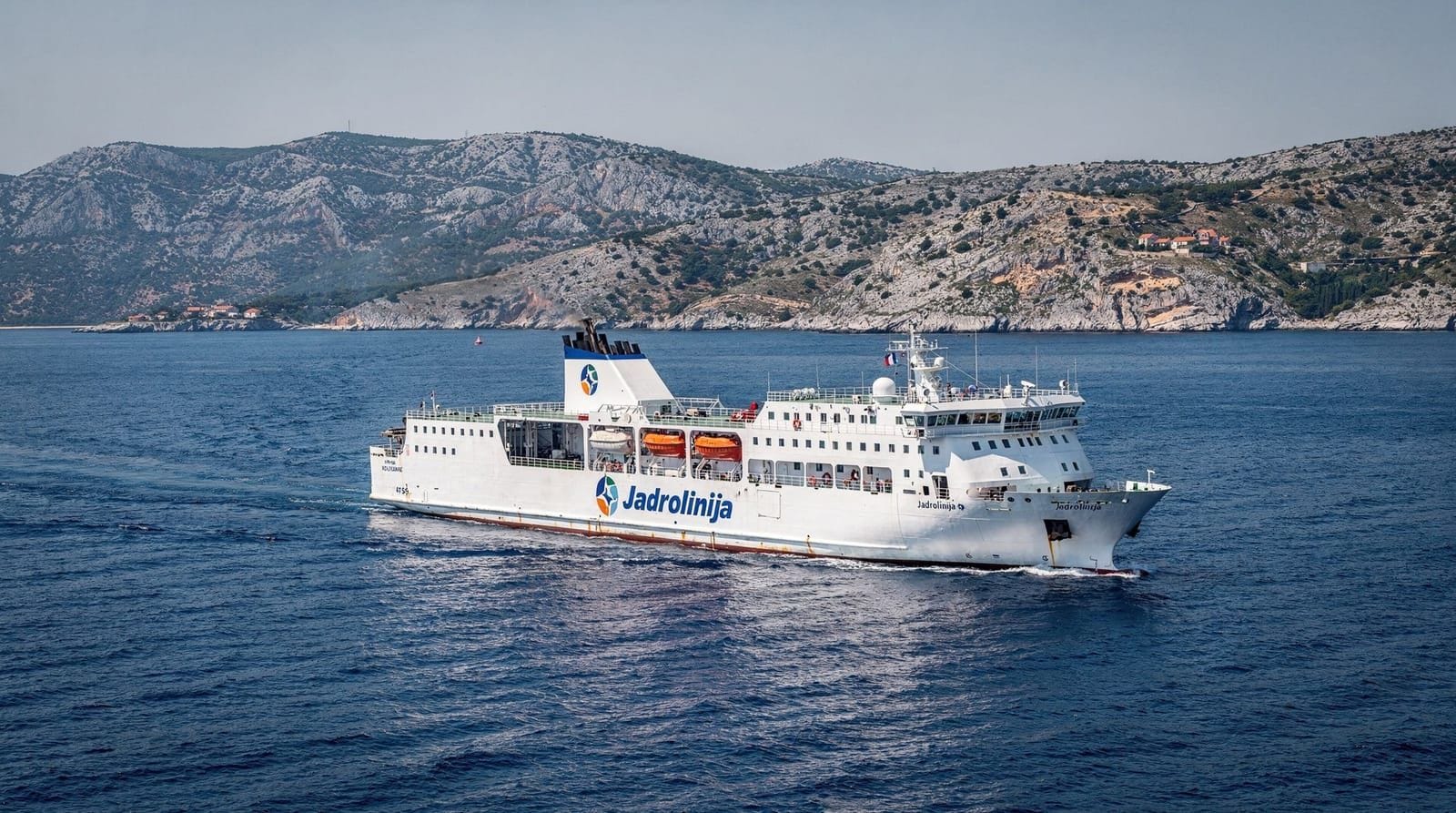
Jadrolinija is Croatia’s national maritime company and operates both the largest car ferry network and a significant catamaran network. Their routes include:
Car ferries:
- Split–Supetar (Brač): 50 min, up to 14 departures/day in peak season
- Split–Stari Grad (Hvar): 1.5–2 hours
- Split–Vis: 2.5 hours
- Split–Vela Luka (Korčula): 3+ hours
- Zadar–Ugljan, Zadar–Pašman
- Dubrovnik–Elaphiti Islands (Šipan, Lopud, Kolocep)
Jadrolinija catamarans:
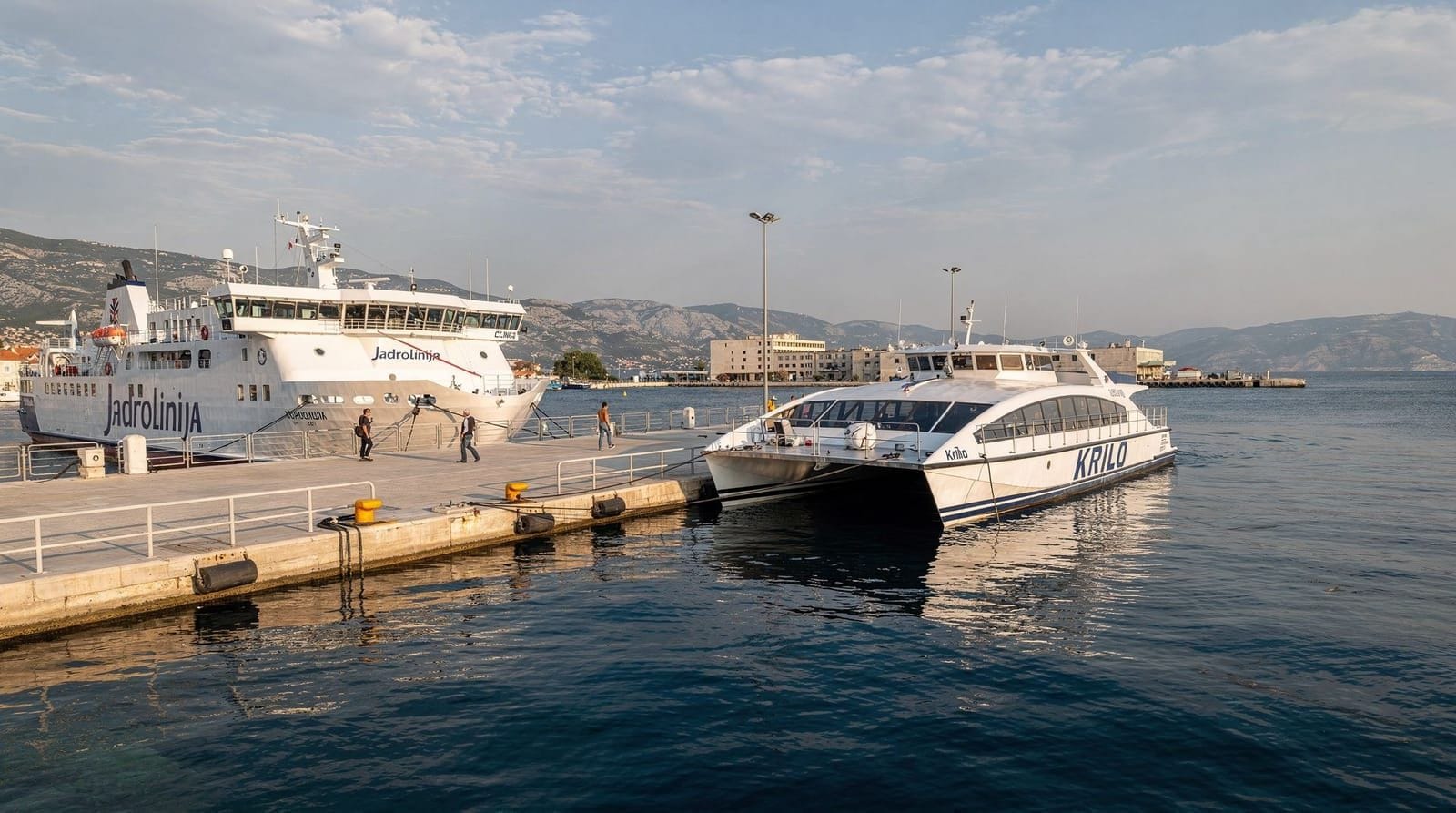
- Split–Bol (Brač)–Hvar–Vis–Korčula–Lastovo: the main coastal catamaran service (once or twice daily in season)
- Split–Hvar–Korčula–Dubrovnik: the overnight coastal catamaran
Private catamaran operators
Krilo (Kapetan Luka / KSC) operates some of Croatia’s best-value and most scenic catamaran routes, including the Dubrovnik–Korčula–Mljet–Šipan–Split route (a full-day island-hopping service) and the Split–Hvar–Vis daily run. Their catamarans are modern and their scheduling often beats Jadrolinija on certain routes.
TP-Line and others cover specific routes, particularly connecting smaller islands not served by the main operators.
How to actually book each one
Booking a Croatian ferry or catamaran is simpler than it looks, but the two systems work differently enough to trip up first-timers. For a car space on a Jadrolinija ferry, book directly on jadrolinija.hr as early as you can once dates are fixed — in July and August, popular car routes such as Split–Stari Grad genuinely do sell out for specific sailings, sometimes a fortnight ahead. Foot passengers on the same ferries rarely need to book: you can usually turn up, buy a ticket at the quay kiosk, and walk on.
Catamaran tickets work more like a budget-airline seat than a ferry car space — each sailing has a fixed number of seats, and popular midday departures on the Split–Hvar or Dubrovnik–Korčula routes can sell out in peak weeks. Booking 1–2 days ahead online (via jadrolinija.hr or krilo.hr depending on operator) removes the risk without requiring the weeks-ahead planning that car ferries sometimes do. If your island-hopping itinerary has a hard connection to make — a flight out of Split the same evening, for instance — book that sailing specifically rather than assuming a later one will have space.
Ferry and catamaran etiquette
A few habits make crossings smoother for everyone. Board in the queue order signalled by crew, not by rushing the gangway. On car ferries, follow the deck marshal’s hand signals exactly — Croatian crews park vehicles tightly and expect drivers to cut the engine and set the handbrake immediately once directed. On catamarans, luggage goes in the designated rack near the entrance, not blocking the aisle; seats are unassigned on most routes, so boarding a few minutes early secures a spot near a window or outside deck. Crew announcements are typically in Croatian and English on major routes; on smaller regional catamarans, English announcements may be limited, so keep an eye on fellow passengers for cues on where to disembark.
Key routes: ferry vs catamaran options
Split to Hvar
Car ferry: Split–Stari Grad (north Hvar, 15 km from Hvar town): 1.5–2 hours. Slow but carries cars. If you want to drive on Hvar (helpful for the interior and eastern end), this is your route.
Catamaran: Split–Hvar town (directly to the main harbour): 50–70 minutes depending on operator. Faster, more convenient for the town centre, foot passengers only.
Verdict: Without a car, the catamaran to Hvar town is far more convenient. With a car, the ferry to Stari Grad is the only option.
Split to Brač
Car ferry: Split–Supetar (north Brač): 50 minutes. Frequent (up to 14/day peak season). The best ferry connection from the mainland to any island.
Catamaran: Split–Bol (south Brač, near Zlatni Rat): approximately 1 hour by direct catamaran in season, or connecting via Hvar.
Verdict: Supetar car ferry is excellent for visitors with cars or those based in Supetar. Bol catamaran is better for Zlatni Rat beach visitors without a car.
Split to Vis
Car ferry: Split–Vis: 2.5 hours. One or two departures daily. Cars carried.
Catamaran: Split–Hvar–Vis: approximately 1.5–2 hours by catamaran connecting through Hvar.
Verdict: The catamaran is faster but connecting through Hvar introduces schedule dependency. For a multi-day Vis stay with car, the direct ferry makes sense. For a day visit, catamaran through Hvar.
Dubrovnik to the islands
Car ferry: Dubrovnik ferry terminal (Gruž harbour, 3 km from Old Town)–Elaphiti Islands (Koločep, Lopud, Šipan). Car ferries run to Šipan.
Catamaran: Several services connect Dubrovnik to Korčula (2.5–3 hours), Mljet (2–2.5 hours), and the Elaphiti Islands.
Verdict: Without a car, the catamarans from Dubrovnik to Korčula and Mljet are excellent day-trip or island-hopping options. The Elaphiti Islands are easiest by the regular passenger/car ferry from Gruž.
Seasickness: the practical concern
Catamarans are faster because they ride higher in the water. This also means more motion in choppy conditions — a relevant concern for seasickness-prone travellers.
When it matters:
- The Bura (north-easterly wind) can create short, steep chop in the channels between islands
- The Jugo (south-easterly) builds longer swells that can affect catamarans significantly
- July–August: typically the calmest months (Maestral sea breeze is predictable and moderate)
- October onwards: more frequent weather disruptions
Practical advice:
- Take seasickness medication before boarding if prone (standard motion sickness tablets work; take 30–60 minutes before departure)
- Sit outside or in the forward section if weather is calm; inside if rough
- Car ferries are more stable — if prone to sickness, prefer the car ferry (Split–Supetar ferry is very calm)
- Accept that rough-weather catamaran cancellations happen; build buffer days into your itinerary
The booking systems
Jadrolinija: jadrolinija.hr — online booking available for catamarans and car ferry car spaces. Foot passengers on car ferries can pay at the quay.
Krilo/KSC: krilo.hr — online booking for catamaran routes.
Tickets on arrival: Foot passengers can usually buy tickets at the quay 30 minutes before departure on most routes. Exception: specific catamaran departures that sell out — book those online.
Car reservations: Book car spaces on ferries well in advance for July–August. Split–Stari Grad (Hvar) car ferry car spaces for weekend departures fill weeks ahead.
The seasickness-free alternative: guided island tours
For visitors who find the open catamaran or choppy ferry conditions unpleasant, guided boat tours (speedboat or sailing boat) offer a more controlled experience:
The speedboat tours to Hvar, Brač and Vis that depart from Split include smaller group sizes, guided itineraries and the ability to stop in calm coves.
Quick decision guide
| Your situation | Choose |
|---|---|
| Travelling with a car | Car ferry — mandatory |
| Split to Hvar town (no car) | Catamaran |
| Split to Brač/Zlatni Rat (no car) | Catamaran to Bol or ferry to Supetar + bus |
| Split to Vis (no car) | Catamaran |
| Split to Korčula or Dubrovnik (no car) | Catamaran (Krilo or Jadrolinija coastal) |
| Prone to seasickness | Car ferry (more stable) |
| Budget priority | Car ferry (cheaper) |
| Speed priority | Catamaran |
| Elaphiti Islands from Dubrovnik | Boat tour or local ferry from Gruž |
Frequently asked questions about Ferry vs catamaran in Croatia
What is the difference between a ferry and a catamaran in Croatia?
Croatian ferries (operated mainly by Jadrolinija) are large roll-on/roll-off vessels that carry cars, trucks and foot passengers. They are slower (8–15 knots), cheaper and run on fixed schedules year-round. Catamarans (operated by Jadrolinija, Krilo/KSC, and TP-Line) are fast passenger-only vessels (no cars, no motorcycles) that travel at 25–40 knots. They're faster, slightly more expensive, more susceptible to rough weather cancellations, and connect some routes that large ferries don't.Can I take my car on a catamaran in Croatia?
No. Catamarans in Croatia are foot-passenger only — no cars, motorcycles, or large cargo. If you need to take a car to an island, you must use a conventional (ro-ro) ferry. The main car ferry routes are Split–Supetar (Brač), Split–Stari Grad (Hvar), Split–Vela Luka (Korčula), Split–Vis, Zadar–Ugljan/Pašman, and Dubrovnik–Elaphiti Islands (Šipan/Lopud/Koločep).How much do Croatian ferries and catamarans cost?
Ferry foot passenger: typically €5–12 depending on route and season. Catamaran passenger: €10–20 for shorter routes, €20–35 for longer routes (Split to Korčula, Dubrovnik to Korčula). Car on ferry: €30–80 depending on vehicle size and route. Jadrolinija and private operators have online booking with printed tickets. Jadrolinija ferries can be paid at the quay (foot passengers) but car bookings must be made well in advance in summer.Which routes are catamaran-only (no car ferry alternative)?
Several island-hopping routes are catamaran-only: Split–Hvar–Korčula–Lastovo (coastal catamaran), Split–Bol (Brač)–Hvar town (direct service), Dubrovnik–Korčula–Mljet–Split (Krilo coastal route). These routes serve the island centres directly, while car ferries call at different ports (usually the main ferry terminal on the island's north or west coast, sometimes far from the main town).Are catamarans safe in Croatia?
Yes — catamarans operated by licensed Croatian companies are subject to EU maritime safety regulations. They are operated by experienced crews. The practical safety concern is seasickness: catamarans ride higher in the water than conventional ferries, which means more motion in choppy sea. The Bura (north-easterly wind) and Jugo (south-easterly) can create rough conditions. Operators cancel services if sea state exceeds safe limits.How far in advance should I book Croatian ferry and catamaran tickets?
Catamaran (foot passengers): 24–48 hours ahead in peak season is usually sufficient online, though specific departure times sell out. Car ferry in peak season: book car space 1–3 weeks in advance in July–August. Popular routes (Split–Hvar car ferry) can be fully booked for specific departure times days ahead. Foot passengers on car ferries can generally board without advance booking except on the busiest routes.What happens if my catamaran is cancelled due to weather?
Operators reschedule passengers to the next available service (same day or next day). If this is impossible and you have a pre-booked ticket, full refunds are given. It is worth having a flexible attitude and some buffer time in your itinerary, particularly for October–November travel when Bura events are more common. In summer (June–September), cancellations are relatively rare.Do ferries and catamarans arrive at the same port on an island?
Not always. On several islands the car ferry and the catamaran use different harbours — for example on Hvar, the car ferry lands at Stari Grad while the catamaran goes directly into Hvar town, and on Brač the car ferry uses Supetar while some catamarans call at Bol. Check the destination port for your specific sailing, not just the island name, especially if you have onward transport arranged from a particular town.Is it worth paying more for a catamaran over a car ferry?
If you don't have a car, yes in most cases: catamarans are faster, often land closer to the town centre, and run more frequently in peak season. If cost is the priority or you're prone to seasickness, the car ferry's lower price and greater stability can outweigh the time saved. On routes that are catamaran-only, such as Split direct to Hvar town, there is no car-ferry alternative to compare against.
Top experiences
Best-rated activities across GetYourGuide and Viator.

Blue cave, Mamma Mia and Hvar, 5 islands speedboat tour
- Viator

Blue Cave and Hvar Tour - 5 Islands Tour from Split and Trogir
- Viator

Blue cave, Mama Mia and Hvar, 5 Island Speedboat Tour from Trogir
- Viator

From Zadar: Plitvice Lakes with Boat Ride & Zadar Old town tour
- Viator

Hvar, Brač & Pakleni islands cruise with lunch & drinks from Split & Trogir
- Viator

Blue Cave & Vis Island speedboat tour from Hvar
- Viator