Peka in Croatia: the slow-cooking tradition you need to know
Split: Small group car tour and Dalmatian peka
What is peka and how do I order it in Croatia?
Peka (pronounced PEH-kah) is a traditional Croatian cooking method where meat or octopus is placed in a shallow pan with vegetables, covered by a heavy iron or ceramic bell (also called peka), and buried under hot embers (zar) for 1.5 to 3 hours. The result is impossibly tender meat or octopus, perfumed with the herbs and juices of everything cooked together. To order peka, you must contact the konoba at least 2 to 4 hours in advance — it cannot be ordered on arrival. Most konobas do it for a minimum of two people. Expect to pay EUR 15–25 per person.
In brief: Peka is Croatia’s slow-cooking masterpiece — lamb, veal, or octopus sealed under an iron bell and buried in embers for two hours until everything inside collapses into tenderness. You must order in advance. It is worth planning your entire day around it.
| Where | Any konoba, best in the Dalmatian Zagora, Vis, Brač |
| Cost | Around EUR 12–25 per person depending on filling |
| Time needed | Order 2–4 hrs ahead; cooking itself takes 1.5–3 hrs |
| Group size | Minimum 2, best for 4+ |
| Booking | By phone or in person — never on arrival, rarely online |
What peka actually is
The word peka refers to two things simultaneously: the dish, and the iron bell that cooks it. Understanding this dual meaning is the first step to understanding what makes peka different from any other cooking method.
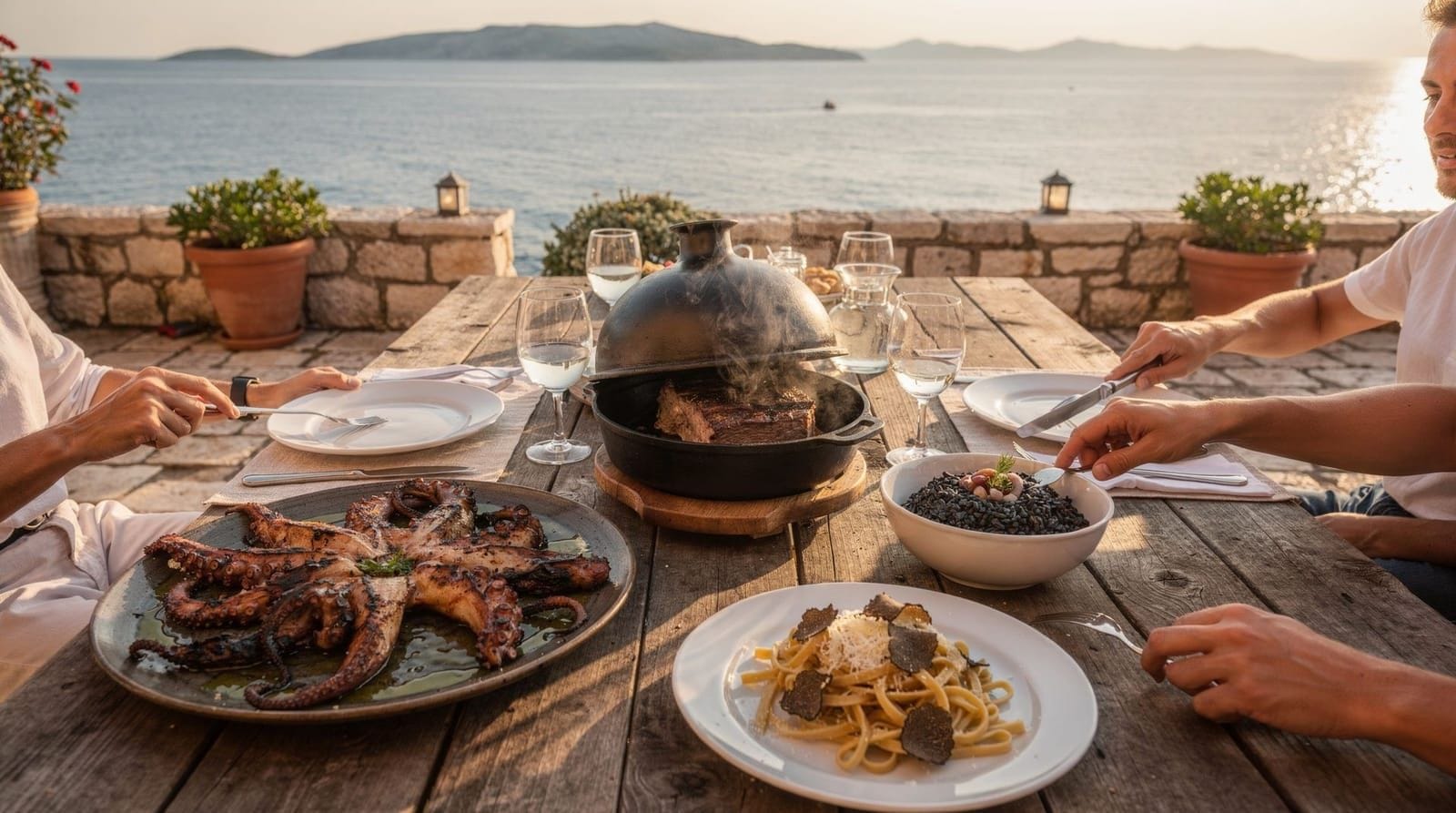
The bell — heavy cast iron, 40–50 cm in diameter, with a domed top — sits over a shallow clay or metal pan loaded with meat, vegetables, and olive oil. The cook places the bell on top, then buries the whole assembly in embers: hot coals or wood ash piled up around the sides and heaped on top of the dome. The bell becomes the oven. The food inside steams, braises, and roasts simultaneously for 90 minutes to 3 hours, depending on what is inside.
The result is something that a conventional oven cannot replicate. The sealed environment traps every drop of moisture from the meat, the vegetables, and the olive oil. These juices evaporate, condense on the cool underside of the dome, and rain back down. The meat never dries out. The vegetables never burn. Everything that goes into the pan — the garlic, the rosemary, the tomatoes, the wine — merges into a unified, unctuous cooking liquid that becomes as important as the protein itself.
The embers on top of the dome are key. They provide radiant heat from above while the pan provides contact heat from below. This two-directional heat — combined with the steam trap — is what gives peka its character. No kitchen oven reproduces it fully.
The history of peka
Peka is ancient. Archaeological evidence for covered clay cooking vessels in the eastern Adriatic goes back to the Bronze Age, and the general technique — sealing food under a dome and covering with embers — appears independently across Mediterranean and Balkan cultures. The Croatian version descends from Ottoman and Venetian-era cooking traditions along the Dalmatian coast and in the Zagora (the hinterland).
For centuries, peka was not a restaurant dish. It was the way Dalmatian families cooked on Sundays and feast days, in stone fireplaces or outdoor hearths. The lamb would be from the family flock; the vegetables from the garden; the rosemary cut from the hillside that morning. The whole family would gather while it cooked, drinking wine and waiting.
The modern konoba has preserved this tradition more faithfully than almost any other element of Croatian cuisine. Ordering peka at a konoba today still involves the same wait, the same anticipation, the same communal reveal when the bell is lifted at the table.
What goes inside: the classic preparations
Lamb (janjetina ispod peke)
The definitive peka. Dalmatian lamb from the rocky karst hillsides — where the animals graze on wild sage, rosemary, and heather — has a particular sweetness and intensity that flatland lamb does not. Young lamb (mlado janje, under 6 months) is the standard; it cooks faster and is more tender.
A whole shoulder or a leg is typical, cut into bone-in pieces. It goes into the pan with quartered potatoes, onions, garlic cloves (many of them), rosemary branches, a bay leaf or two, olive oil, and usually a small amount of white wine or water. The ratio of potato to meat matters — the potatoes absorb the fat and juices and become extraordinary.
Cooking time: 2–2.5 hours for a standard portion. The meat should be falling off the bone with minimal pressure from a fork. The potatoes underneath should be golden on the exterior and creamy inside, stained with lamb fat.
Price: EUR 18–25 per person at most konobas.
Veal (teletina ispod peke)
Veal peka is slightly more delicate than lamb — the meat is paler, milder, and responds well to more aromatic additions: lemon zest, sage, more garlic. It is the preferred option in Istria and the Kvarner islands (Krk, Lošinj), where lamb is less traditional than on the Dalmatian coast.
The technique is identical. Veal cooks slightly faster than lamb, and the resulting cooking liquid is lighter. Excellent when made with quality local veal and properly rested before serving.
Octopus (hobotnica ispod peke)
The maritime peka and, many argue, the most extraordinary result. An octopus weighing 1.5–2 kg goes into the pan whole or in large sections, surrounded by potatoes, cherry tomatoes, capers, garlic, olive oil, and sometimes a splash of white wine or rakija. No water is needed — the octopus releases remarkable quantities of liquid as it cooks.
After 90 minutes to 2 hours under the bell, the octopus is completely tender throughout, even the thickest part of the body. The tentacles become almost jammy. The potatoes and tomatoes turn into something between a sauce and a roasted vegetable. The cooking liquid at the bottom of the pan — part tomato, part octopus juices, part olive oil — is poured over everything at the table and often mopped with bread that takes precedence over everything else.
Octopus peka works for 2–4 people. It is slightly less common than meat peka at inland konobas (which may not reliably have fresh octopus) but standard at any coastal konoba with access to daily catch.
Price: EUR 15–22 per person, depending on size and location.
Chicken (piletin ispod peke)
The everyday peka, made with a whole chicken cut into quarters. Less dramatic than lamb or octopus but excellent when the chicken is a free-range village bird (domaći pijet) rather than a commercial bird — the former has fat distribution and flavor that makes the technique worthwhile. Common at family konobas and rural restaurants where it may be the only peka on the menu. Good value at EUR 12–16 per person.
Peka Fillings Compared
| Filling | Cooking time | Price (per person) | Best for |
|---|---|---|---|
| Lamb (janjetina) | 2–2.5 hrs | EUR 18–25 | Traditionalists, inland konobas |
| Veal (teletina) | Slightly less than lamb | EUR 18–25 | Milder palates, Istria/Kvarner |
| Octopus (hobotnica) | 1.5–2 hrs | EUR 15–22 | Coastal konobas, seafood lovers |
| Chicken (piletina) | Shortest | EUR 12–16 | Everyday value, family konobas |
Vegetarian and lighter options
Peka is built around meat or octopus by tradition, and a fully vegetarian peka is unusual — most konobas simply don’t prepare one, since the dish’s identity is tied to the protein at its centre. That said, the vegetables cooked alongside lamb or octopus (potatoes, onions, peppers) are some of the best you’ll eat in Croatia precisely because they’ve absorbed the meat or seafood juices, so a vegetarian in a mixed group can still eat well from the same pan even while skipping the protein. If you’re vegetarian and travelling solo, it’s worth asking a konoba directly whether they’ll do a vegetable-only peka — some will for advance groups, but don’t expect it as standard, and check our Croatian food guide for other options that don’t depend on advance ordering.
How Peka Compares to Other Slow-Cooked Croatian Dishes
Peka isn’t the only slow-cooked centrepiece in Croatian cuisine, and it helps to know how it differs from the other dishes you’ll see on konoba menus. Gulaš (goulash) and pašticada (a Dalmatian beef stew marinated for days and braised for hours) are both cooked conventionally in a pot on a stove, available without advance notice, and served ladled rather than carved at the table. Peka’s defining difference is the ember-buried bell and the theatrical reveal — it’s a booked event, not an off-the-menu order. If your schedule doesn’t allow the 2–4 hour advance notice peka requires, pašticada is the closest thing to its depth of flavour that you can order spontaneously. The Dalmatian cuisine guide covers pašticada and the rest of the region’s slow-cooked repertoire in full.
Combining Peka With a Day Trip
Because peka needs advance notice, it works best as the anchor you plan a day around rather than an afterthought. A common and effective pattern: call ahead to a Zagora or Omis-area konoba in the morning, spend the day rafting the Cetina river or exploring Omis, and arrive at the konoba in the late afternoon for the reveal. On Vis or Brač, the same logic applies around a beach day — order peka before you leave for the coves, and you’ll return to a meal that’s ready almost exactly when you are. Building the day around the booking, rather than trying to fit peka in spontaneously, is the single biggest factor in whether the experience goes well.
Where to order the best peka
The Dalmatian Zagora (hinterland)
The villages inland from Split, Sibenik, and Omis are the heartland of peka culture. Here, every konoba does it, the lamb is local, and the technique has been passed through generations without adaptation for tourists. The road through the Cetina canyon toward Omis passes through small villages where a sign reading “janjetina ispod peke” on a roadside konoba means you should stop and call ahead immediately.
Konoba Mate in Srijane (10 km from Omis, above the Cetina gorge) is one of the most cited local references — call ahead, arrive hungry, order the lamb and the house wine (which is also homemade), and leave several hours later.
Vis island
Vis has the most developed peka culture of any island, partly because the island was closed to tourists until 1989 (it was a Yugoslav military base) and the local food tradition was therefore preserved without tourist adaptation. Konoba Roki’s in Milna (the village, not the town of the same name — it is a hamlet near Vis town) is the reference. They do peka from lamb, veal, and octopus; booking ahead is essential and usually by phone. The drive alone is beautiful.
Brač island
Brač has good lamb peka at several konobas in the interior villages — Skrip (the oldest settlement on the island), Nerežisca, and Supetar all have options. Konoba Marin in Postira is frequently recommended by locals over tourist platforms.
Split city
Within Split itself, peka is available at konobas in the neighborhoods outside the old walls — Varo, Spinut, Solin direction — and at some restaurants in the Upper Town. Expect to book by 10 am for a dinner peka, or the morning before for lunch. Some tours include a peka lunch as part of a wider culinary experience of the region:
This tour combines driving through the Dalmatian landscape with a sit-down peka experience at a traditional konoba — useful if you are in Split for a short time and want the full context without the logistics of finding the right place yourself.
The ritual of ordering peka
Understanding how the booking process works saves you confusion:
Step 1 — Call or visit the konoba. Do not try to book peka by TripAdvisor message or website form. Call by phone or walk in. In Dalmatia, showing up in person is always better.
Step 2 — State your group size. How many people are eating? Peka is prepared per group, not per person. A konoba will prepare one peka session per table. Groups under 2 people may be turned away for meat peka (though octopus works well for 2).
Step 3 — Choose your filling. Lamb, veal, octopus, or chicken. Some konobas offer only one option (usually whatever they had that morning). If they offer you a choice, take octopus if it is a coastal konoba; take lamb if you are inland.
Step 4 — Confirm your arrival time. Be there on time. The konoba will have started the fire and loaded the pan based on your arrival time. Showing up 45 minutes late disrupts their timing and may result in overcooked food. If you will be late, call ahead.
Step 5 — Trust the process. The bell will be uncovered at the table in front of you. The steam that escapes when the bell is lifted is half the theater. Do not rush the serving — let the konoba staff plate it properly.
Ordering ahead: practical phrases
If your Croatian is limited, these phrases cover the basics:
- Zelim rezervirati peku za [number] osoba za [time] sati — I want to reserve peka for [number] people for [time] o’clock.
- Mozete li pripremiti janjetinu / hobotnica / teletinu? — Can you prepare lamb / octopus / veal?
- Koliko treba narudzbu prijaviti unaprijed? — How far in advance do I need to book?
Most konoba owners in tourist areas speak sufficient English. A simple “We would like to order peka for four people for dinner tonight, is that possible?” in English will be understood and appreciated. In more remote inland villages where English is less reliable, having the Croatian phrases written down on your phone to show, rather than attempting to pronounce them, often works better than a verbal attempt — the konoba owner can simply point at a time on a calendar or write back a number.
The peka at home
For those who want to recreate peka outside Croatia, the process is straightforward if you have a wood or charcoal fire:
Equipment: A cast-iron peka bell (available in Croatian markets, or online from Croatian suppliers for EUR 40–80). A heavy clay or cast-iron braising pan slightly smaller than the diameter of the bell.
For lamb peka at home (serves 4):
- 1.5 kg bone-in lamb shoulder, cut into large pieces
- 4 medium potatoes, halved
- 2 large onions, quartered
- 8 garlic cloves, unpeeled
- 3 tablespoons olive oil
- Fresh rosemary, bay leaves
- 100 ml white wine
- Salt and pepper
Toss everything together in the pan with olive oil. Place the bell over the pan. Put on a charcoal grill or over a wood fire. Heap hot coals on top of the bell. Cook for 2 hours, adding fresh coals to the top at the halfway point. Do not lift the bell to check — trust the process.
Without a peka bell, a large Dutch oven in a 180C oven for 2.5 hours with the lid on achieves a reasonable approximation. The crust on the potatoes and the smoke character of the meat will be different, but the braising principle holds. Whichever method you use, resist the urge to open the lid partway through to check progress — every time the seal breaks, steam escapes and the cooking time effectively resets, which is exactly why Dalmatian cooks treat “trust the process” as a rule rather than a suggestion.
Guided peka experiences from Split
If you are based in Split and want to eat excellent peka without the logistics of researching konobas and booking in Croatian, a culinary tour that includes peka is practical:
The Real Split food tour also covers traditional Dalmatian dishes including peka and gives you the market and food shop context that makes the meal make sense:
Both run in small groups and include transport from central Split, which eliminates the need for a rental car if you want to reach a konoba in the hinterland.
Frequently asked questions about Peka in Croatia
What can be cooked in peka?
The most common options are: janjetina (lamb), teletina (veal), hobotnica (octopus), piletin (chicken), and sometimes lignje (squid) or mixed seafood. Vegetables — potatoes, onions, courgette, peppers — always go in with the meat, absorbing all the cooking juices. Octopus peka is typically the most dramatic result: the octopus collapses into extraordinary tenderness and the vegetables take on an oceanic sweetness. Lamb peka is the traditional and most widely available option.How far in advance do I need to order peka?
Most konobas require 2 to 4 hours advance notice, minimum. Some require you to book the morning for an evening meal. A few high-demand spots (especially in summer on islands like Brac or Hvar) ask you to call a day in advance. Never show up at a konoba and ask for peka on the spot — it will not be available. The first thing you do on arriving in a Dalmatian village is find the konoba and put in your peka order.Is peka worth the price?
Yes. Peka is the dish where Croatian cooking shows what it can do with simple ingredients. The slow cooking under embers creates a steam environment inside the bell that bastes everything continuously. Lamb or veal comes out falling off the bone, perfumed with rosemary and garlic. Octopus peka is revelatory if you have never had it — nothing like fried or simply grilled octopus. The price (EUR 15–25 per person) is fair for 2–3 hours of cooking and the quality of the result.What is the difference between peka and roasting?
Conventional roasting uses dry oven heat from above. Peka creates a sealed environment: the bell traps steam from the juices of the meat and vegetables, which condenses on the inside of the bell and rains back down. The embers on top of the bell provide radiant heat from above; the pan below provides heat from beneath. The result is a hybrid of braising and roasting that produces much more tender, moist meat than a conventional oven at equivalent temperatures.Where are the best places to eat peka in Croatia?
The Dalmatian hinterland (Cetinska krajina around Omis, the Zagora region inland from Split and Sibenik) has the most authentic peka tradition. On the coast, any konoba that does peka seriously will be proud of it and will have it on the menu with advance notice. Konoba Marin in Postira on Brac, Konoba Roki's on Vis, and Konoba Mate near Omis are frequently cited by locals. In Split itself, konobas in the Upper Town and surrounding neighborhoods serve it on weekends.Can I make peka at home?
Yes, but you need the equipment: a heavy iron or cast-iron bell (the peka itself, sold in Croatian markets for EUR 40–80) and access to a wood fire or a gas grill with a domed lid. The technique adapts reasonably well to a home oven at 180 degrees Celsius under a large Dutch oven — not identical but close. The real peka is cooked outdoors over a wood fire or in a stone hearth; the ember heat from above is part of the flavor. Cast iron peka bells are sold at Dolac market in Zagreb and at markets in Split and Sibenik.How many people does peka serve?
Most konobas prepare peka for a minimum of two people, with servings of 300–400g of protein per person before cooking. A whole lamb shoulder under peka serves 4–6 people; half a shoulder serves 2–3. Octopus peka works well for 2–4 people. It is fundamentally a communal dish — arriving solo and ordering peka is unusual and some konobas will not do it for one person. Come as a group of 4 or more for the best experience.
Top experiences
Bookable activities with verified prices and instant confirmation on GetYourGuide.
Top experiences
Best-rated activities across GetYourGuide and Viator.

Krka National Park Tour with tour Guide & Wine tasting from Split & Trogir
- Viator

Dolphin Watching & Sunset Boat Tour With Drinks & optional Dinner
- Viator

Fantastic DOLPHIN & SUNSET TOUR with dinner ( Pula-NP BRIJUNI )
- Viator

Dubrovnik Guided Group Tour with Ston Oyster tasting from Split & Trogir
- Viator

Zadar Highlights: Old Town, Sea Organ & Local Tastings
- Viator

Zadar: Luxury Island Boat Tour, Snorkeling & Unlimited Wine
- Viator