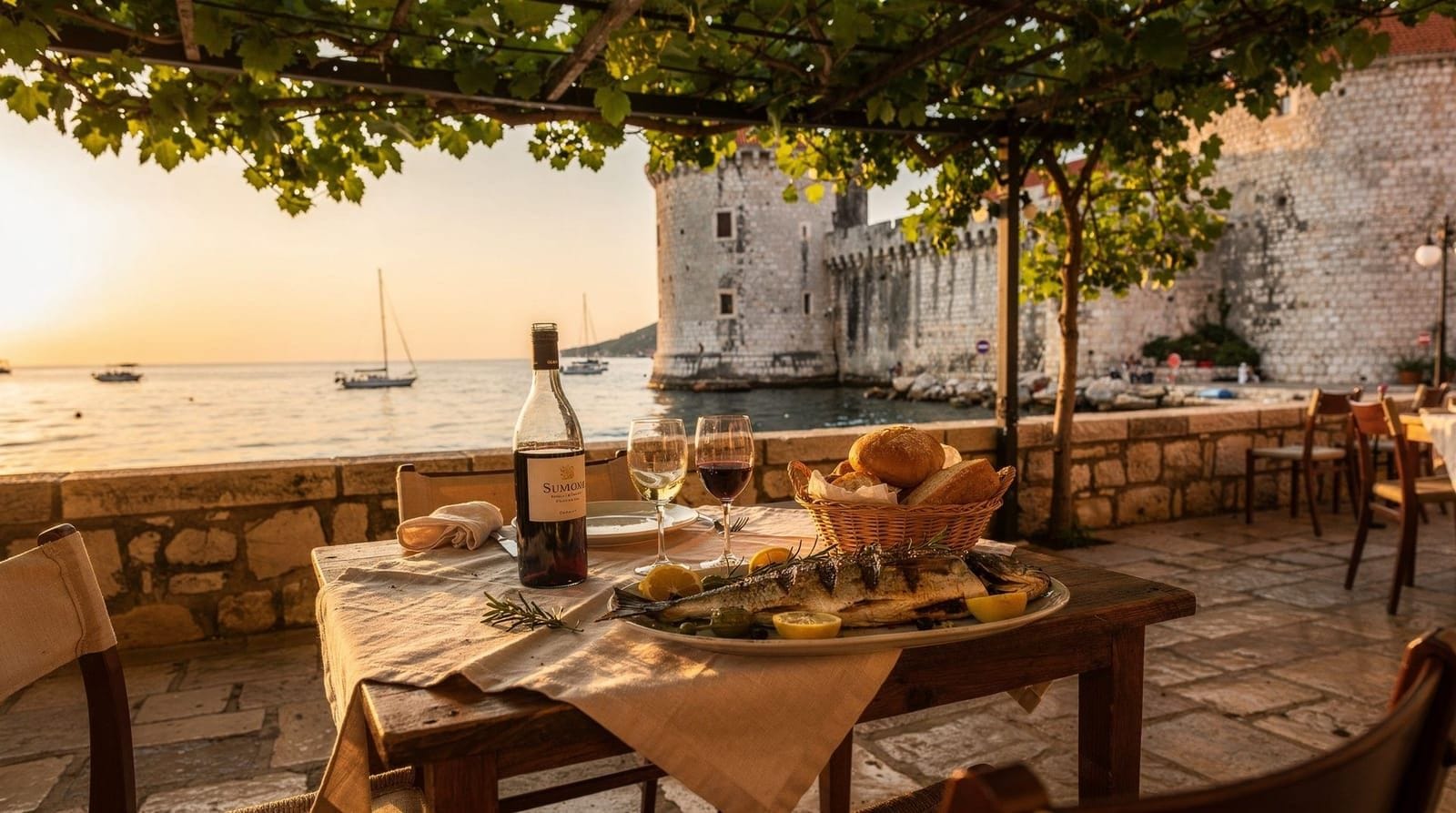
Plavac Mali and Pelješac Wine Guide
Dubrovnik: Deep red wine tour of Peljesac
What is Plavac Mali and why is it famous?
Plavac Mali is Croatia's most celebrated red grape variety, grown on the steep limestone terraces of the Pelješac peninsula in southern Dalmatia. In 2001, researchers at the University of California Davis confirmed it is a parent variety of both Zinfandel and Primitivo — making it genetically one of the most significant discoveries in modern ampelography. The wines are powerful, with 14–16% alcohol, deep colour and flavours of dark plum, blackberry, dried fig and Mediterranean herbs. Dingač and Postup, grown in two specific zones on Pelješac, are Croatia's most prestigious wine designations.
| Where | Pelješac Peninsula, ~90 min from Dubrovnik by car |
| Cost | Tasting fees around EUR 10–20; guided tours EUR 80–180/person |
| Time needed | Half-day (2–3 wineries) to full day with Ston/Korčula |
| Getting there | Self-drive via Pelješac Bridge, or a guided tour from Dubrovnik |
| Best time | April–October for open cellar doors; harvest in September |
Dingač vs Postup at a Glance
| Dingač | Postup | |
|---|---|---|
| Exposure | Steep, intense south-facing | Gentler, eastern-facing |
| Style | Powerful, tannic, high alcohol | More elegant, earlier-drinking |
| Designation established | 1961 (Croatia’s first) | 1967 |
| Access | Potomje village + tunnel to vineyards | Trstenik, Podobuče |
| Best paired with | Lamb peka, aged meats | Grilled meats, heartier seafood |
The grape that changed what we know about wine history
In 2001, researchers at the University of California Davis settled a question that had puzzled wine scientists for decades: where did Zinfandel come from? The grape had been grown in California since the Gold Rush era, adopted as a kind of American identity wine, but its European origins remained murky. DNA analysis pointed to Croatia — specifically to a variety called Plavac Mali, grown on the steep Dalmatian coast. Further research established that Plavac Mali and Primitivo (Puglia’s famous red) share a Croatian parent variety called Crljenak Kaštelanski, a nearly extinct grape that was eventually found growing in a single old vineyard near Split.
The discovery was significant not just academically but commercially. Croatia’s wines were little known outside the former Yugoslavia at the time. Suddenly, Plavac Mali was the ancestor of one of California’s most beloved grapes and a close genetic relative of Apulia’s most successful red. Winemakers on Pelješac who had been selling their wines locally for EUR 5 a bottle found foreign buyers making inquiries.
Two decades later, the quality has followed the reputation. The best Dingač and Postup today are wines of genuine international standing — complex, long-lived, capable of ageing for fifteen years or more — and the peninsula that produces them is one of the most dramatic wine landscapes in Europe.
Pelješac: the peninsula that produces Croatia’s greatest red
Pelješac is a long, narrow peninsula that extends westward into the Adriatic from the Dalmatian coast north of Dubrovnik. It is approximately 65 kilometres long and rarely more than 7 kilometres wide, separated from the mainland by the Pelješki channel and from the island of Korčula by a narrow strait to the south.
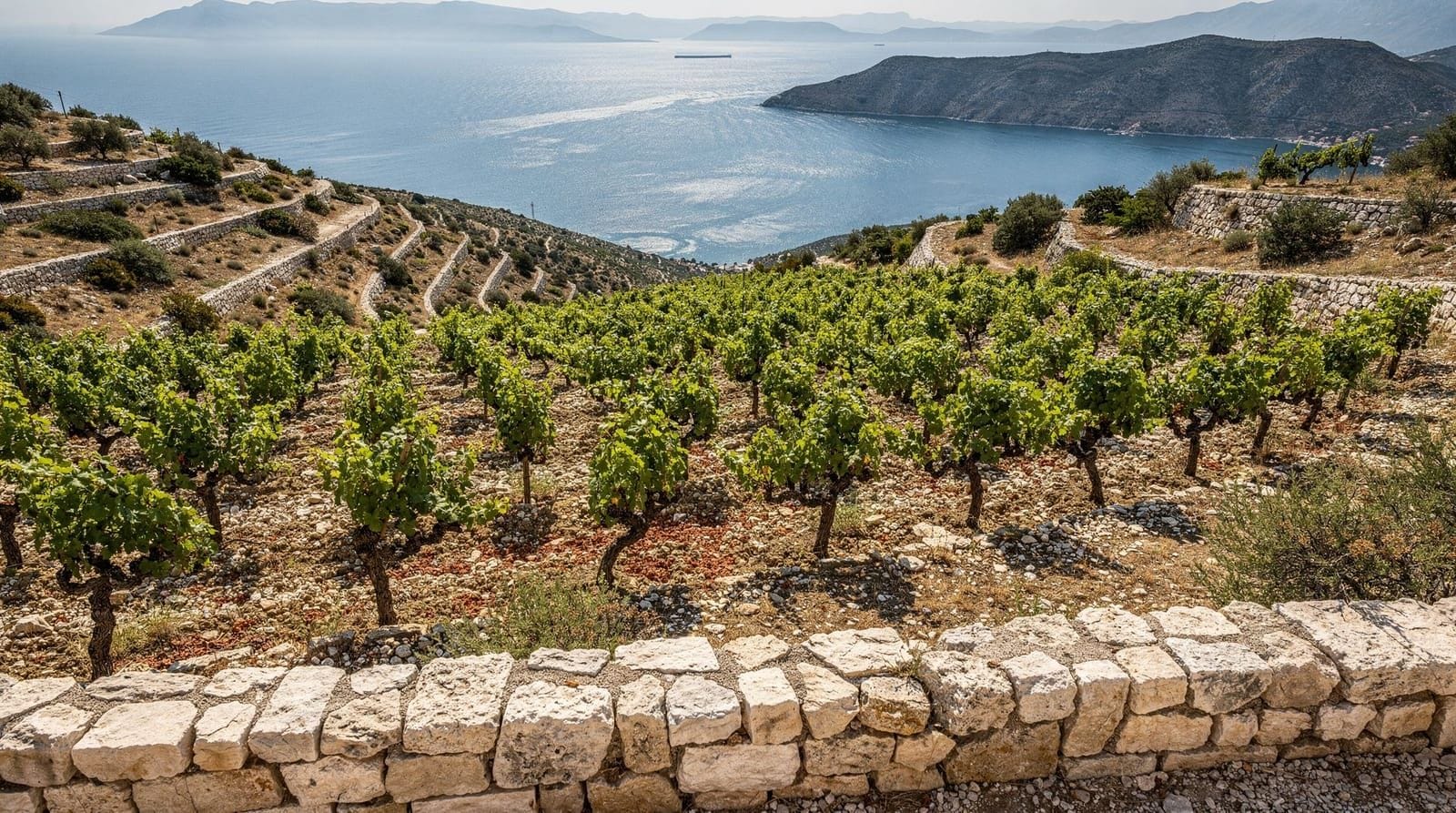
The geology is limestone — white karst that shatters into fragments, drains instantly after rain and reflects sunlight with an intensity that further concentrates the heat received by the vines. The soils above the limestone are thin, poor in organic matter and demanding of the vine: the roots must push deep into fractures in the rock to find moisture. This stress is precisely what great wine requires.
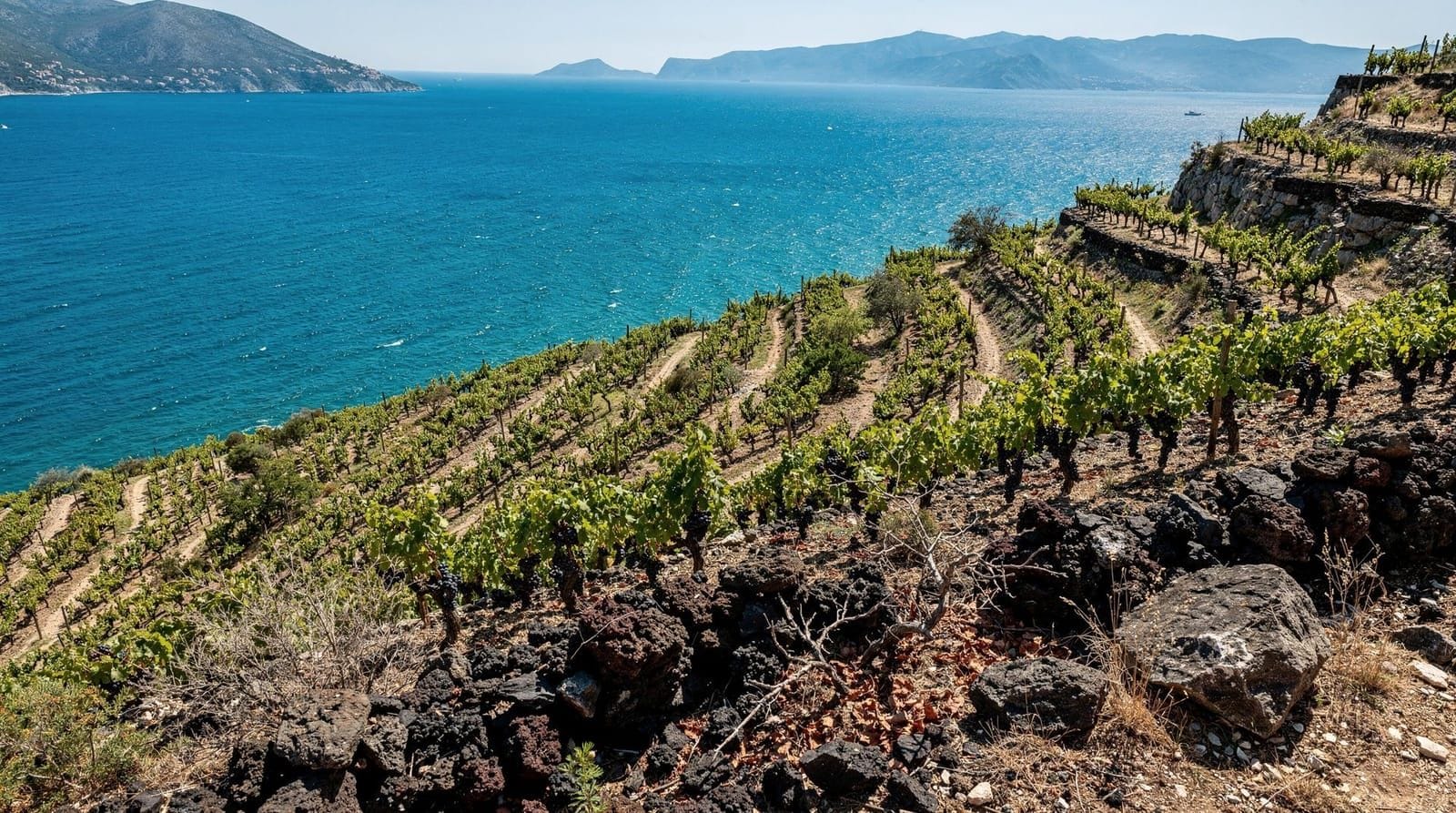
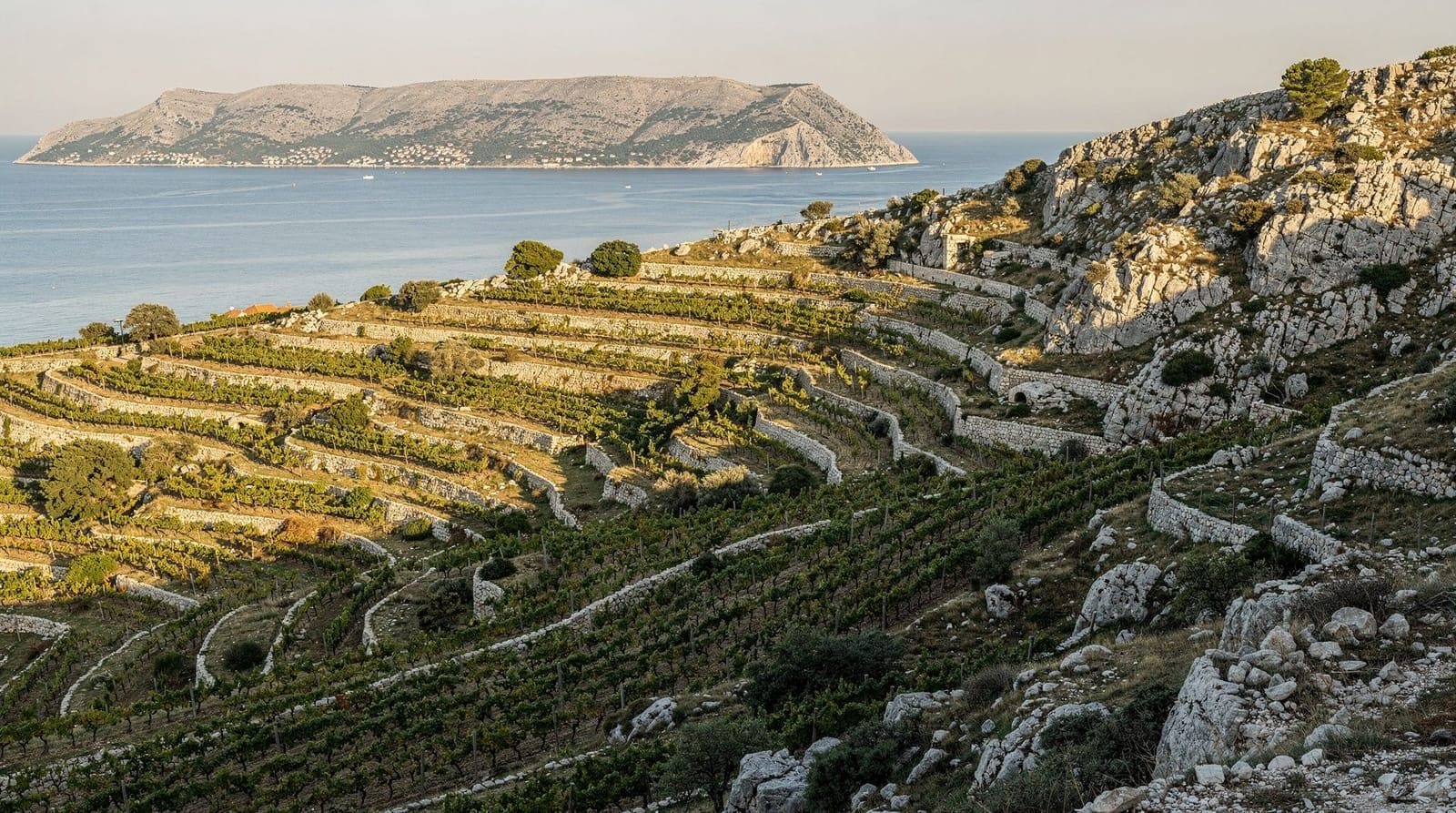
The south-facing slopes above the village of Potomje drop steeply toward the sea. In the Dingač zone, the incline is severe enough that mechanised harvesting is impossible — everything is done by hand, with grapes carried up in baskets from vineyards that can tilt at 45 degrees or more. Workers have been known to use ropes and pulleys on the steepest sections. The combination of southern exposure, reflected light from the sea, poor stony soils and hand harvesting creates conditions for extraordinary concentration in the grape.
Dingač: Croatia’s first controlled wine designation
Dingač was established as Croatia’s first Controlled Designation of Origin in 1961 — predating most of what we now know as modern Croatian wine law. The designation is geographically specific: only Plavac Mali grown in the defined Dingač zone, on those south-facing limestone slopes above Potomje on the western side of the peninsula, can carry the name.
The wines that result are not subtle. Dingač is Croatia’s biggest, most powerful wine: deep garnet to ruby-red in colour, with aromas of ripe black plum, blackberry jam, dried fig, kirsch and a complex herbaceous note that evokes the Mediterranean scrub (macchia) growing between the vine rows. On the palate, the alcohol is always present — 14.5–16% is standard — but in the best examples it integrates with the wine’s extract and tannin rather than burning. The finish is long, warm and persistent.
Young Dingač (under three years) can be unapproachable: tannic, dense and closed. Four to eight years gives you the wine beginning to open. The best bottles from top producers can evolve positively for fifteen or twenty years, developing secondary notes of tobacco, leather, dried herbs and dark chocolate. If you’re buying at the cellar door to drink soon rather than cellar, ask the winery which vintage is currently most approachable — most keep back a few older bottles specifically for visitors who want something ready to drink now rather than in a decade.
Postup: elegance on the eastern slopes
Postup occupies the opposite side of the peninsula — the eastern slopes above the villages of Trstenik and Podobuče, looking toward the Korčula strait. The exposure is different (less brutal south-facing intensity), the slopes are gentler, and the soils retain slightly more moisture. The result is Plavac Mali that ripens a little less fiercely and produces wines of greater aromatic elegance and earlier drinkability.
This is not to say Postup is inferior — it is simply a different expression of the same grape. Where Dingač tends toward power and structure, Postup offers more finesse: red and black fruit rather than just black, softer tannins, and a floral note in the aromatics. Many experienced drinkers prefer Postup precisely because it shows what Plavac Mali can do without needing a decade of cellaring.
The village of Trstenik, on the shore of the Korčula strait, is a good base for Postup tastings. Grgić Vina is located here.
Grgić Vina and the Judgment of Paris connection
The most famous name in Pelješac wine has a story that begins in a chateau in Napa Valley and ends on a limestone hillside above the Adriatic.
Miljenko Grgich — known in California as Mike Grgich — was born in 1923 in the village of Desne, near the Neretva delta just north of the Pelješac peninsula. He grew up around wine: his family grew grapes and made wine at home, as virtually every Dalmatian family did. After World War II, he made his way to Zagreb, then to Germany, Canada and eventually California, arriving in Napa Valley in 1958 with little English and enormous ambition.
He worked his way through several Napa wineries before landing at Chateau Montelena, where he became winemaker. In 1973, he crafted the Chateau Montelena Chardonnay that three years later would defeat France’s finest white Burgundies at the Judgment of Paris — the blind tasting organised by British wine merchant Steven Spurrier that established California’s credentials as a serious wine country. The result shocked the wine world and changed Napa’s fortunes permanently.
Grgich went on to found Grgich Hills Estate in Rutherford, which became one of Napa’s landmark producers. But after Croatian independence in the 1990s, he returned to his homeland and in 1996 established Grgić Vina on the Pelješac peninsula — specifically in Trstenik, at the heart of Postup country. He brought California winemaking discipline to a region that had operated largely on tradition and instinct.
Grgić Vina today produces some of Pelješac’s most refined Plavac Mali, alongside Pošip (sourced from Korčula) and a dry rosé. The estate is open for tastings; book ahead. The price point for their Plavac Mali runs EUR 20–35 at the cellar door.
Grgich’s story resonates on Pelješac in a way that goes beyond one winery — he is, in many respects, the reason international attention returned to the region at all. Before his return, Pelješac wine was known almost exclusively within Croatia and the former Yugoslavia; his Napa credentials and his insistence on planting his flag back in Trstenik gave the region’s wines a story that international journalists and buyers could latch onto. That narrative, combined with the UC Davis genetic discovery a few years later, is really what set up Pelješac’s current reputation. Visiting Grgić Vina today, you’re seeing both a working winery and something close to the origin point of Pelješac’s modern wine tourism.
Other key producers on Pelješac
Miloš (Podgora): Regularly cited as producing Pelješac’s most consistently excellent Dingač. The winery is small, the approach traditional, and the wines — particularly the single-vineyard Stagnum — are among the finest Plavac Mali made anywhere.
Matuško (Potomje): One of the oldest and most established names on the peninsula. Wide range of wines including both Dingač and Postup, plus lighter Plavac Mali under the regional designation. Good cellar door experience with knowledgeable staff.
Saints Hills (Nakovana): An ambitious estate that has invested heavily in both quality and tourism infrastructure. Their range extends beyond Plavac Mali to include international varieties and experimental blends. The tasting room and terrace are among the most hospitable on the peninsula.
Korta Katarina (Orebić): A relative newcomer with strong investment behind it. Produces Dingač, Pošip and rosé; the tasting experience is polished and well-suited to visitors who want comfort alongside quality.
Visiting hours and booking practicalities
Most Pelješac wineries operate seasonal hours, roughly April through October, with peak accessibility in the July–August tourist season. Even in season, smaller family producers may only open for pre-arranged groups rather than casual walk-ins, so emailing or calling a day or two ahead is worth doing even if a winery’s website suggests open tastings. Larger, more tourism-oriented estates like Saints Hills and Korta Katarina keep more predictable hours and can usually accommodate walk-ins during the day. If you’re self-driving rather than joining a tour, plan on visiting no more than two or three wineries in a day — the roads are narrow and winding, tastings run long when the hosts are enthusiastic, and rushing between cellar doors undercuts the whole point of the trip.
Buying and shipping wine home
Most producers sell bottles directly at the cellar door, typically EUR 15–40 depending on the wine and producer, often cheaper than the same bottle in a Dubrovnik restaurant or shop. Serious Dingač from top producers like Miloš can run higher. If you’re flying home, pack bottles in checked luggage with proper protection (some wineries sell padded travel sleeves) rather than risking carry-on liquid restrictions. A few of the larger estates, including Grgić Vina and Saints Hills, can arrange international shipping for larger purchases — ask at the tasting if you’re considering buying a case rather than a bottle or two.
The village of Potomje and Dingač access
Potomje is the administrative centre of the Dingač zone — a small village perched high on the ridge above the south-facing slopes. To reach the actual Dingač vineyards, you either descend on foot (steeply, via a narrow path) or use the Dingač tunnel, a short one-lane tunnel cut through the limestone that brings vehicles from Potomje to the sea-level vineyards. The tunnel was built in the 1970s specifically to facilitate wine transport; it operates on a timed traffic-light system.
Standing at the bottom of the Dingač slope and looking up at the vineyard terraces — irregular, hand-built walls of pale limestone, dark green vine canopy in summer, the sea glittering below — is one of the more striking wine landscapes in Europe. Photographs rarely do the scale justice; it’s only standing at the base of the slope, looking straight up at vines clinging to what looks like a near-vertical rock face, that the labour behind every bottle becomes obvious.
Most guided tours from Dubrovnik include a visit to the Dingač slopes as well as winery visits.
Combining wine with Ston and Korčula
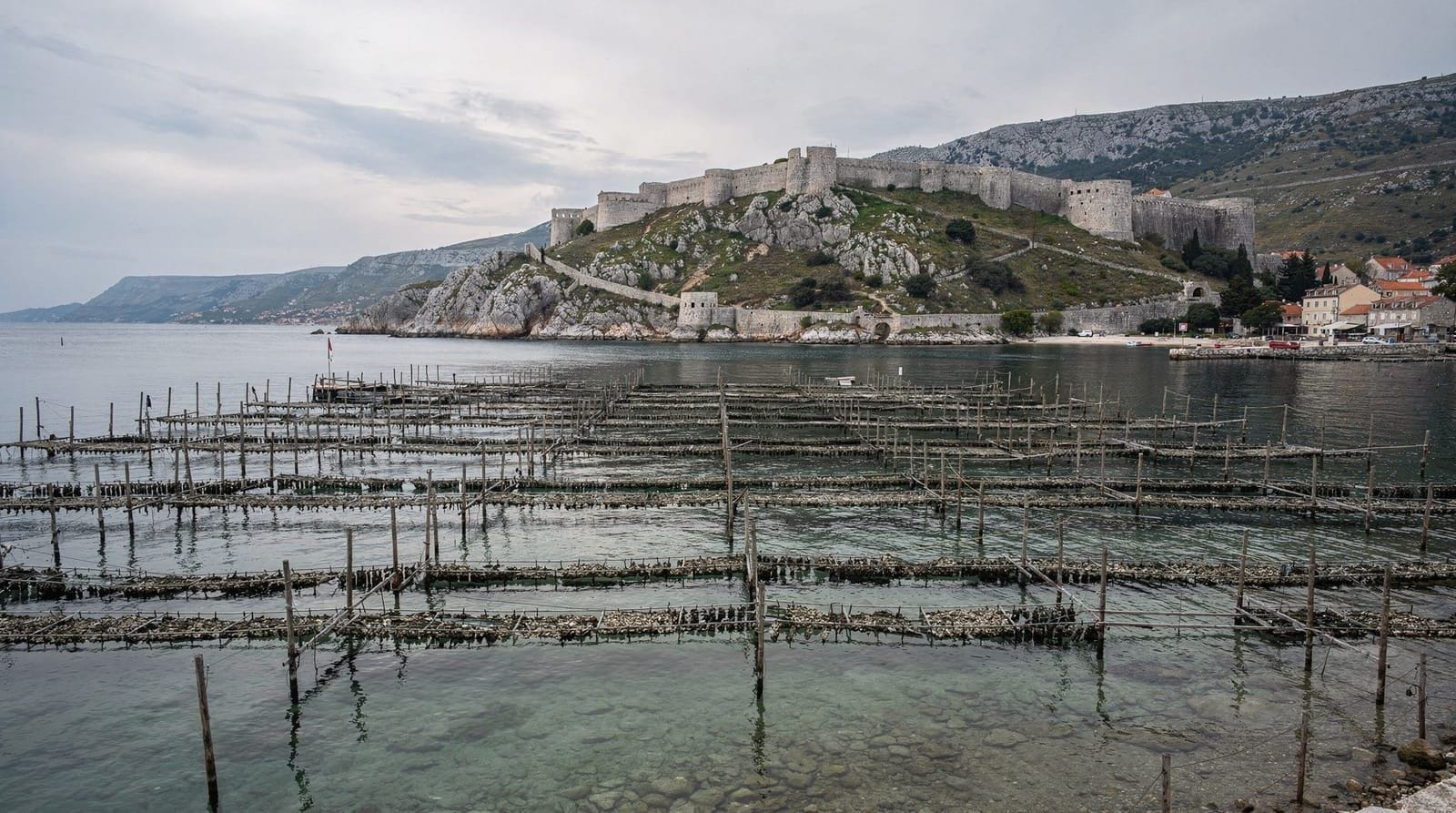
The peninsula’s most logical wine day trip from Dubrovnik begins with Ston, the fortified town at the base of the peninsula famous for its oysters and mussels. The oysters of Ston are grown in Mali Ston bay, one of the cleanest stretches of Adriatic, and eating a dozen with a glass of cold Pošip before driving up to the Dingač slopes is the correct way to start the day.
After the wine tastings on Pelješac, the road continues to Orebić at the peninsula’s western tip, from where a short ferry crossing reaches Korčula town. Combining Pelješac’s reds with Korčula’s whites in a single day gives you Croatia’s wine story in compressed form: the power and drama of Plavac Mali against the mineral elegance of Pošip and Grk.
Food pairings with Plavac Mali
The dalmatian cuisine of Pelješac and the surrounding coast is built around the same ingredients as the wine: lamb, sea, olive oil, herbs.
Lamb peka is the defining pairing. Peka is a method of slow cooking meat and vegetables under a heavy iron bell, covered with embers — the result is impossibly tender, deeply flavoured meat that falls apart at the touch. A glass of Dingač with lamb peka is one of Croatia’s essential culinary experiences. Read more about the technique in our peka guide.
Pašticada — Dalmatian braised beef marinated in vinegar and prunes, cooked with wine and served with gnocchi — is another natural match for Plavac Mali. The dish’s sweet-sour richness stands up to the wine’s tannin and power.
Aged Pag cheese (Paški sir): the sheep’s milk cheese from the island of Pag, sharp and crystalline when well-aged, is the region’s classic cheese partner for red wine. The salt air in which the sheep graze gives the cheese a particular intensity that matches Dingač without being overwhelmed by it.
Grilled meats of any kind work well — lamb chops, veal, game birds. The wine is less successful with delicate fish, though a full-bodied Postup can bridge toward heartier seafood like grilled tuna or swordfish. If your day trip pairs the wine with a sit-down peka meal at a Ston or Pelješac konoba, order the wine before the food arrives — a glass of Dingač poured while the peka is still under its bell, waiting the requisite two-plus hours, is as much a part of the ritual as the meal itself.
Booking a Pelješac wine tour
The logistical case for a guided tour is strong: the winery roads are narrow and challenging, tasting at three or four producers means you cannot drive safely, and a local guide can access producers and get you tastings that would be harder to arrange independently. Most tours depart from Dubrovnik in the morning and return by early evening.
For a dedicated three-winery experience with structured tastings:
If you want wine combined with local food — oysters at Ston, cheese, cured meats — alongside the tastings:
For the most comprehensive full-day immersion on the peninsula:
For more context on what to expect from wine tourism across Croatia, see the Croatian wine guide and the croatia wine tasting booking guide. Day trips from Dubrovnik to Pelješac are covered in detail in the day trips from Dubrovnik guide. For the bridge itself and how it changed the route from Dubrovnik and Split, see the Pelješac Bridge and Neum corridor guide.
Frequently asked questions about Plavac Mali and Pelješac Wine Guide
What is the difference between Dingač and Postup?
Both are Plavac Mali wines grown on the Pelješac peninsula and both carry Croatia's highest geographic designation. Dingač comes from steeper, more exposed south-facing terraces on the western face of the peninsula — the vines receive intense reflected heat from the limestone and the sea, producing wines of greater concentration, higher alcohol and more powerful structure. Postup comes from gentler slopes on the slightly more sheltered eastern side, producing wines that are typically a little more elegant and approachable in youth. Dingač was Croatia's first Controlled Designation of Origin (established 1961); Postup received its designation in 1967.Who is Mike Grgich and what is his connection to Croatian wine?
Miljenko 'Mike' Grgich was born in Desne on the Pelješac peninsula in 1923, emigrated to California, and became one of Napa Valley's most legendary winemakers. As chief winemaker at Chateau Montelena, he crafted the 1973 Chardonnay that defeated France's finest whites at the Judgment of Paris in 1976 — the tasting that shocked the wine world and established California as a serious wine producer. Grgich later founded Grgich Hills Estate in Napa. After Croatian independence in the 1990s, he returned to his homeland and established Grgić Vina on Pelješac, which remains one of the peninsula's most respected producers.How do I get to the Pelješac wineries from Dubrovnik?
Pelješac is about 90 minutes from Dubrovnik by car — drive north along the coast, cross the Pelješki Bridge (opened 2022, free to cross), and follow the wine road through Ston toward Potomje and Trstenik. The road is scenic but narrow in places. Most visitors book a guided wine tour from Dubrovnik rather than driving themselves: you avoid navigating unfamiliar mountain roads, someone else handles the logistics, and you can actually drink the wine you are tasting.What does a Pelješac wine tour typically cost?
Guided wine tours from Dubrovnik to Pelješac range from EUR 80–130 per person for a half-day tour (two or three wineries) to EUR 120–180 for a full-day experience including lunch and multiple tastings. Some tours combine Pelješac with Ston (oysters) or with a visit to Korčula island. Tasting fees at individual wineries, if you visit independently, typically run EUR 10–20 and are often waived if you purchase wine. Most tours include transport by minibus or comfortable van.Which Pelješac producers should I look for?
The most respected names are Grgić Vina (founded by Mike Grgich, Trstenik), Miloš (Podgora, consistently excellent Dingač), Saints Hills (ambitious estate with a range of varieties), Matuško (Potomje, one of the oldest producers), and Korta Katarina (Orebić, also makes excellent Pošip from Korčula). For tasting, Potomje village — the administrative and geographic heart of Dingač — is the obvious starting point: several wineries are within walking distance of each other.What food should I eat with Plavac Mali?
The classic Dalmatian pairings are lamb peka (slow-cooked lamb and vegetables under an iron bell), grilled lamb chops with herbs, pašticada (beef braised with prunes and wine), and aged Pag cheese (Paški sir). The wine's high tannins and alcohol need the fat and protein of meat to show their best. Lighter expressions of Plavac Mali (from non-Dingač zones) can work with heartier fish dishes or grilled octopus, but the serious Dingač and Postup wines are meat wines through and through.Can I visit Pelješac wineries in winter?
Most wineries on Pelješac close or severely limit opening hours from November through March. A few larger estates keep limited hours year-round, but the majority are seasonal operations. If you are travelling in winter, contact your target winery by email at least two weeks in advance — many are willing to arrange private tastings outside the standard season, particularly for serious buyers.
Top experiences
Bookable activities with verified prices and instant confirmation on GetYourGuide.
Top experiences
Best-rated activities across GetYourGuide and Viator.

Krka National Park Tour with tour Guide & Wine tasting from Split & Trogir
- Viator

Dolphin Watching & Sunset Boat Tour With Drinks & optional Dinner
- Viator

Fantastic DOLPHIN & SUNSET TOUR with dinner ( Pula-NP BRIJUNI )
- Viator

Dubrovnik Guided Group Tour with Ston Oyster tasting from Split & Trogir
- Viator

Zadar Highlights: Old Town, Sea Organ & Local Tastings
- Viator

Zadar: Luxury Island Boat Tour, Snorkeling & Unlimited Wine
- Viator