Island Hopping in Croatia: What It's Actually Like
| Typical base | Split, sometimes Dubrovnik |
| Minimum for it to work | 7 days / 2 islands |
| Main cost | Ferries + accommodation, not tours |
| Best months | June, September (July–August is crowded but still works) |
| Booking | Ferries by season; apartments 2–3 months ahead for Hvar/Korčula in summer |
The Island-Hopping Idea and What It Runs Into
The idea has its own aesthetic pull: moving between Croatian islands by boat, each day a different water colour, a different ancient town, a different cove. It is the kind of plan that looks excellent on a map, on a travel blog scroll, on someone else’s Instagram. It also collides, fairly reliably, with the reality of luggage, ferry schedules, and the peculiar exhaustion of constant arrival.
This is not a guide designed to talk you out of island hopping in Croatia. The islands are genuinely worth hopping between. It is an honest account of what the experience is actually like — the logistics, the rhythm, the decisions you will make, the things that will go differently from the plan. And what, ultimately, makes it worth doing despite the friction.
The Ferry as Setting
Every island hop begins on a ferry. This is important to understand, not because ferries are inherently interesting, but because the ferry crossing is the period that forces a certain kind of patience that the rest of the trip depends on.
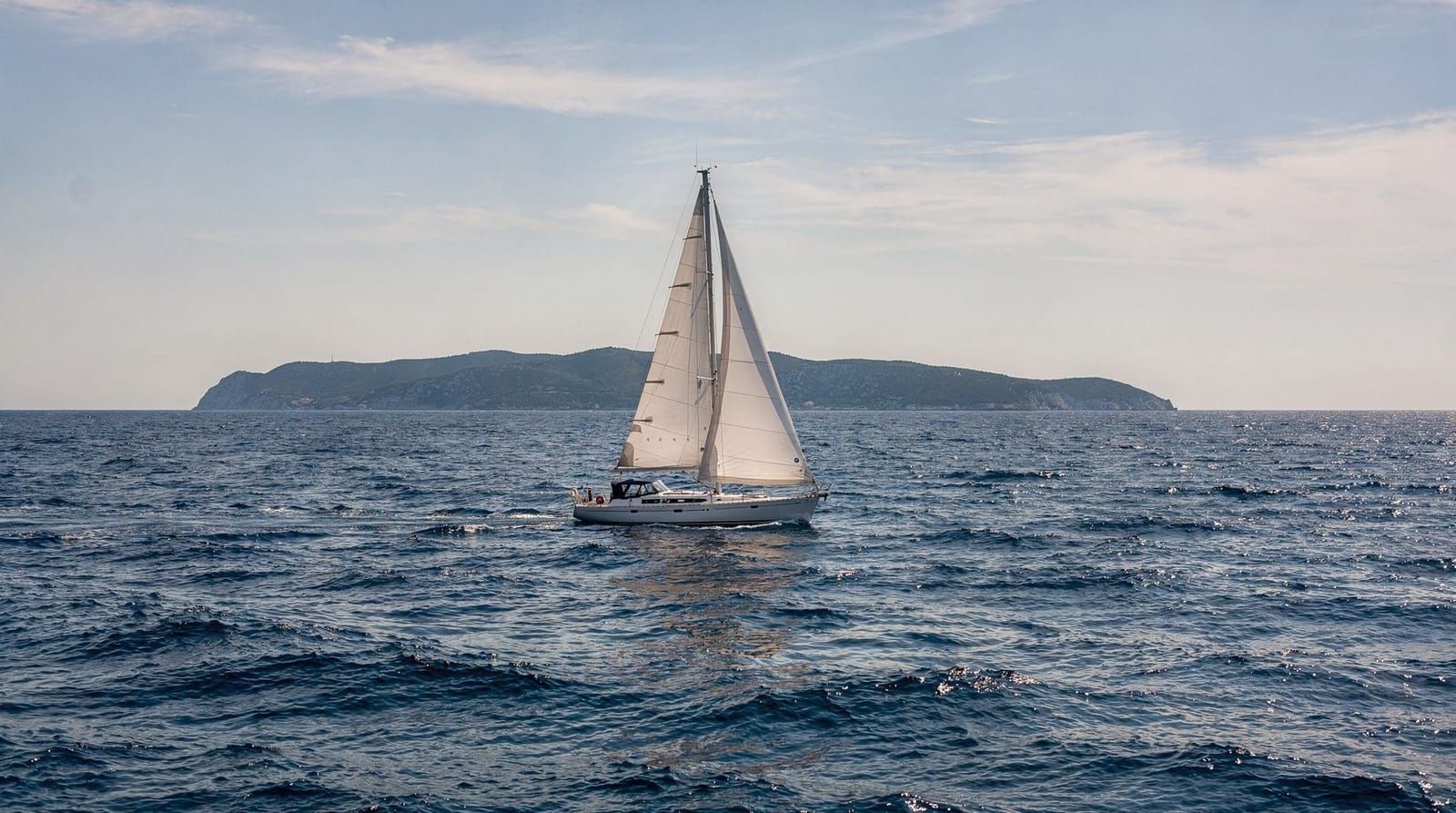
The Jadrolinija car ferry from Split to Stari Grad on Hvar takes about two hours. You leave the Split port — a working port, not photogenic, full of exhaust fumes and waiting cars — and within twenty minutes the view has transformed. The Bračanski kanal (Brač Channel) is a kilometre of dark blue water framed by the mountains of the mainland and the karst limestone of Brač on the other side. It is the kind of view that makes you understand immediately why people come back.
The fast catamarans (Krilo) are quicker but different in character. You sit inside, in air conditioning, with a view through a window rather than from a deck. For Vis, the 2.5-hour crossing on the Jadrolinija ferry is probably preferable to the faster catamaran for exactly this reason — you need the time on deck to arrive properly.
People talk about ferry delays as an inconvenience. They are, occasionally. But more often, waiting for a ferry in a small coastal town — sitting with a coffee at the harbour, watching the fishing boats — is accidentally one of the better parts of the trip.
Hvar: The One You Have Heard Of
Hvar is the island that Croatia is most associated with internationally, and this creates a specific dynamic. Hvar town in July is genuinely crowded, genuinely expensive, and genuinely worth seeing despite both of those facts.
The old town, with its cathedral and loggia and Renaissance theatre (the oldest public theatre in Europe, opened 1612, which almost no one mentions), is beautiful in the late afternoon light when the day-trippers have left for their boat parties and the town briefly becomes its own again. The Fortica fortress above the town is worth the steep climb — the view of the bay, the Pakleni Islands scattered across the water, is one of the more compelling vistas in the country.
But Hvar town is not the whole of the island, which is where the island-hopping logic sometimes goes wrong. The interior — the lavender fields around Brusje, the wine village of Svir, the old road between Stari Grad and Hvar town — is almost entirely unvisited by tourists. If you are going to spend two nights on Hvar, spend one of them in Stari Grad (quieter, more genuine, just as historically interesting) and use the other for the main town. The lavender blooms in June and early July, and the colour against the limestone is one of those images that stays.
The water around the Pakleni Islands (a short boat taxi from Hvar town’s harbour) is exceptional — translucent, cold below the surface layer, with coves accessible only by boat. This is the swimming Croatia you were imagining. It does not disappoint.
The Transition Day
Island hopping has a specific type of day that no travel plan accounts for adequately: the transition day. This is the day you check out of your accommodation by 10:00, store luggage at the harbour café, take the midday ferry, arrive at the next island at 14:00, pick up keys at 15:00, and spend the afternoon trying to orient yourself in a new place. You are not fully anywhere. You are between the island you were enjoying and the one you are about to enjoy.
These days have a specific texture — slightly unmoored, logistically taxing, occasionally frustrating when the ferry runs late or the apartment is harder to find than the directions suggested. They are also, viewed from sufficient distance, often the days that create the clearest memories. The conversation with the woman running the harbour café who recommends the konoba nobody writes about. The wrong turn on a coastal path that opens onto a cove you would never have found otherwise.
The mistake is trying to optimise them out of existence with tight scheduling. The right approach is to treat transition days as their own kind of experience — not destination days, not rest days, but days for the unexpected.
Korčula: The Island That Gets Better the More Time You Give It
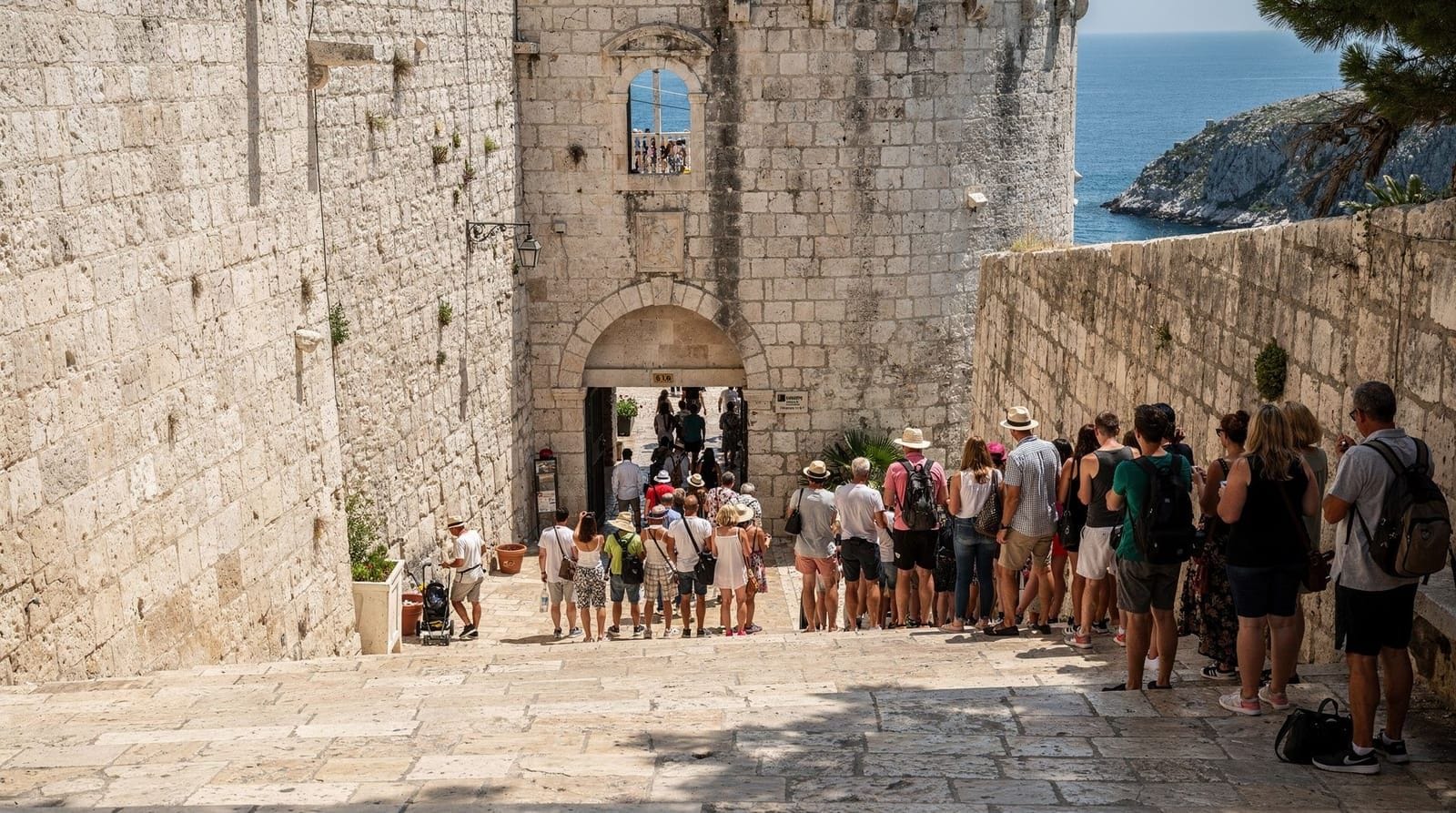
Korčula old town sits on a small peninsula that projects into the channel, with towers and walls built by the Venetians in the 13th century. The street plan is designed to minimise the bora wind — alternating herringbone pattern, narrow enough that two people with bags cannot pass without negotiating. It is compact and walkable and, unlike Dubrovnik’s old town, actually has residents living in it. People hang washing between windows. Children play in the square in the evening. The tourist layer is present but has not entirely replaced the functioning neighbourhood beneath it.
The Marco Polo connection — Korčula claims to be his birthplace — is contested by historians and leaned into enthusiastically by the tourism industry. The house presented as his birthplace is probably not his birthplace. This does not diminish the enjoyment of the town.
What Korčula rewards is time. The first afternoon you are navigating and finding your bearings. The second morning you know where to get coffee and which konoba is worth the wait for a table. By the third day, you have found the footpath along the southern shore that passes through pine forest to a small beach with no facilities and very few people.
This is the rhythm that island hopping at pace cannot access. Two nights on an island means two transition days and one full day. One full day is not enough for Korčula — or, honestly, for any of the larger Dalmatian islands.
Vis: The Island for the Firmly Decided
Vis is the most remote inhabited island off the Dalmatian coast, and this distance has historically protected it from the mainstream of Croatian tourism. The island was closed to foreign visitors during the Yugoslav period (it housed a military base) and only opened to tourists in 1989. The result is an island that feels less processed than Hvar, less immediately picturesque than Korčula, and more like an actual place where people live.
Komiža, the fishing village on the western side, has a harbour where the boats still look like they are working rather than decorative. The restaurants around the harbour serve fish caught that morning because there is no tourist volume large enough to justify buying it elsewhere. The wine — primarily Plavac Mali from the island’s steep terraces — is served in unmarked carafes and is occasionally excellent.
The Blue Cave on nearby Biševo Island is the reason many people come to Vis, and it is genuinely unusual — a sea cave where the refracted light turns the water an electric blue. The cave is accessible only by small boat and only during certain tidal and daylight conditions. It can be closed without warning. Going specifically for the cave is a gamble; going to Vis with the cave as a possibility is the right framing.
Getting to Vis requires committing to the journey. The ferry from Split takes about two hours in each direction. This commitment is exactly what makes the island feel like a reward — you have earned the relative quiet of Komiža in the evening.
Mljet: The Island Most Itineraries Skip
Mljet rarely makes the first-timer’s island list, which is its own kind of argument for going. The western third of the island is a national park built around two saltwater lakes, Malo and Veliko Jezero, connected to the sea by a narrow channel and to each other by an even narrower one. A small islet in the middle of the larger lake holds a 12th-century Benedictine monastery, reachable by the park’s own boat shuttle or by renting a kayak and paddling out yourself, which is the better option if you have the arms for it.
Mljet is awkward to reach directly by ferry from Split — most people access it as a day trip from Dubrovnik instead, which is a genuinely different experience from staying overnight. The day-trip crowd clears out by late afternoon, and the hour before the last boat back to the mainland — cycling the lake path in near silence, the light going gold over the pines — is the kind of thing island hopping is supposed to deliver and often doesn’t, because most itineraries never get this far south.
If Mljet fits your route, treat it as a full day minimum, not a stopover. The bike rental at Pomena or Polače, combined with the lake circuit, takes three to four hours at an easy pace; add swimming time and lunch and the day fills itself naturally.
What a Week Actually Looks Like
Here is a realistic seven-day structure for two islands from Split, without the false efficiency of trying to add a third:
| Day | Where | What happens |
|---|---|---|
| 1 | Split → Hvar (ferry) | Arrive, settle in Stari Grad or Hvar Town, orient |
| 2 | Hvar | Old town, Fortica fortress, Pakleni Islands swim |
| 3 | Hvar interior | Lavender fields, Svirče wine village, slow morning |
| 4 | Hvar → Korčula (ferry) | Transition day — expect it to feel unmoored |
| 5 | Korčula | Old town on foot, find your konoba |
| 6 | Korčula | Southern-shore footpath, the beach with no facilities |
| 7 | Korčula → Split (ferry) | Depart, or extend if flights allow |
This is deliberately unambitious. It leaves the interior islands — Vis, Mljet, Brač — for a second trip, which is the honest trade-off of choosing depth over coverage.
The Pacing Question
Every island-hopping itinerary involves a negotiation about pace. Move too fast and you accumulate arrivals and departures rather than experiences. Move too slowly and you cover fewer islands, which feels like waste.
The honest answer: one island per two to three days is the minimum for any meaningful experience. Seven days of island hopping works well as two islands (three nights each) plus one transition day. Ten days allows three islands with time to breathe.
The Dalmatian island hopping 7 days itinerary offers a structured version. The Croatia 10 days and Croatia 14 days itineraries give more options.
The planning guides — specifically island hopping Croatia and Hvar vs Brač vs Korčula — cover the comparative questions if you are still deciding which combination makes sense.
What You Will Miss and Why That’s Okay
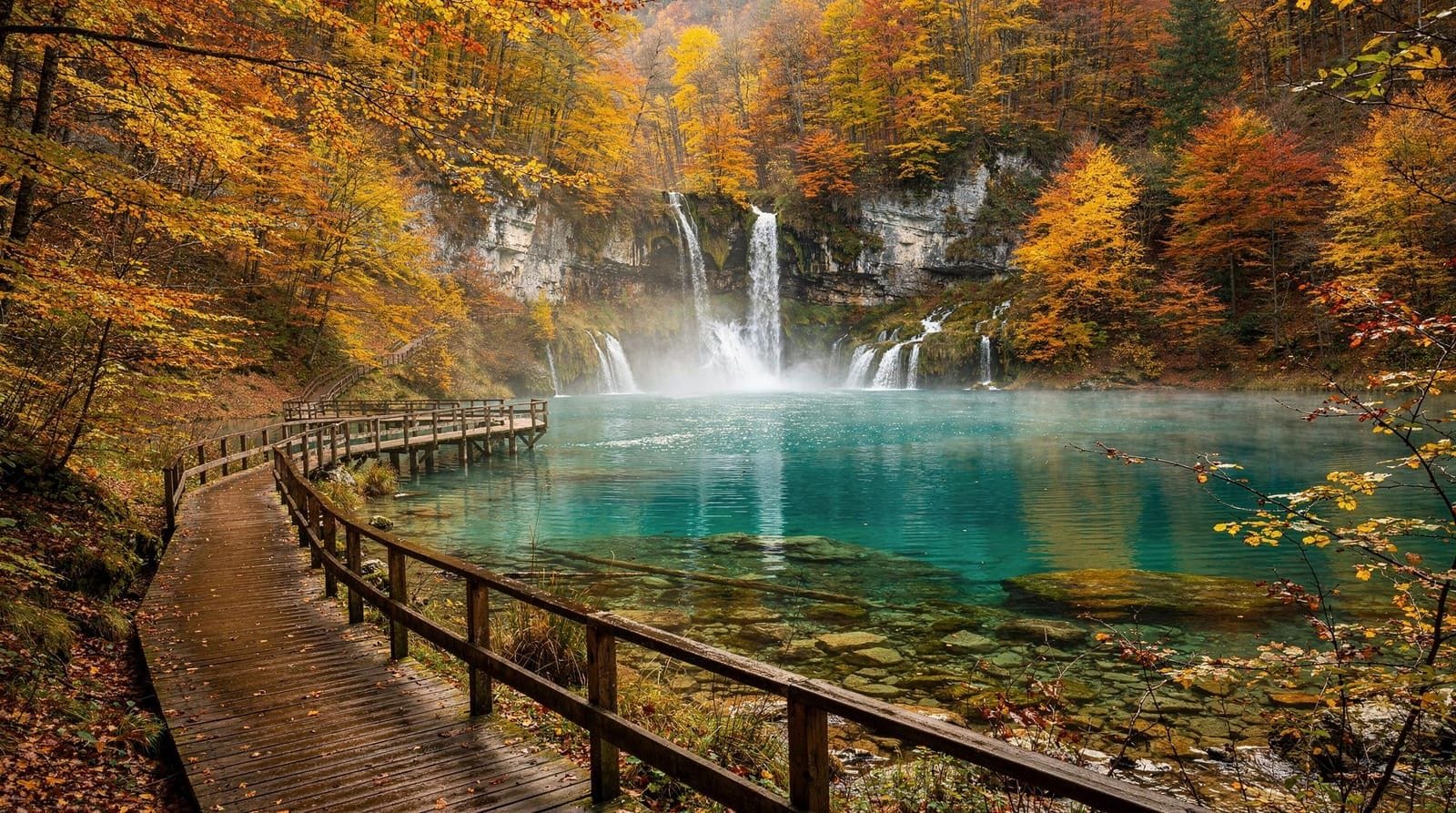
An island-hopping trip through Croatia will not cover the interior. You will not see Zagreb or the Zagorje castles or the mountain roads above the coast. You will probably not see Plitvice Lakes, though Plitvice is one of the most significant things in the country.
This is fine. Croatia is not a country you can see in one trip regardless of pace. The islands are a complete version of a Croatian holiday, not a partial one. What they offer — the particular quality of light on the water in the late afternoon, the sound of a boat against a dock in the morning quiet, the meal that happens accidentally in a place you had no plan to find — is not diminished by what they exclude.
The islands also have a specific relationship to time. Island time is a cliché, but it describes something real: a pace at which an afternoon feels longer and a morning coffee feels like an event. This is most available when you are not rushing to the next departure. Give the islands time, and they give it back.
Try a half-day sailing trip from Split to get your first taste of the islandsA Note on Autumn Island Hopping
The island-hopping story most often told is a summer story — heat, crowds, boat parties, the social scene of Hvar. It is a less commonly told fact that island hopping in September is a qualitatively different experience.
The sea is still warm — often 23–25°C. The ferries run on the same routes with slightly reduced frequency. The islands are quieter. The restaurants have recovered from summer volume and are, in most cases, better. The accommodation is available and cheaper. The social energy is replaced by something harder to describe: an island that has finished performing for the season and is just itself again.
Croatia in autumn covers this in more detail. Many people who have tried island hopping in both seasons consider September their preferred option.
The Part You Cannot Plan
Island hopping is a logistical exercise that occasionally, despite itself, becomes something else. The afternoon you stayed an extra two hours because the konoba owner opened a bottle of something he had no intention of selling and sat down with you. The morning swim in flat water before anyone else was awake. The ferry crossing where the mountains on both sides of the channel turned exactly the colour of shadow that you did not know existed before you saw it.
These moments do not appear on itineraries. They appear in the space between the planned things, which is the argument for leaving space. The islands have more to offer than any schedule can accommodate. The best version of an island-hopping trip is probably the one that goes slightly wrong and takes longer than intended.