Croatian Festivals and Events: A Year-Round Guide
Croatia’s Festival Calendar: What’s Actually Worth Planning Around
Croatia has developed a credible festival calendar over the past two decades. The range is broader than most people realise: electronic music festivals with international headliners, classical performance in medieval fortresses, food and wine events tied to harvest season, and deeply local cultural celebrations that have been running for centuries.
This guide covers the main events by season, with honest assessments of scale, atmosphere, ticket logistics, and whether they are worth building a trip around or just happening to coincide with.
| Biggest music festival | Ultra Europe, Split (July) |
| Most atmospheric setting | Motovun Film Festival, Istria |
| Best value festival window | October (Truffle Days, wine harvest, Photo Days) |
| Book accommodation | 4–6 weeks ahead for major festivals |
| Avoid if crowd-averse | Split during Ultra, Pag during Hideout |
Spring: Easter, Film, and the First Warm Months
Easter Processions — Hvar (Late March/April)
The Za Krizen (Following the Cross) procession on Hvar Island has been running every Holy Thursday for over 500 years. It begins at midnight and involves a cross-bearer from each of six villages leading a procession that visits all other villages in a fixed order — a circuit of roughly 22 kilometres completed through the night.
UNESCO added the Za Krizen to its list of intangible cultural heritage in 2009. For visitors, it is one of the more affecting things that happens in Croatia — not staged for tourism, attended primarily by islanders, and genuinely ancient in its continuity.
Timing: Holy Thursday (the night before Good Friday). Dates vary by year. Logistics: The island is more crowded than usual — book accommodation several weeks in advance.
INmusic Festival — Zagreb (Late June)
INmusic is the largest outdoor music festival in Croatia, held on an island in Lake Jarun on the edge of Zagreb. It runs over three days and attracts headliners of genuine international scale — past lineups have included Arctic Monkeys, Nick Cave, The Strokes, and similar acts.
The lake setting is unusual for a music festival and works well. The atmosphere is relaxed by major festival standards, and Zagreb is more accessible in late June than many coastal destinations.
Tickets: Sell out for popular lineups. Check when the lineup is announced (usually February–March). Logistics: Zagreb accommodation books up; the tram network connects the city to the festival site.
Subversive Festival — Zagreb (June)
An international festival of documentary film and political thought that brings filmmakers and thinkers to Zagreb for a week of screenings and talks. Primarily attended by a Croatian and regional European audience rather than tourists, which makes it more interesting to attend. Tickets are affordable.
Summer: The Main Festival Season
Ultra Europe — Split (July)
Ultra Europe is the European iteration of the Miami-based Ultra Music Festival — one of the largest electronic music events in Europe. The main stage at Poljud Stadium in Split accommodates tens of thousands. The event typically extends with boat parties and island events on Hvar.
For non-festival visitors: If your dates coincide with Ultra Europe, expect Split to be significantly more crowded and prices elevated. Tickets and dates: Typically the second or third weekend of July. Book well in advance.
Dubrovnik Summer Festival (July–August)
The Dubrovnik Summer Festival (Dubrovačke Ljetne Igre) has been running since 1950. The festival uses the old city’s public spaces — the Rector’s Palace courtyard, the Lovrjenac Fortress, the Orlandov Stup — as performance venues for theatre, opera, ballet, and classical music.
Watching opera in a medieval courtyard in Dubrovnik on a warm summer night is a specific kind of experience. Programming quality varies year to year, but the setting is always exceptional.
Tickets: Available on the festival’s official website and at box offices in Dubrovnik. Sell out quickly for popular performances. Best for: Classical concerts and theatrical performances that make full use of the architectural settings.
Split Summer Festival (July–August)
Split runs its own summer festival program using Diocletian’s Palace and the Prošekov fortress as venues. The programming includes classical music, theatre, and film — more modest than Dubrovnik’s but well-suited to the city’s character.
Motovun Film Festival — Istria (Late July)
The Motovun Film Festival takes place in the hilltop medieval town of Motovun in Istria — perhaps the most atmospheric festival setting in Croatia. The main outdoor screening is on the town walls, with the Istrian countryside visible beyond the screen. The selection focuses on independent and art house cinema from across the world.
The festival has a cult following among Croatian and European film enthusiasts. It is small enough to retain character — Motovun has a population in the hundreds — but internationally recognised enough to attract quality programming.
Logistics: Accommodation in Motovun is extremely limited and books out immediately. Most festival attendees stay in Poreč or Rovinj and take shuttles to the festival.
Hideout Festival — Pag (Late June/Early July)
Hideout Festival on Pag Island — specifically at Zrće beach — is a major electronic music festival running five days. Unlike Ultra Europe’s stadium format, Hideout is a beach party atmosphere with stages on and adjacent to the shore. Pag’s stark limestone landscape creates an unusual visual backdrop for the event.
Špancirfest — Varaždin (Late August)
Varaždin, the baroque city in northern Croatia, holds Špancirfest each year — a ten-day street festival of music, performance, and craft that is one of the most popular events in the Croatian interior. It draws both international acts and local performers, with events spread across the city’s baroque streets and squares.
For visitors doing the Zagorje castle circuit or routing between Zagreb and the coast, Varaždin in late August is a worthwhile detour.
Autumn: Wine, Truffles, and Harvest Celebrations
Truffle Days — Buzet, Istria (October)
The town of Buzet in central Istria holds Truffle Days (Dane Tartufa) each October. The centerpiece is a large truffle omelette prepared in the main square — a tradition since the 1990s. The festival includes truffle markets, demonstrations, and dinners at local restaurants.
Istria’s truffle season runs September through December, with October often considered the peak for white truffles. Our Istrian truffles guide covers the season and what to expect from a truffle hunt.
Try truffle hunting, cooking, and tasting in Istria during truffle seasonGrape and Wine Festivals (September–October)
Croatia’s wine regions have harvest celebrations in autumn, most of them local events not heavily marketed internationally. In the Pelješac peninsula, the Dingač harvest in September is celebrated informally and sometimes with organised tastings. In Istria, harvest events at larger estates coincide with truffle season.
The most accessible wine experiences for visitors are booked directly with producers — many offer picking followed by a meal in September and October. For the broader wine touring picture, the Croatia wine roads guide covers regional options.
Rovinj Photo Days (October)
Rovinj holds an annual photography festival in autumn, bringing international photographers and exhibitions to Rovinj’s old town galleries and public spaces. The event is small but well-regarded within European photography circles, and October is one of the better months to be in Rovinj regardless.
Winter: Zagreb Advent and the Quiet Season
Advent in Zagreb (December)
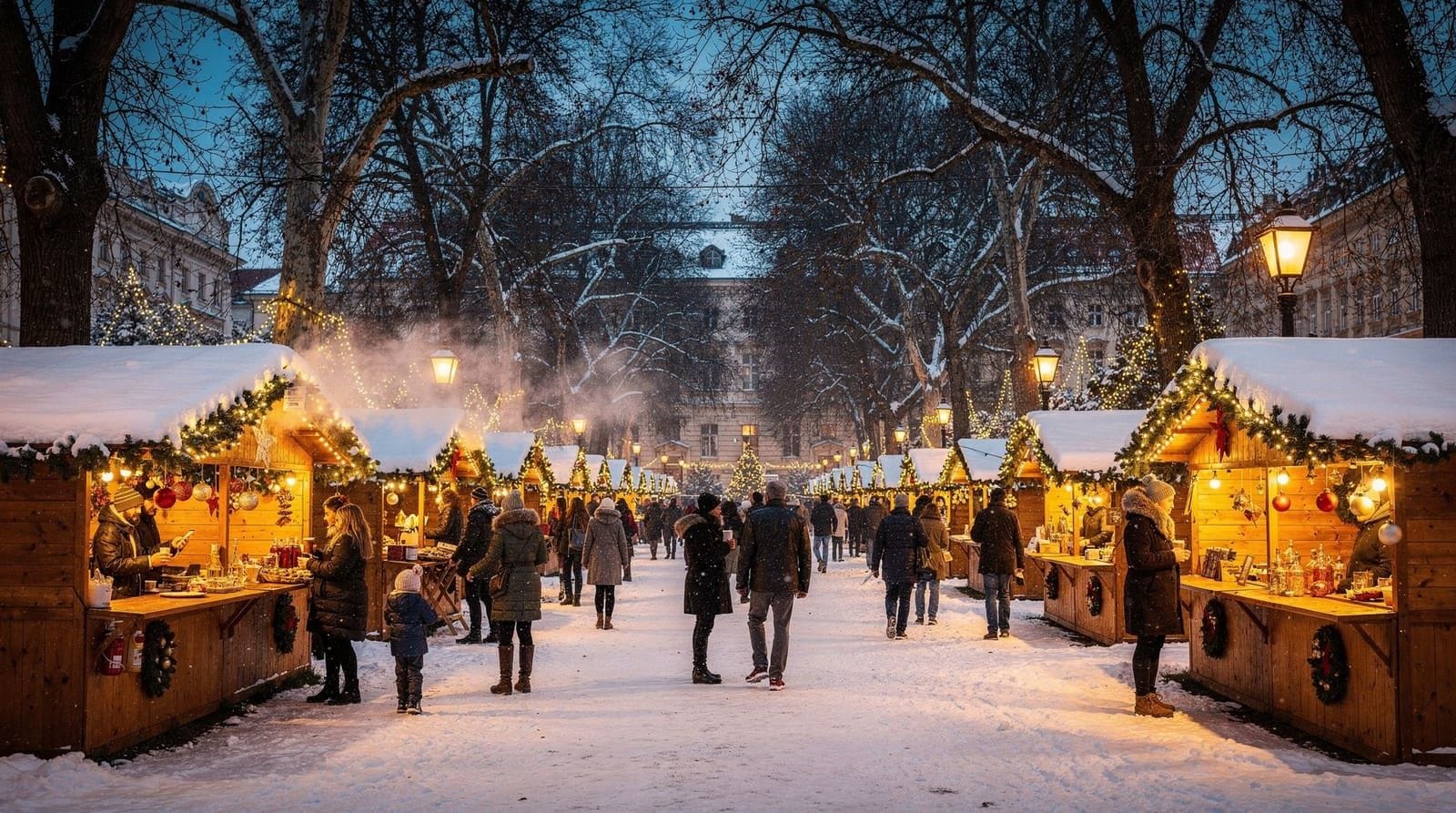
Zagreb’s Christmas market (Advent u Zagrebu) has been voted the best Christmas market in Europe multiple times by European Best Destinations. The designation is partly a function of the city’s compact and atmospheric old town (Gornji Grad) providing excellent staging, and partly genuine — the market is genuinely well-run, with quality local food and craft stalls alongside the seasonal decorations.
The main locations are Zrinjevac park, Strossmayerov trg, and the ice rink at King Tomislav Square. The extended hot wine and mulled spirit offering is better than most comparable European markets.
When to go: The market runs from late November through early January. The first two weeks of December before the peak holiday period offer the best balance of atmosphere and manageability. Combining with a wider trip: Zagreb in December is warm-coat weather but not extreme cold. The city works as a weekend break in itself, or as a stopover before or after a Vienna/Ljubljana/Budapest circuit.
For more detail, our Zagreb Advent guide covers logistics and what to see.
Local Festivals Worth Knowing
Beyond the well-publicised events, Croatia has a network of local festivals that most international visitors never encounter:
Sinjska Alka — Sinj (August): A lance tournament dating from 1715, held annually in the small town of Sinj in the Dalmatian hinterland to commemorate a battle against Ottoman forces. The participants (alkari) ride horses at full gallop and attempt to lance a small iron ring. It is UNESCO intangible heritage and genuinely ancient in its practice. Not many tourists find it.
Brodsko Kolo — Slavonski Brod (June): One of the largest folk music and dance festivals in Croatia, held in the Slavonian town of Slavonski Brod. Tamburica music (stringed instrument ensemble) and traditional Slavonian dance are the main attractions. Almost entirely unknown outside Croatia.
Đakovački Vezovi — Đakovo (late June/July): A folkloric festival in the Slavonian town of Đakovo, combining folk performances, horse shows (Đakovo is known for its Lipizzaner stud farm), and traditional crafts.
Rijeka Carnival — Rijeka (January/February): One of the largest carnival celebrations in Europe, running for weeks with a masked parade through Rijeka that draws over 100,000 people on the main parade day. Less internationally known than Venice’s carnival but comparable in scale, and considerably cheaper to attend. Nearby Opatija hosts related events during the same weeks.
Fažana Fisherman’s Festivals (summer): Small coastal towns across Istria and Kvarner hold traditional fishermen’s festivals (fešte) through summer — grilled sardines, local wine, live tamburica or klapa music, usually free to attend and genuinely local rather than staged for tourists. These are not individually famous but worth asking about locally; most fishing towns run at least one during July or August.
Planning a Trip Around Festivals: Practical Considerations
Book accommodation early: All major festivals create local accommodation pressure. For Dubrovnik Summer Festival, Ultra Europe, and INmusic, book at least 4–6 weeks ahead; for events like Motovun, book as soon as you decide to go.
Ticket availability: Major international festivals (Ultra, Hideout, INmusic) can sell out before travel decisions are made. Check ticket release schedules and act quickly for popular lineups.
Price spikes: Accommodation prices around major festivals — particularly Ultra Europe in Split and INmusic in Zagreb — can increase 50–100% compared to adjacent dates. This is worth factoring into budget planning.
Shoulder season festivals: Truffle Days, wine harvest events, and Rovinj Photo Days all fall in October, which is already a good value month. The festivals add content to an already cost-effective travel window.
Non-festival visitors: If you are specifically not interested in the festival atmosphere, checking event dates before booking is worthwhile — particularly for Ultra Europe (Split) and Hideout (Pag). The islands and cities involved take on a different character during these events.
For broader seasonal context, our best time to visit Croatia guide and the Croatia month by month breakdown cover how festivals fit into the overall seasonal picture.
Explore Dubrovnik’s food culture and history on a walking food tourThe Calendar at a Glance
| Month | Event | Location |
|---|---|---|
| March/April | Easter Za Krizen procession | Hvar |
| June | INmusic Festival | Zagreb |
| June | Subversive Festival | Zagreb |
| Late June/July | Hideout Festival | Pag (Zrće) |
| July | Ultra Europe | Split |
| July–August | Dubrovnik Summer Festival | Dubrovnik |
| July–August | Split Summer Festival | Split |
| Late July | Motovun Film Festival | Motovun, Istria |
| Late August | Špancirfest | Varaždin |
| October | Truffle Days | Buzet, Istria |
| October | Rovinj Photo Days | Rovinj |
| December–January | Advent u Zagrebu | Zagreb |
Croatia does not have a single unmissable festival in the way that some countries have an iconic event that defines the cultural calendar. What it has instead is a consistent program across the year that reflects the country’s range — from ancient religious procession to contemporary electronic festival, from art house cinema on a hill to truffle omelette in a baroque square. The best festival to plan around is whichever one aligns with the kind of travel you want to do.
If wine is more your focus than music or theatre, see the Croatian wine guide and the Croatia wine tasting guide for producer visits that run independent of the festival calendar. And if you would rather visit Croatia entirely outside festival season for a quieter trip, the Croatia in summer and Croatia in winter guides cover what each season looks like away from the event crowds.