The Best Day Trips from Croatia's Main Cities
How to Use Croatia’s Cities as Bases
Croatia’s geography lends itself to day tripping. The country is not large, but it is diverse enough that a single base — Split, Dubrovnik, Zagreb, or Zadar — can serve as a launchpad for dramatically different landscapes within two hours. The challenge is not finding day trips but choosing between them.
This guide covers the best options from each major city, with honest assessments of logistics, what the experience is actually like, and when to go independently versus booking a tour. It draws on the dedicated guides we have for each origin city: day trips from Split and day trips from Dubrovnik go deeper on specific routes.
| Best base overall | Split — widest range within 2 hours |
| Best for cross-border trips | Dubrovnik — Mostar and Kotor |
| Best for national parks | Zadar or Zagreb for Plitvice, Split for Krka |
| Typical cost | Guided day tours generally run from around €40–€90pp depending on distance and inclusions |
| Book ahead | Plitvice tickets and Blue Cave tours, especially June–August |
From Split
Split is Croatia’s best-positioned city for day trips. Within two hours by car or ferry, you can reach national parks, islands, waterfalls, and medieval towns. The combination of a working port, good bus connections, and central Dalmatian location makes it the most versatile base in the country.
Plitvice Lakes
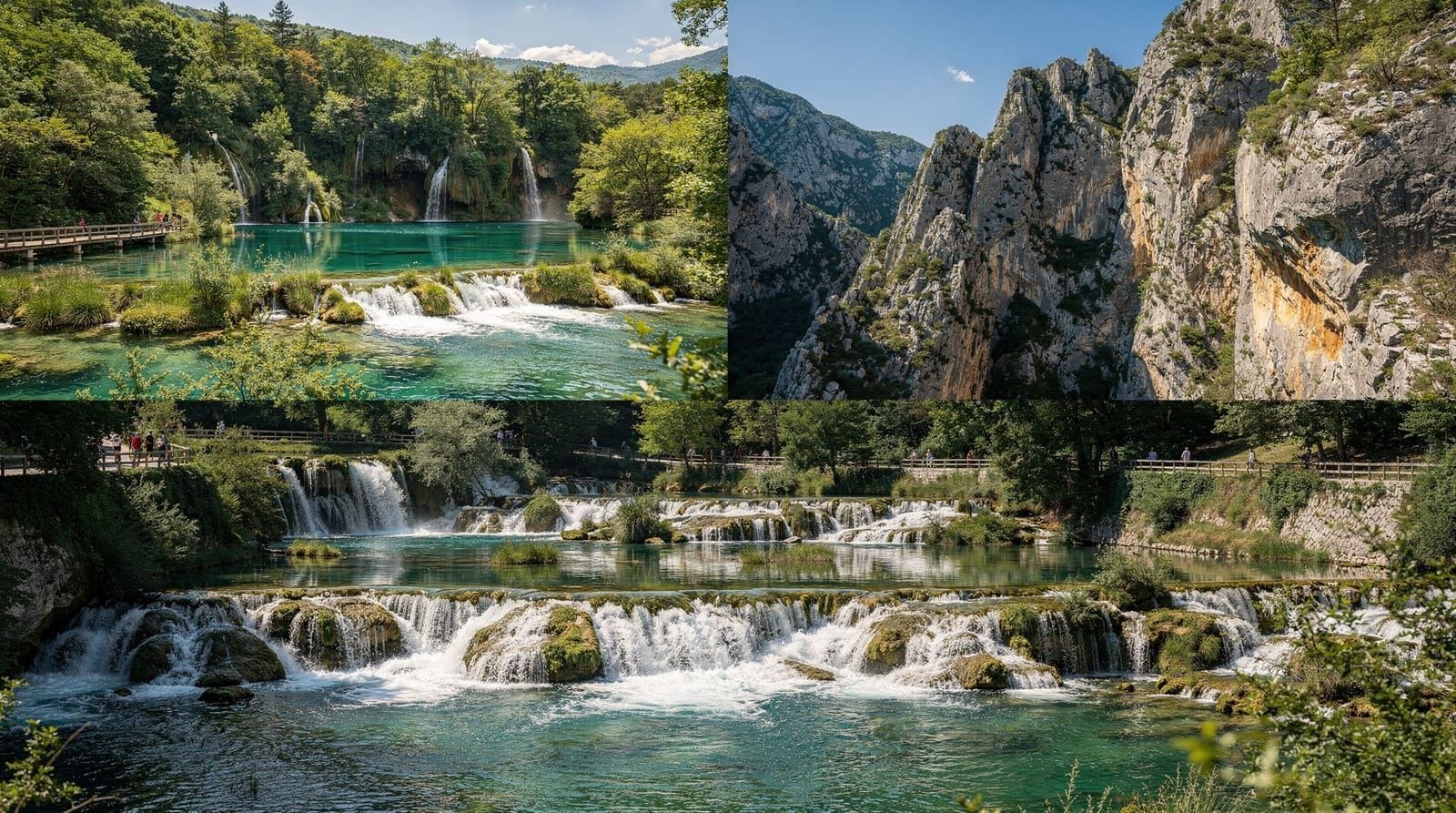
Plitvice Lakes National Park is a UNESCO World Heritage Site and Croatia’s most visited attraction. The park consists of 16 terraced lakes connected by waterfalls and wooden boardwalks through dense forest. From Split, the drive north is about 2.5 hours. By bus, the journey takes 3–4 hours on the faster services.
Plitvice is legitimately spectacular, but it is also genuinely crowded between June and August. The early morning advantage is real: arrive before 8:00 to see the lakes with minimal people. Tickets must be booked in advance online — the park now uses strict entry quotas.
Going with a tour from Split means a comfortable bus, included entry tickets, and a guide who handles logistics. The trade-off is less flexibility on timing and which sections of the park you visit.
Book a guided Plitvice day trip from Split with entry ticketsKrka National Park
Krka National Park is closer to Split (about 90 minutes by car) and offers a different experience from Plitvice — the focus is on the Skradinski Buk waterfall and the lower canyon, and swimming was historically allowed in designated areas. Check current regulations before visiting, as swimming rules have changed in recent years.
Krka is less dramatic than Plitvice in terms of sheer visual impact but more accessible and, outside peak summer, less crowded. The nearby town of Šibenik is worth combining into the day — its medieval old town and UNESCO cathedral deserve at least an hour.
Visit Krka with wine tasting on a day trip from SplitHvar and the Blue Cave
The Blue Cave on Biševo Island is one of Croatia’s most unusual sights: a sea cave where daylight enters through an underwater opening and refracts off the bottom in a vivid blue. It cannot be entered by larger boats and requires transfer to small dinghies. Timing depends on sunlight and sea conditions — the cave is sometimes closed.
Combined with a stop on Hvar and one or two other islands, this makes for a full day on the water. The Blue Cave and 5 islands tour is one of the most popular day trips from Split, and for good reason — the combination of sea, caves, and island scenery is hard to beat on a clear day.
Explore the Blue Cave and Hvar on a full-day island tour from SplitTrogir
Trogir is only 30 minutes from Split by bus or car, and its UNESCO-listed medieval centre is genuinely compact and beautiful. It can be done in half a day, which makes it useful as a morning excursion before an afternoon elsewhere. The Cathedral of St Lawrence and the Kamerlengo Fortress are the main draws.
From Dubrovnik
Dubrovnik’s position at the southern tip of Croatia means that the most interesting day trips often involve crossing into Bosnia-Herzegovina or Montenegro. The city also has good access to the Elaphiti Islands and the Pelješac wine peninsula.
Mostar, Bosnia-Herzegovina
Mostar is about 2.5 hours from Dubrovnik by car — shorter with a tour bus. The Stari Most (old bridge), reconstructed after its 1993 destruction, is the centrepiece, but the city is more than its bridge: the bazaar, the mosques, the street food (burek, ćevapi), and the blend of cultures make it one of the most interesting cities in the western Balkans.
A full day from Dubrovnik is tight but workable. Organised tours typically include the bridge, the bazaar, and sometimes a stop at the medieval village of Počitelj. Going independently by car gives more flexibility.
Kotor, Montenegro
Montenegro’s Bay of Kotor is one of the most dramatic landscapes in the Adriatic — a deep fjord-like bay surrounded by mountains, with the medieval walled town of Kotor at its base. From Dubrovnik, it is about 90 minutes by car to the border, then another 30–40 minutes to Kotor itself.
The bay is best appreciated by driving the perimeter road rather than heading straight to town. Perast, a small baroque village with two island churches visible offshore, is worth a stop. The walls above Kotor climb steeply — the 1,350-step ascent to the fortress is an hour of effort but rewards with panoramic views.
Elaphiti Islands
The Elaphiti Islands — Koločep, Lopud, and Šipan — are the closest island escape from Dubrovnik, accessible by regular Jadrolinija ferry or on organised boat tours. They offer a dramatically quieter version of Croatia’s coastline: no cars on Koločep and Lopud, small communities, empty coves.
A boat tour visiting two or three islands in a day gives a good overview. Those who prefer slower travel can take the public ferry to Lopud and spend the day on Šunj beach — one of the rare sandy beaches near Dubrovnik.
Pelješac Wine Peninsula
The Pelješac peninsula has been transformed logistically by the Pelješac Bridge (2022). The drive from Dubrovnik is now straightforward. A day trip can combine the oyster beds at Mali Ston, a wine tasting at a Dingač or Postup producer, lunch in Ston, and a return via the coast.
This is one of the better adult-oriented day trips from Dubrovnik — the wine quality and food combination justify the relatively straightforward logistics.
From Zagreb
Zagreb’s day trip options are geographically different from the coast — you are in Central Europe here, and the surrounding landscape reflects it: thermal spas, medieval castles, and forest-covered hills.
Plitvice Lakes
From Zagreb, Plitvice is about 2 hours by car or bus. It is the most logical day trip from the capital and works well on the drive down to the coast. The same advice applies as above: early arrival, pre-booked tickets, and expect significant crowds in summer.
Join a guided full-day Plitvice day trip from ZagrebZagorje and the Castle Circuit
The Zagorje region north of Zagreb contains a concentration of medieval castles that most visitors to Croatia never see. Trakošćan Castle on its lake, Veliki Tabor (one of the best-preserved medieval fortresses in the country), and the spa town of Krapina (Neanderthal finds, Museum of Krapina Neanderthals) make for a solid circuit drive.
Samobor
Samobor is a small Baroque town 25 kilometres west of Zagreb, known for its carnival (February), its mustard, and its kremšnita — a cream cake that locals will insist is superior to the version served everywhere else. It is a gentle half-day trip that feels more authentic than most tourist circuits.
Ljubljana and Lake Bled
The Slovenian capital Ljubljana is 130 kilometres from Zagreb (about 90 minutes by car). It is doable as a very long day trip, though overnight makes more sense. Lake Bled is an additional 40 minutes from Ljubljana — the lake with its island church is every bit as photogenic as photographs suggest, and slightly more tranquil outside July–August.
From Zadar
Zadar is often used only as a transit point, but it makes an excellent base for day trips into northern Dalmatia.
Plitvice Lakes (From Zadar)
Plitvice is closer to Zadar (about 100 kilometres) than to Split or Dubrovnik, making Zadar potentially the best coastal base for visiting the park. The drive is scenic through the Velebit mountains.
Kornati Islands
The Kornati Archipelago is a national park consisting of 89 islands and islets arranged across the northern Dalmatian sea. The landscape is stark and unusual — limestone karst islands with almost no vegetation above the tideline, surrounded by transparent water. Boat tours from Zadar (and from Šibenik) navigate between islands, with swimming stops and usually lunch on board.
Kornati is different from typical Croatian island tourism. There are no towns, no beaches in the conventional sense, and almost no facilities. The appeal is precisely this absence — an austere maritime landscape that makes most of the rest of the Adriatic feel crowded.
From Rijeka and Opatija
The northern Kvarner coast around Rijeka and Opatija is less used as a day-trip base than Split or Dubrovnik, but it works well if your itinerary already includes Istria or the Kvarner islands.
Plitvice Lakes (From Rijeka)
Plitvice is roughly 130 kilometres from Rijeka, about a two-hour drive through wooded hill country. It is a viable day trip, though slightly longer than from Zagreb or Zadar, and it means missing the coastal scenery those other approaches offer.
Cres and Krk
The islands of Cres and Krk are both reachable from Rijeka within an hour, Krk by bridge and car, Cres by a short ferry hop. Cres in particular is undercrowded relative to its size — worth it if you want island scenery without the Dalmatian island crowds.
Motovun and Istrian hill towns
Motovun, the hilltop Istrian town famous for truffles and film festivals, is about 90 minutes from Rijeka or Opatija by car. It combines naturally with a truffle-hunting excursion and a stop in a smaller Istrian village en route.
Private truffle-hunting experience in IstriaDay trips compared: what each one actually delivers
| Day trip | From | Travel time | Best for |
|---|---|---|---|
| Plitvice Lakes | Split / Zagreb / Zadar / Rijeka | 2–2.5 hrs | Waterfalls, forest walks, UNESCO scenery |
| Krka National Park | Split | ~90 min | Shorter waterfall trip, combine with Šibenik |
| Blue Cave + Hvar | Split | Full day by boat | Sea caves, island-hopping in one day |
| Mostar | Dubrovnik | ~2.5 hrs | Bosnian culture, the Stari Most bridge |
| Kotor Bay | Dubrovnik | ~90 min to border | Fjord-like scenery, Montenegro |
| Elaphiti Islands | Dubrovnik | 30–60 min by boat | Quiet islands, no cars, quick escape |
| Zagorje castles | Zagreb | ~1 hr | Medieval castles, thermal spa towns |
| Kornati Archipelago | Zadar / Šibenik | Full day by boat | Stark, uncrowded island landscape |
| Motovun | Rijeka / Opatija | ~90 min | Truffles, Istrian hill towns |
Choosing Between Tours and Going Independently
Go with a tour when: You do not have a car, the destination requires a guide (Blue Cave logistics, national park taxis, cross-border navigation), or you are a first-timer who benefits from having logistics handled.
Go independently when: You want to control your timing (especially for Plitvice early mornings), you are already driving through the region, or you want to linger beyond the group schedule.
Most national park day trips can be done independently with a hire car and online ticket booking. Cross-border trips to Mostar and Kotor are more straightforward with a tour if you are unfamiliar with the border crossing formalities.
For more context on what to expect at each park, our Croatia national park tips guide covers practical logistics across all the major sites. If you are deciding whether to rent a car for the trip, the renting a car in Croatia guide covers costs and where it pays off versus organised tours, and the getting around Croatia guide compares buses, ferries and driving more broadly. Comparing Split and Dubrovnik as a home base directly is also worth doing before you book accommodation — see Split vs Dubrovnik.